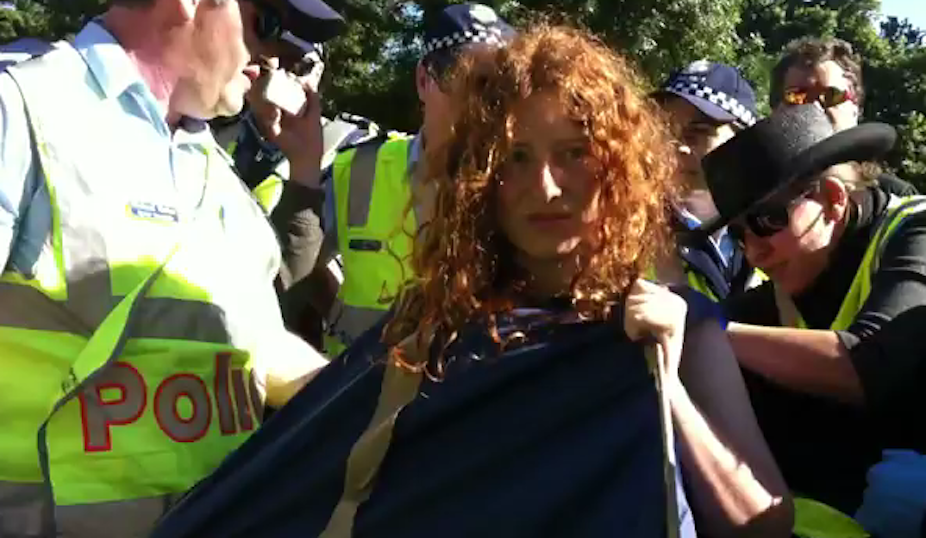
When police removed a young woman’s “tent dress” this week at the Occupy Melbourne encampment, it was yet another controversial interaction between protesters and authorities.
As shown in the Occupy movement, the increasing regulation of public spaces through intensive policing is a global phenomenon. Governments across Australia are introducing increasingly strident laws to police public spaces.
However, the evidence shows that these powers do not reduce crimes, they are exercised in a discriminatory way against young people, racial minorities and people experiencing homelessness, and they breach the norms and standards of international human rights laws.
Legal confusion
Occupy Melbourne demonstrators were first evicted by police from City Square in October. Afterwards, there were conflicting explanations about the legal basis for protesters’ removal. It seemed that government, police and the local council were all citing different laws.
The Police Minister’s office suggested police were using the move-on powers contained in section 6 of the Summary Offences Act. But these powers were created in 2009 to help police deal with alcohol-fuelled violence; they specifically prevent police from moving on people “demonstrating or protesting”.
Vulnerable targets
Move-on powers allow police to control both the users and the usage of public space. Similar laws have been introduced in most Australian jurisdictions, with troubling implications.
Legal expert, Ben Saul notes that “particularly if you are a young person, indigenous, homeless, or a sex worker, police scrutiny and state surveillance of the public use of public streets has become acute”. Empirical research is limited and not very recent, but it does point to discriminatory use of move-on powers.
People experiencing homelessness – like Bruce Rowe, who was brutally arrested by Queensland police in 2006 – occupy public spaces out of necessity but are disproportionately and adversely affected by move-on powers.
A Brisbane survey of 132 people experiencing homelessness found a total of 76.5% of respondents had been told to move on one or more times in the last six months. Nearly 78% of respondents who received a move-on direction said their behaviour was innocuous and unlikely to meet the threshold requirements for a lawfully issued move-on direction.
Concerns about police “chasing” homeless people from one place to the next were raised throughout this research. Some respondents stated that it was often the same officers that followed homeless people throughout the day to “chase them away”. I often heard stories like this when I worked as a lawyer with Victoria’s Homeless Persons’ Legal Clinic.
Unequal treatment

Indigenous Australians appear most likely to be moved on compared to other community members. A detailed 1995 study found that Indigenous young people were over-represented at every level of the justice system except police cautions.
This certainly appears to be the case with move-on orders. Chan and Cunneen note that police use “move-on” powers against Aboriginal people at a massively disproportionate rate.
The New South Wales Ombudsman expressed concern with the large numbers of Aboriginal and Torres Strait Islander people given direction to move on. This brings otherwise law-abiding individuals into contact with the criminal justice system in areas where relationships between the police and Aboriginal communities have been very poor.
Young not welcome
But it’s not only Indigenous young people who are over-policed by these move-on powers. The struggle over territory between police and young people is not a new phenomenon.
A 1992 study found that 80% of young people aged 15 to 18 had been stopped by the police, and that 83% of them had been stopped on the street. In addition, 53% of the police officers who participated in the research thought that young people were causing problems in malls.
The disparity between young people being moved on by police, and the rate of their involvement in crime compared to their representation in the population, is disturbing. The disparity suggests police are not using the powers as an effective tool and are exercising the power in a discriminatory fashion.
This does not reduce the incidence of crime and it may lead to even more unsatisfactory outcomes. Police and young people may come into conflict or young people may be pushed into more serious offending behaviours.
There is no evidence, in Australia or internationally, that suggests move-on powers reduce crime rates.
Breaching human rights?
Human rights lawyers have suggested that the October eviction of Occupy protestors may breach Victoria’s Charter of Human Rights and Responsibilities Act.
Researchers have previously questioned the human rights implications of move-on powers and other regulation of public space. The exercise of these police powers engages Charter rights including freedoms of movement, association and expression, among others.
Infringement of these rights, particularly given the disproportionate impact on vulnerable groups discussed above, may amount to an unreasonable limitation of the rights. This question is currently before the Courts, following action brought by an Occupy Melbourne protester.
As the Occupy movement challenges some of the existing power structures, let’s hope that this draconian legal development of police move-on powers is one of the first casualties.
Roxane Paczensky
Registered Nurse
Thank you for your article. I can't understand why more Australians aren't standing with the people of the Occupy movement to support their right to freedom of movement association and expression - even if they don't agree with what the movement is protesting about. Surely the defence of these rights are fundamental, because of the idea that "next time it may be you who wants to express discontent, with others, in public places." It's not a Democracy we live in if the rights of citizens to dissent…
Read moreAdam Butler
logged in via LinkedIn
Great article. Whilst I generally support the work of the police service, I have grown ever more skeptical of the use of their "powers". People protesting peacefully should be allowed to do so as long as they wish. I sometimes feel that police present themselves at situations in order to subtly incite aggression thereby justifying their presence. This whole notion of "riot police" in NSW is a joke and they are continually justified by the so-called Cronulla "riots" of a few years back - I dare not mention the OPEC meeting of 2007! If ever there was abuse of police "powers" it was then, although the Chaser did manage to give us all a laugh and show them up for what they are. Unfortunately these move-on episodes are yet another example alpha males with too much testosterone making indiscriminate decisions because they enjoy the power trip.
John Harland
bicycle technician
It surprises me constantly that, as an older person, Police treat me with respect.
It was not that I am indigenous, or was homeless, or a sex worker. It was simply that I was younger and did not look like a compliant consumer or a Liberal voter.
If, when you are young, you question the propriety of police action, you may quietly be threatened with violence, and with their finding some pretext to arrest you. To a young person it is power of police prejudices that generally plays a far greater role than police "powers" in the legal sense.
Thomas Reuter
ARC Future Fellow at University of Melbourne
The way in which political protests are suppressed in this city today is a testimony to the police state that has quietly arisen from a long process. The war-on-terror and other scare campaigns about "our security" have been used systematically as a means to compromise civil liberties in the majority of western democracies.
I increasing feel I am no longer living in a democracy.
What the Occupy Melbourne protesters are experiencing is a preview of what we will all experience, once the ruling…
Read moreJeff Haddrick
field manager
"I increasing feel I am no longer living in a democracy"
I feel the same way.The reason I feel that way is that democracy fundamentaly relies on the populace developing opinons and making choices based on thought and good information. The lack of both of these prerequisites has been fostered by the mass information services abuse of their position in the pursuit of promoting consumerism.
Something is grossly wrong when supposed bastions of the public interest are complicit in "scare campaigns about "our security" have been used systematically as a means to compromise civil liberties in the majority of western democracies."
James Walker
logged in via Facebook
I look like a thug; further as a shift worker I need to exercise at strange hours of the day/night. So every couple of weeks while I'm walking around at night a police car will pull up and I'll be quizzed by the coppers about what I'm doing/why.
It's really not a problem - a polite and friendly explanation later calms their suspicions, and slapping my belly while explaining 'need to get rid of this' usually gets a chuckle and a "know the feeling!" Then they wish me a good night and head off to patrol elsewhere.
The teenagers get in trouble, not because of prejudice, not because they are a problem, but because no one has ever *taught* them how to be polite and friendly! If you *assume* that the police are hoping that you are a witness to a crime that's just happened, and are happy to tell them where you've been (even if you've seen nothing, you can rule out escape routes for runners) you'll have a much better experience than if you're surly and uncooperative.
Emma Anderson
Artist and Science Junkie
If you're not breaking the law in any fashion, it would seem that being pulled over by the cops based on your appearance alone is a form of discrimination.
Whether the youth are polite in response to the police in a similar situation is irrelevant. Crime isn't a demographic, it's an action.
So unless being impolite amounts to a crime, let's say by belting the police officer for no apparent reason - I'd say it's exercising a human right in response to discrimination in this sort of context.
Two wrongs don't make a right and all that, but, a little empathy for people who may well be standing up for themselves couldn't go astray.
John Harland
bicycle technician
A problem for many young people is that privacy is a new and valuable experience and police seem to think themselves entitled to invade it at will.
Well, that was how it felt to me. It still does but I am better at smiling and dissimulating now, and saying the right kinds of blokey cliches in the right tone of voice.
It shouldn't take that to be treated decently.
Michael Maloney
Supercheap Self Storage
When I visited Melbourne to see some storage facilities and learn from their best practices, I happen to see the Occupy Movement taking place. It is very interesting to see people from all walks of life gather in one place and having a common voice on various issues that are plaguing the way things are done in Australia. I know that it may not be the best way to voice out opinions, enforce change and getting things done when it comes to the government, but it just shows that people are not just going to sit and wait for things to happen. I just hope that there are better ways of doing it and I hope, too, that the government will be able to listen to the people and their concerns.