

Mysterious poles make road crossing easier for high flying mammals

Wildlife can have a tough time crossing roads. Noisy, fast vehicles and wide, open gaps in habitat make it an uninviting and risky venture. This means some animals are cut off from food, shelter or loving company on the other side of the road, young have trouble dispersing to find new territories and…

8fn575wx-1358316511
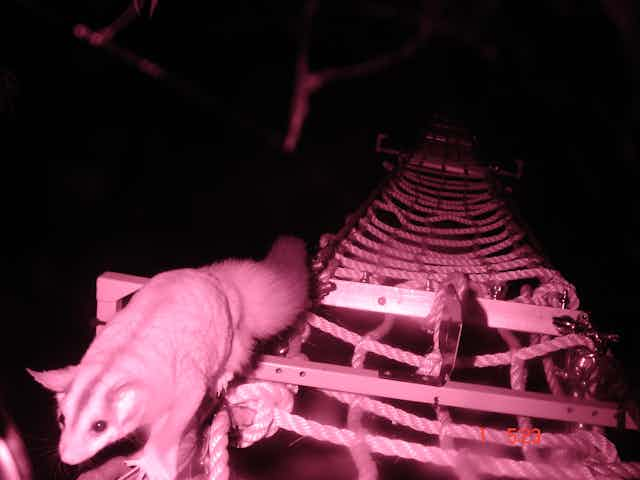
A squirrel glider crosses a rope bridge over the Hume Freeway. Kylie Soanes

Wildlife can have a tough time crossing roads. Noisy, fast vehicles and wide, open gaps in habitat make it an uninviting and risky venture. This means some animals are cut off from food, shelter or loving company on the other side of the road, young have trouble dispersing to find new territories and populations might become small and genetically isolated.

On the Hume Freeway in north-east Victoria, though, specially designed structures are making life a lot easier for squirrel gliders. Rope ladders bridge the gap between trees on either side of the freeway and wooden “glider poles” in the centre median and roadsides replace missing trees, helping these small, threatened marsupials cross safely.

A rope bridge (left) and glider poles (right) across the Hume Freeway Kylie Soanes

Early research tracking the nightly movements of almost 50 gliders, showed that they used tall trees in the freeway median as a stepping stone, and crossed in a few short glides. But animals couldn’t cross where the gap across the freeway was wider than 50m (squirrel gliders glide an average of 30–40m).

On top of that, the average lifespan of gliders living near the freeway was estimated to be only about one year, compared with two to four years for those living further away. This reduced survival is most likely caused by roadkill at the freeway – in fact, one of the gliders we tracked was killed while crossing the road.

Based on this research, crossing structures were installed in 2007 at five sites where the freeway was a barrier to glider movement. The aim was for rope bridges and glider poles to provide safe passage for gliders across the freeway, re-connecting habitat and reducing roadkill – not to mention baffling passing motorists.

This is where my research project comes in, monitoring glider populations to figure out just how well these structures really work.

Over the past five years we’ve used motion-triggered cameras to spy on animals that use the crossing structures. It began slowly, with only a few gliders tentatively inspecting the structures during the first two years.

Since then, both the rope bridges and glider poles have become popular, with squirrel gliders crossing more than 2000 times. We’ve also detected common brushtail possums, common ringtail possums, sugar gliders, brush-tailed phascogales, and even a goanna using the structures to cross the freeway.

A brush-tailed phascogale (left) and goanna (right) crossing a rope bridge over the Hume Freeway. Kylie Soanes

We also repeated the original tracking study to compare squirrel glider movements before and after the structures were installed. Within four years of installation, rope bridges and glider poles re-established glider movement across the freeway, whereas sites without crossing structures remained a barrier. However, even with crossing structures installed, gliders are still around half as likely to cross the freeway as they are to cross quiet, narrow roads, meaning the barrier effect of the freeway is only partially repaired.

Still, a partial fix may be good enough if it allows squirrel glider populations to persist. We’re investigating changes in population size, survival rates and gene flow to see if these have improved since the structures were installed. Only then can we know if the rope bridges and glider poles are successful.

Gliders aren’t the only animals getting the crossing structure treatment. Millions of dollars are spent on culverts, tunnels, and land-bridges all over the world, helping everything from turtles to elephants get safely across roads. Evaluating the success of these efforts is critical, because if we’re relying on these structures to mitigate road impacts on threatened species, then we need to be very sure that they work.

Sign in to Favourite

Want to follow The Conversation?

Sign up to our free newsletter to get the day's top stories in your inbox each morning, with a special wrap on Saturday.

Spinner
Help us have better conversations — donate

Join the conversation

11 Comments sorted by

  1. Chris Owens

    Professional

    Nice work on a budget (no doubt).

    How nice it would be if wildlife were a consideration at the design phase of road construction like they are elsewhere especially in Europe http://sitstudy.blogspot.com.au/2012/08/wild-life-over-cross.html

    Whilst gliders and other arboreal species are important, so are all the other ground based species - macropods, reptiles (other than goanna's), echidna's, etc. and they still have to take their chances with ever increasing traffic.

    report
    1. Mat Hardy

      Lecturer in Middle East Studies at Deakin University

      In reply to Chris Owens

      Having spent a bit of my life within a company that does design major road projects, you'd be surprised how much this sort of consideration does come into it these days. If only because it allows various stakeholders to flash their green credentials.

      report
    2. Kylie Soanes

      PhD student at University of Melbourne

      In reply to Mat Hardy

      Thanks for your input guys. Yes, road agencies now put a quite lot of work into reducing the impacts of new projects on wildlife. But your right Chris, in Australia this tends to be restricted to threatened species. This issue has come a long way in the last 10-20 years and hopefully they keep getting better.

      report
  2. Jim KABLE

    teacher

    I think there are similar structures on the highway/freeway near where I live - which - at first had me baffled - some new system of traffic monitoring I thought. It's good to know that these means are being provided for wildlife movement - and are being monitored to provide the kinds of statistical evidence of their efficacy as revealed in this article.

    report
  3. Murray Webster

    Forestry-Ecology Consultant/Contractor

    I have heard people saying that predators have learnt that crossing points, such as described here, are a good place for a quick snack! - is there any evidence if increased predation on animals using these structures?

    report
    1. Kylie Soanes

      PhD student at University of Melbourne

      In reply to Murray Webster

      It's a really interesting problem! I have heard that some predators learn to hunt around culverts and tunnels - very smart! But to my knowledge there have been no signs of the same thing happening on poles and rope bridges. We head out every few weeks to inspect the site and look for any signs that owls have been preying on gliders or possums. So far, so good. Unfortunately the big owls that would prey on gliders are usually also threatened species and in a lot of places there aren't many left to cause too much damage. It's definitely a possibility though, and one we're keeping an eye out for. There are ‘predator shields’ and ‘refuge tubes’ for gliders and possums to hide in if they need, so hopefully these give a bit of extra protection.

      At the end of the day though, we need to weigh it up – Would the number of gliders eaten by owls while crossing the structure be more than the number of gliders killed by traffic if the structure wasn’t there?

      report
  4. David Jones

    Engineer

    I hate to be a party pooper but this does not sound like a success story to me.
    If there have been 5 crossings operating for 5 years and only 2000 gliders crossings have occurred, then that is not even one glider crossing per week per crossing.
    I seem to recall that these structures were built at a cost of more than a million dollars (please correct me if this is wrong). That is at least $500 cost for each time a glider used one of these crossings!
    Funding for conservation measures is always in short supply. Surely this money could have spent more effectively on some other conservation project?
    It sounds terrible but perhaps it would have been better to actually remove the trees that the gliders had been using to cross and so discourage them from crossing at all?

    report
    1. Kylie Soanes

      PhD student at University of Melbourne

      In reply to David Jones

      Not a party pooper at all! You're right - conservation funding is limited and it's important to rigorously evaluate projects to make sure we're spending money on things that work. That's what this project is about - testing the effectiveness of these crossing structures to see how well they work and if they should be used in the future.

      The best way to measure success is to compare the results of our conservation action to what would have happened if we had done nothing at all. While 2000 crossings…

      Read more
    2. David Jones

      Engineer

      In reply to Kylie Soanes

      Thankyou Kylie, as long as the effectiveness of the project is sensibly evaluated then such experiments are worthwhile.

      report
  5. Bernie Masters

    environmental consultant at FIA Technology Pty Ltd, B K Masters and Associates

    Thanks for the article, Kylie, and more importantly thanks for the years of work you've put into this research. Where I live in south west WA, we have the threatened Western Ringtail Possum being killed in their 100s by vehicles. However, most locals are aware that these animals will happily cross from one tree to another or from one house to another or across the road using any bridge they can find, including powerlines (often with electrifying results unfortunately). Many people like myself are…

    Read more
  6. Edwina Hayes

    logged in via Facebook

    Kylie, I looove the phascogale. Your pictures are always so heartening!

    report