
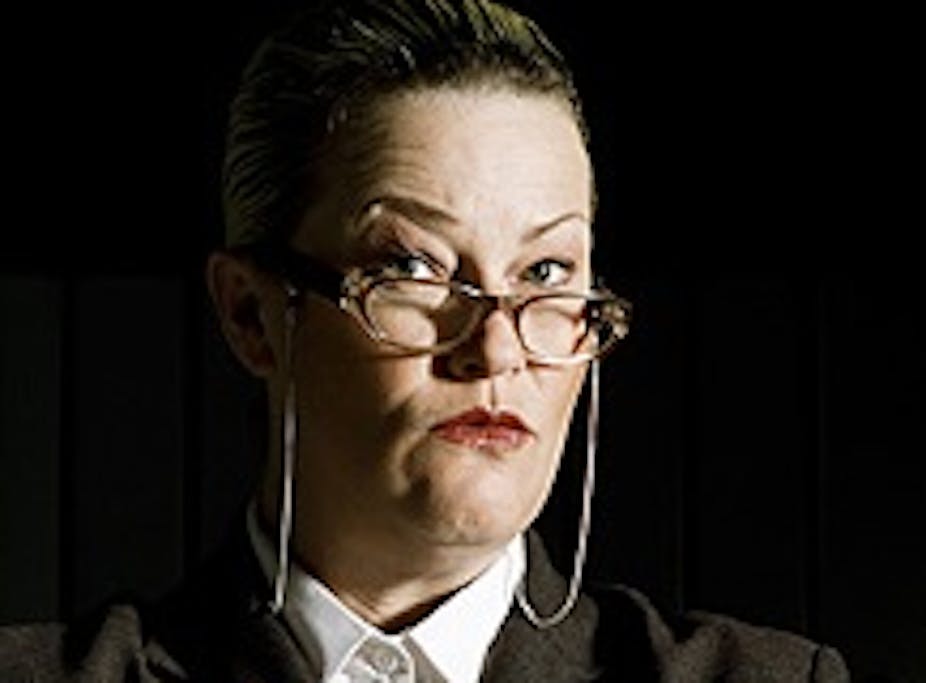
Nanny knows best: Why Big Tobacco’s attack on Mary Poppins ought to backfire

In its latest attempt to derail the plain cigarette packaging legislation, Big Tobacco has pulled out one of its favourite pro-tobacco messages: say no to a nanny state. The print advertisements and website ask, “Do you really like living in a nanny state?” and explain, “The government doesn’t believe…

Tobacconanny-1308533435
It will take more than a spoon-ful of sugar to make this medicine go down.

In its latest attempt to derail the plain cigarette packaging legislation, Big Tobacco has pulled out one of its favourite pro-tobacco messages: say no to a nanny state.

The print advertisements and website ask, “Do you really like living in a nanny state?” and explain, “The government doesn’t believe you can make your own decisions. More and more, the government is telling us what we should and shouldn’t do.”

The tobacco industry’s concern with the legislation is, of course, the loss of their branding – one of the last available avenues to market cigarettes to consumers.

It’s motive? Retaining the current level of profit by selling cigarettes that cause addiction and then prematurely kill one in every two people who smoke them.

Big Tobacco has relied on a range of arsenal and contradictory messages to fight the plain packaging legislation so far.

First we were told there was no evidence plain packaging would work. Then, we were told it would increase smoking. And most recently, that it would increase terrorism and allow organised crime to flourish.

Economically, we were told plain packaging would waste taxpayer money. And, it would cost the taxpayer even more money because the tobacco manufacturers would sue the government.

Historical nannies

The term “nanny state” was coined by British politician Iain Macleod in 1965. At one stage a health minister, he smoked furiously and died at 57 of a heart attack.

The metaphor was given further prominence by the British author and journalist Auberon Waugh. Waugh, also a heavy smoker, opposed any action on smoking and died of heart disease at 61.

Closer to home, governments have been accused of nanny stateism in the process of implementing all of our greatest public health reforms.

In the 1950s, 75% of Australian men smoked. But with bans on tobacco advertising, smoke-free legislation and increased tobacco taxes, this rate is down to less than 17%, and we now have the lowest levels of smoking ever among adolescents.

Government interventions have also resulted in other outstanding public health successes.

Interventions to reduce road trauma – with seat belts, speeding restrictions, and alcohol and drug buses – have saved the lives of more than 45,000 Australians and saved 600,000 from serious road trauma over the past 40 years.

So there is little doubt that government has a role to positively influence public behaviour.

Consumer nannies

The tobacco, alcohol and food industries often accuse the government of nanny statism. But what about the enormous influence that they’ve had, and continue to have, on our behaviour?

After all, how did we get into this public health mess with tobacco, alcohol or obesity in the first place?

In a functioning society, we need rules to promote and maintain good health. These are particularly necessary to control industries that can mount massive, long-term promotions of unhealthy products.

A 2007 study showed Australian children aged 5 to 12 years were exposed to nearly 100 food advertisements every week and more than 60% were advertisement for high-fat/high-sugar products.

It’s difficult not to view our obesity epidemic as the result of the food industry’s profound commercial success.

Junk food and drinks have promotional budgets and profits that dwarf those of healthy food or drinks. Compare the Big Mac to a zucchini.

Similarly, the meagre advertising budgets promoting active transport (walking and cycling) and physical games (bats and balls) will never be able to compete with the advertising budgets of cars, video games, television, videos and computers.

So although these private nannies use a much softer and more persuasive carrot to influence our behaviour, they are very much present.

Government’s role

It’s true that we need a balance between personal responsibility – where individuals and families take responsibility for their own health – and shared responsibility.

But equally, governments have a responsibility to create environments where healthy choices become the easiest and the most preferred.

We mustn’t allow the government to be bullied by companies intent on maximising shareholder or individual’s profit – at the expense of the nation’s health.

Join the conversation

21 Comments sorted by

  1. Dean Moriarty

    logged in via Twitter

    As a Victorian, I'm pretty anti nanny-state. But these ads are terrible - they have NO chance of achieving their intended aim.

    report
  2. Michael Koukoullis

    Web Developer

    As an ex-smoker I entirely support what the Government is trying to achieve with the plain packaging legislation.

    If there ever was a time for Government to act in the broader public interest on health grounds, this is it!

    report
  3. Simon Chapman

    Professor of Public Health at University of Sydney

    As someone who has been engaged in this issue for 35 years, I never cease to be amazed by the latest depths of ineptitude that the tobacco industry can dig to. When you think about it, it surely must reflect a kind od Darwinian natural selection. If you were a bright young person, newly graduated with your MBA , you'd mentally spread out a range of industries across your career table and go ....."yes! the tobacco industry!", right? Bears thinking about .. the mentality and values of the sort of person who would get out of bed each morning thinking "now how can I do a wonderful days working trying to increase smoking, halt any efforts to reduce the brakeless downhill trainwreck that it has become, and climb aboard the most slender of arguments? Most of then don't even smoke! cab you imagine the head of Toyota saying "I choose not to drive". Or the head of the meat & livestock corp saying "I won't eat meat myself."

    report
  4. Ellie Saari

    This ad makes it appear that smoking doesn't have a far-reaching affect on the entire country. We all know the toll that smoking has on the public health system, being over $12m between 2004-05. If they want to smoke, then they should be prepared to be taxed on it, because the health system shouldn't be strained by peoples' decision to harm themselves, especially when they know full well the harm cigarettes inflict. Also, I'm sick of inhaling other people's cigarettes in public areas, sometimes I am forced to cover my face to avoid breathing in their smoke. Although I agree with restrictions on cigarettes, I don't know how helpful plain-packaging will be in deterring people from smoking... I think that the Government should spend more time on reviewing public smoking laws.

    report
  5. John McLean

    logged in via email @connexus.net.au

    Tell us, Rob. Can medical science describe every step (biochemical, physical) in the chain between smoking and the development of lung cancer?

    Can medical science explain why some non-smokers get lung cancer or conversely why some heavy smokers live to old age without getting cancer?

    Do we in fact anything more substantial than a statistical correlation between smoking and lung cancer? By the way, what is that correlation given what I said just above about exceptions to the "norm"?

    report
    1. Trent Bagshaw

      logged in via Facebook

      In reply to John McLean

      The lack of a complete explanation is NOT a weakness in this argument.

      All that is required is a strong correlation.

      Cigarette smoking does not cause cancer in everyone who smokes cigarettes, but we are certain that a group of 1000 people who smoke heavily will see more cases of cancer than a demographically identical group of nonsmokers.

      report
    2. Simon Chapman

      Professor of Public Health at University of Sydney

      In reply to John McLean

      There's only a statistical correlation between playing Russian roulette and blowing your brains out too. 5/6 are winners!! There is massive evidence about the carcinogenicity of tobacco smoke. Google IARC carcinogenic tobacco

      report
    3. Owen Carter

      Senior Research Fellow, Centre for Behavioural Research in Cancer Control at Curtin University

      In reply to Simon Chapman

      Except with tobacco, the statistics tell us that only 3/6 smokers are winners...

      report
  6. Tom Stevens

    logged in via Twitter

    Whilst the idea of a nanny state worries me (I'm a conspiracy theorist at heart!), I hate nothing more than smoking as a concept, a pastime or an industry. So no, get rid of these ads. Not through censorship, but through enough people saying no to smoking.
    #T_D
    www.truthdetective.com.au

    report
  7. Michael J. Biercuk

    Senior Lecturer in the School of Physics at University of Sydney

    So long as the Australian government provides state-funded healthcare, the government has a right to act as a bit of a nanny.

    I'm (somewhat) satisfied with those who "choose" to smoke doing so, with whatever packaging is appropriate - if they sign a waiver forever relinquishing their right to publicly supported healthcare. They can try to get private insurance instead.

    And if Mr Mclean (also a vocal opponent of anthropogenic climate change on this site) is unconvinced of correlations between smoking and lung cancer, why has the private health insurance market priced smoking/nonsmoking status into premiums and underwriting? It certainly seems the market experts believe in a correlation between smoking and negative health outcomes...

    report
  8. James White

    logged in via Twitter

    The paradox driving the emotion in this debate is that smoking, alcohol, drug taking, gambling, eating fatty and processed foods are all potentially bad for us, but prohibition generally fails. In alcohol, drugs, gambling, prostitution - wherever it is tried, people will find a way to satisfy their desires, legally, or otherwise.

    Therefore we need to balance the role of the State in identifying "bad" things, raising the cost of access (age limits / excise / controlled sales points) and the responsibility of the individual for their own health and welfare.

    The insurance angle is a complete furphy: society pays for smokers and drug addicts through the health system - on is legal, one not. Drugs have additional costs in the Police and Justice systems. One way or another we pay for our own "sins" and those of others.

    report
    1. Michael J. Biercuk

      Senior Lecturer in the School of Physics at University of Sydney

      In reply to James White

      What is improbable or a rumour about the insurance angle? Is it your contention that private insurance companies do not consider smoking status when setting premiums or underwriting decisions (not for hospital cover in Australia - health insurance more broadly)?

      Indeed society pays for smokers through the health system - that's why "nanny" behavior is acceptable. Similarly, government clamps down on the legality of a range of recreational drugs because the societal costs are high, even for personal decisions. Smoking is dissimilar only in that it remains legal at this stage.

      report
  9. Ari Dyball

    logged in via Facebook

    The irony is that Australia actually is a nanny state, with one of the most active censorship programs in western democracy. Regardless of whether or not the cigarette companies have a point (and i don't think they do), these adverts are a distraction from the actual and far more insidious practice of our government denying its citizens access to information.

    It is cynical and unconscionable for cigarette companies to invoke the spectre of the nanny state when all they want to do is maintain their market share in death.

    Anyone interested should listen to Phillip Nitschke's talk at a University of Melbourne Library forum on censorship, the whole thing is interesting but his part starts at 11 minutes in.

    http://harangue.lecture.unimelb.edu.au/Lectopia/Lectopia.lasso?ut=1035&id=99794#

    and for good measure take a look at this book:

    http://www.bookshop.unimelb.edu.au/cbc/p?9781921775109

    report
  10. Maree Davidson

    Consultant

    The Nanny State ads are a sign of big tobacco desperation. Interestingly this campaign does not appear to be supported publicly by all companies. Could it be that they understand the flaws in this approach?

    report
  11. Margo Saunders

    Public Health Policy Researcher

    The people who scream about the nanny state are the pretty quick to rant and rave when the Government hasn't done things like conduct sufficiently rigorous inspection programs to prevent Australians from getting seriously ill and dying from contaminated food. Or keep children from being maimed by dangerous toys. So there's obviously no nanny unless you're the one on the receiving end of the protective action. The nanny state argument usually just means 'stay out of my life except when I expect you to protect me' -- even if that protection comes at the expense of someone else's 'freedom'. The other version of the nanny state is the 'canny state'...but the tobacco industry doesn't quite go there.

    report
  12. Tom Stevens

    logged in via Twitter

    Has anyone else seen those weird posters in Sydney? They mention something called the Australian Interior Authority and whatever it is they're doing, I don't like it. Nanny state not so far off?

    www.truthdetective.com.au
    #T_D

    report
    1. jamie wanda

      logged in via Twitter

      In reply to Tom Stevens

      Cigarette smoking does not cause cancer in everyone who smokes cigarettes, but we are certain that a group of 1000 people who smoke heavily will see more cases of cancer than a demographically identical group of nonsmokers.

      report
    2. Rockstar Philosopher

      Rockstar Philosopher

      In reply to Tom Stevens

      It's probably worth noting that the Truth Detective website is registered to someone who works for the company behind both the nanny state ads and the Australia Interior Authority. It's all part of the same campaign.

      report
    3. Mac Egg

      logged in via Facebook

      In reply to Rockstar Philosopher

      We are in a nanny country, Look at how lax road rules were 10 years ago compared to now with safety cameras, how strict the police are on the tiniest offence. ect.all these extra fines, cameras,yet road deaths have only dropped marginally in the last few years. from 600 in 1998 to around 450 in 2008. nothing compared to the 1400 in 1988. In 10 years from 88-98, only minor laws were enforced yet we had a drop of half. 98-08 , more technology, more laws, only 1/4 drop? Seems we were better off in the 90's

      report