


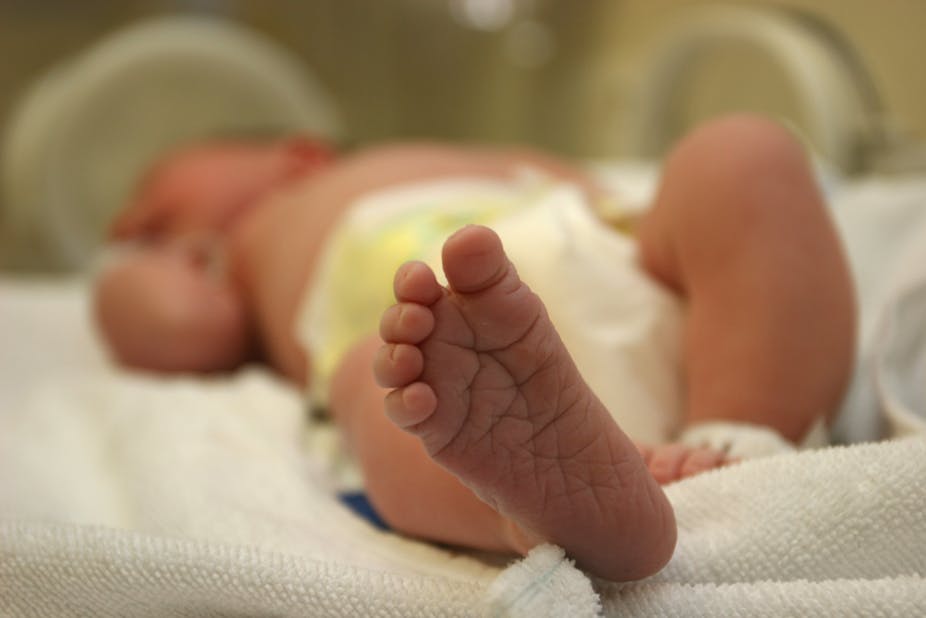
Recently on The Conversation, legal academic Neera Bhatia drew attention to two recent Australian court cases of withdrawing of life-saving medical treatment from infants with severe brain damage. She suggested there was a need for urgent attention by the Australian government to “set the bar for decision-making processes”, and to create a framework to prevent similar cases needing to go to the courts.
But what would such a framework look like?
A heart-breaking decision
Court cases like the ones referred to by Bhatia are rare. In Australia there have been only two cases in recent years. In the United Kingdom, there were approximately 13 cases over a 30-year period.
Care planning for critically ill children involves decisions about life-sustaining treatments. Parents are frequently faced with the heart-breaking question of whether life support should continue, or whether it should be stopped, and the child allowed to die.
In one study of an Australian children’s hospital, eight out of ten deaths occurred in intensive care, and most had life-sustaining treatment limited or withdrawn in the time leading up to the child’s demise.
The figures are similar in newborn intensive care units. Based on data from Australian and international studies, it’s likely that every day at least three Australian families face an end-of-life decision for their child.
Why do we need a framework?
One potential benefit of a decision-making framework would be to resolve conflict between parents and doctors, and to prevent such conflict reaching the courts. But as the above figures attest, it’s only a very small proportion of cases that ever reach this point. In the majority of situations, doctors and families are able to reach agreement about the best care for a child.
A different reason to seek a framework would be to support doctors and families who are facing these very difficult dilemmas, and to help them to make the best decision.
The paediatric arm of the Royal Australian College of Physicians published a policy document in 2008 which covers a number of issues relating to end-of-life treatment in children. The guideline is a detailed and nuanced, but it remains vague about when it’s appropriate to limit potentially life-sustaining treatment, and when it’s not.
One of the increasing challenges for doctors in intensive care arises from advances in technology. Sophisticated new forms of brain scans and other tests used in intensive care are able to provide doctors and families with predictions of a critically ill child’s future health and capacities. If a child could survive, but would be very severely disabled, parents and health-care professionals face very difficult questions about whether or not intensive medical treatment should continue.
What sort of framework do we need?
Bhatia referred to the need for a “bar” for decision-making. But in fact, we need two different bars or thresholds to aid decisions. The upper threshold is the point at which life sustaining treatment must be provided; if a child’s outlook is better than this, doctors should not limit life support. The lower threshold is a point beyond which a child’s outlook is so grave that life-sustaining treatment must not be provided, even if this is something that parents strongly desire.
In between these two thresholds lies a grey zone: life support might be provided or it might not, depending on parents’ views about treatment and what would be best for their child and for their family.
This “threshold” model fits with the way that many end-of-life decisions are made for children. However, it is not reflected in current guidelines in Australia or overseas, and there is little or no published guidance to help doctors and parents determine whether treatment for a child who is critically ill would be mandatory, optional, or unreasonable.
How would we go about determining where these thresholds for decisions should be? There lies the rub. It might prove so difficult, contentious and controversial that we cannot provide a detailed answer.
However, in one highly specialised area of paediatrics there are clear published guidelines and thresholds for decision-making. There are guidelines from a range of different countries (including North America, Europe and Australia) relating to resuscitation of extremely premature infants those born more than four months early, often weighing as little as half a kilogram. These guidelines have subtle differences, but also have much in common, setting out when a newborn infant is too premature for resuscitation to be attempted, and when it would be obligatory.
These international guidelines have been criticised for placing too much emphasis on one factor: degree of prematurity. But they could be modified to take account of a range of factors affecting outcome.
On this basis, I have suggested that in developed countries like Australia if a very premature infant has a less than one in ten chance of surviving without profound disability, doctors should not usually provide resuscitation and intensive care. If the infant has a better than 50:50 chance, doctors should almost always provide intensive care.
In theory, the same sort of thresholds could be used for seriously ill newborn infants with other health problems, or for older children.
These specific guidelines may not be the right ones to apply, but they provide a starting point for debate. Although such a debate may be uncomfortable, it is too important to ignore.
It is time to create a more detailed and practically applicable framework for end-of-life decisions for children.
Dominic Wilkinson is the author of Death or disability? The ‘Carmentis Machine’ and decision-making for critically ill children