
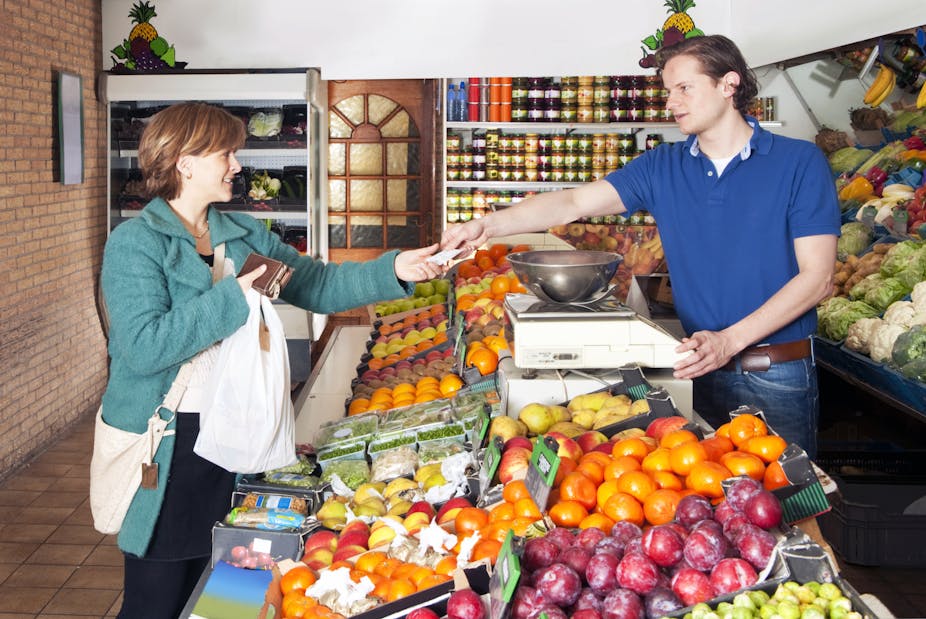
We all know that children learn by example. I know if I swear in front of my four year old I’m going to hear that word again soon, probably right in front of my mother-in-law, a school teacher, or a priest.
But even as adults, it turns out that we remain more like more like kids in the playground than we like to admit.
As I discovered while conducting a study into the beliefs that influence our environmental actions, most grown-ups still want to do what “the cool kids” are doing. Or to put it in more academic terms, we are more likely to engage in behaviours that we think are socially acceptable, or “normal”.
Interestingly, few people wanted to admit to themselves how much those social norms swayed their own behaviour.
Striving to be normal
My study, involving 1637 people from Brisbane and Moreton Bay in south-east Queensland, examined whether people walked for transport, shopped with reusable bags, turned off lights when leaving a room and switched off appliances when not in use.
Other research, mostly coming from the US, has found that descriptive normative messages such as “join your fellow citizens in helping to save the environment” had a relatively strong influence on environmentally-friendly behaviour.
Signs on a bathroom door can have a similar impact. A study of hotel guests' behaviour found that messages such as “The majority of guests who stayed at our hotel do recycle their towels at least once” increased towel reuse by more than 28%.
Another study found that individuals were more likely to engage in kerbside recycling if they believed that their neighbours recycled.
Everyone needs good neighbours
Yet when I sent out my surveys, with a question asking “About how often do you think that your neighbour shops with reusable bags?”, I received emails, phone calls and letters – including hand-written, five-page epistles – expressing indignation that I would imply they should be spying on their neighbours.
Even some of my friends expressed outrage that I would imply their behaviour may be governed, even in part, by what they think their neighbour or their friend is doing.
However, when the surveys I sent out were all returned and I sat down and crunched the numbers, I found that people are, indeed, keeping a very close eye on their neighbours and friends.
In fact, beliefs about the actions of friends and neighbours were predictive of whether people chose to walk, use green bags and turn off unused lights and appliances.
Barriers to action
Of course, what we think other are doing isn’t the only factor influencing environmentally-friendly behaviour. Issues around convenience, health and cost are also important. For example, people were more likely to walk for transport if they thought it would be convenient and if they believed it would be a good way to relieve stress, which it is.
While people were less likely to switch off appliances at the wall if they were concerned about having to reset timers and clocks, they were more likely to switch off appliances if they wanted to save money.
Identity was also important. If you think of yourself as someone who is concerned about environmental issues, research shows you are more likely to engage in environmentally-friendly behaviour.
Change starts at home
It’s a good thing that we learn by example and want to feel like part of a community. We can harvest these very human characteristics to bring about important social and environmental changes.
That’s why it’s great when celebrities with millions of fans, such as Miranda Kerr and Woody Harrelson, use the internet and other media to spread the word about environmental issues.
But you are watched too, as am I. Our friends, family and neighbours notice what we do, and that helps them decide what is socially acceptable in our groups.
In the end we are all watching and learning from each other. I’m heading out to the shops now. I’ll just grab my green bag on the way out the door. Have you remembered yours?
Chris Maddigan
Economist
Your whole article extols the virtue of what we do as examples to others. Then you finish off by praising celebrities for what they say rather than what they do.
I make no comment on Miranda Kerr and Woody Harrelson but most peoples take out from celebrities spouting environmental messages is that they are hypocrites. The lifestyle they lead contradicts the message.
Mark McGuire
climate rebel
So, our little eco-warrior grabs her "green bag on the way out the door".
The amount of fossil fuels required to make & supply the "green" bag far exceed that required for plastic bags.
The process of delivering materials to bag makers takes a spoonful of oil to make "green" bags, but manufacture of plastic bags is equal to a pin head in use of fossil fuels,
1 box of plastic bags contains 5000 bags delivered to shop.
One box of green bags contains 50 bags delivered to shop.
There fore, it takes many more deliveries to deliver a supply of green bags to shops, burning more fuel.
It is the height of stupidity & ignorance to claim that a "green" bag helps the environment.
Liz Minchin
Queensland Editor at The Conversation
Mark, it's a fair point about green bags - if you take it to be only the green bags sold to us at supermarkets - but Lee-Ann's study did ask people about their use of *reusable* bags, which is a much broader thing. I read her final reference to her "green" bags at the end to mean a reusable bag. I'll see if she wants to clear this up.
Meanwhile, please bear in mind The Conversation's comments policy https://theconversation.edu.au/community_standards We welcome debate and dissent, but we simply ask everyone to remain courteous in expressing their opinions.
Mike Swinbourne
logged in via Facebook
No Mark, it is the height of stupidity and ignorance to think that the only environmental impact of plastic bags is in their fossil fuel requirements.
Plastic bags have a significant impact on wildlife as well - particularly sea turtles.
You might also factor into your calculations the simple fact that 'green bags' are reused over and over again, whereas plastic bags are not.
Robert Veerman
renewable power station designer
It is a wonderful thing that some people take make an effort to improve the life of others as well as themselves. It is also creditable thing if some folks who have better knowledge seek to correct them thus improving our collective effectiveness. I don't see much merit in ridicule and bold pseudo-scientific statements particularly Mark Maguire's who doesn't appear to acknowledge there is a problem and accordingly offers no solution.
He says,"It is the height of stupidity & ignorance to claim that a "green" bag helps the environment." making it clear he misses the point. 4 strings and some bits of timber don't make a voilinist either! It is the mind set and BEHAVIOUR in the USE of the green bag which is the issue. I use mine until they fall apart. They remind me not to over-buy, which usually means I waste less food etc.
So, Mark, Is there a problem? Would you like to add your effort to solving it? If not perhaps find some other problem worthy of your talent. Go and fix that.
James Jenkin
EFL Teacher Trainer
The jury is out on bags and domestic recycling. Maybe better role models would be people who encourage dispassionate discussion - looking at possible benefits and unintended consequences of actions -, rather than people who parade their worthy but possibly midguided behaviour.
Grendelus Malleolus
Senior Nerd
I don't know about Recycling James, but I think the Jury is back on the issue of bags - there have been a large number of economic and environmental studies where a lifecycle analysis clearly shows that reusable bags have substantial advantages over any single-use bag. The trick, as the author suggests, is getting people to use them consistently.
Byron Smith
PhD candidate in Christian Ethics at University of Edinburgh
And best of all is when they are not used because they are not needed. That is, the single largest contributor to many people's ecological footprint is the purchase of unnecessary consumer goods. Living with less stuff can mean enjoying the things you do own more. Buying better quality items less frequently means that your money goes to people who put more effort into their work (and often saves money in the long run over buying many low quality items that are frequently replaced).
michael russell
electrical engineer
I dont want to blow anyones mind in the green bag ' reusable bag' vs. plastic bag ' single use bag' debate here.... but... what if I use a plastic bag multiple times? I will use these until they fall apart of get gross. Is this better or worse than a 'green bag'. So far the only thing i can see green about a green bag is its colour. Some of these shopping bags are also biodegradable too. does that give me bonus points?
these will also be used as bin liners. Yes, i know that i could wrap it in…
Read moreComment removed by moderator.