
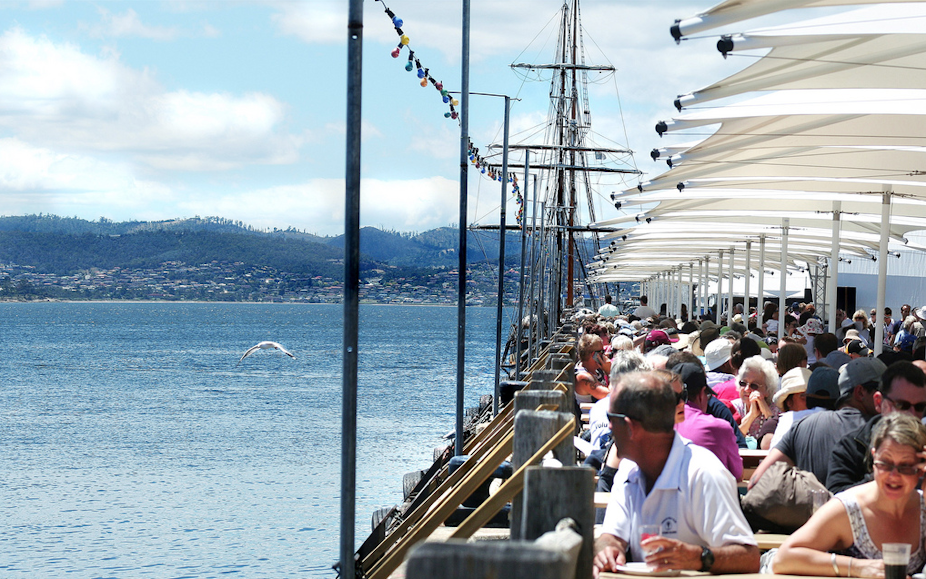
Is Tasmania at a tipping point? Over the next two weeks The Conversation, in conjunction with Griffith REVIEW and the University of Tasmania, is publishing a series of provocations. Our authors ask where does Tasmania’s future lie? Has it reached a “tipping point”, politically, economically and culturally? Thinkers, writers and doers from Tasmania and beyond, including members of its extensive diaspora, challenge how Tasmania is seen by outsiders and illuminate how Tasmanians see themselves, down home and in the wider world.
A steady drumbeat of purportedly bad economic news from Tasmania has been seized on by mainstream politicians and pundits to drive home a standard Economics 101 lesson.
Economies must grow or they are doomed.
The prescribed medicine takes two rather different forms. The standard neoclassical remedy is to cut taxes, eliminate red tape, downsize government, and let the market work its magic.
In contrast, a Keynesian approach promotes deficit financing to stimulate the economy and regenerate business confidence.
Before we swallow either pill, it would be prudent to get a third opinion.
Even using conventional economic measures, Tasmania remains one of the best places in the world to live.
Consider the following. Tasmanians’ average per capita income in purchasing power parity terms is about $31,472. While certainly lower than the Australian average ($42,112), if ranked as a country, Tasmania would still be in the world’s top 30.
True, Tasmania’s unemployment rate of 7.3% is greater than Australia’s (5.1%). But the state is well below European (11.3%) and OECD (8.0%) averages. It is also well below that paragon of market virtue, the United States (8.1%).
The state’s debt is minuscule. Projected debt for 2013 is $134 million which, for a $24 billion economy, gives a debt-to-GSP ratio of less than 1%. Few other OECD economies come close.
In modern economic discourse, the growth mantra drowns out measures of fairness. It should be noted, however, that Tasmania has a low Gini index (0.238) indicative of an egalitarian society. This measure is substantially below the coefficient for the United States (about 4.0).
Luckily, Tasmanians recognise how well they are actually going. An August 2012 EMRS survey of community attitudes reported that almost 90% were satisfied or very satisfied with their own life and personal circumstances. Similar high percentages were reported with regard to standard of living and level of personal happiness.
So, as a broad generalisation, Tasmanians are doing fine, thank you very much.
This is not the same as saying that no Tasmanians are hurting. The shake-out from the bursting of the woodchip bubble, for example, has affected the forest sector heavily, especially in the state’s northwest.
More generally, a recent study by Tasmania’s Social Inclusion Commissioner suggested that around 13% of Tasmanians live on or below the poverty line.
The trick is to figure out how to improve the lot of those who are doing it tough without dismantling all that makes living in Tasmania worthwhile: stunning natural beauty, safe communities, affordable housing, low traffic density, rich culture, and superb food and wine to mention but a few.
Asking the right question
There is so much wrong with modern economic theory that it is entirely understandable that it asks — and then answers — the wrong questions about national and regional economies.
A central problem is that, at its core, modern economics whether neoclassical or Keynesian has little interest in either social capital or the physical processes that underpin the operation of the market.
With regard to the latter, as ecological economists have clearly demonstrated, the operation of national and regional economies depends on physical, biological and chemical laws.
Production and consumption fundamentally involve the conversion of matter and energy. We know from the Second Law of Thermodynamics that this is a one-way process. Production and consumption use up low-entropy energy sources — such as coal and oil — leaving in their wake not only the (not-always) useful products (which deteriorate over time) but waste and pollution.
The waste and pollution are disposed of in the earth, air and sea. The more we produce and consume, the more waste and pollution there is, unless there are accompanying gains in “eco-efficiency”.
Labour efficiency is not the issue here. It is throughput efficiency. Less material, less energy, less waste and less transportation per unit of output is what is required. The market only haphazardly delivers this kind of eco-efficiency, as even the World Business Council on Sustainable Development recognises.
While some producers are working hard to be more eco-efficient, marketers, advertisers, fashion designers, promoters and yes, even governments, are busy stimulating us to consume more and more indiscriminately. In the race between the two, eco-efficiency clearly seems to be the loser.
From an ecological economics perspective, therefore, the right question to ask is not why Tasmania’s economic metrics are lower than the rest of Australia’s and thus require either market or state stimulus, but whether the state is beginning to live within its ecological means.
Answering the right question
Is Tasmania on the path to sustainability? One way to answer this question would be to calculate the state’s ecological footprint.
Ecological footprint analysis measures how much annual biocapacity (land and sea) a region has at its disposal to produce the resources it consumes and absorb the wastes it generates.
If a region’s annual consumption continuously exceeds what can be produced from its available biocapacity, then the region is living beyond its means and needs to modify its production and consumption profile to bring it back into balance.
Ecological footprint analysis is now well established, following the publication of Our Ecological Footprint by Rees and Wackernagel in 1996. It is being used to compare countries and regions within countries.
Australia fares very badly in international ecological footprint comparisons. As a nation, we consume about 6.6 global hectares per person per annum, ranking us 8th worst in the world behind Qatar, Kuwait, United Arab Emirates, Denmark, USA and Belgium.
If the whole world consumed like Australia, we would need three Earths instead of the single one we have.
Is there anything more unrealistic than that?
A few Australian states and territories have calculated their own ecological footprints. In 2008, the Government of Victoria released a report that concluded “The average Victorian requires 6.8 productive hectares to support their lifestyle…. This level of consumption is unsustainable and places significant pressure on the natural environment” (page 3).
The key elements contributing to Victoria’s high ecological footprint were food (especially processed foods) (28%), services (22%), residential energy use (16%), goods (14%) and transport (10%).
Sadly and surprisingly, no ecological footprint has been calculated for Tasmania. How would it fare, if one were done? An inter-temporal comparison might demonstrate it has embarked on the bumpy journey towards real rather than rhetorical sustainability.
Several unique features about the island state suggest that its ecological footprint might be lower than Australia’s or Victoria’s. Compared to Victoria, we can note that Tasmanians:
produce much of their own food
have a sustainable energy mix of hydroelectricity and wood heating
earn and spend less
spend fewer hours a day in cars and traffic.
These features may mean that Tasmania’s economy is more sustainable than Australia’s overall as well as than most other states in Australia. For comparative purposes, it is not unreasonable to think that Tasmania might rank similarly to New Zealand, which is currently 35th in the ecological footprint league tables.
We won’t know of course until a detailed study is conducted.
Of course, if Tasmania were to have a similar rank to New Zealand’s, there would still be no room for complacency. Tasmanians would still be consuming more than four productive hectares per capita per annum: the required level for global sustainability is 1.8 hectares. But while there would be some distance to travel, the analysis would indicate that Tasmania is on the path to sustainability while the rest of Australia is lagging behind.
That would all paint a rather different picture of where we are, where we need to go, and the policies that might get us there.
Getting to sustainability
Ecological economists have proposed numerous policies to help regions like Tasmania in their quest for sustainability. Many of these policies are designed to reduce the level of material throughput and foster a more social economy.
One set of policy measures that goes to the heart of the matter is known as Sustainable Consumption and Production, or SCP. SCP emerged at the 1992 United Nations Conference on Environment and Development and played a bit-part in last year’s hugely disappointing Rio+20 conference.
While the SCP agenda has been all but ignored in Australia, a few other countries, notably the UK, have been more welcoming. In 2009, Tim Jackson, Economics Commissioner for the UK’s Sustainable Development Commission, published Prosperity without Growth, a landmark analysis of all that’s wrong with our current economic growth fetish.
From his and other reports, a wide range of infrastructural, taxation and information policies can be elucidated to promote far more sustainable consumption patterns at the national, state and local levels. These include:
sustainable transportation policies, like dedicated bike lanes so people can cycle to work without fearing for their lives
food security policies, like community supported agriculture to foster producer-consumer partnerships in the production of locally grown, low-input vegetables, fruit and other produce
green taxation policies, like a tough carbon tax to make carbon-intensive goods substantially more expensive than their decarbonised substitutes
certification and labelling schemes, like the Forest Stewardship Council’s, to enable consumers to purchase economically, socially and environmentally responsible products.
A shift to knowledge-intensive industries would also be actively encouraged.
In fact, there is no end of SCP and degrowth policies that could be implemented to keep Tasmania on the trajectory towards sustainability.
The problem is not a lack of policy ideas, but the continued dominance of the vision of materialistic growth embedded in modern economics on the one hand and of a governance system that is ill-adapted to tackle the range of complex, cross-cutting issues raised on the other.
Knowing this means that we cannot call upon the normal suspects to lead on the issue. Most are too fully committed to the growth mantra and too embedded in a winner-takes-all political system to be able to think and act outside the box.
It will be up to innovative groups in civil society — especially those committed to fostering sustainable communities of place and interest — to be the agents of change.
Luckily, this is an area where Tasmania has proven capacity.
Tasmania is uniquely placed to be a world leader in sustainability and is clearly taking faltering steps along a very bumpy road to get there.
Rather than lecture Tasmania on its growth-mania shortcomings, perhaps it’s time for the rest of Australia to follow the island state’s lead.
You can read the whole series here.
John Newlands
tree changer
Good article; an antidote to those who say we must be panicked, frazzled and anxious in order to be model economic citizens. One day the bubble will burst on the boom states like WA and Qld. They will then have a long way to fall. Most of what people really need is cheaper and more accessible in Tasmania. With its 66% hydro electricity, cooler summers and possible food self sufficiency (maybe not bananas) we will cope better.
Paul Wittwer
Orchardist
Great article, by far and away the most sensible in the series.
As I've pointed out before, in neo-liberal, growth-fetish financial terms, the other states aren't doing well either except where they are furiously digging up and selling non-renewable resources, and/or using population growth to prop up their economies. Neither is sustainable and the piper will have to be paid eventually.
I especially like the idea of a tough carbon tax, as long as the state can apply it to imports as well.
In fact, as a model of sustainability, the state would then have to apply other trade barriers to ensure a FAIR trade regime was in place to give the model a good kick along.
Phil Dolan
Viticulturist
'I especially like the idea of a tough carbon tax, as long as the state can apply it to imports as well.'
My thoughts exactly. I've asked why this can't happen and get the standard political reply which says absolutely nothing.
If a foreign product is sold here it attracts GST. Why can't it attract a carbon tax?
And you're right about the article, by far the best so far.
Robert McDougall
Small Business Owner
look at the fossil fuel lobby for your answers as to why the carbon tax isn't that tough.
Trevor S
Jack of all Trades
"look at the fossil fuel lobby for your answers as to why the carbon tax isn't that tough."
that's simply a buck pass Government enact legislation, not interest groups, Government should and does hear from all interested parties. Ultimately the blame lies with the Voters.
Robert McDougall
Small Business Owner
voters only get a say once every 3-4 years and as soon as the elections are over, greasy over promising politicians suddenly develop deafness. E.g Barry O'Farrell and CSG?
If you think that fossil fuel lobby groups aren't immensely powerful in terms of influencing politicians and legislation then you have had your eyes closed or are completely and blissfully ignorant of Australian history.
It may surprise you to learn that the National party was originally set up by the coal industry. Are…
Read moreKaren Witcombe
logged in via Facebook
Unfortunately, neither Fred nor the so far two comments acknowledge the fact that Tasmania may be on the road to sustainability, but on the back of substantial subsidies from mainland taxpayers. Per capita distribution of GST receipts would immediately plunge the state into bankruptcy and throw thousands of public servants onto the dole - yet another form of taxpayer subsidy from the mainland. Any call for sustainability must include a plan to end the dependence we currently nurture.
Paul Wittwer
Orchardist
Karen, your comment fails to acknowledge the fact that SA and the NT exist by subsidies from the other states and until very recently, so did WA.
Australia is a commonwealth, that is, a political community for the common good of all.
The states which are currently contributing more to the common good are doing so by virtue of good luck in having vast underground recources which they are flogging off at a furious rate. Don't those non-renewable resources belong to ALL Australians?
Flogging off those non-renewable resources has also created most of Tasmania's financial deficit by way of the very high Australian dollar.
Karen Witcombe
logged in via Facebook
It's rather more than good luck Peter, its also a community that is prepared to facilitate development. Your argument that wealth belongs to all is an easy way to abdicate responsibility for its generation. It may sound good to descry materialism but a certain level of productivity is needed in order that life is even marginally sustainable. Large sections of the Tasmanian community are proudly non-productive and are perceived as not carrying their weight at all. This state enjoys a wealth of natural assets but a dearth of initiative and enterprise. A redistribution of industry and enterprise would seem to be called for, rather than a redistribution of wealth.
Josephine Colahan
Peripatetic traveller
Perhaps its time to balance the books then:
For example: the millions of dollars leaked out of the state from mining and forestry activity balanced against the huge hydro debt
any other suggestions?
and please remember that many Tasmanians are paying their taxes in other states.
Paul Wittwer
Orchardist
Karen, I very much doubt your assertion that non-productive sections are 'proud' of it and the mainland has large non-productive sections also. It's no fun living in poverty.
Just what would you have them do?
Suggested enlightening reading. http://tasmaniantimes.com/index.php?/weblog/article/the-hope-jon-west-rejects/
"Tasmania is badly governed from Canberra. State revenue has been hit by the global financial crisis, and our exports and tourism are down thanks to the over-valuation of the dollar by the mining boom. Our agricultural products are under threat from cheap foreign imports and the diseases they carry. "
Karen Witcombe
logged in via Facebook
Paul, I live among the non-productive sector and I see plenty of evidence of pride in doing nothing but expect others to provide. I also see a lot of people struggling to hold themselves together with little prospect of improvement under current conditions in this state. Whilst there are undoubtedly faults, blaming Canberra for our problems won't do; I see far too much evidence of extremely poor governance, ineptitude, incompetence, cronyism and corruption in our state and local governments to accept that argument. Tasmania has many enviable qualities but that should not absolve us from facing up to our shortcomings and trying to address them.
Robert McDougall
Small Business Owner
In WA, our government quite happily borrows billions to support the resources boom that is crippling the non mining enconomy. At the same time, much the same as the experience in QLD, regional communities bear the brunt of the actual operations and are run over by the Lib/Nat Government for the benefit of the mega wealthy who refuse to pay a reasonable return to the taxpayer for their resources being flogged off at bargain basement prices.
The whole point about economic prosperity is to improve the living standards of the population. It appears that Tasmania's population is very happy with their life. Don't hold it against them that they haven't been sucked into the "consume, consume, must have, gotta have, wattaboutme wheresmine?" mentality that seems to permeate modern Australian populations.
Paul Wittwer
Orchardist
Karen, perhaps what you perceive as 'pride' in being non-productive is merely a defense mechanism to regain some sort of sense of worth in what for them is a futile situation.
Perhaps what you perceive as "poor governance, eneptitude, yada yada" in your governments is also a survival mechanism against the futility of fighting a Neoliberal Federal government.
I agree there has had to be some major faults in Tassie's governance in the past but good governance could not possibly overcome the bastardry which successive neoliberal, free trade fundamentalist federal governments have inflicted on the economy of not only Tasmania but sectors of all other states.
Trevor S
Jack of all Trades
"Karen, your comment fails to acknowledge the fact that SA and the NT exist by subsidies from the other states and until very recently, so did WA."
Probably because the article is about Tasmania ? SA and NT are equally subsidised economic basket cases, pointing the finger elsewhere and saying they are just as bad is the same argument people had against the carbon tax. There was mention in the article of sustainability, so being subsidised would seem an important point in pointing out the lack…
Read morePeter Sommerville
Scientist & Technologist
Right on Karen. The arguments against you are nothing but spin.
Peter Sommerville
Scientist & Technologist
Because they can't get work at home!
Paul Wittwer
Orchardist
Trevor S, re vast underground resources, you said "Tasmania has them as well, it just chooses not to exploit them"
Which resources, where and why has it chosen not to exploit them?
The fact that Tasmania, SA and NT are subsidised, and the fact that WA was recently subsidised, does not mean that they are/were economic basket cases. It just means that they are sharing in the non-renewable wealth being extracted from beneath Australian soils.
Josephine Colahan
Peripatetic traveller
While much of West's article 'Obstacles to progress' seems to have a basis for truth (I think he's actually going for the popular 'let's look down on Tasmanians' from the popular media approach) what I can see is always forgotten in the 'Tasmanian demographic' is that, like all rural populations in Australia and the majority of the western world, a large body of Tasmanians (who still think of themselves as Tasmanian) head for the major cities (which, I am claiming on observation rather than official figures, are almost the sole repositories for nongovernment based employment) and to do that we also have to leave the state. Hobart's population is 217,000 Adelaide's 1,213,000 (smallest state capital after Hobart) and Sydney's 4,630,000 (largest in Australia). So that throws a spanner in West's calculations on Tasmanian demography.
Peter Brennan
Academic Director
Thank you Fred. Finally some sanity; a great article. And Karen, you ignore how Tasmania subsidises the rest of Australia through the preservation of its protected areas and how the rest of Australia has subsidised Western Australia for the vast majority of the time since federation.
Karen Witcombe
logged in via Facebook
Peter, I take your point re preservation of protected areas, but protected for whom? The vast majority of Australians will never see them or appreciate their value. I applaud the preservation of much of this state, but we need to be doing a lot more with what is left to reduce our dependency or accept that we will never have the wherewithal to improve living standards for the genuinely needy people in our midst. Just getting by is not very comforting for those struggling to pay their living costs, let alone afford timely and quality medical and social services.
Sally Boteler
customer service officer at health & leisure
Re the value of protected areas:
I certainly hope to spend time enjoying Tasmanian wilderness, but even if i never do, it is still extremely important to me that it continues to exist and remain protected.
I will probably never see African animals in the wild, but it truly breaks my heart to think of a world without them, or polar bears , or all the many wonders of the road that i will only experience through the magic telescope.
It should not be about a "what's in it for me?" kind of attitude.
Not 'seeing' something doesn't mean you can't or shouldn't appreciate its value.
Robert McDougall
Small Business Owner
i suppose it would depend on how you view the world, is it solely there to be used by humanity, or does it carry its own intrinsic value? Do native species of plants and animals also have a right to share the earth? or is it acceptable to drive them to extinction so that we can have the latest ipad?
Les McNamara
Researcher
Jonathan West (Obstacles to progress: what’s wrong with Tasmania, really?) tells us that "for every dollar Tasmanians contribute to the national tax kitty, they receive back $1.58 in benefits and services". Surely this needs to be factored in when we compare Tasmania with other countries' debt levels, GDP, PPP, unemployment rate, level of satisfaction and ecological footprint?
How would the economies compare, and how satisfied would Tasmanians be with their incomes and their lot in life, without this huge injection of capital?
There may be a lot wrong with modern economic theory, and we might be able to learn a lot from Tasmania, but I'm not sure we should be following Tasmania's 'lead'.
Josephine Colahan
Peripatetic traveller
You may be interest in the comment made by Sean Lamb to yesterdays article by Jonathan West. The trouble with figures is that they are not always defined well enough to make a quick judgement. I don't know if this comment is correct - but it gives pause for thought
John Newton
Author Journalist
Perhaps Tasmania and its advance towards sustainability and steady state economy could be the model for the future of Australia?
As for subsidies, check the fossil fuel subsidies that keep the rapidly declining and inefficient mining industry from total collapse.
Angela Ballard
Consultant/Facilitator at Atmosphere Consulting
In response to Karen Whitmore
Once 'ecosystems services' have a market value (in a future where forests will be valued for the oxygen they provide in addition to the other services - food and water perhaps then will the folks who cannot yet see and hear beyond the mainstream/growth/economy mantra understand. Some things are fundamental to existence (clean air, food, water and shelter), markets and growth are not. In questioning what value forests in Tasmania have and promoting industry I wonder if people of that view would be prepared to live in the pollution levels of China. I commend Fred for reframing the debate and asking the more relevant questions. His introduction of the Gini index is useful....mainly because we are all in this (climate mess) together and will need to learn how to share better than we do currently.
Karen Witcombe
logged in via Facebook
Taking the argument to extremes is not very helpful and waiting passively for a utopian future where ideal states are somehow called into being might take too long and will certainly try the patience of those whose charity is relied on in the interim. I am certainly not an advocate for heavy and polluting industry, I merely suggest that there is a great deal that can be done to make Tasmania productive. Changing the culture is fundamental to any improvement in the conditions of ordinary Tasmanians of whom I am one.
Paul Wittwer
Orchardist
Karen, both myself and Josephine have asked you, in a roundabout way, what you would do to make Tasmania productive? What would you do to create more jobs?
Even if the management of Tasmania is as substandard as you assert, how could good management overcome the hurdles of unfettered imports of cheap products, artificially high AUD and challenged overseas markets still reeling from the GFC.
I fail to see anything extreme in Angela's comment. Can you please explain why you think there is?
Robert McDougall
Small Business Owner
Tasmania is looking better and better all the time.
I think i'd rather be on $20k and wake up with a smile on my face in a healthy environment than be on $120k and waking up in a cloud of pollution looking at a concrete jungle.
Angela Ballard
Consultant/Facilitator at Atmosphere Consulting
Yes, what price health and wellbeing? I suppose what I was getting at was the idea that human notions of 'productivity' and 'growth' will not count for much if the ecosystems we fundamentally depend upon are trashed. Successive Tasmanian governments and Gunns were prepared to sacrifice the air quality of residents with toxic dioxin emissions in a river valley already well known for its particulate pollution. I wouldn't call the public campaign that ultimately toppled the pulp mill at Bells Bay extreme. Tasmanians showed very good sense. Sure, become more productive....but in a way that preserves the fundamentals not trashes them as they are doing in the extractives states with CSG. Tassie will do well in the long term by maintaining its pristine ecology as much as possible and not just for the tourists.
Peter Sommerville
Scientist & Technologist
The reality is that Tasmania's economy is totally dependent on revenue "donated" via the Commonwealth Govnment from income generated in other states. Hardly a sustainable path.
Angela Ballard
Consultant/Facilitator at Atmosphere Consulting
Totally dependent?? - Now that's what I call spin! lol...and it seems that the argument has come full circle so time to step out.
thanks to one and all for the interesting conversation and to Fred Gale for a more holistic and inclusive view of the fuller complexity.
Peter Sommerville
Scientist & Technologist
We each have our own views. Lol
Peter Gringinger
logged in via email @iinet.net.au
One of the better articles in this series and starts to ask the right questions about what our economy should be really about in relation to our lives and wellbeing. With some useful hints for some basis for solutions it still does not go far enough and not fundamental enough. For example ecological economics still works under the current economic and financial system (i.e. capitalism), which basis is totally flawed and rotten to the core. There is no other way than to completely dismantle current…
Read morePeter Ormonde
Peter Ormonde is a Friend of The Conversation.
Farmer
Top bit of gear. I reckon Tasmania is on the hinge of history myself... facing very deliberate decisions about the future.
Must admit I find myself cringing when I hear "sustainability" spoken. Too utopian even for me. That's not to say we shouldn't try and do as little damage as possible.
As one of those ecological economisty types you mention above I'd quibble about whether the re-orientation of the Taswegian economy is not in fact economic growth.
Used strategically some of those…
Read moreGerard Dean
Managing Director
The only tipping point that Tasmania has to look forward to is the loss of all of it's best and brightest to Melbourne's brown coal fired lights.
Sad, but a reality.
Gerard Dean
Peter Ormonde
Peter Ormonde is a Friend of The Conversation.
Farmer
Aw Gerard,
Tasmania has been exporting it's best and brightest for a century or more... not all to Melbourne ... Look at Errol Flynn! And Boonie!!! Not to mention Punter.... That's who I found listed in Tasmania's Top 10 people. Oh yes and a princess and a Kelvinator of a fella chopping wood. These are Tasmania's heroes.
And that of course is the problem innit? All the smart clever capable buggers who head north year after year - all the scientists and authors and poets and historians…
Read morePeter Ormonde
Peter Ormonde is a Friend of The Conversation.
Farmer
PS....
It gets worse.
Looking at the results of searching for "Famous Tasmanians" I came across this genuinely sad question and answer....
Are there any popular people in Tasmania?
http://wiki.answers.com/Q/Are_there_any_popular_people_in_Tasmania
A cold empty friendless place apparently filled to the gunnels with social pariahs..
But no it's OK - there's a list - quite a few folks are popular. Phew.
Gerard Dean
Managing Director
Mr Gale
Your recommendations such as 'dedicated bike lanes' and 'community supported agriculture' and '...tough carbon taxes..' would only do one thing - destroy Tasmania's economy and force even more to fly over to live in Melbourne.
Young Tasmanian's don't want to ride up and down the hills or grow vegetables in a local plot, they want jobs, high paying jobs in health, manufacturing, transport, retail etc etc.
Gerard Dean
Philip Dowling
IT teacher
Given that Tasmania is such a sustainable paradise, I am puzzled that it's population has not been increasing at the rate of Queensland's.
Of course, I would not be so cynical as to draw comparisons with the economies of North Korea, or until recently Myanmar. Pol Pot also advocated an agrarian sustainable paradise.
Russell Y
Financial planner
Perhaps much of the discussion of Tasmanians running a deficit to other parts of Australia needs to kept in perspective. It is notable that Victoria was initially settled and financed from the more established Tasmania. Also, whilst there is much nashing of how 'other states are picking up the tab' it is worthy keeping in mind that not all parts of every state is a positive contributer to the tax base. You do not have to look far to find relative poverty within any state in the country. I expect Tasmania is no different in that respect. Something of more interest to me is how the voting process is more representative than most other parts of the country. Whilst this might be more bureaucratic, its likely to be much more sustainable over the long term.
Dale Bloom
Analyst
Excellent article.
I am sure this article mentions issues we are completely unlikely to hear about during the current federal election campaign.
To keep Tasmania’s economic situation in perspective, it could be compared to the state of QLD, that increased its population by over 400,000 in 5 years.
“Queensland’s debt as a proportion of gross state product (GSP) for instance sits close to 20%.”
“Queensland’s balance sheet has seen a rapid increase in gross debt, estimated to be about $64 billion in 2011-12 and, if the current course were not altered, would reach $100 billion by 2018-19.”
www.bartondeakin.com.au/LiteratureRetrieve.aspx?ID=118833
Paul Felix
Builder
There is more than an environmental/economic issue at play both in Tasmania, and Aus. as a whole.
Read moreThe problem essentially is not about facts but about attitudes.
We collectively believe that the Rudd/Gillard governments are bad economic managers, while the rest of the world are jealous of their effectiveness.
We believe we are highly taxed while our taxation level is pathetically low.
We believe that we are struggling financially while we buy new cars and fly around world.
We believe that…
Michel Stasse
logged in via LinkedIn
The statement "Economies must grow or they are doomed" is incorrect.
There is but one reason why the current system has to have growth: without growth, the debts incurred to build the system cannot be repaid..... and this is due to a totally flawed monetary system based on fractional banking. Google it.......
In case you hadn't noticed, the world has a serious dose of Peak Debt. Make no mistake, the debt burden of the world will never be repaid, there are not enough resources left today to grow the economy to justify printing the trillions of dollars required to do it.
Australia could be out of oil as early as 2015/16. The cost of fuel will skyrocket. How will the tourism industry cope with this?
I'm planning to abandon Qld this year and move to Tassie...... not because Tasmania is a basket case, but because it will be best placed to ride out the storm.