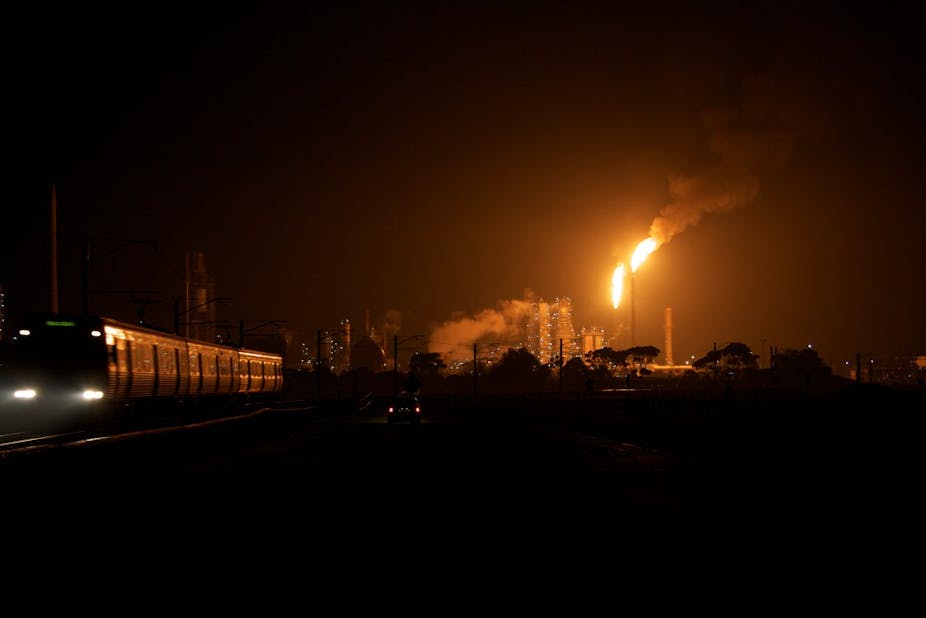
Wind farms make noise. Coal fired power stations pollute the air and atmosphere. Coal-seam gas mines pollute underground water aquifers. All electricity generating sources, to some people, pollute the scenic landscape. Yet in NSW wind farms, and wind farms alone, will be subject to an additional assessment requirement which allows individuals living within two kilometres to veto the development.
The NSW government, following the approach taken by the Victorian government, announced draft planning guidelines two days before Christmas 2011.
These will require an extra stage of planning assessment for new wind farms. The potential operator must seek written consent from every landowner within two kilometres. If this is not forthcoming, they must go through an additional “gateway process” which requires detailed information on the visual and noise impacts of the farm (including photomontages of how the turbines will appear from each non-host residence).
The government also wants to reduce the allowable noise level to 35dB. This is far lower than Europe (55dB), the US, the Netherlands (50dB), and other Australian states (40dB) allow. The two kilometre distance is also more stringent than overseas countries. Denmark, for example, requires that wind turbines be constructed 600-800 metres away from houses, depending on the turbine height.
Justifying this policy shift is a desire to increase community consultation particularly with regard to the visual amenity losses, noise, and human health effects. The environmental impact of wind turbines is a separate issue: impacts on bird life are covered in the required Environmental Impact Statement, which, incidentally, also requires an assessment of landscape and noise effects.
However, behind the push for stricter policy is lobbying by anti-wind farm group, the Landscape Guardians. This group has strong links to the fossil fuel industry and has run a disinformation campaign on so-called “wind turbine syndrome” – psychological effects from infrasound and shadow flicker – for which there is no evidence. And perhaps behind this push is the fact that wind power is set to become cost-competitive with fossil fuel sources by 2016.
At its core, this new requirement is an environmental policy. It seeks to create an emission standard with “emissions” referring to noise and visual impacts – the externalities from producing electricity from wind power. Theoretically this is similar to emissions of sulphur dioxide, nitrogen oxides and carbon dioxide from coal fired power plants or the toxic release of chemicals into underground water aquifers, an externality from coal-seam gas production. But the externalities from wind power are treated differently from fossil fuel externalities.
Where is the industry assistance now?
When environmental policy on fossil fuels is introduced, industry argues for, and inevitably receives, assistance for the loss in competitiveness and jobs that they argue will arise. For example, consider the extent of industry assistance in the Federal Government’s carbon pricing policy. Yet assistance is not forthcoming for the wind power industry despite the uncertainty created and the limiting of optimal wind-farm locations.
The Clean Energy Council states that a similar proposal from South Australia’s opposition Liberal Party would cost $3 billion in investment and 1000 direct jobs. Since the Victorian Coalition Government’s policy was introduced there have been no new wind farm applications. In NSW, the Planning Minister, Brad Hazzard, has estimated that 13 of the 17 wind farms currently being considered will be affected by the new guidelines.
Moreover, for states to meet Mandatory Renewable Energy Targets, more expensive renewable energy sources will be required. This will ultimately increase the price of electricity.
The policy also removes incentives to establish supporting industries (such as turbine manufacturers) in Australia. These industries would greatly reduce the cost of establishing wind farms in the long run and create jobs.
Why apply the precautionary principle now?
The NSW government claims that they are adopting a precautionary approach concerning the health issues associated with wind turbines. This is despite the absence of evidence supporting wind turbine syndrome.
Yet this is not the approach taken with coal seam gas, where health effects are more conclusive. In fact, development is allowed outside of five metres to 20 metres (depending on the type of well) from the well-head of existing or potential future coal-seam gas mines. This is despite the Petroleum (Onshore) Act 1991 (NSW), which governs coal-seam gas mining, requiring under section 72 that a holder of a petroleum title must not carry on operations within 200 metres of a residence or 50 metres from a garden or orchard without the written consent of the affected party.
Moreover, it is clearly not the case that the precautionary principle is applied at the federal level in regard to carbon emissions and the potential for global warming. If it was, much deeper cuts than the 5% below 2000 levels by 2020 would apply.
Where are the neoliberals now?
Usually when an environmental policy is announced, neoliberals seek clarification on why the market can’t deal with this issue and propose market solutions such as tradeable emission permits.
The wind farm policy is an emission standard approach (where a blanket rule governs allowable emissions from all sources), rather than an incentive-based Pigouvian tax – which internalises the noise and scenic externalities – or a market-based emissions trading scheme. You would expect neoliberals to point out that the policy is not cost effective and that it would be better if potential wind farm operators could trade their right to emit noise. This would ensure that those operators who can easily restrict noise (in this case through location choices) do so and trade their rights to those who cannot.
Moreover, this is clearly a case where the Coase theorem, a favourite of neoliberals, could apply if property rights are allocated. With the number of affected parties being small, a wind power operator could pay local citizens to allow wind turbines within close proximity. Such a bargaining solution, as with a Pigouvian tax or an emission trading scheme based on decibels, would create an incentive to innovate low noise wind turbines.
But these claims are missing when it comes to wind power. Perhaps it is because fossil fuel lobbyists usually drive such debates in the case of other environmental policies. Or perhaps it is because, like everyone else, neoliberals started their Christmas break half a day early and missed the announcement.
Where is the compensation test now?
When public policies are proposed, economists draw on the Kaldor-Hicks compensation test. This test suggests that a policy is efficient if the winners can compensate the losers and all end up better off (whether or not such compensation actually occurs). Such a test is invoked when justifying, say, tariff reductions or new roads (which, incidentally, do not have the same noise requirements as other developments) or even the development of a coal-fired or coal seam gas electricity source.
In the case of a wind farm, the compensation test would look at the cost, if any, on local households and weigh this up with the greater good of reducing emissions from fossil fuel powered electricity. Thus, it seems fairly obvious that the compensation test is not being applied here.
Why are the scenic issues any different from tree removal?
Effectively, the NSW government has placed ownership of the scenic landscape in the hands of households. However, in comparable situations such as cutting down neighbourhood trees, the right to veto is held with the local council. This is also the case for wind farms in many other countries.
In the NSW policy the consent for development must come from individual property owners. This appears to go against the spirit of “consent” in the State Environmental Planning Policy (Infrastructure) 2007 which is made under the Environmental Planning and Assessment Act 1979. It defines consent with reference to the “consent authority” – the council, minister or public authority having the function to determine the application.
If requiring individual household consent is deemed a more satisfactory model, it should also be the case for tree removal and coal seam gas mines.
Support research and development and reduce uncertainty
An alternative to the neoliberal policies and the blanket veto approach is to:
support research and development into lower-noise turbines if this is proven to be necessary
support the development of offshore wind farms
support the industry in general by removing red tape (rather than increasing it)
provide clear targets for wind power to reduce uncertainty.
The requirement for more community consultation, the official justification for the policy shift, is a laudable aim. Allocating scenic property rights and noise levels to individual households is more problematic: it has the potential for manipulation (from both sides) for the aims of profit rather than electricity requirements or environmental effects.
However, the government must be consistent and this is clearly not a level playing field. The same veto rule must be placed on other electricity generating sources or the veto rule must be removed and consent placed back in the hands of council or the other relevant planning authority. Otherwise, this is another win for big mining and the fossil fuel industry. And that must raise suspicions about why governments are so set against wind.
Comments on this article are now closed.
Matthew Thredgold
Software Engineer/Secondary Teacher
I'd like to veto every wood burning stove and every pile of burning prunings within 2km of where I live. I'd happily live 500 metres from a large wind turbine and I'd put a small one in the back garden or smaller ones on my roof.
John Phillip
John Phillip is a Friend of The Conversation.
Grumpy Old Man
Matthew, when I'm sitting in my house warmed by a wood burning heater this winter, I'll think of you and hope that you have indeed managed to move away from such devices and have found peace within 500m of a wind turbine. :)
Matthew Thredgold
Software Engineer/Secondary Teacher
Well I hope Andy that your neighbours sue you for the carcinogenic, mutagenic and toxic fumes that you emit, the state bills you for the average annual $2000 of externalities that your woodheater causes and that you are charged for your share of the murder that are all the unneccessary deaths that woodsmoke particulates cause. Other than that your selfishness is duly noted.
As someone who has been forced to move away from my home because of neighbours' woodsmoke at great financial and emotional burden I can say that your attitude is pretty much a sickening kick in the guts.
It is an immoral act to heat a home with wood.
Blair Donaldson
logged in via Facebook
Andy, as you are a physics teacher, would you mind explaining how it's possible for the sound from a wind turbine to be louder at 5 or 10 km from the source that it is at 500 m?
You see, this is one of the claims frequently made by windfarm opponents.
John Phillip
John Phillip is a Friend of The Conversation.
Grumpy Old Man
Nah. I dont think that'll happen, Matthew. You see wood heaters are the only affordable way to heat a house in winter where I live. So most houses in the town have one. You've used words like 'murder' and 'immoral' to describe the effects and users of wood heaters so I would guess that you'd like to drown us all in a sea of hyperbole and legislation. Grow up and come up with a practical solution - humans have burned wood since they discovered fire and it's going to take a lot more than your emotional and irrational outpourings to change that.
John Phillip
John Phillip is a Friend of The Conversation.
Grumpy Old Man
Nah. I dont think that'll happen, Matthew. You see wood heaters are the only affordable way to heat a house in winter where I live. So most houses in the town have one. You've used words like 'murder' and 'immoral' to describe the effects and users of wood heaters so I would guess that you'd like to drown us all in a sea of hyperbole and legislation. Grow up and come up with a practical solution - humans have burned wood since they discovered fire and it's going to take a lot more than your emotional and irrational outpourings to change that.
Matthew Thredgold
Software Engineer/Secondary Teacher
Don't be an ass Andy. My attitude to woodsmoke is not emotional and irrational. It has been learnt from bitter experience. Woodsmoke particulates can and do kill. Woodsmoke also makes some places unliveable. It does drive people from their homes. It does cause asthma and other respiratory diseases. Your town sounds like a nightmare of a place to live.
And have some sympathy. I lost my home to woodsmoke. I suffered a huge injustice. I very much view myself as a victim. I got no help from anyone…
Read moreChris O'Neill
Telecommunications Engineer
I recall several years ago a news item about the air pollution in Launceston in winter caused by woodfires. It's not surprising that this could happen considering Launceston is in a deep narrow valley and there is no gas supply. It was causing widespread serious health problems so the authorities decided to act.
John Phillip
John Phillip is a Friend of The Conversation.
Grumpy Old Man
Look Matthew I really strongly disagree with you, but I am ignorant of your circumstances ("Woodsmoke particulates can and do kill. Woodsmoke also makes some places unliveable. It does drive people from their homes.") so I am willing to listen - how did it drive you from your home, and how does it kill? Can you be more specific. As a chronic asthmatic, I am very careful about my preventative protocols etc and have never had an attack that I can attribute to woodsmoke in my town. Sure, I'm being a bit of a samrtarse, but surely you can see that your position appears to be driven by your own personal issues and it's a bit hypocritical to call me selfish when it appears that you would change everyone else's behaviour to meet your personal needs? (ps dont wanna learn chemistry - it does my head in :))
John Phillip
John Phillip is a Friend of The Conversation.
Grumpy Old Man
Didn't know that Chris. Must've been pretty horrendous for those affected. Fortunately, my location precludes that sort of 'trpping' effect - ie it is on a wide, open plain. I can understand the authorities taking action under those circumstances but for such action to be extended to areas that dont share those particular geographic problems is wrong and from the tone of his comments, I think that that is what Matthew is suggesting (apologies if I am incorrect about this assumption).
George Crisp
Medical Practitioner
Hi Andy,
If you would like references regarding this I am happy to provide them.
The long and short of it is, air pollution is a major public health issue. WHO estimated ( 2004 ) that around 800,000 people die each year, and that is just the tip of a proverbial "clinical iceberg". Approx deaths from air pollution: 100,000 in USA, 168,000 in Europe ( CAFE ) and 29,000 UK ( COMEAP ).
The majority of health effects are mediated by small Particulates ( particulate matter ) produced by combustion…
Read moreJohn Phillip
John Phillip is a Friend of The Conversation.
Grumpy Old Man
George, thanks for the heads up. I'll do a bit of follow up reading based on the above. In the meantime,Ii seems that the installation of modern, "catalytic” or "non-catalytic" stove designs would solve the problem.
Matthew Thredgold
Software Engineer/Secondary Teacher
All attempts by the industry to provide "clean" fires so far have been met with failure and fraud. They can get the level of particulates down to below what the standards say in the laboratory, but there are 4 issues with that:
Read more1. Emissions are still not zero, and on some nights, where there is no wind they need to be zero and people still live downwind even on a windy night.
2. The standards still allow too much pollution, and the industry organisations have a proven record of trying to resist…
Matthew Thredgold
Software Engineer/Secondary Teacher
Yes I am passionate about getting the air clean driven by my experience of the horrible injustice of having to deal with woodsmoke, but the science is on my side. Public policy is frustratingly behind the science.
For the science start with http://burningissues.org or for one of the local sites try http://www.3sc.net/airqual/
And the experience dealing with certain organisations has been quite an eyeopener. The Australian Home Heating Association have interfered in my personal affairs, stepping…
Read morePeter Lang
Retired geologist and engineer
George Crisp. Thank you for the statistics. How interesting that none of the problems are due to CO2. Why are we trying to implement poliices that will spend trillions to tackle CO2 when clearly the real problem has nbothing to do with CO2? We waste all our wealth on fighting the wrong problem)s). How ofteh have we done that before?
- anti-nuclear
- ban DDT
- subnsidise and mandate renewable energy
- promote bio diesel (and cutting down tropical rain forest to grow it)
the list is long
Matthew Thredgold
Software Engineer/Secondary Teacher
Airborne paticulates, and sulphurous and nitrous oxides are problems.
Carbon dioxide is also a problem, but not for the same reasons.
DDT was a problem, and it still is in some parts of the world.
In the Peter Lang problem-calculus can you only have at most one thing that is a problem?
We waste all our wealth letting other people's and corporation's externalities steal from our common good and our common future.
Peter Lang
Retired geologist and engineer
Don't be an ass Matthew. The looney left invariably descend into the class warfare rhetoric of evil corporations. I wonder if these ideologically driven people even understand what wealth means or how human welfare is so dependent on it. I think not, despite the people who keep sprouting this nonsense being amongst the wealthiest people on the planet and preaching that others should suffer. 'Looney' is a very appropriate term fro these idelogues.
Matthew Thredgold
Software Engineer/Secondary Teacher
Peter, you've called me an ass, and the looney left. I think that is infantile. (It wasn't infantil when I asked Andy above not to be an ass. as he was being an unsympathetic ass). I am still asking the question from my experience, why were the profits of the members of the Australian Home Heating Association, ie the manufacturers of the woodburners more important than my health and comfort in my own home? That is what I was faced with. It wasn't fair. And I got treated like a third class citizen. That is a definite case of an "evil" coroporation making profits at the direct expense of the populace. I lost my home to those bastards. Too bloody right should the average person have a say against policy that directly affects them. They should be listened to and not dismissed as looney or "left".
And what was the point of what you replied to George above? It looks to me as you dismiss any argument without understanding it.
Peter Lang
Retired geologist and engineer
Well, Matthew, since I was just quoting your exact words you addressed to Andy just a few comments up, that means you are "Infantile". Right?
Peter Lang
Retired geologist and engineer
Matthew,
I was just quoting what yiun said to Andy up thread: "Don't be an ass Andy". I thoughy you'd understand the lingo.
Peter Lang
Retired geologist and engineer
Matthew Threadgold,
Can you interpret charts?
If so, spend a bit of time with this. http://www.gapminder.org/world/ Change the axes to chart various Human Development Indexes versus GDP per capita and energy consumption per capita.
Then present a justifiable argument to support your belief that increasing the cost of energy and reducing the rate of GDP growth is good for humanity.
Next step, see through the ideological beliefs of the loony left, and jettison your adherence to that ideology.
Peter Lang
Retired geologist and engineer
Well, Matthew, since I was just quoting your exact words you addressed to Andy just a few comments up, that means you are "Infantile". Right?
Matthew Thredgold
Software Engineer/Secondary Teacher
What is your problem old man? I've made a statement (which is rather off-topic seeing the story is about windfarms) and related my experience in how dealing with woodsmoke pollution was horrible, and because of my experience and the science of particulate pollution it would be really a good idea to ban it, and now you are coming out of the closet as a global warming denier, ignoring the assymetry of the argument about calling people asses, and telling me I'm a card carrying member of the loony left. Well I can't be bothered dealing with yet another loony from the ill-informed 'right' with a bee in their bonnet, trying to make me read stuff not related to the topic, to reenforce their own world view.
I still think you were saying to George above that because people are complaining about particulate pollution that therefore they can't complain about CO2 and all this global warming malarkey is wrong? Were you really saying that? If so. wow!!
Blair Donaldson
logged in via Facebook
Matthew, I agree with you regarding wood heaters. On calm frosty evenings where I live, a blue haze fills the air and although I don't suffer from asthma, I often wonder how those that do breathe at all in such an atmosphere.
We use a split system which is compensated for by a medium-sized rooftop solar system. Winter or summer we can be comfortable without destroying the neighbourhood or polluting the air around us.
George Crisp
Medical Practitioner
Peter, they are both forms of air pollution. Acute and reversible harmful effects mediated via gaseous and particulates, and longer term cumulative atmospheric and marine changes mediated by CO2. They are 2 sides of the same coin.
Interestingly the short term cost-benefits of reducing air pollution in economic and health benefit justify phasing out fossil fuel generation by themselves. ( It is worth reading the European CAFE and US EPA publications which detail these costss.
The climate benefits…
Read moreHamish M
Mechanical Engineer
I bet land owners under threat from CSG would love to be able to enfoce a 2km zone.
James Jenkin
EFL Teacher Trainer
I don't think the 'level playing field' metaphor makes sense. Surely a new coal-fired power station would already face different requirements from a wind farm - can anyone give an expert opinion here? And surely wind farms need different planning laws since they're small and can spring up anywhere?
Gideon Polya
Sessional Lecturer in Biochemistry for Agricultural Science at La Trobe University
Excellent article by Dr Neil Perry and sensible, germane comment by Matthew Thredgold. While there is no hard evidence for "wind turbine syndrome", carbon burning variously generates deadly particulate and other pollutants that kill about 10,000 Australians each year.
Our corporate-dominated look-the-other-way Lobbyocracy resolutely fails to ask the key question: "How many Australians die each year from the effects of pollutants from vehicles, coal burning for electricity and other carbon…
Read moreJoel Courtney
Technologist
Just a small note.
<blockquote>Wind farms make noise. Coal fired power stations pollute the air and atmosphere. Coal-seam gas mines pollute underground water aquifers.</blockquote>
Coal fired power stations also make noise. So do CCGT and OCGT power stations. As do hydro stations. Do we have any studies into the noise levels of these at comparable distances?
George Crisp
Medical Practitioner
Yes. Where are the notorious Landscape Guardians, so vocal about the trumped impacts of wind turbines, when it comes to CSG, shale gas, coal mining or wanton wholesale destruction of of forests.?
Nowhere to be seen.
Simon Chapman
Professor of Public Health at University of Sydney
The nonsense described in this piece is predicated on "concerns" about windfarms causing health problems in some exposed. Here is a collection I am compiling of health claims made by anti-windfarm groups and individuals. So far 63 different diseases!! Did you know that earth worms leave the soil up to 18km away? That lung cancer, bowel cancer, weight gain, wight loss, infertility, strike, epilepsy, and "many, many" deaths are caused by windfarms? Here is a link to no less than 17 reviews (not single papers, but reviews) of the evidence on windfarms and health. http://tobacco.health.usyd.edu.au/assets/pdfs/WindHealthReviews.docx This is a contemporary mass hysteria phenomenon which ignorant governments are colluding with.
Peter Lang
Retired geologist and engineer
The real point is that wind farms cost a lot of money, their electricity is unreliable and costly, and they require back up by fossil fuel generators. They save little if any CO2 emissions but are pushing electricity costs through the roof.
The following will provides some insight into the costs of renewable electricity:
“Researchers at the Centre for Energy and Environmental Markets (CEEM), University of NSW, did a desk top study called “Simulations of Scenarios with 100% Renewable Electricity…
Read moreSimon Chapman
Professor of Public Health at University of Sydney
odd then Peter, that economic dunce nations like Germany, China and India are now investing big time in wind energy. Why aren't they listening to you & your pals?
Ryan Farquharson
Research officer
Odd too that in SA which has the highest wind penetration, the wholesale price of electricity decreased.
Peter Lang
Retired geologist and engineer
What do you mean by big time? Compared with what? Wind contributes near nothing, and costs a bundle. It is mandated and subsidised by taxpayers and electricity consumers. It is totally uneconomic without the regulatiosn that force it on us and the subsidies. All these are caused by beleif and faith that renewables must be "good". They are not.
Many argue that the growth rate is high. So what, if you double 1 cent, you get 2 cents. Tht's a hoigh growth rate, but it won't buy a cup of coffee, let alone sustain you. Like your comment, most of the comments supporting wind and renewables are just plain misleading. may I urge you to read this and understand it:
http://bravenewclimate.com/2012/02/09/100-renewable-electricity-for-australia-the-cost/
Ryan Farquharson
Research officer
35dB. Wouldn't it be nice if the neighbour's air conditioner, barking dogs and motor vehicles had to comply with that?
Simon Chapman
Professor of Public Health at University of Sydney
And fossil fuel is not subsidised? Get real. Please ... http://www.smh.com.au/environment/billions-spent-on-fossil-fuel-incentives-20110228-1bbsn.html#ixzz1lmspRAZv
Peter Lang
Retired geologist and engineer
What a nonsensical argument. Decreased from what to what? How does it compare with other states? Cause and effect? Are you really a research officer if you make silly statements like that? It sounds more like a comment from a GetUp! one liner, or a zealot.
Simon Chapman
Professor of Public Health at University of Sydney
Peter -- time you read up on China & wind http://en.wikipedia.org/wiki/Renewable_energy_in_the_People%27s_Republic_of_China#Wind_power
Anton Lang
Retired
I've been contributing to a Blog site now for 4 years, with around 800+ Posts and most of those are with relation to electrical power generation.
Originally, the Kyoto protocol asked that CO2 emissions be lowered to a level 5% lower than what they were in 1990, something that no Country on the Planet has achieved.
As 40% of those total man made emissions come from the generation of electrical power, to comply means that those CO2 emitting plants must be closed down in part, and eventually…
Read moreAnton Lang
Retired
So, let me see if I have this right. South Australia's wholesale cost for electrical power decreased then, because of Wind Power.
The chart shown at this link is from the Federal Government's own Yearly Energy Paper, and this is the most recent Paper.
Note the orange highlighted number below the State Name.
http://papundits.files.wordpress.com/2012/01/australia-power-costs-master.jpg
South Australia pays more for wholesale Power than any other State, and it would be even higher if they were not importing cheap coal fired power from Victoria.
Tony
Chris O'Neill
Telecommunications Engineer
"35dB. Wouldn't it be nice if the neighbour's air conditioner,"
Indeed. Councils won't even let you build a wall, without planning permission, to keep out a neighbour's noise caused by poor building design that the council itself approved. All of a sudden governments are interested in noise simply because it comes from a windfarm.
David Osmond
Wind Engineer
Some misleading statistics you've provided there Tony. South Australia has historically had more expensive power. However, as they've installed more wind power, its wholesale price has reduced, by about 2% between 2005/06 and 2010/11. Moreover, in this same period, it has reduced its net imports of electricity from Victoria by almost 90%. Energy from wind has increased by a factor of 3 over this period, while its emission intensity from generation has reduced by 18%.
To restate, over this 5 year period, a 3-fold increase in electricity from wind has been associated by a 2% reduction in wholesale price of electricity, an 87% reduction in imports from Victoria and an 18% reduction in emission intensity.
http://www.aemo.com.au/planning/SASDO2011/documents/SASDO2011.pdf
Grendelus Malleolus
Senior Nerd
Peter, consider South Australia as an individual jurisdiction. Consider its wholesale power costs over time. The comparison for this exercise should be of the juridiction's own costs not comparative with other states and territories. There is a wide range of policy, infrastructure and administrative efficiency variation between jurisdictions that make a straight cost comparison problematic. However since the issue here is "has the establishment of wind allowed wholesale prices to decrease" then you need to look at the data for South Australia alone.
A further consideration should be the variability of wholesale costs with shifting coal, oil and gas prices. Renewables can assist in buffering the wholesale price against market fluctuations in fossil fuels. At present a mix of both would seem to be a very viable and sensible option.
Anton Lang
Retired
David,
you can make your points and I can make my points.
What I find hard to justify is that the 24 most recently constructed Wind Plants in Victoria, New South Wales, Tasmania, the ACT and NSW have cost $5.2 Billion in total, half of that ins Fed and State subsidies, and then the wholesale cost of electricity is also subsidised by State Governments as well.
Those 24 Wind Plants total out at 2003MW Nameplate Capacity, and deliver their power at around 600 to 700MW only, on an averaged year…
Read moreDavid Osmond
Wind Engineer
Care to provide a source for your claim that half of that $5.2 billion is in State and Federal subsidies?
Chris O'Neill
Telecommunications Engineer
I think I can summarize the cost issue by saying that wind generation makes very little difference to the required installed capacity of the rest of the generating system. Thus using wind generation requires a huge amount of additional capital to achieve whatever reduction in carbon emissions it achieves. Fundamentally, using renewables to reduce carbon emissions requires a huge injection of capital.
Mark Duffett
logged in via Facebook
I hold no brief for fossil fuels, but I call bull on this. Despite considerable enquiry, no one has ever explained to me how certain exemptions from FUEL TAXES (I mean, hello?) qualify as subsidies for said fuels, yet they are the lion's share of the sums uncritically quoted as 'fossil fuel subsidies'.
Byron Smith
PhD candidate in Christian Ethics at University of Edinburgh
"Originally, the Kyoto protocol asked that CO2 emissions be lowered to a level 5% lower than what they were in 1990, something that no Country on the Planet has achieved."
I currently live in a nation that had Kyoto requirements to reduce CO2e by 12.5% by 2012. By 2008, according to Kyoto-agreed measurements, it had already achieved a 20% cut. We now have legislated targets of a 50% reduction by 2027.
David Osmond
Wind Engineer
No source yet? Perhaps that is because that statistic is a complete fabrication. The main subsidy for Wind Power is sale of the renewable energy certificates. There is no large up-front capital subsidy for large-scale wind projects as you suggest. It is only once they start producing electricity that the subsidies come into play.
And funny that you should mention that the costs are only going in one direction. Yes, wind and solar continue to get cheaper every year, while coal continues…
Read moreJohn Phillip
John Phillip is a Friend of The Conversation.
Grumpy Old Man
Thank you Anton for raising these issues. I have read about them before but it's great to see them put together in one succinct response. It seems that many respondents think wind farms are one of the 'silver bullets' (in terms of reducing co2 emmissions) whereas they are very far from being a faultless, practical practical replacement for 'conventional' energy production.
John Phillip
John Phillip is a Friend of The Conversation.
Grumpy Old Man
Once again, you've answered myth with fact - again thanks. :)
Blair Donaldson
logged in via Facebook
Andy, it is a misconception on your part to claim proponents of wind energy believe it alone is the silver bullet to CO2 reduction. We acknowledge that wind energy in conjunction with other renewables is what is required to achieve that end.
John Phillip
John Phillip is a Friend of The Conversation.
Grumpy Old Man
Blair, I did say 'one of the silver bullets'. As Anton has pointed out accurately and in some detail, wind turbines have got problems. They may not produce the CO2 of a coal power station but their energy production per dollar of investment is their achilles heel. The point is, are they an effective use of a limited budget available for renewables.
Blair Donaldson
logged in via Facebook
Andy, others here have refuted Anton's claims. His figures don't seem to square with reports from the International energy agency for Bloomberg but in any case, he ignores the fact that the energy source of wind farms is free while that of fossil fuel generators is increasing in cost. He also ignores the large subsidies provided to fossil fuel generators while focusing on the subsidies received by renewables. Finally, he ignores the long-term health costs from the pollutants resulting from fossil fuel fired energy.
Do a little research and you'll find the cost curve is reducing for wind while its increasing for fossil fuels. Depending on the figures you want to choose, parity is here now or only a matter of a few years away at most.
Do you have an answer to my question on sound levels at different distances from turbines?
John Phillip
John Phillip is a Friend of The Conversation.
Grumpy Old Man
No Blair, not yet - off the top of my head, thinking that the landscape and surrounding environment is not a lab perfect, reflectionless sound stage, I would say that the low frequency sound waves may be affected by constructive interference patterns and that at some distances their 'volume' may be louder than expected. Closer sites may be shielded in certain directions. I really am just taking an educated guess here and would certainly appreciate a 'proper' explanation from someone with more expertise in this area. What do you reckon?
Blair Donaldson
logged in via Facebook
Andy, I'm aware that landscape and buildings can focus or reflect sound but the quack who moonlights as the medical director of the Waubra Foundation along with some wind farm opponents claim that sound from turbines is far louder at 5 and 10 km from the source then it can be at 500 m.
If that was true, the inverse square law is BS. As far as I'm aware, nobody else has discovered this new physics that only wind farm opponents appear to have discovered.
John Phillip
John Phillip is a Friend of The Conversation.
Grumpy Old Man
Blair, I havent found the relevant statements at the Waubra Foundation site. They've got some statements their by different physicians raising issues (insomnia/sleep deprivation etc) concerning the turbines. On the surface of it, their concerns seem to be worth investigating. I'm not yet prepared to adopt Simon's position on them yet. (At the moment I feel it's a case of who's results you believe.) As to the inverse square law - yea, I'd love to see an explanation re that too - there's quite possibly some other factor(s) involved and I'd be really interested to hear them.
George Crisp
Medical Practitioner
Andy,
there are probably 2 main things to consider when assessing the clams of "low frequency noise" induced symptoms.
1. Is there epidemiological or clinical evidence to support it ?
2. Is there a pathophysiological mechanism ?
There have been more than a dozen reviews by peak health bodies and regulators around the world into an industry that has been "exposing people" for decades. There is a common finding: none of the reports or reviews finds any evidence of ill health in local residents…
Read moreBlair Donaldson
logged in via Facebook
Andy, the comments about loudness at distance have come from various windfarm opponents, they have been echoed by the so-called medical director at different times but to my knowledge, it's never been categorically stated on the website.
There are approximately 16 studies that show there is no direct link between turbines and ill-health but I'd be quite happy to see yet another independent study conducted.
The problem is, or the problem will be that even if another independent study is conducted…
Read moreChris O'Neill
Telecommunications Engineer
"Their mindset is identical to proponents of alternative medicine or creationism,"
as it is with anti-climate scientists,
"no amount of science demonstrating the fallacies of their beliefs will convince them."
Mark Duffett
logged in via Facebook
"Not a level playing field for wind power"? At least it's not outright banned like nuclear.
Peter Lang
Retired geologist and engineer
It certainly is not a level playing field. It is mandated that we build renewable energy by the Renewable Energy Targets. It is mandated that the electricity distributers must buy renewable energy or pay a huge fine, more than the cost of the electricity they were required by regulation to buy. Who pays? We do of course. But not a fossil fuel power station in the world has been replaced by wind power. It is a huge cost for no benefit. In fact it is helping to send the European countries broke. That is why most of the European countries are cutting back on their subsidies. They are all waking up to the joke of renewable energy. And so is the population - at last.
Stephen Prowse
logged in via LinkedIn
We seem to be having these circular discussions about energy supply that are predicated on the assumption that one particular energy source will supply all our energy needs. For various reasons we are moving away from total reliance on carbon based generation and increasing non-carbon based generation. This would seem to be a sensible move from a long term sustainability point of view. Such diversity also increases our resilience.There are costs,risks and benefits from each energy source. So how about looking at those relative costs, risks and benefits, include nuclear in the mix and develop a national strategy for a diversity of power sources. Perhaps we already have one but it gets buried by the lobbyists?
Michael Brown
Professional, academic, company director
Environmental activists spent years opposing nuclear power, coal generation and industry in general, using exaggerated health effect arguments. Now the tables are turned and they don't like the attacks on their beloved wind farms. Very ironic indeed.
Wind is of course ridiculously expensive because you need back-up alternatives for still or overly windy periods, and extra capacity to deal with the variable nature of winds. And of course extra distribution lines.
Read moreThat can never match Victorian…
David Clarke
logged in via Twitter
Wind power is actually highly reliable. Yes, wind is variable but it is highly predictable. Yes, there must be backup generators, but there also must be backup generators for fossil fuel power stations (they are typically available only 85% of the time due to breakdowns or scheduled maintenance). The first wind farm was connected in SA in 2003, in 2011 wind power provides more than 20% of SA's power and the carbon dioxide emissions from the power sector have declined while power consumption has increased.
Blair Donaldson
logged in via Facebook
Peter, you shouldn't believe all the propaganda the landscape guardians tell you. You only need to spend a little time and effort to find plenty of new investment in wind, all around the world.
You seem to be falling over yourself to find fault with wind but have no qualms with the money wasted each year propping up inefficient coal-fired power stations and dead end technologies like carbon capture and storage.
Of course mixed renewables could provide 100% of Australia's electricity needs if…
Read morePeter Lang
Retired geologist and engineer
Blair Donaldson,
Read this then tell me what you think:
http://bravenewclimate.com/2012/02/09/100-renewable-electricity-for-australia-the-cost/
John Harland
bicycle technician
The problems with wind turbines are well below the claims of many of their opponents. Importantly, though, the issues are greater than acknowledged by many proponents.
To rubbish all concerns is disrespectful and far more likely to turn people against wind power than to win their support.
We might fairly ask if the problems described in the article are not the result of such disrespect.
Helicopters overhead often cause severe television signal problems, seemingly due to reflections of the…
Read moreSimon Chapman
Professor of Public Health at University of Sydney
This phenomenon is massively parochial and Anglophone. I have many European colleagues in nations like Spain, Portugal, France, Germany, Netherlands where wind turbines have operated for many years without any significant complaint. I lived in France myself in 2006. Panic about "wind turbine syndrome" (a term that you will not find even once in a search of the US National Library of Medicine's PubMed data base .. go and try) is virtually unheard of. Isolated examples with research showing that pre…
Read morePeter Lang
Retired geologist and engineer
Well, clearly you are not aware of the complaints and that they are part of sending the countries you mention broke.
"This phenomenon is massively parochial and Anglophone. I have many European colleagues in nations like Spain, ..., France, Germany, Netherlands where [nuclear power has] operated for many years ...."
You could change "wind turbines" to nuclear power plants" and make the same statement. The difference, of course, is the nuclear supplies huge amounts of cheap, reliable baseload electricity, and massively cutes CO2 emissions, whereas wind does not. Wind is expensive, unreliable and does not cut emissions.
Denmark, with the highest penetration of wind power, has CO2 emissions from electricity that are about ten times higer than France which has 75% of its electricity supplied by nuclear. Join the dots ...
John Phillip
John Phillip is a Friend of The Conversation.
Grumpy Old Man
Simon, you state "For 22 yrs I've lived 120m under the Sydney flight path, 50 metres from a busy rd and 150m from a railway line. I can hear the repetitive explosion of tourist fireworks from Darling Harbour every Saturday night. I sleep beautifully every night, as do 4 others in my family." So, clearly, Simon background noise doesnt bother you. You seem however, quite prepared to assume that because of this it shouldnt bother or cause distress to anyone else either. That's a fairly large and egocentric leap.
Simon Chapman
Professor of Public Health at University of Sydney
I would have to be deaf & blind to not be aware of claims that windfarms bother & cause distress to a small minority of people. But the research on such people repeatedly shows that exogenous factors like pre-existing attitudes to wind farms & renewables, being able to see turbines, not receiving $$ from hosting them are predictive of such distress. Reaction to windturbines is highly psycho-and sociogenic. That being the case, should policy act as if they were really, intrinsically noxious? The world is full of precious people who don't like all sorts of things and sometimes worry themselves sick. If we built social policy around just the expression of distress, everything would shut down.
Tim Scanlon
Author and Scientist
I live near the largest wind farm in the southern hemisphere, 106 turbines. Speaking with the property owners about the turbines, they have no problems with them. At 500m they are background noise "probably less noise than being next to a main road in the city" and at 1000m barely noticable. One farmer even stated that the railyard was far more noisy and it is in the middle of town.
The disinformation about wind farms are far too prevalent in the media. I have heard of virtually no downsides to wind power, as long as the wind farm is suitably setup (located correctly, etc). Not everywhere can have a wind farm, as wind speeds have to be suitable and consistent. The only real downside is the subsidisation of the fossil fuel industry that makes it hard for the new energy systems to compete with established industries.
Blair Donaldson
logged in via Facebook
“Helicopters overhead often cause severe television signal problems, seemingly due to reflections of the broadcast signol off the rotating blades. Why is it difficult to accept that the same might happen off turbine blades?"
Odd then that helicopters are frequently used to transmit television broadcasts covering anything from the Tour de France, assorted marathons and events such as the Sydney to Hobart yacht race.
I also doubt that claim because my house is directly under the flight path of…
Read morePeter Lang
Retired geologist and engineer
IEA (2012) – “The Impact of Wind Power on European Natural Gas Markets”
http://www.iea.org/papers/2012/impact_of_wind_power.pdf
This paragraph from the Executive Summary reinforces an important message:
"An analysis of the effect of an increasing wind market share on residual demand shows that wind significantly alters the load duration curve (LDC) of residual demand, changing not only its size but also its slope. Comparing the LDC of demand and residual demand shows how wind strongly decreases…
Read morePeter Lang
Retired geologist and engineer
http://www.iea.org/papers/2012/impact_of_wind_power.pdf
Even though the effects of an increasing wind market share on gas markets are relatively limited and there are several tools available within natural gas systems that can support an increased demand spread and unpredictability, natural gas should not be seen as a inexpensive or easy way to support a higher wind market share. An increasing wind market share strongly decreases the capacity factor of gas‐fired generation capacity, thereby increasing…
Read moreLuke Weston
Physicist / electronic engineer
I fully support eradicating any legislation which is unfairly, irrationally biased in favor or against any particular energy technologies in a way that is not based on scientific facts and evidence and scientifically credible data and analysis.
Political policymaking in this context should absolutely not be biased in favor of fossil fuels, or in favor of solar, or against wind, or in favor of wind, or against nuclear energy.
All energy generation technologies, including fossil fuels, solar…
Read moreDavid Clarke
logged in via Twitter
Why do so many people believe that base load power is what Australia needs? Base load power is the inflexible sort of power you get from coal-fired power stations. It cannot be increased or decreased to match the changing demand; it's just there. It has a pretty low value.
Why do so many people believe that wind power is unreliable? It is not. It is highly reliable, but is variable in a way that is highly predictable, because the wind is predictable.
Peter Lang
Retired geologist and engineer
There is lot's wrong with your understanding.
Baseload is low cost but high value. It supplies the electricity to meet a modern society's constant demand. Baseload comprises about 75% of our electricity. We need it as cheaply as we can get it.
You also misunderstand flexibility. Baseload power stations can and do follow load, it is just that it is cheaper to turndown the wik on others like hydro and gas generators.
"“The electric system is more than just the delivery of energy—it is…
Read moreDavid Clarke
logged in via Twitter
Peter; Baseload power plant as defined in Wikipedia. "Baseload plant, (also baseload power plant or base load power station) is an energy plant devoted to the production of baseload supply. Baseload plants are the production facilities used to meet some or all of a given region's continuous energy demand, and produce energy at a constant rate, usually at a low cost relative to other production facilities available to the system."
Peter Lang
Retired geologist and engineer
David,
What is the point you are trying to make?
Did you read the report I linked for you?
John Harland
bicycle technician
Blair, the simple reality is that helicopters do cause interference with signals here. They will not necessarily do so where you are, depending on the location of the broadcasting and receiving antennae and the height at which the craft are flying.
Your claim that wind proponents, presumably including yourself, are aware of the problems is clearly false because you are denying what I know from personal observation to be a real phenomenon in some circumstances.
The use of helicopters to transmit and receive signals, such as in the Tour de France, is not a contradiction. The antennae are below the rotating blades, and pointed away from them, so interference is highly unlikely.
I wonder if your reception of my ideas is swayed by my not having made clear whether I support or oppose wind power?
Blair Donaldson
Researcher
John, I'm sorry I didn't make myself clearer. I was trying to point out that helicopters are used to transmit television signals so there is no reason to automatically conclude that wind turbines will necessarily interfere with transmitter signals.
I have no doubt that in certain situations helicopters may affect a signal but I'd suggest it's rare given the huge volume of helicopter traffic allowed in and around major cities, many used by police and emergency services who I know are sticklers for good signal transmission and reception. You'd think if there was any serious problem, the issue would have been raised frequently by the relevant authorities?
Given that windfarm projects are in more remote areas, there should be even less of a problem with interference.
Whether or not you support wind energy is irrelevant when discussing the degree to which helicopter or wind turbine blades may affect radio and television signals. I hope that clears up any confusion.
wilma western
logged in via email @bigpond.com
Good on you Blair, Tim and David - speaking from close study and first-hand experience. The real story in the unprecedented restrictions imposed by Victorian and NSW Liberal/Coalition governments is the powerful influnence within their ranks of Landscape Guardians and fossil fuel interests. Nothing to do with amenity, planning or economics.
John Phillip
John Phillip is a Friend of The Conversation.
Grumpy Old Man
The shrill cry of the consiracy theorist. lol What do you mean by 'the real story'? Where is your evidence to back up your assertions? FInd and present some facts.
John Harland
bicycle technician
The problem is not common but it does occur and it is very irritating when it does. particularly when it is partway through a favourite program.
However, rather than being rarer than in the city, signal strength and interference are more-severe problems in remote areas.
My key contention is that it is counterproductive to dismiss such a problem as rare, or "non-existent". It can be a real and important issue to some people and, if they are treated disrespectfully in the process, their friends…
Read moreBlair Donaldson
logged in via Facebook
Given the abysmal program options available to television viewers these days, at least on commercial television stations, it could be argued that any disruption of television signals by aircraft, wind turbines or anything else should be considered a community service :-)
To be fair, I think that everybody who supports renewable energy and wind farms in particular recognises the technology is not perfect but then I'd also ask, what technology is?
I have been battling the propaganda promoted…
Read moreBlair Donaldson
logged in via Facebook
Here you go John, yet another example of the Victorian government's bastardry when it comes to wind farms.
Ramsay’s wind farm demands fail, but he still faces questions
http://www.standard.net.au/news/local/news/general/ramsays-wind-farm-demands-fail-but-he-still-faces-questions/2463370.aspx
john mills
john mills is a Friend of The Conversation.
artist
We should all have been driving electric vehicles well over thirty years ago, but the petrol money people stopped that, and wed rather kill ourselves and our kids. We should all have solar or wind power to power our homes and our electric cars, but the petrol and electric money people hand in hand stopped that, a conscience, whats that?, electric car and solar to power our home = cost $12,000 to $14,000 at the most and our kids live pollution free and we want to talk bull crap about this and that, get real.
Chris Harries
logged in via Facebook
The coal industry does not feel particularly threatened by wind power. They are busy building gas generators to supply their peaking load and far more gas generation is being built installed than is wind capacity.
The pro-nuclear lobby feels very threatened by wind power, because wind is being deemed okay and attracting investment whereas the main non traditional energy source, nuclear, is not. The increasingly bitter battle between the wind and the nuclear folk is getting more emotive by the day with both sides pouring scorn on their opponent's preferred technology.
Ironically, both wind and nuclear devotees suffer equally from the NIMBY effect. i.e. Fear in local communities that they may be negatively affected. And these fears are played upon. Yet the things we are used to we've just learned to live with. Car smashes kill and maim people in their thousands but cars are part of our everyday lives, we actually love them despite all.
Peter Lang
Retired geologist and engineer
Wind energy costs 10 times more than gas
CO2 abatement cost with wind energy is about 10 times more than with gas
And CO2 abatement costs with wind generation is about 10 times more than the starting price for the Australian CO2 tax.
http://www.thegwpf.org/images/stories/gwpf-reports/hughes-windpower.pdf