
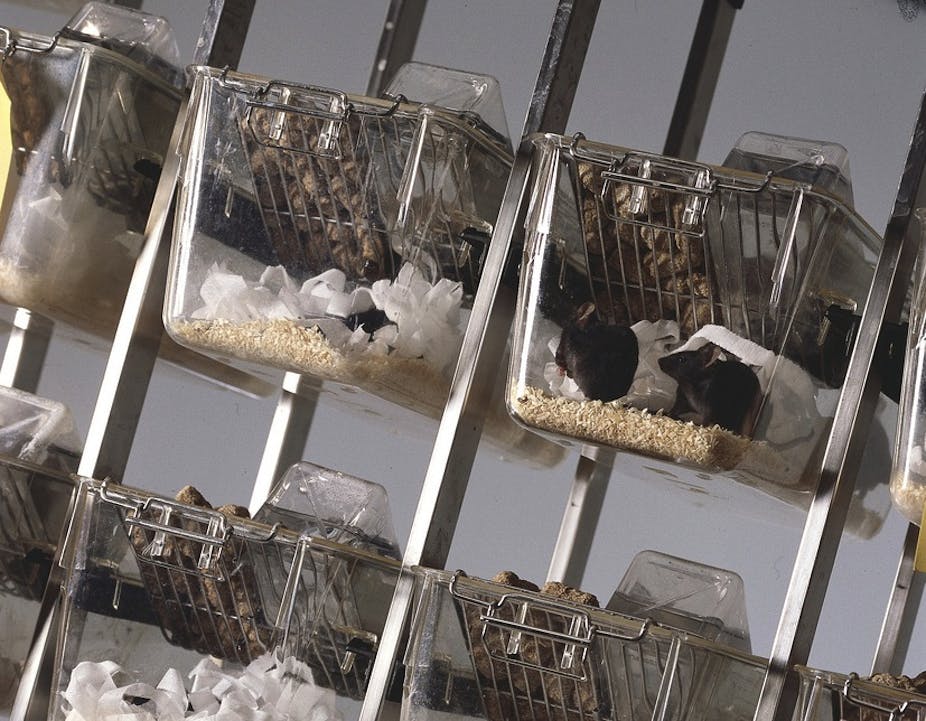
Of mice and men: role of mice in biomedical research questioned

A study recently published in the peer-reviewed journal PNAS (Proceedings of the National of Academy Sciences) shows that mice are poor models for human inflammatory diseases. The paper, which focused on sepsis, burns and trauma, raises questions about the fundamental role of mice in biomedical research…

Gjsgpvf2-1361404417
The authors say their findings raise important questions about the central role of animal models in biomedical research. Understanding Animal Research

A study recently published in the peer-reviewed journal PNAS (Proceedings of the National of Academy Sciences) shows that mice are poor models for human inflammatory diseases. The paper, which focused on sepsis, burns and trauma, raises questions about the fundamental role of mice in biomedical research.

Bodily responses to burn injuries and acute infections look similar in mice and humans, but the study authors found they’re driven by fundamentally different genetic and molecular mechanisms. They spent ten years examining which genes in human white blood cells are activated during infection. Data from 167 patients suggested there are particular patterns of genomic change associated with acute inflammation.

After having their paper rejected by several journals, the researchers decided to redesign their study. Apparently, one objection from reviewers was that the results had not been validated by mouse studies. But when the researchers looked at the genomic response to different forms of inflammation in mice, they made a number of startling discoveries:

  1. The relatively uniform gene changes found in human patients were not found in mice.

  2. Genomic changes in mice were completely different to humans, and there was no discernible pattern of gene modification.

  3. None of the mouse models for sepsis, bacterial blood poisoning, trauma or burns predicted the magnitude or direction of inflammation in humans.

These findings have significant ramifications.

There have been almost 150 clinical trials of drugs designed to block immune responses to acute sepsis in humans. These trials were all based on research in mice and have all failed to produce a positive result.

Clinical trials are expensive. The costs of a failed trial include financial losses and opportunity costs (other things that could have been done with the resources used). These opportunity costs are both scientific, and in terms of the health and well-being of human participants.

As specified by the Declaration of Helsinki, which governs the ethics of research involving people, before a candidate drug can be given to humans, it must first be tested on at least two different animal models. So the drugs used in human trials were run through standardised mouse models, and each model was designed specifically to replicate human inflammatory responses.

The authors of the PNAS study make clear their findings don’t invalidate mouse models of other human diseases. But they do think their experience raises important questions about how biomedicine is researched, particularly, the central role of animal models.

In an interview in the New York Times, one of the authors said,

They were so used to doing mouse studies that they thought that was how you validate things. They are so ingrained in trying to cure mice that they forget we are trying to cure humans.

The study also highlights a problem for researchers who study animal models to better understand and treat human diseases. The practice depends on the assumption that some properties of humans and non-human animals are both functionally and causally similar. But to assume that the first leads to the second is to commit what some philosophers of science describe as the “modeller’s functional fallacy”.

Digital watches and sundials can both tell the time, for instance, but they do this in completely different ways. A cloudy day obscures the time on the sundial but it doesn’t have the same effect on the digital watch. Similar functions can clearly have different causes.

Other biomedical researchers are beginning to take a different approach to devising therapies. They advocate a comparative strategy that prioritises the study of naturally occurring human and animal disease. They believe this form of “translational research” could solve many of the quandaries raised by this and other examples of research where animal models have been poor predictors of human disease.

Public support for animal experimentation rests on its purported value to human health. But arguments against the practice are increasingly based on examples of how it has misled medicine. Unfortunately, however, so much is invested in current research models that it’s unlikely to see significant change anytime soon.

Articles also by These Authors

Sign in to Favourite

Want to follow The Conversation?

Sign up to our free newsletter to get the day's top stories in your inbox each morning, with a special wrap on Saturday.

Donate and become a friend of The Conversation

Join the conversation

17 Comments sorted by

  1. David Priest

    PhD Student

    Hang on a sec. Are you questioning the efficacy of rodent models of human disease in general or just inflammatory conditions?

    The paper you cite clearly states "our study supports higher priority for translational medical research to focus on the more complex human conditions rather than relying on mouse models to study human inflammatory diseases. "

    ...whereas your title "Of mice and men: role of mice in biomedical research questioned" might suggest differently.

    Please clarify

    report
    1. Reema Rattan

      Editor at The Conversation

      In reply to David Priest

      Hello David,

      For reasons of accepted style and convention, headlines on news articles are not comprehensive, like journal articles.

      The article above clarifies the paper its talking about in limited to a few conditions in the first couple of lines. And it mentions other diseases where animal models have not been useful.

      Perhaps another way of thinking about this is that the headline is not "Of mice and men: role of mice in all biomedicine research questioned"

      I hope that clarifies things a bit for you.

      report
    2. Lois Salamonsen

      Professor at Prince Henry's Institute at Prince Henry's Institute

      In reply to Reema Rattan

      This holds also for embryo implantation. Vast amounts of data from manipulation of mice have indicated pathways critical for implantation - yet implantation in mice is substantially different from that in humans and many of the genes manipulated in mice are not appropriately expressed in the human uterus. Worse still, many of the review papers on implantation do not state clearly that the work is predominantly from mouse studies. Only very selected positive data is referenced to suggest that mouse work will hold in the human -no mention is ever made of the many cases when it will NOT hold

      report
  2. Gerard Dean

    Managing Director

    I cannot handle the idea of testing drugs on animals.

    But I eat meat and if my daughter develops a deadly disease and the doctor says there is a new treatment that may cure her, but it has to be tested on pigs or mice or monkeys first, what would I do?

    My ethical stand against testing on animals would be instantly shelved.

    Funny things us humans.

    Gerard Dean

    report
  3. Monika Merkes

    Honorary Associate, Australian Institute for Primary Care & Ageing at La Trobe University

    Thank you Christopher and Jane for the article.
    Animal models are not useful to study human diseases, not just mice and inflammatory diseases.
    Andrew Knight, a European Veterinary Specialist in Welfare Science, Ethics and Law and Fellow, Oxford Centre for Animal Ethics, has recently published a book with the title “The costs and benefits of animal experiments” in which he reviewed over 500 scientific publications about the contributions of animal experimentation to human healthcare and the extent…

    Read more
  4. Rob Buttrose

    University of Melbourne

    Very interesting article .
    The mouse paper is one in a long list of studies that make it plainly irrational to keep believing the extravagant claims of the animal experimentation industry . It is just false that the sacrifice of hundreds of millions of animals in biomedical research each year has resulted in significant advances in human healthcare or at least, not significant enough to justify the heinous wrongs that are perpetrated on animals in the lab .

    More evidence for this is found…

    Read more
  5. Rob Buttrose

    University of Melbourne

    I have a couple of questions for the authors:
    In this quote:
    "They were so used to doing mouse studies that they thought that was how you validate things. They are so ingrained in trying to cure mice that they forget we are trying to cure humans."

    who are "they"? The pronoun does not seem to have an anchor in the previous paragraph. From the New York Times article, it is of course obvious that “they” are the reviewers who claimed the result of the inflammation study had not been validated by…

    Read more
    1. Christopher Degeling

      Researcher at University of Sydney

      In reply to Rob Buttrose

      Hi Rob - I cannot answer for the reviewers or the researchers.
      However, the nature of model based science means that no study is ever likely to be 'definitive'. There is always some level of abstraction and assumption - which then requires the modeller to make extrapolations in order to make some claim about the target.

      As to whether the patient-based study stands on its own, again no scientific finding stands on its own, all of them rely upon some level of acceptance about previous findings - how genes work, what genes do etc...

      It is interesting that "Animal studies" are not given any status in EBM evidence hierarchies - whereas a patient-based study usch as the one published in PNAS would be recognized as evidence useful to practice.

      For a more detailed discussion of the role of causes in functions have a look at Daniel Steel's Book "Across the boundaries: extrapolation in biology and social science"

      report
    2. Rob Buttrose

      University of Melbourne

      In reply to Christopher Degeling

      The "particular patterns of genomic change associated with acute inflammation" from the patient study were not replicated in the mouse study of the same condition. I take it this result could be explained in two main ways: either 1) the patterns found from the patient study are unreliable/spurious/not real or 2) mice and humans just have radically different genetic responses to inflammation.
      Was 2) accepted because in the case where you have two studies, one with human patients and one based on an animal model, the animal results are generally discounted when there is a conflict? Of course that seems to make sense. I suppose the real point is that the mouse results were wildly at odds with the results of the patient study, and that means relying on mouse models alone (when there is no corresponding patient study to compare) to be predictive of human outcomes is a very dangerous course.

      report
    3. Sue Ieraci

      Public hospital clinician

      In reply to Rob Buttrose

      Quite apart from the ethics of animal testing, the animal model only represents an early stage of drug development, a long way from release.

      Following trials in animal models, therapeutic substances have to pass through pharmacokinetics and dose testing on healthy volunteers, prior to controlled testing on patients, and, following eventual release, post-marketing surveillance.

      There is no single step from lab to patient.

      report
  6. Rob Buttrose

    University of Melbourne

    The authors recognise the epistemological and ethical problems with animal research as currently practiced, but stop far short of arguing that it should be largely halted or greatly reduced in scope as many philosophers, ethicists and scientists have called for. They instead favour "translational research" and "animal-as-patient' research. In the latter approach, instead of making a healthy animal sick (e.g. with AIDs, hepatitis or diabetes) , trying out various drugs, then killing it and examining…

    Read more
  7. Michael Lardelli

    logged in via Facebook

    We have just submitted a paper describing how the genes involved in familial Alzheimer's disease (AD) appear to be evolving particularly rapidly in mice and rats but not in guinea pigs or most other mammals. And yet the vast majority of AD research is done in mice! Guinea pigs seem to be closer to humans in their cholesterol metabolism as well and so may be a better AD model overall. But for some reason there is no germline transgenesis in the published literature for guinea pigs.

    We have even found one feature of AD genes that is conserved in humans and zebrafish but not in mice. In fact, with hindsight, if there was one mammalian model that one would not choose for AD research it would be mice. Could that be why there has been so little progress in our understanding of AD?

    report
  8. Sean Lamb

    Science Denier

    Nothing much to see here. A group of researchers who objected to having to validate their findings in animal models, produce data to show this is a waste of time.
    There paper would have been stronger if they could have defined strong characteristics or meaningful signatures of the human response and the mouse response. But basically all they do is create a statistical storm and throw up their hands crying "Its all too difficult."
    In regards of toxemia and sepsis, the mouse as functioning Caspase 12 gene and we (or most of us) do not. But the authors don't seem interested in characterising how exactly the mouse response differs from the human response.
    It may be this is largely driven by too mild treatment of their model mouses - because in general the mouse response seems very muted.
    On the positive side, I suppose no reviewers are going to try and get them to validate their findings in mouse models in the future.

    report
  9. Yoron Hamber

    Thinking

    Well, Isn't that explained by the Hitchhikers guide to the galaxy. Once again, the mice has put one upon us.

    Da*n those (infernally clever) mice.

    report
    1. Tanya Barber

      Chef

      In reply to Rob Buttrose

      Unless you are to suffer brain damage one day, in whcih case you might become grateful that someone had figured out that fish oil can help reduce the damage...

      report
  10. Tanya Barber

    Chef

    I think the original article made a sensible point: In order to study a phenomenon or disease you have to use an adequate model. In the case of the phenomenon they studied, it turns out that mice were not really a good model. Which to me just means that they should look for a better animal model, rather than giving up. It is unfortunate that, as shown in the follow-up commentaries, the animal rights lobby has interpreted this in the wrong way, to mean that all animal research is flawed. This is…

    Read more