


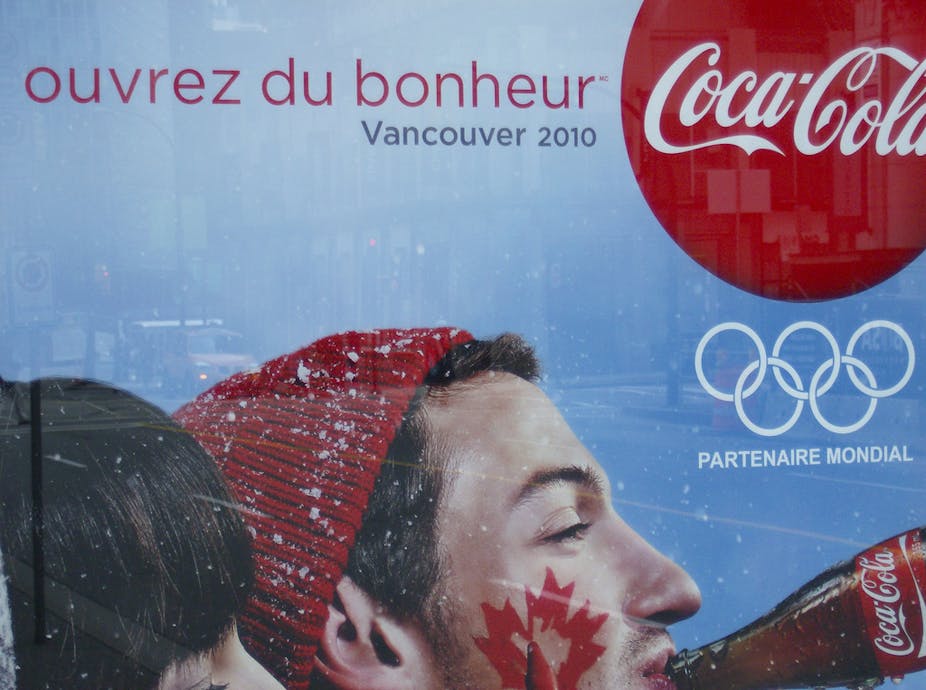
What does the Olympics stand for: is it the inspiration for a healthier, sportier community? Or is it just another way to sell junk food and booze to an ever-fatter, ever-drunker population of couch potatoes?
The high ideals in the Olympic Charter include “to oppose any political or commercial abuse of sport and athletes”. Organisers of the London Olympics say they are using the games as a springboard to promote physical activity in the community. Former Olympic hero Sebastian Coe, now Chair of the London Olympics Organising Committee, tells us that, “London’s vision is to reach young people around the world. To connect them with the inspirational power of the games”.
The International Olympic Committee’s (IOC) marketing documents spruik the massive reach and influence of the Olympic Games and advertising related to the Olympics. Nonetheless, according to the IOC, one of the “fundamental objectives of Olympic marketing” is “to control and limit the commercialisation of the Olympic Games”.
It is hard to reconcile the objective of controlling commercialisation with the reality that the Olympics’ “Top Sponsors” include Coca-Cola and McDonalds.
McDonalds is “the official restaurant of the Olympic Games”, and is already engaged in massive television, print, billboard and online promotion linking its products with the best in sport. McDonalds has even recently been reported as trying to prevent anyone else from selling chips at Olympic venues.
Ironically, the Olympic Games organisers themselves clearly recognise that this is a totally unacceptable association. A special question on their website asks “Why is McDonalds a sponsor?”. But there is no rationale or justification other than that “McDonalds has been an ‘official sponsor of the Olympic Games’ since 1976”.

Coca-Cola has been associated with the Olympics since 1928, telling us that “The Coca-Cola company shares the Olympic ideals”. Coca-Cola has developed its own “Olympic Anthem”. In Australia - as elsewhere around the world - it is associating Olympic athletes with its promotions. It has even, in association with its Powerade brand, published a “Nutrition for Athletes” guide. Nobody could doubt that kids as well as adults are being targeted - Coca Cola’s own marketing materials include activities and competitions for children, alongside promotions that make full and creative use of social media.
We can expect further massive promotion of the association between the Olympics and junk food from McDonalds and Coca-Cola as the Games approach. They and other junk food companies have no doubt already spent millions buying advertising time during the telecasts. But they are not alone. Cadbury is “the official treat provider of the London 2012 Olympic Games” and an “Olympic partner”, while Cadbury subsidiary company Trebor is “a provider and supplier”. Both are already promoting their association with the Olympics through marketing materials, such as the Cadbury Australia “Cadbury Catch Up at the Olympics” competition.
All this at a time when obesity is one of our most pressing public health threats. More than 60% of adults and a quarter of our children are overweight or obese.
It gets worse. At a time when there is justified community concern about the impacts of alcohol, and particularly a culture of drinking to get drunk among our young people, the Olympics are directly associated with alcohol promotion.
Heineken UK is the “official lager supplier and sponsor of London 2012”. Heineken is also active in all media, including online,and through massive outdoor displays that will presumably be magically invisible to children.Internationally, Heineken is hoping “to reach untapped audiences in emerging markets through its sponsorship of the Olympic Games”.
The only British Parliamentary criticism thus far of the Olympic/alcohol association appears to be from a muddle-headed Liberal Democrat MP, Greg Mulholland, whose criticism is that the sponsor should be a British brewer rather than a Dutch company, because beer is “the UK’s Britain’s national drink”. Amazingly, Mr. Mulholland is a former Health spokesperson for his party.
The Bibendum wine company is also associated with the Olympics. Wines supplied by Bibendum have been nominated as the first “official” Olympic wines since the modern games began in 1896 and will be sold at almost all Olympic venues (except Hampden Park in Scotland - which given the Scottish penchant for alcohol is probably just as well). Bibendum, which sees the Games as “a fantastic trading opportunity”, has even “assembled a dedicated Olympics logistics planning team” to ensure drinkers have ready access to its products.

The IOC tell us on their website that they aim “to control sponsorship programs to ensure that partnerships are compatible with the Olympic ideals”. While the Olympic Games were associated with tobacco promotion long after the harmful effects of smoking were known beyond doubt, the IOC now has a clear policy that it will not accept commercial associations with tobacco products.
But the IOC policy on alcohol remains at best bizarre. The policy excludes “alcoholic beverages (other than beer and wine)”. So we conclude that it is inappropriate to associate the best in sport with spirits, but not with other alcoholic products.
There is no conceivable justification for a policy that excludes promotion of spirits, but not beer and wine. The IOC’s first “Fundamental Principle of Olympism specifically refers to "the educational value of good example (and) social responsibility”. Why would the IOC not want to protect children and young people from exposure to promotion for beer and wine as well as for spirits and other alcoholic products?
The Olympic Games are a wonderful celebration of the best in sport. Surely the IOC can do better than permit this global celebration of sporting excellence to promote products whose consumption is associated with some of the greatest threats to our health and wellbeing.
If previous Olympic Games are a precedent, media coverage of the Olympics will be associated with a tsunami of direct and indirect promotion for junk food and alcohol.
By the time the next Olympics come around, perhaps the IOC will have taken a more responsible approach to promotion of its wonderful product, and will consign all association of sporting success with alcohol and junk food to the promotional graveyard where tobacco sponsorship now resides.