
Just how much would it cost electricity generators if I reduced my electricity consumption by turning off just one light? You would think the answer is half of bugger all, and you’d be almost right.
In an attempt to be a bit more precise, let’s quantify exactly what “half of bugger all” amounts to. Assume that the light I stop using is a 75 watt globe and that I was only using it for about 3 hours a day. So turning it off reduces my average electricity consumption by about 10 watts and saves me about 85 kilowatt-hours over the year.
With my generator expecting to get about 5 cents for every kilowatt hour traded on the wholesale market, the lost income due to my action is a touch over 4 dollars for the year. So “half of bugger all” comes in at about 1 cent each day. It means even less to the generator’s bottom line, because it no longer has to cover the cost of making the electricity that I no longer want.
So you wouldn’t expect the generator to give two hoots about my action. But there are reasons why the generators might be concerned, and they are all about multipliers.
Firstly, demand reduction has a significant multiplier on generator income. Not only does my not using electricity cost the generator a lost sale, it also reduces the price of all other sales on the wholesale market. And in theory, that directly impacts the generator’s profit, since that is on electricity that still has to be delivered.
In reducing my demand, I effectively create an oversupply in the market. And, as with any efficient market, prices respond with a signal to reduce supply. In fact recent market trends show that in addition to reducing the revenue in electricity sold by about $4, my turning off one 75 watt globe reduces the revenues of all other electricity sold by more than $10 across the year. So the net impost on the generator’s revenue is more than $14, most of which is profit.
Still not too much of a worry, unless of course I am not alone. Multiply my action by 7 million, or about 1 in every 3 Australians, and generator revenue would be down more than 100 million dollars on a net reduction in demand of 65 megawatts. That is about 1% of expected annual wholesale market bottom line, but a much higher percentage of generation profits. Multiply that again by a factor of 10, and we are talking of losses in the billions, and a potential bankrupting of some leading industry players.
And it is already happening.
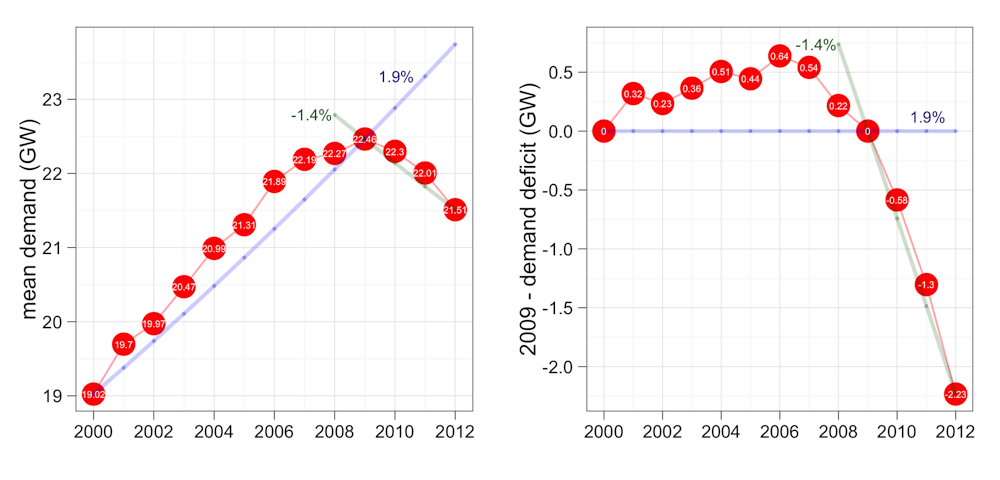
Over the last few years, demand for electricity traded on the National Electricity Market – or NEM – has collapsed by over 900 megawatts and over twice that on forward projections. And wholesale electricity prices on the NEM have plummeted to record lows, down some 40% on just a few years ago.
Until early 2009 the demand for electricity traded on the market grew fairly consistently at around 2% each year. Although there was some slackening in demand before 2009, most industry analysts put it down to the GFC and thought it inevitable we would need another gigawatt or thereabouts of supply to meet 2012 demand.
That is the equivalent of one big new coal-fired power station, about 3 gigawatts of installed wind power capacity or 6 gigawatts of PV.
But instead, in 2009/10 demand actually fell in real terms by 140 megawatts, fell again in 2010/11 by 290 megawatts and again in the last 12 months by 500 megawatts. Compared to 2009, demand is now down by about 930 megawatts, or almost 4%. Compared to the forward projections of just three years ago demand is down by about 2.2 gigawatts or 10%. That is the equivalent of two big power stations we thought we would need, but no longer do.
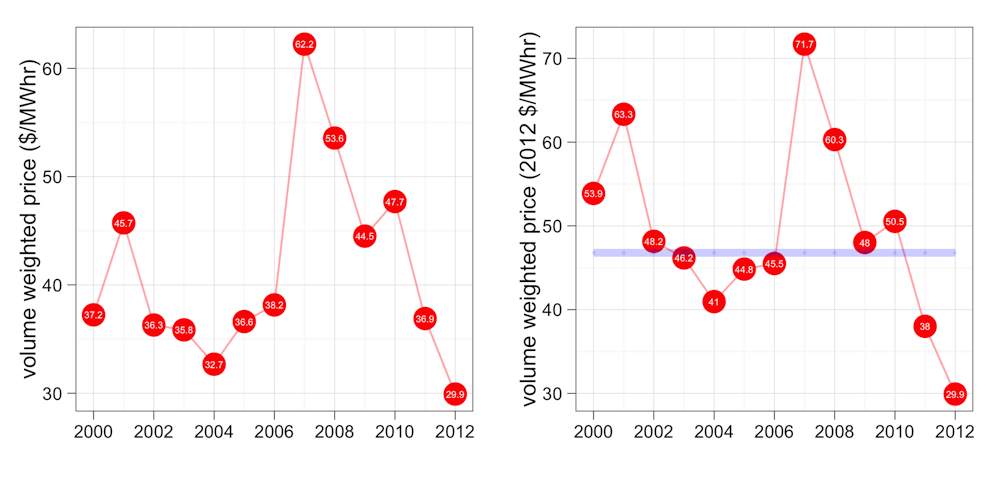
And since 2010, wholesale prices have collapsed. The average price in the last financial year was a touch under $30 per megawatt hour. That is the lowest average annual price recorded on the market since 1999 and is about 40% lower than the long-term average of around $47, adjusted to 2012 dollar terms. Market revenue was down almost $3.5 billion on the yearly average of $9 billion in adjusted terms, and more than $5 billion on forward growth projections.
These figures give a direct measure of how the electricity market values demand reduction in terms of its impact on wholesale prices or, in other words, the price signal of oversupply. In fact the market is valuing a demand reduction of 1 watt on the forward projection at about $1.40 over the year. That compares to the expected wholesale value for 1 watt-year of electricity of 44 cents.
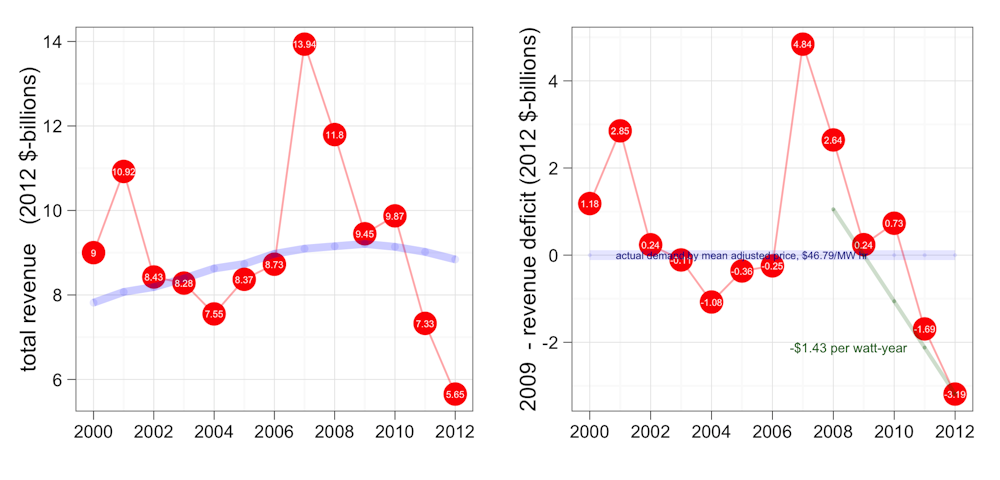
And so we get an estimate of our multiplier, of 140/44 or 3.2. Factoring in some other price effects such as the prevailing la Niña weather cycle, and a more conservative estimate of the price signal multiplier is probably a bit lower at around 2.5.
That is a very strong price signal, and testifies to the effectiveness of an efficient market. It may explain why generators are less than enamoured by schemes, such as energy efficiency and distributed PV, that take market share away from their business.
Of course, in the face of plummeting wholesale prices, consumers should be asking if they are seeing any of the benefit. Near record increases in retail prices would seem to suggest not and raise a raft of questions such as what exactly is the function of the wholesale market?
Jonathan Maddox
Software Engineer
The purpose of introducing a wholesale market, I thought, was precisely to permit this sort of shakedown. To allow cheap efficiencies and tiny consumer austerities to compete, for the first time in Australia, on a level playing field with the cost of building new power stations and transmission networks.
It should come as no surprise to anyone that generators are finding their bottom lines pinched.
It hasn't been a smooth ride because the regulatory system failed to anticipate any fall in…
Read moreChris O'Neill
Telecommunications Engineer
"Unfortunately some poor communication on the part of energy distributors, and some massive disinformation campaigns by the tinfoil hat brigade, have blocked distribution of smart meters where timely rollout has been attempted."
You failed to mention another cause, i.e. where energy distributors failed to pass on the cost savings of smart meters to their consumers. The distributors grabbed all the benefits and gave the consumers nothing. Hardly the sort of behavior to encourage cooperation. The distributors shot themselves in the foot.
Jonathan Maddox
Software Engineer
I'm not actually sure there are any benefits from smart metering if the consumers aren't motivated to change their consumption behaviour by improved information and/or potential financial benefit. The distributor only *enables* this benefit; it is up to the consumer to realise it.
Compulsorily charging customers hundreds of dollars for new meters they didn't ask for is another way to shoot yourself in the foot. Some of these consumers will likely choose to ignore their new meters, avoid changing their consumption habits in any way, and blame the imposition for any increase in their bill.
In some cases the new "smart" meters replaced defective old ones and billed substantially more or less than the old meter did. I can understand it if some few consumers, used to being billed some modest amount, were highly resentful when they started getting bills for their usage. The few who benefited from the change would be happier but less likely to make a public noise.
Peter Sommerville
Scientist & Technologist
Being a practical realist I think we have to accept the fact that the smart meters are being installed and as a consequence three things will happen:
1. Time of use tariffs will become the norm.
2. Contracts offering cheaper rates for customers who are willing to permit remote shutdown of such things as air-conditioners for specified maximum periods during peak demand will also be available.
3. Distributors will adopt less impactful strategies for shutting down domestic dwellings when and…
Read moreChris O'Neill
Telecommunications Engineer
"The distributor only *enables* this benefit;"
That was the problem, the distributor didn't enable the benefit. It just kept charging like it did before, same rate regardless of time of day. Is it any wonder consumers were turned off by this sort of behavior?
Peter Sommerville
Scientist & Technologist
Chris,
I've followed your comments and have some sympathy with your frustration. Mine were identical. I am still mightily annoyed at how the cost of the smart meters has been passed back to the customer.
At last the situation is changing - at least in here in Victoria. Mine smart meter went in in Feb 2010. Just recently my distributor, United Electricity, has enabled a website from which I can down load all the smart meter data as a csv file.
At the same time I installed a PV system - at…
Read moreJohn Browne
John Browne is a Friend of The Conversation.
Surveyor
Just imagine the effect of shutting down an aluminium smelter.
Gerard Dean
Managing Director
John
Good point. I am just imagining the Australian industrial workers and their families and rural communities thrown on the scrapheap when an Australian aluminium smelter is forced to close.
Aluminium is a wonderful metal. It is light, strong, malleable, machineable and makes wonderful airframes for things called aeroplanes. These aeroplanes, pushed along by irreplaceable hydrocarbon fuels, carry academics around the world to conferences to discuss how to reduce the use of electricity and irreplaceable resources.
Professor Sandiford shouldn't just switch off a 75 watt light, he and the Melbourne Energy Institute should have the guts to stop flying and go Renewable Only. When they do, I will start taking notice of what they say.
Gerard Dean
Glen Iris
David Arthur
n/a
Just imagine the effect of replacing coal-fired power generation for aluminum smelting with whichever non-fossil generation makes sense. For Port Henry, it may well be wind power and solar thermal power from an installation in the Wimmera or Mallee. If transport costs and emissions are to be minimised, then alumina refineries and aluminum smelters would be constructed in Arnhem Land and on Cape York, and would be powered by solar thermal stations (or nuclear if that proves optimal).
Aluminum airplanes need not be powered by "irreplaceable" fossil fuels, they'd be powered by hydrocarbon fuels derived from algae.
David Boxall
logged in via Facebook
Imagine the jobs in alternative energy and fuels.
For mine, we'd be a lot better off if we didn't subsidise aluminium smelters. They should stand or fall as the market dictates.
Gerard Dean
Managing Director
Mr Boxall
Responding to your points.
Imagining jobs in alternative energy and fuels is all you can do Mr Boxall, because there are virtually none in Australia. The number of such
So aluminum smelters have have to stand or fall as the market dictates!!!!!!!! Professor Sandiford and the Melbourne Energy Institute won't be happy to hear that idea, because if we applied the same rule to wind turbines, solar panels, geothermal or wave energy they would all fall.
if you want to see the green jobs nirvana go and visit Tasmania. Poor old Tassie's motivated youngsters flock to Melbourne, drawn by the glitter of real jobs powered by brown coal! The ones who stay get 'green' jobs like waiting on tables or driving tourist buses.
Do any of you guys know how much oil feedstock, rare earths, refined copper, steel, aluminium, beryllium copper, brass, lead, tin goes into making the keyboard you are tapping away at.
Gerard Dean
Glen Iris
Mike Hansen
Mr
Gerard Dean says
"Imagining jobs in alternative energy and fuels is all you can do Mr Boxall, because there are virtually none in Australia."
Nonsense. Who do you think is installing solar pv and building and maintaining wind farms.
Due to a change in solar tariffs in Qld, 75,000 applications for new solar pv were received in 13 days between the 26th of June and the 9th of July.
http://www.climatespectator.com.au/commentary/newmans-accidental-solar-boom
Any thoughts Gerard as to who is going to install those panels?
In Germany *before* they committed an extra $100 billion to renewable energy, 300,000 jobs had already been created in renewable energy.
http://www.guardian.co.uk/environment/2010/jul/07/germany-renewable-energy-electricity
Are you arguing that renewable energy can be rolled out in Australia without creating jobs?
You have an unfortunate habit of making evidence free claims Gerard.
David Boxall
logged in via Facebook
Gerard Dean: "Imagining jobs in alternative energy and fuels is all you can do Mr Boxall, because there are virtually none in Australia." So our alternative energy and fuels sectors run without staff? Now that's efficiency that only an extreme market fundamentalist could dream up!
Gerard Dean: "So aluminum smelters have have to stand or fall as the market dictates!!!!!!!!" Subsidising power users, good; subsidising power producers, bad. That's even handed for you!
Peter Sommerville
Scientist & Technologist
Well David, we have found and area where you and I can at last agree, but probably for different reasons.
I am sure you are familiar with the political history of aluminium smeltering in Victoria. It was subsidised via extremely favourable power prices, attached to assurance of security of power supply by earlier state governments in order to create employment in the regional centres, Geelong and Portland. It succeeded in the job creation objective, but they are very expensive jobs.
Invariably, subsidising industries, unless it is for national security reasons, leads eventually to the chickens coming home to roost. That in my opinion, applies uniformly - and will in time be the case for all the 'green' subsidies too. C'est la vie.
Peter Sommerville
Scientist & Technologist
There are some interesting studies of the cost of the jobs created in Germany, and the impact of the jobs exported as a consequence. If I had the time I could probably find the references.
Gerard Dean
Managing Director
Mr Boxall
There is a disconnect somewhere. Why do you have a problem with Australian workers smelting aluminium in Australia?
The first industrial production of aluminium was based on base load renewable, hydroelectricity in Europe.
Surely if Australian aluminium smelters are supplied by renewable energy, all Australians should be proud.
Why is subsidising foreign made manufacturers making windmills and solar panels good, whil subsidising Australian workers making Australian products bad?
Gerard Dean
Glen Iris
Peter Sommerville
Scientist & Technologist
Hi David
Fuel from algae is a promising technology, and I suspect in the future at some time will find a place in the liquid fuel industry. But it needs sufficient scale to get costs down to a competitive level.
Interestingly the "peak oil" predictions are again proving to be wrong, with the development of shale oil deposits, particularly in America. Some years ago the USA imported 60% of its oil & gas needs - it is now 45%. The economic situation has had an influence on this. Although a bit early to say yet it is possible that the US could be self sufficient and indeed become a nett exporter.
It is a development which is driving environmentalists into a lather, and which goes a long way to explaining the US reluctance to engage in any cap and trading scheme.
Gerard Dean
Managing Director
Mr Hansen
You claim that I make "Evidence free claims", and then you quote the Climate Spectator and The Guardian.
You mentioned Germany. We all agree that German cars are no match for the mighty Holden Commodore, however they are fantastic engineers and manufacturers. While many western nation's base manufacturing are contracting, Germany's is growing. That is despite the obliteration of German solar panel manufacturer's by low cost Chinese competition.
I make machines for German manufacturers…
Read moreMike Hansen
Mr
Gerard. Your claim was "Imagining jobs in alternative energy and fuels is all you can do Mr Boxall, because there are virtually none in Australia."
"Look, over there a wombat" is not an argument.
Jonathan Maddox
Software Engineer
... but still they come.
German network operators have been successfully integrating ever-increasing power from renewables for decades. They are facing, understanding and overcoming the difficulties inherent in this process. First up, it's important to note that a large portion of German renewable electricity comes from biogas, which is perfectly dispatchable, ideal for load-following, and essentially indistinguishable from fossil natural gas.
Among the innovations required to adapt to ever…
Read moreJonathan Maddox
Software Engineer
Aluminium smelters have for decades been subsidised through a massive distortion of the electricity market in a way that has proven to have several detrimental externalities.
I for one have no issue at all with subsidising Australian manufacturing, providing that it results in a net benefit to the country. Aluminium smelters don't automatically qualify.
Support for renewable energy innovation most certainly *would* have, if we had actually sustained them. But the now-you-see-it, now-you-don't nature of our clean energy support has led time and time again to technically brilliant Australian people and businesses moving offshore.
Peter Sommerville
Scientist & Technologist
A curious distinction Jonathan. After all aluminium smeltering is a manufacturing operation. However, the employment base is trivial cf the the total manufacturing base, agreed. But exactly how far do you go? And how do you assess a nett benefit in the long term? One man's subsidy is inevitably another man's tax.
Peter Sommerville
Scientist & Technologist
What you forgot to mention Jonathan is that they are also investing in coal powered generation - the last time I looked it was 12 Gigawatts and growing.
David Boxall
logged in via Facebook
Gerard Dean: "Why do you have a problem with Australian workers smelting aluminium in Australia?" Mendacious non-sequitur.
I live near the recently closed smelter at Kurri Kurri. From acquaintanceships with locals who worked at the smelter, both on pot-lines and in administration, I have a reasonable overview of the industry (at least, at that location).
When will you learn how foolish your habit of pontificating in abysmal ignorance makes you look?
assistance from the state government (specifically, a subsidised power deal) so they pulled out. Join the dots yourself to get some idea of the magnitude of subsidies involved. Much as I dislike our state government and much as the closure has distressed people close to me, I support the state government's action.
Norsk Hydro, the owners of the smelter, were actually offered federal government assistance. They couldn't get additional
David Boxall
logged in via Facebook
Not sure what happened there; that last paragraph should read:
Norsk Hydro, the owners of the smelter, were actually offered federal government assistance. They couldn't get additional assistance from the state government (specifically, a subsidised power deal) so they pulled out. Join the dots yourself to get some idea of the magnitude of subsidies involved. Much as I dislike our state government and much as the closure has distressed people close to me, I support the state government's action.
David Boxall
logged in via Facebook
The military and aviation industry evident think otherwise.
Peter Sommerville
Scientist & Technologist
I assume you are referring to biofuels from algae? The military are not investing nor is aviation, as far as I know. But there is some commercial investment. Let's hope green politics doesn't get involved and give this investment the "green kiss of death".
Peter Sommerville
Scientist & Technologist
Whilst I agree with you, the result of course is that the smelters simply move elsewhere, where someone else is prepared to subsidise the electricity. Such is the nature of the beast. I'd be happy to see shelters operating here - unsubsidised. But that is not the way of the world is it!
Jonathan Maddox
Software Engineer
I'm not aware of any *new* coal-fired power station making it past drawing-board status in Germany within the last decade, despite numerous proposals. I am aware of a couple of upgrades, increasing generating capacity and/or adding district heating (combined heat and power for improved overall fuel efficiency), with no associated increase in coal consumption or CO2 emissions.
12GW is a big figure. Can you corroborate?
Peter Sommerville
Scientist & Technologist
Sure Jonathan - it was in a report in one of the science magazines I think last year. I will see if I can track it down tomorrow.
Jonathan Maddox
Software Engineer
I was not distinguishing between "manufacturing which brings a benefit" and "smelting which has negative externalities" -- smelting *is* manufacturing; and any particular manufacturing process or scenario should be evaluated on its specific merits.
I didn't mean to imply aluminium smelting is not manufacturing; just that it has proven rather expensive and that I have no qualms whatsoever with the least-viable Australian smelters going out of business -- not least because of the follow-on effects in the electricity market. As I'm absolutely certain I've made clear elsewhere.
Gerard Dean
Managing Director
Mr Maddox.
But still they come.
Don't listen to the Guardian and Melbourne Energy Institute Dreamers, look at the facts. "German Energy mix", Wikipedia says:
- Renewables make up approximately 20% of German electricity production, with wind and hydropower making up 70% of this total. Biofuels hardly rank.
- Germany imports approximately 65% of its power consisting of oil, gas, coal and nuclear.
- Therefore, renewable energy makes up about 6% of Germany's total energy use, which is…
Read moreDavid Boxall
logged in via Facebook
Peter Sommerville: "... the result of course is that the smelters simply move elsewhere, where someone else is prepared to subsidise the electricity."
The market comes into play. Part of the problem was the high Australian dollar and low prices on the aluminium market. It depends how far we're prepared to distort the market. Eventually, it get too expensive. My neighbours are suffering, but I can't deny that the cost was beyond what could be demanded of the state.
David Boxall
logged in via Facebook
Peter Sommerville: "The military are not investing nor is aviation, as far as I know." Then you know too little.
Despite Republican obstructionism, the US military has invested in various biofuel projacts. The latest RIMPAC exercises providing cases in point. Aviation industry and airlines have been investing for some time, the latest of which I'm aware being Qantas (can't remember much about that) Lufthansa recently signed with some Australian mob.
Do your research.
David Boxall
logged in via Facebook
Peter Sommerville: "Invariably, subsidising industries, unless it is for national security reasons, leads eventually to the chickens coming home to roost."
If the subsidies are ongoing, perhaps. That's what happened to aluminium. The industry proved not to be self-sustaining.
Peter Sommerville: "That in my opinion, applies uniformly - and will in time be the case for all the 'green' subsidies too."
If renewable energy proves not to be self-sustaining, probably. If subsidies are needed, only to allow self-sustaining industries to establish, probably not.
Jonathan Maddox
Software Engineer
Seems to me you are conflating electricity with energy. You're not the only one to do this, so perhaps your sources confused you.
There is no "German energy mix" page on Wikipedia; and pages such as "Energy in Germany" and "Renewable energy in Germany" give numbers which differ considerably from the ones you give here.
Germany does not import 65% of its electric power; it is a net exporter of electricity. It does rely somewhat on trading electricity with neighbouring countries to balance…
Read moreJonathan Maddox
Software Engineer
Duh. I want an "edit" button to get rid of the abortive paragraph there :)
Peter Sommerville
Scientist & Technologist
David,
"If renewable energy proves not to be self-sustaining, probably. If subsidies are needed, only to allow self-sustaining industries to establish, probably not."
True.
But the history of subsidised industries is replete with failures, or otherwise maintained by ongoing and sometimes hidden subsidies that distort the rest of the economy. In principle I am not adverse to governments using tax payers funds to provide start up capital for new industries, but bureaucrats tend to be not all that successful in picking winners. Geodynamics is a good example.
Peter Sommerville
Scientist & Technologist
David,
"It depends how far we're prepared to distort the market."
I agree - it is a question that applies to all subsidies.
Peter Sommerville
Scientist & Technologist
Jonathan
"I didn't mean to imply aluminium smelting is not manufacturing."
Accepted - I didn't intend to criticise. The question of where you draw the line always remains however.
I also agree with your views concerning the impact of subsidised Aluminium smelters of the electricity market.
Jonathan Maddox
Software Engineer
And to correct "1930s" to "1950s and 1960s" : Snowy Hydro isn't quite that old. Sorry.
Peter Sommerville
Scientist & Technologist
David,
"Then you know too little."
Us scientists tend to be linear thinkers and I thought we were discussing algae as a source of biofuel. As I am sure you are aware algae are mostly lipids and grow rapidly - a good combination for a biofuel feedstock.
And I also suspect we ascribe a different meaning to the word "investing".
The Qantas trial was simply trial and used vegetable oils as a source. To me that was not an investment. From memory the trial involved a 50:50 mixture with conventional…
Read morePeter Sommerville
Scientist & Technologist
Jonathan,
As promised. The statement is based on an analysis by Michael Pahle from the Potsdam Institute:
http://www.pik-potsdam.de/members/pahle
It was reported in the New Scientist, Issue 2801, page 4. To save you time the report follows:
"EUROPE'S plans for tackling global warming by driving down emissions of carbon dioxide may have backfired in Germany, where they have encouraged energy companies to build coal-fired power stations instead of gas-fired stations, which emit less CO2…
Read moreDavid Boxall
logged in via Facebook
Peter Sommerville: "... I also suspect we ascribe a different meaning to the word "investing"." I find it hard to ignore the substantial investments by countless corporations and governments, here and overseas. One obvious one you've missed is NASA.
Peter Sommerville
Scientist & Technologist
David,
"I find it hard to ignore the substantial investments by countless corporations and Governments"
A bit of an exaggeration, but never mind, we are all entitled to vent our enthusiasm. I didn't intend to provide a comprehensive list, even though I have one somewhere, I personally don't regard NASA as commercial, but certainly NASA is interested in the technology. I also left out Synthetic Genomics - a big player,
Interestingly the bulk of the investment is is in America. You might find this article interesting:
http://www.forbes.com/sites/kensilverstein/2012/05/20/will-algae-biofuels-hit-the-highway/
Cheers.
Jonathan Maddox
Software Engineer
Thankyou Peter.
I'd seen some of this information, and seen plenty of publicity about new coal-fired power plants, including publicity from protest groups who successfully prevented construction of proposed new power stations. I wasn't aware of any of the genuinely *new* ones actually going ahead.
Most of the projects which have gone ahead represent a significant increase in energy efficiency over older equipment, by way of (a) using a higher furnace and boiler temperature; (b) being better…
Read morePeter Sommerville
Scientist & Technologist
No problems Jonathan.
I think two key points emerge here. The "rush for coal" identified by Michael Pahle indicates how creation of artificial markets can often have unintended consequences.
The second point is that the principle reason Germany will move to more coal power generation is to ensure base load capacity. The renewable technologies don't really provide that. Despite the protests this is inevitable as the nuclear stations are shut down. Otherwise Germany will have to import base load from surrounding countries.
There is no question that modern technology enables far more efficient production of electricity so emissions per tonne will go down.
Jonathan Maddox
Software Engineer
I have to object to "Germany will move to more coal power generation", seeing as it These generation investments are not ongoing and current policy strongly favours renewables. We've come up with just one instance of a new power station that will actually increase coal consumption -- the other dozen or so leave it more-or-less unchanged and indeed pave the way to reducing aggregate consumption over their lifetimes by permitting greater integration of intermittent generation.
You're absolutely…
Read morePeter Sommerville
Scientist & Technologist
Jonathan, I guess we will just have to wait and see what the future brings. Supplying a reliable base load from solar and wind is moot. Gas would of course give far more flexibility.
In 20 years we should compare notes again on this topic.
Meanwhile this interaction with you has been a pleasure. Thank you.
(I have a son who is a software engineer - he runs his own company)
David Boxall
logged in via Facebook
I think I've figured out your problem; you confuse investment with profit. Aren't development and testing necessary investments? Wouldn't a genuine "Scientist & Technologist" recognise that?
Peter Sommerville
Scientist & Technologist
My problem?
Oxford dictionary:
Invest: "Apply or use (money) especially for profit"
Investment: "The act or process of investment; money invested; property etc in which money is invested".
But I am happy to accept you have a broader definition.
I do consider development and testing necessary investments, which is exactly what the various companies developing algae farming as a feedstock for biofuel production are doing. But their investment is directed at a commercial outcome. The Qantas, Lufthansa and RIMPAC trials were simply validating what is already known - biofuels work.
But I really don't wish to bog down in a trivial argument. The important issue is that research and investment into utilising Algae as a commercially viable feedstock is actually happening, funded largely by private capital. As a scientist and a technologist I find that exciting. :-)
David Boxall
logged in via Facebook
So you go from denying that there's any investing:-
Peter Sommerville: "The military are not investing nor is aviation, as far as I know."
To denying that investment is investment:
Peter Sommerville: "Investment: "The act or process of investment; money invested; ..." ... But I am happy to accept you have a broader definition."
Peter; whatever you're trying to argue, it isn't coming through.
Peter Sommerville
Scientist & Technologist
David,
I suggest you read back through the thread. It is quite clear.
But just in case....
I actually have a strong interest in seeing the Algae feedstock idea progress. I gave a presentation on this possibility over a decade ago to a bunch of chemical engineering students. From another place you may remember I worked in the water industry. I learned a lot about algae in the process. I actually did some research on the effect of algal blooms on pH back then.
I am concerned that the…
Read moreSteve Drummond
Retired (self funded)
I am seriously looking at installing a smart meter so that I can buy when the price is right. I reckon this might be a better way of slashing electricity costs than installing solar panels.
The ideal solution would be a duel 12v- 240v system which would allow me to buy electricity off the grid at the cheapest rate, store it in battery and use it the grid price is high. Better still, a natural gas to electricity power cell which would give me greater choice in how I source my electricity.
I want to be able to act in my own self interest and not have to swallow the current take it or leave it offerings from the big electricity generators.
David Boxall
logged in via Facebook
Steve Drummond: "The ideal solution would be a duel 12v- 240v system which would allow me to buy electricity off the grid at the cheapest rate, store it in battery and use it the grid price is high." Bear in mind that the best batteries are about 80% efficient (of what you put in, roughly 20% doesn't come back out). Efficiency doesn't increase as batteries age.
Gillian King
logged in via Facebook
I got a smart meter when I got solar panels, and I love it. My bills show how much electricity I use in the three daily time periods and the different rates per kWh for each. Our main response has been to do optional things (using the oven, dishwasher, washing machine, etc) outside the 2.00-8.00pm peak period.
I think our bills are slightly lower since we got the smart meter. The meter shows all our electricity consumption. The solar PV production is shown separately and, as we installed them in 2010, we benefit from the now-defunct 60c FIT in NSW.
Peter Sommerville
Scientist & Technologist
Interesting observation Gillian.
I recently installed a 4 KW system. The distributor for my area has recently enabled a website where I can download my consumption in half hour increments since the smart meter was installed over two years ago. Once the PV system started my retailer switched me to a time of use tariff. Using the downloaded data I am able to model the costs for different charging systems viz the peakload plus service charge or the peak, shoulder and off-peak plus service charge…
Read morePeter Sommerville
Scientist & Technologist
I looked at this David - the cost is considerable. Deep cycle batteries are not cheap.
I have wired my PV system so I can fall back on this option should the feed-in tariff be reduced to irrelevancy thereby using PV and off-peak to charge the batteries. Theoretically, if I wanted, I could also go off grid, provided I also install a generator backup for those occasions where the PV system can't keep up. But it is all expensive, and getting off grid is not all that easy.
David Boxall
logged in via Facebook
Peter Sommerville: "Deep cycle batteries are not cheap."
The last time I checked, service grade storage was about $500 per kWh. I don't know about domestic grade.
Peter Sommerville
Scientist & Technologist
I did my costings in Amp Hours, because fundamentally the amps drawn dictate the specifications of the battery system. This can be very different between residences - defined by the appliances installed. For example I have an industrial grade water pump (none of that domestic rubbish) and it pulls 4 amps when operating.
The other design issue is how long you want the batteries to be able to supply the residence. I have a home office for business purposes where I prefer to have a reliable supply…
Read moreGavin Moodie
Principal Policy Adviser
I thought the electricity distributors' big spending increases were due not to inflated projections of demand, but to high but rare peaks in demand during heat waves and cold snaps.
@ Steve Drummond
The Victorian Labor Government required electricity distributors to install so-called 'smart meters', at considerable cost to consumers. This policy is being continued by the Coalition Government. But both Labor and the Coalition stopped distributors using the smart meters to change tariffs to reflect changing demand and supply because they fear consumers will react badly.
But this is short term political cowardice, since variable tariffs would reduce the need for the expensive infrastructure which is adding so much to electricity bills.
Dino Legovich
Researcher
Thank You Mike,
I would look the US, Enron in particular.
Nice movie/documentary called 'The Smartest Guys in the Room' which gives a simple analysis.
Also the investigation into the company and it's political connections was 'interrupted and basically stopped when WTC 7 collapsed.
Alot of the files were destroyed apparently. Still wholesale electricity could work as long as the infrastructure doesn't include too much transmission loss.
Dave Smith
Energy Consultant
Mike,
Great article, until that very last sentence. If falls in the wholesale market price are not feeding through to retail prices, that suggests a failure in the retail market, not the wholesale market. So a more pertinent question would be: "what is the function of the retail market?"
In fact, as you will be well aware, retail prices are being driven up by increased network tariffs. So the real question is: "what exactly is the function of the Australian Energy Regulator?"
David Boxall
logged in via Facebook
Dave Smith: "... the real question is: "what exactly is the function of the Australian Energy Regulator?"". Indeed.
I've just been informed of upcoming changes in my electricity supply contract:
Daily Service Charge goes from 46.2 cents per day to 67.089 (GST inc.);
Usage goes from 19.03 cents for the first 19.23 kWh per day to 26.84 for the first 10.95. I cop it coming, going and standing still.
What really puzzles me is the Daily Service Charge. Wouldn't folding that into the usage charges be a greater incentive to reduce consumption?
Mike Sandiford
Director, Melbourne Energy Institute at University of Melbourne
Dave,
Read moreagreed there are many, many questions for energy markets and regulators that the unanticipated demand changes are raising, and it will be interesting to see how this plays out. It seems as though the regulator is already onto some of them. I hope to touch on those in future columns and my last point about the functioning of the wholesale market was intended as something of a lead in. While it appears that the market is functioning as an efficient and responsive manner - by sending a very…
Peter Sommerville
Scientist & Technologist
In Victoria (via AGL) there are two tariff combinations. Costs for 2012/13 are:
Peak (i.e. flat) Tariff: 24.70 c/day less 10% discount plus GST
Service Charge: 84.84 c/KWh + GST (no discount)
or
Peak (1500-2300): 32.30 c/KWh + GST
Shoulder (0700-1500): 22.98 c/KWh + GST
Off Peak (1100-0700): 10.67 c/KWh + GST
Service Charge: 87.29 c/KWh + GST
Off peak also applies on Weekends. There are no discounts.
The service charge will never be folded into the supply rate here. It provides a guaranteed cash flow that is not impacted by reduced consumption. The same situation exists for gas and water supply as well. It is understandable in the context that there is a cost associated with simply supplying a connection point to each residence, irrespective of whether or not it is used.
Enjoy your rates - they seem very good to us southerners.
David Boxall
logged in via Facebook
Peter Sommerville: "The service charge will never be folded into the supply rate here. It provides a guaranteed cash flow that is not impacted by reduced consumption. ... there is a cost associated with simply supplying a connection point to each residence, irrespective of whether or not it is used."
It depends what behaviour we want to encourage. Incorporating infrastructure costs in usage charges increases consumption unit cost, thus motivating consumption reduction. It's basic market economics. Service availability charges reduce consumption unit cost, thus giving less incentive to reduce consumption, but motivate those who can to go off-grid. What is the impact of that on the value of the infrastructure?
David Boxall
logged in via Facebook
I've just noticed that you mentioned a service charge per kWh, whereas mine is per day. If that's accurate, the way you're charged seems to be what I'd advocate.
Hang on, rereading your post again, there's something you call a Peak Tariff, which is a daily charge. I'm getting a headache.
Peter Sommerville
Scientist & Technologist
My mistake David - sorry. The Service charge is c/day, not c/KWh.
The "Peak Tariff" to which you refer is a flat rate tariff charged by AGL on consumption irrespective of the time. It is their terminology.
You appear to have a two stage tariff - so much for a specified number of KWh, increasing to a higher rate when you exceed that amount. As I remember it when I lived in NSW I had a similar contract. Don't know why the states are so different. I suspect it is an accident of history.
Structurally my gas tariff is similar to your electricity tariff.
It all gives me a headache too!
Peter Sommerville
Scientist & Technologist
As I said the service charge is designed to cover the cost of the distribution infrastructure. Basically it ensures a predictable income to distributors and retailers in the unlikely event customers massively reduce their consumption. Mind you there are real costs associated with the network that are not related to demand.
In Victoria of course both the service charges and consumption charges have increased by around 100% in five years. Fundamentally the industry doesn't really want us to reduce…
Read moreDino Legovich
Researcher
Mike,
Scary stuff, real scary.
I don't want to read it all right now, but I will.
Thanks for your work.
Dino Legovich
Researcher
The Above comment should have been in this article.
I think there was a mix up with the login programme or maybe I just stuffed up-
16 June 2011, 6.02am AEST
Our effect on the earth is real: how we’re geo-engineering the planet
Geoff Russell
Computer Programmer, Author
Thank you Mike. The art of good explaining is to make the complex sound obvious ... which is exactly what you did. I have a question?
So what is the impact of solar panels on people's roofs? According to the Clean Energy Council, they generated 680 GWh in the 12 months to Sept 2011. If that was evenly distributed over the day ... which it obviously isn't ... then it would be responsible for a 77 MW drop in wholesale demand. How do you think it impacts the wholesale market?
Mike Sandiford
Director, Melbourne Energy Institute at University of Melbourne
Geoff,
if you look at the right panel of my last graph, you see the figure -$1.43 per watt-year, which is a somewhat crude estimate for the price impact of 1 watt demand reduction on wholesale prices over the year. As domestic and small scale PV generation do not trade on the market, the wholesale market feels it as a demand reduction. If it is effective in reducing demand on average by 77 megawatts, then I'd estimate its impact on wholesale revenues for the year at around $110 million.
I commented on this a while back in a piece on Climate Spectator, in which I argued that you can use such logic to justify a feed-in-tariff of around 15 cents per kilowatt-hour. Such a feed-in-tariff should have no impact on the overall cost of electricity to other consumers, providing the reduction in wholesale prices flowed through to consumers.
Geoff Russell
Computer Programmer, Author
Thanks Mike, I'll chase up the CS article.
Fiamma Kitching
Arts & Education
Would this directly impact the fact 20,000 individuals are yet to have their solar installed as they're ability to feed power back to the grid destabilises concepts like credit margins, National Energy Provision and perhaps even on a much broader scale democracy and class?
Jonathan Maddox
Software Engineer
Time of use and generation matters. PV production tends to coincide with peak demand and high wholesale prices, so it contributes far more significantly to other generators' loss of revenue than something that shaved demand at 3am (like solar hot water heaters).
Jonathan Maddox
Software Engineer
I wouldn't jump to the conspiracy conclusions just yet. There's plenty of scope for that, but there are also simple typical administrative cockups and, far more significantly, real costly technical issues with integration of distributed generators into a network designed purely to deliver centrally-generated electricity to distributed consumers. You can't easily make a sixty-year-old substation run backwards.
Peter Sommerville
Scientist & Technologist
Already a significant problem in Germany Jonathan as I am sure you are aware. Of course we could modify the system and and make it "smart" - and give the distributors/retailers a great reason to keep bumping up the Service Charge.
Peter Sommerville
Scientist & Technologist
Mike,
Isn't this reduction of the feed in tariff one of the recommendations of the looming VCEC report? I understand that the PV installers and retailers are in a lather about it.
As posted elsewhere, I have recently installed a 4 KW PV system, and using the facility provided by my distributor I have been able to show that all else being equal the move from a single peak tariff to a time of use tariff will reduce my annual cost by 13% of total cost including service charge - something I am not sure the retailer intended! If this is wide spread the effects might be interesting. Also, because I now have access to the detailed data I believe I can wipe off a further 10% with relatively little effort, as the data revealed a time dependent daily event of which I was totally unaware that is pushing up my consumption from 0700 to 1200.
I suspect we are in for interesting times as a result of the unintended consequences of the way the market has evolved.
Mike Sandiford
Director, Melbourne Energy Institute at University of Melbourne
In an attempt to contribute to a number of the ideas raised in this thread.
1) regarding time of use, it is already factored into my calculation of the multiplier since I am simply equating the observed revenue reduction to the observed demand reduction. If the demand reduction all occurred at low price times, it would have a lower multiplier than if it occurred at high price times. Of course there a number of factors in demand reduction and PV is just one, so the price impact is aggregated…
Read moreStephen Pritchard
Researcher, cognitive science
Correct me if I'm wrong, this is what I thought was happening:
The quantity of kWh used (energy consumption) has fallen over the year.
Peak demand (in megawatts) has been RISING steadily over the last decade or longer (except for the recent mild summer in NSW)
http://www.aer.gov.au/node/9767
driven in part by the huge increase in air conditioners.
Electricity infrastructure has to be there for those peak days, even if it is only required for a few days in a year.
So given that, it makes…
Read moreJonathan Maddox
Software Engineer
"Correct me if I'm wrong, this is what I thought was happening:
The quantity of kWh used (energy consumption) has fallen over the year.
Peak demand (in megawatts) has been RISING steadily over the last decade or longer (except for the recent mild summer in NSW)"
That's correct as far as it goes, *but* the spot market is supposed to allow for more economical ways of coping with peak demand than just building generators and transmission lines to meet the highest conceivable instantaneous consumption scenario. Regulation, and the lack of participation of consumers in the time-of-use spot market, has mostly prevented the consumption side of the market from responding to, and profiting from, this major driver of costs in the industry.
Fiamma Kitching
Arts & Education
Having grown up without electricity in some parts of our home until I was 16, switching off a light or two was 'normality' from where I sit. Having read this article and understood the multiplier theory - is it indeed any wonder that one of this countries biggest providers and a pip squeak like me are at logger heads over some bill disputes.
Toss in the fact I hold a long history of climate campaigning and perhaps my colleagues "Agitator" tag has some weight but did they have to turn my supply off and damage my credit history. Well.. the energy addiction habits of a nation ARE going to throw their profits around. Do I care? No I don't care about their dirty coal addiction and yes its time they were belted in their profit margins.
12 Years in the making, its been a loo-O-o-oong time coming.
Best provider ORIGIN.
Jonathan Maddox
Software Engineer
Demand response in action, in a power market where consumers are able to compete with generators:
http://www.masshightech.com/stories/2012/06/25/daily17-EnerNOC-heat-wave-drives-record-demand-for-services.html
Luke Weston
Physicist / electronic engineer
"That is the equivalent of one big new coal-fired power station, about 3 gigawatts of installed wind power capacity or 6 gigawatts of PV."
I am very happy to see that you actually recognise and point out, unlike most of the wind or solar energy evangelists out there, that one gigawatt of installed nameplate capacity from these different energy sources is not the same and interchangeable.
David Boxall
logged in via Facebook
Luke Weston: "... one gigawatt of installed nameplate capacity from these different energy sources is not the same and interchangeable."
It's good to see you tacitly acknowledge that renewable energy sources have value. That's rare among anti-renewable extremists.