One step forward, two steps back for asylum seeker mental health

The recent overhaul of Australia’s immigration policies aims to protect the lives of asylum seekers by removing any advantage of arriving by boat. Whether this goal will be achieved remains unclear. But while we wait for an answer, we need to consider the toll of Australia’s immigration policies on the…

Qgkb4gw5-1353638777
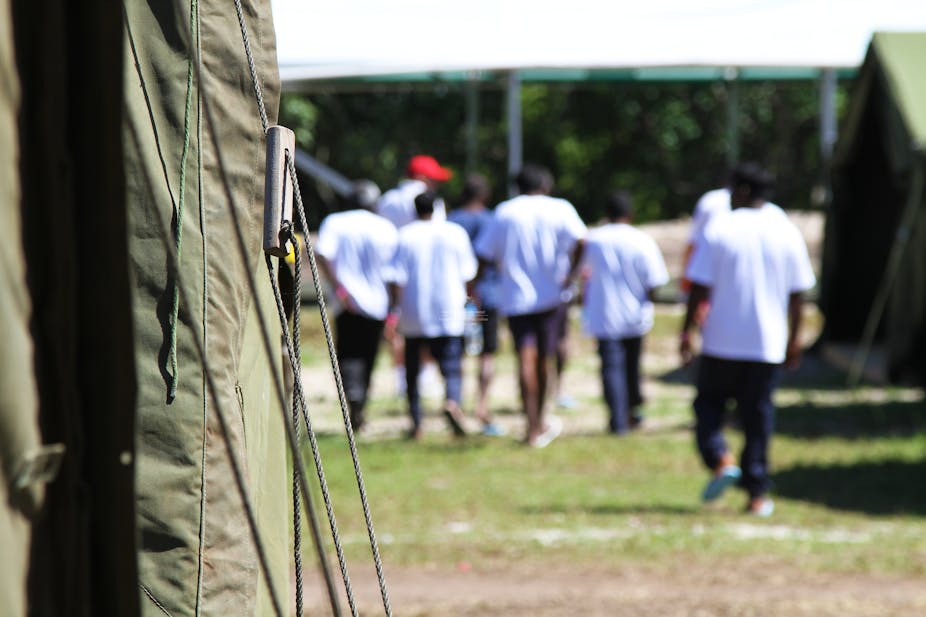
Current immigration policies promote uncertainty, fear and disempowerment, which contribute to mental illness. AAP

The recent overhaul of Australia’s immigration policies aims to protect the lives of asylum seekers by removing any advantage of arriving by boat. Whether this goal will be achieved remains unclear. But while we wait for an answer, we need to consider the toll of Australia’s immigration policies on the mental health of asylum seekers.

In Nauru, where more than 380 asylum seekers are currently being detained, there have been reports of hunger strikes, self-harm, aggression and suicide attempts.

Unfortunately this isn’t new – these signs of psychological distress have been repeatedly witnessed in Australia’s immigration detention centres since the early 1990s.

For several decades now, mental health professionals have documented the psychological health of asylum seekers within mandatory detention facilities. Findings from multiple studies provide clear evidence of deteriorating mental health as a result of indefinite detention, with profound long-term consequences even after community resettlement.

Current immigration policies continue to promote uncertainty, fear and disempowerment among asylum seekers, which are known to contribute to poor mental health. There are also concerns that allowing asylum seekers to live in the community on bridging visas without the right to work could further exacerbate these feelings of helplessness.

Compounding trauma

Asylum seekers are already vulnerable to mental distress before arriving in Australia. Significant exposure to potentially traumatic incidents, including gross human rights violations, persecution, conflict, forced displacement and family separation, are common.

Being detained as part of the process of seeking asylum can actively compound existing mental suffering. Rates of mental health problems such as depression, anxiety, post-traumatic stress disorder (PTSD), suicide and self-harm are much higher among detained asylum seekers compared with compatriots in community settings.

One primary stressor that systematically undermines the mental health of asylum seekers is the pervading sense of uncertainty within mandatory detention. Visa processing times are often unknown, as are visa status outcomes. There is ambiguity about the duration of detention and barriers to family reunification. Asylum seekers also worry about the safety of family members and have doubts about whether they’ll be able to assimilate into the Australian community.

Other stressors that continue to undermine asylum seeker mental health within detention include reduced self-determination and autonomy, and physical and cultural isolation from family, friends and community. These factors, among others, can combine to fuel a pervasive helplessness that is commonly reported by detained asylum seekers.

Ongoing situational stress, such as being in an unfamiliar, poorly resourced environment, as well as living among other distressed individuals, does little to provide the safe and secure environment necessary to support recovery from traumatic stress.

Bridging visas

Bridging visas may be a welcome avenue for some asylum seekers to reside within the Australian community while their refugee applications are processed.

Asylum seekers living in the community commonly present to health services with mental health problems, but research has shown symptoms to be less severe compared with detained asylum seekers.

Bridging visas could impact on the mental health of asylum seekers in a similar way to TPVs. AAP

But critically, some of the key stressors fuelling mental distress in detention will not be addressed by bridging visas. These include uncertainty about the projected five-year waiting period to determine visa status, and powerlessness associated with restricted work and financial support entitlements.

Insights can be drawn from research into the mental health impacts of other restrictive visa policies such as the temporary protection visa (TPVs) program. Research shows TPV holders faced much greater challenges settling into the community than refugees on permanent visas. They were also more worried about their uncertain residency status and reported greater living difficulties.

Over a two-year period, TPV holders demonstrated less English proficiency and were unmotivated to socially engage within their new community, thereby exacerbating isolation. This mix of factors can effectively dampen any hope for convalescence from mental health problems, even while residing in the community.

The concern is that bridging visas could impact on the mental health of asylum seekers in a similar way to TPVs. Additional research is needed to understand the effects of bridging visas on mental health.

Next steps

What can be done to reduce the impact of immigration policies on the mental health of asylum seekers?

The most straight-forward approach is to avoid policies that already have an evidence base of harm, including indefinite mandatory detention and restrictive visas such as TPVs.

New policies need to support asylum seekers to rebuild their psychological health. Within the current policy framework, strategies could be implemented to mitigate the impact of known detrimental factors. Asylum seekers on bridging visas, for example, could be permitted to work. And within detention facilities, asylum seekers could have greater access to legal resources to actively participate in their visa application process.

Ultimately, we need to adopt policies that harmonise immigration and national security priorities with strategies to protect the health and well-being of asylum seekers. This could prevent further damage, facilitate recovery from trauma, and pave the way for the positive integration of refugees into Australian culture and society.

Sign in to Favourite

Want to follow The Conversation?

Sign up to our free newsletter to get the day's top stories in your inbox each morning, with a special wrap on Saturday.

Donate and become a friend of The Conversation

Join the conversation

15 Comments sorted by

  1. Hilde Rombout

    Hilde Rombout is a Friend of The Conversation.

    retired

    Thank you for your article, Belinda. I too share your stress about the treatment of asylum seekers, but i wish i knew what we as a community could do about it. Could we start a protest like we did with the Alan Jones abuse of the PM? I realise it is difficult to change people's perception especially when they are afraid or when they have closed minds. We can not wait and have more deaths on our nation's conscience until the next election. And i certainly do not even want to anticipate how the…

    Read more
    1. Marilyn Shepherd

      pensioner

      In reply to Hilde Rombout

      The preamble to the refugee convention clearly states that states must not use refugees to cause friction between states yet Australia is jailing them all over the Asia Pacific and torturing them here for the sake of racist votes.

      Our MSM are worse than useless, they still refuse to understand or find out what refugee law means and is and they still refuse to understand that RESETTLEMENT IS NOT A RIGHT BUT PROTECTION IS AN ABSOLUTE OBLIGATION.

      Resettlement is the migration of refugees from one country to the other without any legal backing or basis or treaty cover at all.

      report
    2. Linus Bowden

      management consultant

      In reply to Hilde Rombout

      Marilyn, perhaps you might like to read the AUSTRALIAN Constitution? It says, something along the lines of, now let me see, er, 'WE will decide who comes into this country..." and so on and so forth. Happy reading.

      report
    3. Fran Barlow

      teacher

      In reply to Hilde Rombout

      Linus Bowden said:

      "perhaps you might like to read the AUSTRALIAN Constitution? It says, something along the lines of, now let me see, er, 'WE will decide who comes into this country..." "

      Good luck finding that in the Constitution. It was part of a John Howard election speech.

      Thanks for the laugh though.

      report
  2. John Coochey

    Mr

    Belinda. What is your solution?

    report
  3. Hilde Rombout

    Hilde Rombout is a Friend of The Conversation.

    retired

    Marilyn, thank you for your comment, which has not changed for as long as i have seen your posts. I appreciate your concerns, but what do you see as a solution, not what the government must do but what we can actually do right now as ordinary citizens.

    report
    1. Marilyn Shepherd

      pensioner

      In reply to Hilde Rombout

      We could abide by the law Hilde, which is why I don't change what I say.

      WE have no need ever to lock up refugee applicants so DIAC can twiddle their thumbs for years over what amounts to 18 hours work on each case.

      The convention is legally binding, we promised to abide by it so it's not rocket science is it.

      report
  4. James Bush

    primary teacher

    We offer a refuge, a place free from harm, from persecution, from death. Surely that should improve their mental health?

    report
    1. Fran Barlow

      teacher

      In reply to James Bush

      Strictly speaking, as the article points out, we don't. Yes, we aren't threatening to kill them, but we ceratinly are punishing them for their manner of arrival -- in express violation of Article 31.

      Also we are acting contrary to Articles 21-24 on Welfare and IIRC 16 and 17 on work. We are also contrary to the chapter on Admin measures and movement of refugees.

      report
    2. James Bush

      primary teacher

      In reply to James Bush

      Hi Fran,
      Article 31 refers to people "coming directly from a territory where their life or freedom was threatened" This doesn't apply to economic migrants hopping through Indonesia.

      report
    3. Marilyn Shepherd

      pensioner

      In reply to James Bush

      Do you seriously think that years in a concentration camp without proper rights and services is protecting them?

      Who protects them from us?

      report
    4. James Bush

      primary teacher

      In reply to James Bush

      Hi Marilyn,

      I would say that a few years in a safe environment is better than the horrors from which these poor people are escaping. What is your definition of 'proper services'? I am sure that there is an ample supply of shelter, food and water.

      report
  5. Michael Bolan

    Systems practicioner

    Perhaps we need to adopt, or at least consider, policies other than attacking the victim?

    The notion that locking up refugees in inhumane conditions is somehow affecting overseas 'entrepreneurs' that took their money is too fatuous to take seriously. The only 'rationale' for the current system appears to be to satisfy psychopathic tendencies of those in power.

    Australia needs to explore the tendency of its institutions to punish the powerless (e.g. stolen generation, The Intervention, refugee policy etc)

    report
  6. Marilyn Shepherd

    pensioner

    There is no such thing as being punished for hopping through Indonesia as Indonesia does not protect refugees.

    Why do people seem to think that coming direct means that literally when the only people who are able to come direct are the nearest of our neighbours.

    People fly here from all over the world without this same nonsense being spouted and without us punishing them.

    report