


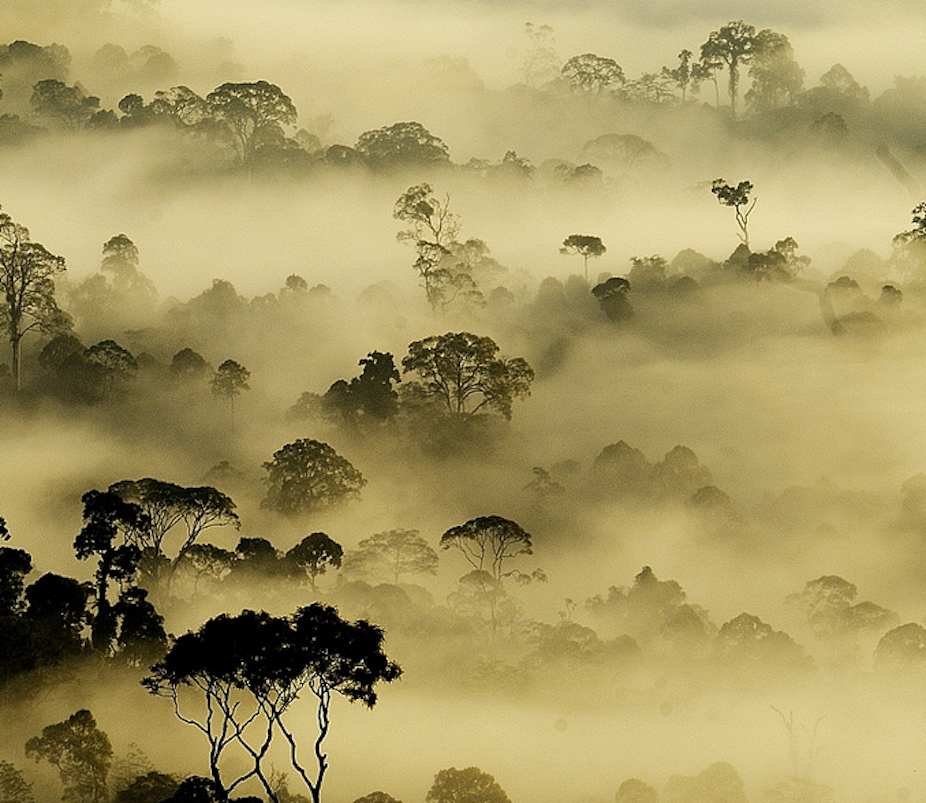
We live in an age of vanishing rainforests. Half of the world’s tropical forests have disappeared since World War II and roughly another 10 million hectares are being felled each year — the equivalent of 40 football fields every minute.
It’s a bit of a no-brainer to say this is bad for biodiversity. After all, rainforests are the biologically richest real estate on the planet, sustaining at least half of all known species of plants and animals in just 7% of the Earth’s land area.
Despite these facts, biologists are far from certain about how many species are imperiled by rainforest destruction. Some believe as many as two-thirds of all species could disappear in the coming century, largely because of tropical deforestation.
Others reckon the figure will be a lot lower — perhaps just 5-10% of all species will eventually disappear.
Why the big difference in these numbers? A key reason is that we’re still unsure about how many species can survive in degraded forests.
Degraded forests come in lots of flavours.
There are selectively logged forests, fragmented forests, forests that are scorched by ground fires, and forests that are overhunted.
In many areas, forests are regenerating after being completely felled or burned. In other areas plantations of exotic species, such as acacia or oil palm trees, are spreading across the landscape.
Degraded forests are the future. All across the tropical world, old-growth rainforests are vanishing and being transformed into human-dominated landscapes. These landscapes might sustain a few isolated patches of old-growth rainforest surrounded by expanses of farmland, human settlements, plantations and degraded forests.
So will most species survive in these wounded landscapes, or just a few?
The debate about species extinctions and degraded forests has polarised the scientific community. A leader of the extinctions-won’t-really-be-that-bad-camp, Joe Wright of the Smithsonian Institution in Panama, has upset a lot of people by arguing that most species will be able to survive in regenerating rainforests.
Some biologists think this is bunk.
At a large international meeting in Darwin a few years ago, one well-known scientist got so upset with Joe that he told him to perform a rude physical act that is technically impossible. Joe was mortified but the audience loved it. They felt Joe wasn’t taking the extinction crisis seriously enough.
This week my colleagues and I jumped into the middle of this debate. We did so by publishing a research paper in the journal Nature today, synthesising 138 different studies around the tropics.
These studies were used to contrast the biodiversity in old-growth forests with that in many different kinds of degraded forests.
In broad terms we found that the old-growth forests won, hands down. For the species we are most concerned about —those most vulnerable to extinction — you just can’t beat an undisturbed rainforest.
There was, however, one kind of degraded forest that fared better than the others: those that have been selectively logged.
In logged forests, bulldozers are used to extract a few large logs per hectare of forest. The bulldozers do quite a lot of damage, but the forest itself largely remains. In logged forests, some disturbance-sensitive species decline in abundance, but only a few vanish altogether.
This means we shouldn’t write off logged rainforests as being unimportant. They’re not pristine, but from a biodiversity perspective they’re a heck of a lot better than farmland, regenerating forest or plantations.
This conclusion has some vital implications.
Earlier this year, the Indonesian government designated a vast area of logged forest – around 35 million hectares, a dozen times the size of Belgium — to be cleared for farmland or exotic tree plantations. They’ve done so because logged forests, they argue, are too badly degraded to be of much importance.
Our findings suggest the Indonesian government is flatly wrong: logged forests have a great deal of biological value. Instead of clearing logged forests, they should be expanding agriculture onto degraded grasslands and abandoned farmlands, which exist in abundance in the country.
Biologists like myself are not anti-development. But we are anti-foolish development. The thing that irks me and others is to see biological travesties still occurring in an era when we should (and do) know better.
The bottom line is that old-growth rainforests are the greatest celebration of life on earth. We should do everything we can to preserve them.
But if we can’t save enough old-growth forest to sustain nature, then selectively logged forests are pretty good as well.