
‘Overmassive’ black hole holds the mass of 17 billion suns

Astronomers have discovered a new, enormous black hole that could change our understanding of how galaxies evolve. Holding the mass of 17 billion suns, the black hole at the centre of the NGC 1277 galaxy may be the largest discovered to date. It is 250 million light-years from the Earth. Most supermassive…

Yxb4v8ds-1354150661
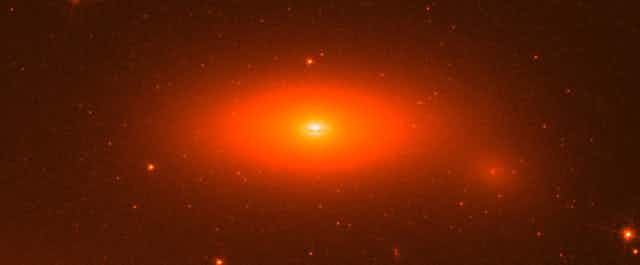
The black hole at the centre of NGC 1277 galaxy is one of the largest ever discovered. NASA /ESA/Andrew C. Fabian/Remco C. E. van den Bosch (MPIA)

Astronomers have discovered a new, enormous black hole that could change our understanding of how galaxies evolve.

Holding the mass of 17 billion suns, the black hole at the centre of the NGC 1277 galaxy may be the largest discovered to date. It is 250 million light-years from the Earth.

Most supermassive black holes are contained within very large galaxies. But the NGC 1277 galaxy is remarkably small compared to the black hole at its centre.

The researchers, who reported their findings in Nature today, say black holes usually take up 0.1% of a galaxy’s “stellar bulge” (the collection of stars at its centre). It’s thought this black hole comprises 59% of its galaxy’s stellar bulge mass, and 14% of the galaxy’s mass overall.
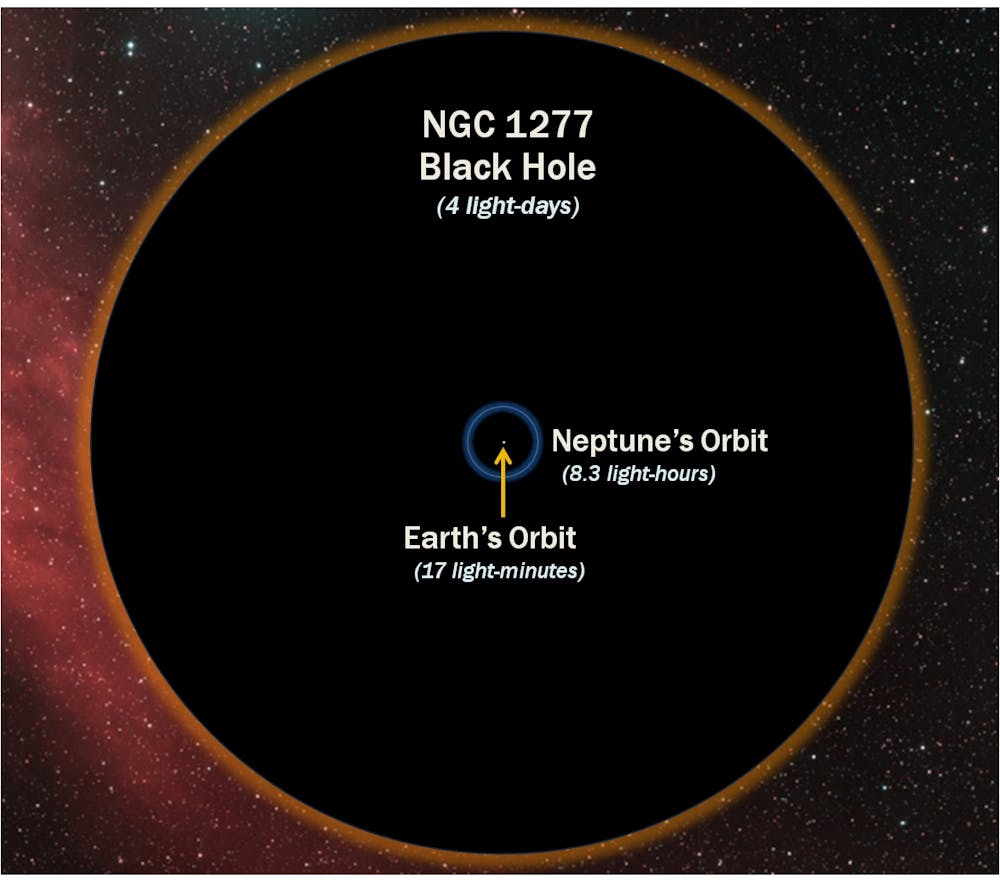
The diameter of the black hole in NGC 1277 compared with the orbit of Neptune. D. Benningfield/K. Gebhardt/StarDate

For this reason, the black hole has been described as “overmassive” rather than simply supermassive.

In its entirety, it is thought to be 11 times wider than Neptune’s orbit of the sun.

“This is a really oddball galaxy,” team member Karl Gebhardt of The University of Texas said in a statement. “It’s almost all black hole.”

“This could be the first object in a new class of galaxy-black hole systems.”

Professor Geraint Lewis, an astrophysicist at the University of Sydney, said the result runs counter to everything we currently know about black holes and galaxies.

“One of the things we’ve found out over the past few decades is that it looks like all galaxies have a black hole in their heart, and there seems to be a relationship between the mass of the galaxy and the mass of the black hole,” he said.

“We’re going to have to scratch our heads a bit now, because this black hole tells us there must either be extreme events that mean they don’t obey that relationship, or there’s something missing here.”

Professor Stuart Wyithe, who won the Physical Scientist of the Year Award last year for his work on galaxy formation, explained how our current understanding of the galaxy-black hole relationship.

“The topic of ongoing research is what the relationship might be, whether the black hole stops stars from forming in the galaxy once it grows to a particular size, and by removing the gas that forms the stars, it also starves,” he said.

“Or it could be that the stars form, the black hole grows, but once the first generation of supernovae form, which have the potential to clean the gas out of the galaxy, again the black hole starves.”

“It’s a chicken and egg situation and we don’t know which one came first.”

Over-massive black hole in compact galaxy NGC1277 from Remco van den Bosch.

Professor Lewis said the discovery will lead to new research into more supermassive black holes.

“We need to see how many more of these extreme mass black holes there are,” he said.

“If they’re very rare, it’s not too much of a problem, but if they start to be more common we’ll have to see if there’s a chunk missing from our understanding of galaxy evolution.”

Sign in to Favourite

Want to follow The Conversation?

Sign up to our free newsletter to get the day's top stories in your inbox each morning, with a special wrap on Saturday.

Spinner
Donate and become a friend of The Conversation

Join the conversation

7 Comments sorted by

  1. George Crisp

    Medical Practitioner

    How many "over-massive" black holes would it take to account for the missing matter ( or gravitational effect ) in the universe? Or would every galaxy have to have one?

    report
    1. Geraint Lewis

      Professor of Astrophysics at University of Sydney

      In reply to George Crisp

      Excellent question, but, while massive, these black holes are still a relatively small mass compared to the total stellar mass in a galaxy (in this case, 11%), and it has to be remembered that there is almost 100 times as much mass in dark matter.

      The only way these could be dark matter is if there are large numbers of them out there, not in the centre of galaxies. But this would be observable, as these black holes would be slicing through the disks of galaxies, basically tearing holes in them and eventually ripping them apart.

      report
    2. Adam Zielinski

      logged in via Facebook

      In reply to George Crisp

      From what I understand, "over-massive" black holes would still not take into account how much extra mass we need to make up... However, I wonder if another alternative would be that there are some galaxies out there that not only have a "over-massive" black hole in them which accounts for 11% of their mass, but where the entire galaxy has been swallowed up into a single black hole? Such galaxies would be hard to find I assume (or am I wrong about that?), and could potentially account for the "dark matter" if there were enough of them, and they were massive enough.

      report
    3. Geraint Lewis

      Professor of Astrophysics at University of Sydney

      In reply to George Crisp

      Actually, if we had black holes with the masses of entire galaxies, then we could still find them via their gravitational lensing effect. They would distort the background Universe with a particular patten which we could detect. We haven't seen anything like this (although, every so often, there is a claim that a dark galaxy has been identified via its lensing effect).

      report
  2. Leslie Shaw

    Retired

    Why is this theory totally rejected by the majority of astronomers and astrophysicists

    Supposed black hole causes a flare in the nucleus of a distant galaxy. Credit: NASA/JPL-Caltech/JHU/STScI/Harvard-Smithsonian CfA

    Problematic black hole physics is in the news again.

    In a recent press release from the Galaxy Evolution Explorer and the Pan-STARRS1 telescope in Hawaii, astronomers announced “direct evidence” for the existence of a supermassive black hole (SMBH) in another galaxy. The high…

    Read more
  3. Comment removed by moderator.

  4. Comment removed by moderator.