
Plain packaging for junk food? Health experts call for govt intervention

Australia should consider a healthy food rebate, tax on sugary drinks, and regulated portion sizes argue health experts, as New York pushes ahead with government regulation to address the obesity epidemic. The New York City health commissioner behind a proposed cap on the container size of sugary soft…

4ybz8d5h-1347933214
New York City’s health board is cracking down on sugary soft drinks, but Australian health experts say more is required to address the obesity epidemic. AAP

Australia should consider a healthy food rebate, tax on sugary drinks, and regulated portion sizes argue health experts, as New York pushes ahead with government regulation to address the obesity epidemic.

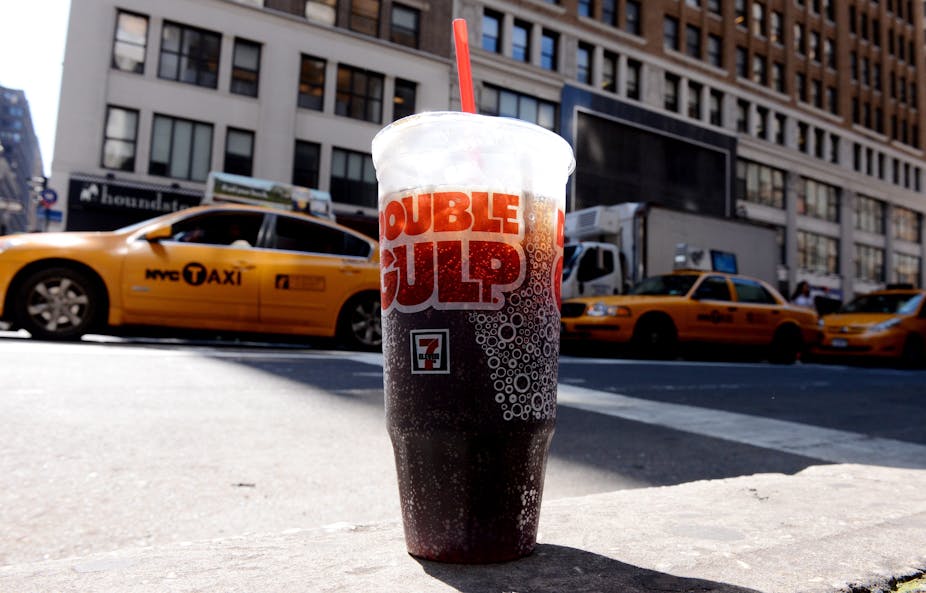
The New York City health commissioner behind a proposed cap on the container size of sugary soft drinks has argued government regulation of portion sizes is justifiable and could help fight America’s obesity problem.

Writing in the latest issue of the Journal of the American Medical Association, Dr Thomas Farley writes governments that do nothing about the marketing of high-calorie sugary drinks are inviting even higher rates of obesity, diabetes and related mortality.

It’s a view shared by Australian health policy experts, who say self-regulation by food groups will never be enough to address the obesity problem. In the US it’s a problem that costs 100,000 lives and $150 billion in health care costs every year.

“What it is necessary to do is to create a neutral environment for consumers, because at the moment we have an environment that is obesity-promoting,” said Bebe Loff, director of the Michael Kirby Centre for Public Health and Human Rights at Monash University.

“We don’t even give people a good sort of chance to combat the environment that’s encouraging them to buy more of these goods.”

The food and drinks industry is using the same tactics as the tobacco and alcohol industry argues Rob Moodie, professor of global health at University of Melbourne.

“There’s no way they’re going to move unless there’s regulation in my view.”

Professor Moodie said saturated advertising to Australia’s children and sponsorship of key sports created a culture where eating junk food and drinking junk drinks was the norm.

“Things won’t change until we get substantial changes to foods that have lower levels of salt, sugar and fat. That probably won’t happen until there’s regulation or the serious threat of regulation,“ Professor Moodie said.

In his article, Dr Farley details the measures taken by New York’s City Board of Health to “regulate food products that harm the most people”.

The measures include banning the use of trans fat in New York restaurants, pushing food companies to reduce the high levels of sodium in food, requiring chain restaurants to post calorie counts on menus, and imposing a 1-cent-per-ounce excise tax on sugary drinks.

The food industry continues to argue against the proposed sugary drinks portion rule, but Dr Farley said the sale of huge portions is driven by the food industry, not by consumer demand.

Kerin O’Dea, professor of population health and nutrition at University of South Australia, agreed.

“Large portion sizes are a great generator of profit. Unless there’s regulation they’re not going to change.”

Professor O’Dea said labelling of menus was critical so people knew how much they were consuming, and could make informed choices.

State governments have started to mandate for calorie counts on menus, applying schemes to fast food restaurants with more than 50 outlets. McDonalds already does this in Australia, and this week moved to do the same across America, catching up on New York where calorie counts on menus have been mandated since 2008.

Professor O’Dea said she’d like to see measures introduced that encourage people to choose a healthy diet.

“We have a diesel fuel rebate for people in the country. I would like us to have a healthy food rebate for people in isolated locations, particularly aboriginal communities… so financially people have an incentive to buy healthy food.”

But Rob Moodie said with more people dying from preventable deaths and huge strains on the health care system affecting both state and federal governments, measures akin to those imposed on the tobacco industry might be required.

“We have a particular problem in Australia with large, well organised and very aggressive junk food and drinks industries. To quote Professor Kelly Brownell from Yale, one of the leading scientists in this area: ‘When the history of the world’s attempt to address obesity is written, the greatest failure may be collaboration with and appeasement of the food industry’.”

Professor Loff said stemming the tide of disciplines dedicated to the marketing of food was a huge ask, but controlling the portion size of sugary drinks was a good start.

She added that it took 60 years, and a decision by the government to ignore its own guidelines for regulating, to see the plain packaging crackdown on the tobacco industry.

“What I would think our government would say in response to something like banning the oversized sweet drink containers is that not only do you have to show that there is this informational problem, or that the harm created outweighs whatever potential benefits there are; you would also have to show the impact that intervention was going to have on dealing with the problem, that is lowering obesity.”

Professor Loff said what’s required is restructure of both our physical and psychological environments to give everyone a fair chance to protect their health.

“I’m not suggesting it be welfare-promoting, but suggesting that it be neutral so we’re not encouraged every time we turn around when walking through a supermarket, and being bombarded with all sorts of imaginative marketing techniques.”

Sign in to Favourite

Want to follow The Conversation?

Sign up to our free newsletter to get the day's top stories in your inbox each morning, with a special wrap on Saturday.

Spinner
Help evidence based journalism become the norm and donate

Join the conversation

27 Comments sorted by

  1. Lincoln Fung

    Economist

    Isn't that idea a step too far?
    Do those experts really want government to decide every commercial packaging?
    Are we becoming a police state in the commercial area?

    report
    1. Chet Mannly

      Artist

      In reply to Lincoln Fung

      "Do those experts really want government to decide every commercial packaging? "

      Yes - as long as those experts are the ones telling the government what to do. Imagine going from an obscure, unknown Academic in Health, to suddenly having the power to dictate what people can eat.

      People are fine with making Australia a police state - provided they are a member of the police...

      report
  2. alexander j watt

    logged in via Twitter

    i wonder what the figures are for premature deaths due to obesity in australia, and how they compare to alcohol/drugs?

    difference with drugs perhaps is that we all indulge in bad eating, so we all understand it, whereas one is either e.g. a smoker or one isn't. Also there are no third party effects (road accidents, passive smoking) just medical costs.

    however an insidious effect of eating poor quality food is that it 'displaces' the healthy option. so in a sense, food of no nutritive value (but not actually unhealthy) is bad to the extent that it replaces healthy food and leads to malnutrition. This affects particularly low income people who can only afford cheap junk food, as of course cheap or absent ingredients are by definition cheaper.

    there are still some things we need to know - for instance, we know it's unhealthy, but to what extent is sugar/salt/fat actually addictive?

    report
  3. Andrew C

    Manager

    When the politicians and social nannies are required to use plain packaging on their advertisements, and provide verified factual details 'on the packet' then I will support this.

    Pollies can't even get their costings right, why hold everyone else to standard they themselves refuse to meet?

    report
  4. Steve Brown

    logged in via email @yahoo.com.au

    "Australia should consider a healthy food rebate, tax on sugary drinks"

    Evidence sugar is killing us, please.

    Unlike with cigarettes, there is broad disagreement about what constitutes a 'health food'. That means any government intervention is going to result in one group of people forcing their views onto another group. No thanks.

    The track record of government intervention in this area of health has been absolutely disastrous. Recent advice to not eat all the foods which were staples for people for thousands of years (eg butter, red meat, eggs, coconut oil, full fat dairy) prior to the obesity/heart disease/diabetes epidemic and instead eat a bunch of recently developed industrial concoctions.

    These people can't be trusted with our health.

    report
    1. Steve Brown

      logged in via email @yahoo.com.au

      In reply to Steve Brown

      I should have added sugar to that list of things we were enjoying before the current epidemic of ill health.

      I'd expect any article proposing government intervention on packaging (or a tax like others are proposing) to supply us with some evidence when it makes a claim against a certain food.

      A website written by academics should be the last place anybody should be permitted to level accusations without providing the accompanying science to support it.

      Recitation of dogma does nothing to help the debate and educate the public about good choices.

      report
    2. David Arthur

      n/a

      In reply to Steve Brown

      Revenue from a sugar consumption tax could fund a National Dental Scheme (which should necessarily include education of dentists and associated professions).

      report
  5. George Naumovski

    Online Political Activist

    Junk food is cheap and easy! You don’t have to prepare it, it comes in packages ready to eat and people are addicted to it.

    We have McDonalds/Hungry jacks open 24/7 but no health or fresh food shops opened or easily available!

    To what point can you tax a drink or a packet of chips? What needs to happen is to make fresh vegetables, fruits, fish, cheap and easy to get 24/7.

    report
    1. Ken Swanson

      Geologist

      In reply to George Naumovski

      And what is junk food George. Please define it?
      When I look at a Big Mac what I see is:
      Beef Patties made by Birds Eye which are available in packaged form in the freezer of supermarket
      Bun from Goodman Fielder which can be bought in packs of 6 at the same supermarket
      Tomato Sauce from Kraft from the same place
      Dill pickle and sliced lettuce from the fruit and vegetable section of the same supermarket
      Vegetable oil used in cooking from same supermarket also
      Cardboard box which is less packaging than any of the cardboard boxes for the ingredients mentioned
      Are you saying all these ingredients are bad for you and need to be banned from supermarkets also?
      Again I ask, define "junk food".

      report
  6. Simon Chapman

    Professor of Public Health at University of Sydney

    The headline on this piece is highly misleading: no expert reported said anything about plain packaging of food,

    report
    1. Ken Swanson

      Geologist

      In reply to Simon Chapman

      What it is necessary to do is to create a neutral environment for consumers, because at the moment we have an environment that is obesity-promoting,” said Bebe Loff, director of the Michael Kirby Centre for Public Health and Human Rights at Monash University.

      Simon
      What would you call a neutral environment? I would call it a market devoid of package differentiation; a market devoid of marketing communication (advertisments and other promotion) which is the vehicle for differentiation; standardised product formulation so that every product can be directly compared to another like product (like comparing apples in a green grocer); which would mean that pricing was the same because there was no differentiation. That is a "neutral environment".
      It is also the basis of private enterprise and the consumer society we have lived with as a first world nation over the past 100 plus years.

      report
    2. Chet Mannly

      Artist

      In reply to Simon Chapman

      Good pick up, I hadn't read the original article.

      Too late to get it changed to reflect that the plain packaging is the article author's idea?

      report
  7. Radar Insight

    logged in via Twitter

    I believe there is an education problem here in conjunction with the food companies preying on vulnerable consumers. Some government intervention is required, but I don't think a tax is the answer.

    After-all, food doesn't make people fat, people make people fat.

    Applying a tax will only serve to further hike up food prices without targeting the real problem - people's uncontrollable desire to overindulge.
    I'd more likely to support food packages to have warnings on the packs such as: Run for 45 minutes to work off this chocolate milk, or off putting pictures of people who are morbidly obese. It worked for smoking...

    report
  8. Bruce Tabor

    Research Scientist at CSIRO

    Seems to me restricting advertising of junk food - in particular banning advertising of junk food on TV during children's programs - is the first step in addressing the obesity epidemic. The control of advertising was the first step in tobacco control.

    Also I wish we'd stop using the oxymoron "self-regulation". You either have regulation or you don't. Regulation implies an external authority with the power to enforce rules. "Self-regulation" is spin to hide the absence of regulation.

    These are of course my views as a private citizen, not necessarily those of my employer.

    report
    1. Ken Swanson

      Geologist

      In reply to Bruce Tabor

      Junk food would be? Maybe:
      Ice Cream
      Confectionary
      Beer
      Sausages in white bread
      Breakfast cereals like Coco Pops and Just Right
      White bread
      Butter
      Full cream milk
      Full strength orange juice
      Coffee
      Cheese of almost any kind and the crackers you eat them with
      Donuts and cakes from the local bakery
      Meat pies
      Cordial and any fizzy soft drink
      Any chocolate biscuits
      Fish and chips from the local fish monger
      Salt
      Sugar I put in my tea and which we use to make homemade cakes
      Pizza from my local pizzeria
      All these foods are the same as you get from McDonalds, KFC, Red Rooster, Pizza Hut, Subway, Hungry Jacks when you strip it down to their core ingredients, which is what you should do to be objective. If we ban one, we should I suppose ban them all. I hope this whole discussion does not boil down to an inbred hatred of all things corporate and all things American.
      I wonder?

      report
    2. Ken Swanson

      Geologist

      In reply to Ken Swanson

      Oh I forgot a few:
      Jam
      Roast Pork with crackling
      Potato chips
      Corn chips and that salsa I put on them
      Fruit Chutney
      Custard and the apple pie I eat it with
      Cream
      Goodness knows if I eat too much of all this stuff I will get fat and cost the health system a fortune. Oh, that's right, I already do, its called living in a first world country in the 21st century. And after all that I did not even get to the fast food/ junk food store which of course is the cause of the problem really as we all know.

      report
    3. Ken Swanson

      Geologist

      In reply to Ken Swanson

      Just got home from the bottle shop.
      Walked through the local pub which was serving beers in pints and margaritas in a bowl which saved the uni students money because each had a straw.
      They were serving counter meals of veal parmigiana with fries, steak with fries and spicy sauce, fried fish and chips, and worst of all fried dim sims.
      This is exactly the place which needs to be closed down or at the very least be banned from advertising and sponsoring anything in our society. In fact, the Royal Children's Hospital should not be accepting donations from them. This would be a statement of principle at least (symbols and tokenism matter in these things).
      Like the "junk food" outlets I suppose these places will have to go as well.

      report
    4. Chet Mannly

      Artist

      In reply to Bruce Tabor

      "Also I wish we'd stop using the oxymoron "self-regulation". You either have regulation or you don't. Regulation implies an external authority"

      You mean like Food Standards Australia & New Zealand, which regulate the packaging and labeling of food? ACCC and others covering advertising standards, marketing, and contract law?

      I agree we should stop using that term, because this industry isn't self-regulated.

      report
  9. Tracy Heiss

    logged in via Facebook

    I doubt there's a child or adult in this country who isn't aware, through education, of healthy food choices. I fully advocate continuing education. I respect the intent behind the idea of regulation, but it would cause a minefield of controversy from industry, libertarians and everybody with concerns about free choice.I believe there would ensue further division in our society. For instance, will people who purchase fast food begin to feel like outcasts? Woud this create an 'us vs them' mentality…

    Read more
    1. Simon Chapman

      Professor of Public Health at University of Sydney

      In reply to Tracy Heiss

      Tracy - -you may recall that cigarettes used to display tar, nicotine & CO levels. These were outlawed several years ago when the ACCC investigated them, what they meant and whether they provided misleading information to consumers. The ACCC banned their use because the numbers were machine obtained yields under standard puff parameters. It has long been known that people do not smoke like machines and that there is virtually no correspondence between what the numbers on the pack said and what smokers actually drew out of cigarettes. The ACCC declared that they were therefore misleading and likely to falsely reassure smokers that they were using products which delivered reduced levels of those three components. Smokers alter their smoking behaviour (puff frequency, depth, butt length, number smoked) to get what their nicotine receptors "demand".

      report
    2. Tracy Heiss

      logged in via Facebook

      In reply to Simon Chapman

      Thanks Simon. I would still prefer to know what the tar and nicotine content is, especially when they go plain. Why doesn't the government just regulate a consistent lower tar content? That way, when the packaging gives us no clues by colour coding, I don't have to guess whether I'm buying 16mg or 4. Or is the government going to do that?

      Incidentally, how was it known how smokers actually smoke? I smoke the same way whether it is high or lower; I just feel worse when it's the higher one. Obviously, I'd be better off not smoking at all, hover I still feel resentful that I can't choose.

      report
    3. In reply to Tracy Heiss

      Comment removed by moderator.

  10. Comment removed by moderator.

  11. Maria Murphy

    logged in via Facebook

    I don't think we're really at the stage of needing plain packaging of food in Australia - and who ever asked for that anyway??? A great start would be to regulate the advertising of junk food to children and to have an easier system in supermarkets for consumers to assess the healthiness (or unhealthiness) of food items. For those of you asking for precision in defining a "junk" food........it is not a precise science. I think it's fair to say that food items lie on a continuum and the appropriateness…

    Read more
  12. Chet Mannly

    Artist

    "being bombarded with all sorts of imaginative marketing techniques."

    Is it just on the Conversation that people have such amazing levels of faith in marketing? Marketing can increase awareness of a brand or product, but the population doesn't turn into burger-eating zombies every time a Maccas ad comes on TV.

    Sooner or later you'll have to acknowledge that fast food companies have spent billions figuring out what people actually like (which is obviously different to your opinion of what's best for them), and are actually doing a good job of giving their customers what they want.

    If healthy food companies did as good a job then they'd be a lot more popular and you'd see a change in eating habits. If your opinion is correct, we have 2 products here - 1 which saves your life, one which kills you - surely that is the easiest sell in history?

    report