
Plane trees getting on your nose? The truth about hay fever

Spring brings with it hay fever and red eyes for many inner-city residents and in absence of fields of flowering grasses, people turn their attention to other possible causes. The most suspicious candidate, with its new leaves and flower buds, is the London plane tree. Plane trees are commonly planted…

2yrn7fnt-1346637711
There are numerous allergic causes of hayfever symptoms in cities, including grasses in local parks. Mislav Marohnić

Spring brings with it hay fever and red eyes for many inner-city residents and in absence of fields of flowering grasses, people turn their attention to other possible causes. The most suspicious candidate, with its new leaves and flower buds, is the London plane tree.

Plane trees are commonly planted along the pavements and parklands in the inner-city areas of several Australian and European cities. They are popular with town planners as they are deciduous, pollution-tolerant, quick-growing and well-shaped. They provide welcome shade in summer, reduce the urban heat-island effect, improve local ambience, and even add a European touch to Australian cities.

But plane trees are also blamed by residents for provoking nasal, throat and eye symptoms. In Sydney, this led to the “No more plane-trees” action group whose aim was to raise awareness and lobby councils to substitute new planting with less irritating species. The issue became politicised between residents and councils, and was fuelled by the fact that accurate and locally-relevant information on the health risks posed by plane trees is scarce.

The airborne fine spiky ‘hairs’ visible as a white film on the back of plane tree leaves may be causing the hay fever symptoms. the weed one

Indeed, it’s not known to what extent people have a true allergy to plane tree pollen and whether the airborne fine spiky “hairs” (called trichomes) from the back of the leaves contribute to the symptoms. So our respiratory research group decided to examine airborne pollen exposure in inner Sydney and its relationship to symptoms to find out.

The experiment

We set up public booths at markets in the inner-city suburbs of Kings Cross and Paddington and recruited 64 local residents who attributed their spring symptoms to plane trees.

All the subjects were tested for allergies to a range of pollens, including plane tree, as well as fungi and indoor allergens, such as dust mites and cats. And they all agreed to keep a written diary of symptoms.

During the period July 2006 to April 2007, we located air-sampling devices on the roofs of three buildings to collect a continuous record of airborne pollens in the area of the residences. These samples were examined for pollens, fungi and other airborne plant fibres, which were identified and counted.

Residents were also supplied with small sampling devices to be worn in the nose to collect what they inhaled, and instructed to wear these in the street for half an hour on occasions when they thought they were getting symptom-causing exposure.

What we found

Of the 64 people tested, we found that 86% of the subjects were allergic to something (mites, cats or pollens, for instance). Two-thirds were allergic to one of the pollens tested (including 56% to ryegrass and 41% to Bermuda grass), but only about a quarter were allergic to plane trees. All those allergic to plane trees were also allergic to grasses. And seven of the 64 (12%) were not allergic to anything.
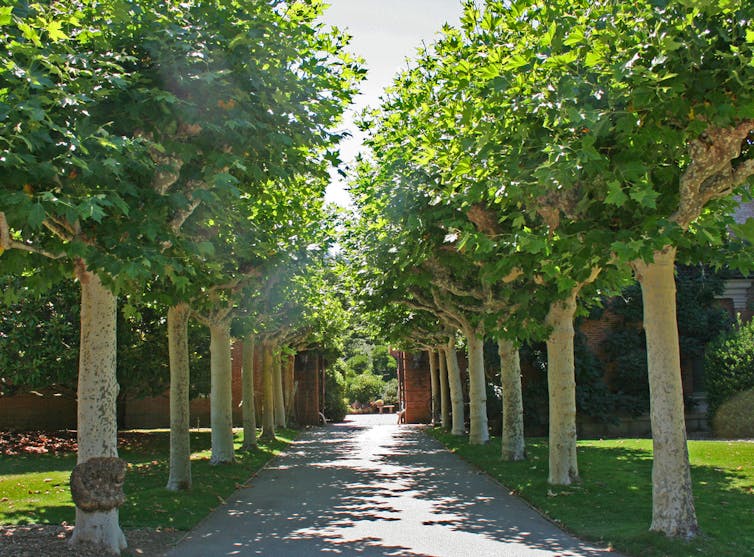
Plane trees add a European touch to Australia cities. Jill Clardy

The relatively low rate of plane tree allergy was surprising, particularly when we found that plane tree pollen accounted for about three-quarters of the total pollen over this time. The season for plane tree pollen was intense but short, starting in September with decreasing amounts through to November.

Pollens from plants other than plane trees also started in September, but continued at a lower rate right through to April the following year. The trichome fibres from plane trees started in October and persisted through to December.

The pattern of reported symptoms occurred over a longer timeframe than the plane tree pollen season and was weakly related to the total period when plane tree and other pollens, and plane tree trichomes were all present in the air. The individual effects of each of these could not be distinguished, despite additional analyses in which subjects were divided into groups based on different pollen allergies.

Only eight people used the nasal samplers and when these were analysed, the most frequent particles were trichomes, followed by plane tree and grass pollens. But such a sample is much too small to draw any conclusions from.

It’s difficult to work out exactly what pollens people are allergic to. jessamyn west

There’s also anecdotal evidence from arborists and from our experience in conducting the study that supports the irritant effect of the trichomes for throat and eye symptoms. Such irritation might also explain symptoms in the few non-allergic and the non-plane tree allergic subjects in the study. But better establishing this role would require more research under controlled conditions.

Other factors

We weren’t able to clearly establish a primary role for plane tree pollen allergies in generating eye, nasal and throat symptoms in inner city-residents. The symptoms occurred over longer timeframes than plane tree pollen exposure, and non-plane tree allergies were more than twice as common. So we suspect that other pollens also contribute to allergic symptoms, and that the tiny, spiky protective fibres derived from the leaves of plane trees probably play a non-allergic, irritant role in a range of symptoms too.

There were limitations in our study such as the variability in exposure – some residents have large plane trees literally on their doorstep, while we measured our exposure on the roofs of buildings hundreds of metres away.

So do plane trees cause hay fever symptoms? The answer is a guarded yes – particularly in September, among people with allergies. It’s also likely but unproven that plane tree leaf trichomes cause a range of irritant effects in a wider population and for longer. And there are clearly other allergic causes of symptoms in the inner city as well. Their sources include other tree species, and grasses in local parks.

Even though we weren’t able to find a definitive link between hay fever and plane trees, this new awareness may not be in vain. Our understanding is that local councils are moving towards planting a range of other, less allergenic exotic and indigenous trees in streetscapes, so perhaps change is in the air after all.

Sign in to Favourite

Want to follow The Conversation?

Sign up to our free newsletter to get the day's top stories in your inbox each morning, with a special wrap on Saturday.

Spinner
Help us have better conversations — donate

Join the conversation

28 Comments sorted by

  1. Gavin Moodie

    Principal Policy Adviser

    Thanx for this most informative report.

    report
  2. Anthony Kaye

    Retired Vet. Surgeon

    My son studies at Imperial College, London. He (and occasionally I) spend time drinking in the quad outside the bar- a quad stuffed with plane trees. I have no known allergies or hypersensitivities, but am delighted to know what gets up our noses and makes us sneeze like mad in spring are called trichomes.

    report
  3. Ian Donald Lowe

    Seeker of Truth

    Plane trees are not only pollution tolerant, they are pollution absorbent. The trichomes and bark trap particulates from the air and when the leaves and bark are shed the pollutants are still in/on the leaves and bark. I suffer quite a bit from hayfever and there are many things that can set off an episode. Perhaps Plane trees are one cause but there are many many others. Pollen is the most common cause of hayfever, followed by dander and certain chemical substances that may be in the air. Personally…

    Read more
  4. Brad Stringer

    logged in via Facebook

    Can you also explain why the various forms of antihistamine that I am taking have stopped working for me? There is something on my back deck that is driving me crazy at the moment! **sniffs**

    report
  5. lavinia kay moore

    child and family counsellor

    I know that plant induced allergies are an inconvenience for most of us and a real problem for some.
    But maybe those who want to ostracise London Plane trees should think very carefully about replacing them with some Australian native trees/shrubs, some of which are the worst hayfever inducers that exist!
    For example some of the large acacias- bailyeana( that is probably not spelled correctly!) for example is definitely troublesome.
    But i have them near my home and I just put up with it and instead focus on the beauty of their golden aura every late winter/early spring.

    report
  6. Sue Ieraci

    Public hospital clinician

    Thanks for the article. The plane tree myth is a great example of "correlation does not equal causation". The same goes for wattle - the bright yellow flowers are highly visible, but their timing coincides with other highly allergenic grasses that are not so easily visible.

    It's also interesting to note that this article coincides with a time of year when a lot of eastern Australia has warm high winds (westerlies) - which bring airborne allergens from inland areas.

    Finally, it is interesting to note that, while airborne industrial pollutants and smoke are often measured and thought to be correlated with various symptoms, it is generally "natural" allergens like house dust mite and various grass pollens that are more culpable. Even the "natives" can be severe contact allergens - some grevillea species being a good example.

    Allergy testing is a good way to distinguish which particular allergens are actually the cause of our symtoms, rather than just temporal associations.

    report
    1. Andrew Roberts

      Manager

      In reply to Sue Ieraci

      "plane tree myth" ????

      Did you even bother reading the article? Or perhaps your too fixated on ignoring fact and confirming your own opinion that hayfever symptoms from plane trees dont exist because you're not impacted by them.

      Just to recap from the article:

      - "a quarter [of subjects] were allergic to plane trees"
      - "...plane tree pollen accounted for about three-quarters of the total pollen over this time"
      '- "So do plane trees cause hay fever symptoms? ...yes "

      Sounds pretty…

      Read more
    2. Sue Ieraci

      Public hospital clinician

      In reply to Andrew Roberts

      Wow - way to go with all those ????

      Not only did I read the article, but I have also heard about this and other studies in more detail.

      The "myth" part is that the most visible flowering trees - like plane trees and wattle - are the cause of a lot of people's hay fever when, for many people, they are not the actual allergen but are temporily related to the presence of other airborn allergens - commonly grasses.

      The study showed that some of the people who thought they were allergic to plane trees where not (while others were) - proving that people focused on the most visible airborne particles when some people had different allergens.

      What;s to misunderstand?

      report
  7. Peter Ormonde

    Peter Ormonde is a Friend of The Conversation.

    Farmer

    Nice little study.

    Being blessed by a brutish insensitivity to such things as allergens my dislike in and indeed distrust of plane trees comes from a different angle.

    The local government enthusiasm for them stems from the fact that they are cheap. One breaks off a stick, shoves it in a pot and it's away, growing at a rate of knots. So they are genetically identical - all clones. Just waiting for a virus to take the lot out. Asking for trouble that sort of thing.

    I also have a hunch…

    Read more
    1. lavinia kay moore

      child and family counsellor

      In reply to Peter Ormonde

      I agree with you Peter in that I dont favour monochromatic landscapes. And my comment about the acacias is what others moan about. I love them! As I love most of the trees and shrubs that grow around where I live in the beautiful Adelaide Hills.
      But I dont like the politically correct one way thinking which wants to ban all non-indigenous plants. As some have already said when monocultures are attacked by disease the results can be disastrous, and I for one would not like the oaks of the world, or the Eucalypts, to be wiped out simply because politically correct mafia in all countries decided that they should not have exotix plants in their lands.
      On our lovely but increasinngly overpopulated (by humans) planet, they all help us breathe, albeit with a sneeze or two on the way. And that is a small price to pay, at least it is for me.

      report
    2. Peter Ormonde

      Peter Ormonde is a Friend of The Conversation.

      Farmer

      In reply to lavinia kay moore

      Mornin' Ms Lavinia - lovely name...

      Yes you're right of course ... exotics are OK - it's a matter of scale and impact.

      Actually we';re probably the major source of invasive species world-wide ... they didn't call it Botany Bay for nothing after all. Here's some instances:

      The US Army's Corps of Engineers did a bit of work - well quite a lot of work -draining and making Florida. Part of this involved shovelling tonnes of melaleauca seed out of the back of low flying aeroplanes. The…

      Read more
    3. lavinia kay moore

      child and family counsellor

      In reply to Peter Ormonde

      Peter, I agree totally with your comments.... moderation and careful awareness about feral plants going feral.
      I recall on a visit to california long ago that Eucalypts had done exactly that. It was very plain to see.
      In kenya eucalyptus viminalis have become a problem. Its much the same here with south African varieties of many sorts. Without their usual opposition/predators they take off at an enormous rate!
      My garden in full of birds and I treasure their presence there, and have banned dogs and cats for their benefit. The rosellas pinch my apples but they are a delight with their teenage enthusiam for life! And i would not be without magpies- the latest baby was heard for the first time Wednesday this week- or the honey eaters etc etc.

      report
    4. Michael James

      Research scientist

      In reply to Peter Ormonde

      PO wrote: "So they are genetically identical - all clones. Just waiting for a virus to take the lot out. Asking for trouble that sort of thing."

      I am not sure they are clones (from 18th century, possible I suppose?) but of course it is exactly what is happening to the 42,000 200-year old plane trees that border and shelter the Canal du Midi in southern France. They are being attacked by a fungus and are dying. A program of cutting them down has begun and replacing with resistant varieties.

      I cannot remember if the reason is fully understood (fungus brought in from elsewhere) but the increasing droughts in France have also stressed the trees since the 90s (so yes, we can blame global warming!). This is a tragedy beyond reckoning.

      I'll post separately a literary extract about "the massive annual dump of leaves and trichomes", also from the canal zone.

      report
    5. Michael James

      Research scientist

      In reply to Peter Ormonde

      From Bill & Laurel Cooper's book A Spell in Wild France. They are retired Brits who spent a few years on their boat at Aigues-Mortes which is on the Canal du Rhone a Sete (links the terminus of the Canal du Midi at Sete to the Rhone river at Beaucaire, just downriver from Avignon):

      "Market day Mistral under the ramparts of Aigues-Mortes" For there is more to it than wind, at this time of year. The plane trees that would bring a welcome shade to the market in the sweltering days of July were showering…

      Read more
  8. John Ooi

    Retired

    I am totally ignorant of plane trees or other plants other than looking at them.
    I like to thank Euon Tovey and all the comments here. How delightful!

    May all be well and have a prosperous life.

    report
  9. Dianna Arthur

    Dianna Arthur is a Friend of The Conversation.

    Environmentalist

    First off:
    Thanks to Peter Ormonde for his beautiful prose - a delight to read.

    Now, I get hayfever practically all year round. So far, however, so good. Maybe because where I live, Plane Trees are few, but Acacias abound so dunno why I am not suffering yet.

    Plane trees were a topic of contention way back in the 80's when I was studying Landscape Architecture - and still the debate rages.

    Don't really like them myself. However they are highly resistant to pollution and have a straight upright…

    Read more
    1. Michael James

      Research scientist

      In reply to Dianna Arthur

      I love plane trees but mostly because I associate them with gracious avenues and boulevardes of well-designed cities, mostly in France, especially Paris where I lived for years. But also Asian cities that benefited from French town planning (notably Hanoi and a few Chinese ones, I think Nanning is famous for their shaded avenues). I don't know if Australian natives can really substitute. What does Buenos Aires use?

      Anyway I think the annual "snow" and leaf shedding is inseparable. In France it is a part of the changing of the seasons. At certain times of the year (towards the end of winter I think?) there are big teams of men pruning the trees. Parisian streets are swept regularly anyway so I am not sure the leaf or blossom fall is an especial problem.

      report
    2. Dianna Arthur

      Dianna Arthur is a Friend of The Conversation.

      Environmentalist

      In reply to Michael James

      @ Michael James

      "I don't know if Australian natives can really substitute."

      For a start this is Australia, not Hanoi or Paris.

      If you fail to appreciate the splendour of a flowering gum, its roughly doomed canopy coated in either snowy white or blood red blooms, a stately straight salmon coloured trunk, large glossy deep green leaves in favour of the pallid plane tree, then that is your choice.

      report
    3. Michael James

      Research scientist

      In reply to Dianna Arthur

      By "substitute" I did not mean substitute for kindling my nostalgia but more practical matters. There are a lot more issues for a city/street shade tree. And obviously there is a reason (a whole series of reasons) why plane trees have been used by the Brits, French and everyone else. Interesting that even in the sub-tropics like Hanoi etc planes trees also work well.

      So the question is whether there are any natives that would perform the same function (without pest problems, without bat infestations…

      Read more
  10. Michael James

    Research scientist

    I developed terrible allergies in my youth. It was initially provoked I believe by jasmine which was growing over a fence in huge profusion. When I lived in the UK obviously that was less of a problem and the bigger issue was grass spores. Then when I moved to Paris I was relatively clear for the first few years but then something else really got me; certainly it coincided with plane trees blooming but of course lots of things bloom at the same time (and though I was in Paris I worked in a big hospital…

    Read more
    1. Sue Ieraci

      Public hospital clinician

      In reply to Michael James

      Michael James - Hay fever (allergic rhinitis) is an example of Type 1 hypersensitivity, in the same group as allergic asthma and anaphylaxis.

      Type 1 hypersensitivity relies on an initial exposure to the antigen. In repeated exposure, the antigen binds to IgE and tirggers mast cell degranulation (after the mast cells have been primed with IgE by the initial allergen exposure.). The mast cells release inflammatory mediators, which cause teh manifestations of an "allergic response".

      I haven't seen any evidence that "breaking the annual cycle" has any effect on the hypersenitivity reaction. The corticosteroids inhibit the release of inflammatory mediators, including prostaglandins.

      report
    2. Michael James

      Research scientist

      In reply to Sue Ieraci

      I knew an immunologist would stomp all over me. (I'm a molecular-geneticist/biochemist but several decades since I gave up trying to follow the utterly arcane details of immunology).

      The thing is some people do grow out of their allergies. In my case I am persuaded it happened only because I suppressed reaction each year with those nasal corticosteroids. Unless the original antigen-stimulated cells disappear then it is hard to explain how the whole thing just disappears, especially if antigen…

      Read more
    3. Sue Ieraci

      Public hospital clinician

      In reply to Michael James

      Michael James - one of the keys to understanding clinical immunology is to also understand the other clinical sciences - anatomy, pathology, physiology, pharmacology - because they are all linked.

      Rather than inventing new theories, it might be useful to see whether your dilemma has already been answered - why do some people "grow out of their allergies"?

      There are many examples of this. Classically, children almost always outgrow egg allergy. Asthma is much more common in childhood (also a type 1 hypersensitivity if it is the allergic type). There is good evidence that IgE-mediated Type 1 hypersensitivity diminishes with age. There is associated evidence that IgE production diminishes with age. Here is a good review:
      http://www.immunityageing.com/content/2/1/9

      I am always puzzled when people stick to their own theories despite the evidence. Michael - don't you find it frustrating if people expound their own theories in your own areas of expertise?

      report
    4. Michael James

      Research scientist

      In reply to Sue Ieraci

      Sue, perhaps my tone was poorly judged or executed but I was not entirely serious. On the other hand, while in fact I did say that my ageing during the period of my loss of my allergies was probably a factor, the dramatic loss over just a few years--while the environment remained as allergenically hostile as ever--and that it perfectly coincided with the use of the nasal spray, indicated to me that the strategic use of the corticoid steroids was pivotal.

      Oh, and ok I must admit to a certain robust…

      Read more
    5. Sue Ieraci

      Public hospital clinician

      In reply to Michael James

      Michael - you seem to be confusing the products of immunological therapy (vaccination) with an understanding of the mechanisms of clinical immunology.

      Anti-histamines and steroids act on the inflammatory mediators, once released. In a sense, they represent symptomatic treatment.

      You might want to read about desensitisation or immunotherapy , which has been found to be both more effective and more cost-effective than either steroids or anti-histamines.

      report
    6. Dianna Arthur

      Dianna Arthur is a Friend of The Conversation.

      Environmentalist

      In reply to Sue Ieraci

      Sue

      I am one of those for whom the desensitising program did not work. After the skin tests had been examined, the doctor concluded I was allergic to the usual suspects like pollen but not to other substances like chemicals. I had red swellings on the "pollen" arm and none on the "chemical and other stuff" arm.

      10 minutes later I was waiting for a tram and both my arms swelled into sausage balloons, it was also one of those windy spring days. I went back to the doctor - he stated that this was not a problem, because I did not react within the time period given to the irritant test!

      I was on only my third desensitising treatment, when I had an anaphylaxis response and had to be rushed to hospital for a shot of adrenalin.

      I stick to using a preventative inhalant these days, as I swiftly become immune to tablet forms of anti-histamines.

      And I think you know where the medical profession can shove their desensitising programs.

      report
    7. Sue Ieraci

      Public hospital clinician

      In reply to Dianna Arthur

      Dianna - it's a pity you didn't benefit from desensitisation, but many people do. Here is one of many many references from the major journal Paediatrics:
      The Safety of Sublingual Immunotherapy With One or Multiple Pollen Allergens in Children

      I don't think anyone has claimed 100% sucess for any medical treatment - that's how life works - but there is definitely benefit for many people.

      report