
Plastic, like diamonds, is forever: time to use fewer bags

Between 30 million and 50 million plastic bags enter the environment as litter in Australia each year. These environmentally damaging bags – produced to be used once and then thrown away – are a symbol of our disposable society. When future generations reflect on our convenience-maximising consumer…

Rtcnh66c-1343194905
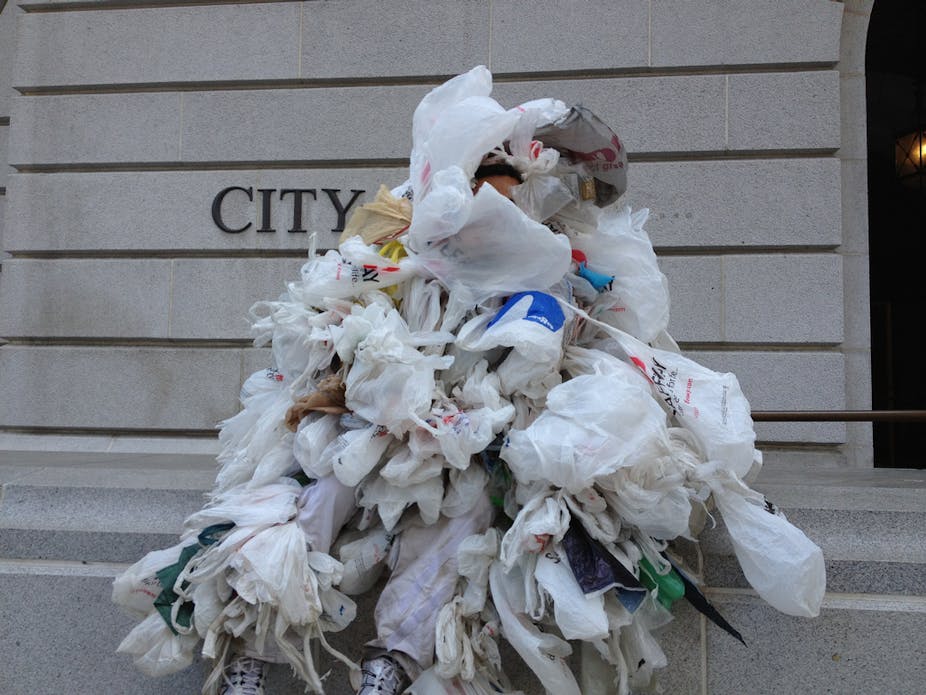
World of bag people: a million a minute are used globally, with Australians churning through almost one a day on average. Flickr/Heal the Bay

Between 30 million and 50 million plastic bags enter the environment as litter in Australia each year.

These environmentally damaging bags – produced to be used once and then thrown away – are a symbol of our disposable society. When future generations reflect on our convenience-maximising consumer behaviour, the permanence of disfigured, shredded, flying white flowers (A.K.A. plastic bags) will testify to a discard culture and dispose culture in the name of brief convenience. Like a globally pervasive cancer, plastic bags everywhere entangle, drown, asphyxiate, and starve animals that mistake their wavy, sun-struck allure for food. Bags adorn trees and fences, becoming the new indestructible urban weed. A colony of bags visible from space (it is 15 million square kilometres!) has accrued in the Pacific, an enormous soup of tiny plastic nodules.

We know the bags do untold damage, but we only act on what costs us directly

Most of us are aware that plastic bags create litter, kill wild life, clog drains, inflicting wounds on wild and inhabited environs alike. But unfortunately, awareness of the peril of plastic has not changed behaviour at the check-out; if offered bags at no additional cost or inconvenience, most consumers will, without a second thought, allow their groceries or takeaway to be packed into lightweight 35-micron-thin polyethylene plastic bags that are usually used only once more to line their bins or pick up after their dogs. When it matters most, the community’s apparent support for reducing plastic bag use is not backed up by altered packing behaviour at the check-out.

Most consumers do not:

  • Re-use bags for storage or carriage until they are irreparable;
  • Recycle single use bags;
  • Bring their own durable reinforced bags;
  • Refuse single use bags;
  • Ask for biodegradable or compostable bags.

Bear in mind that no human has, or will ever witness the entirety of a discarded non-biodegradable bag’s natural decomposition since it was invented by Swedish engineer Sten Gustaf Thulin in the early 1960s and patented in 1965. We can only surmise that bags will take 50 generations to decompose, with most travelling through, or ending up in, Earth’s three elements: the soil (as landfill), water, and briefly afloat in air.

According to the European Union (EU) Executive, Europe alone produced 3.4 million tonnes of plastic bag carriers – the equivalent in weight of 2 million cars – in 2008. Only 6% of plastic bags were recycled in the EU in 2010. Plastic bags are extraordinary travellers; I have had occasion to clear plastic litter delivered by trans-Siberian currents to a remote uninhabited Norwegian Arctic beach. One million plastic bags are used every minute worldwide – plastic is endemic at supermarkets, groceries, liquor stores, pharmacists, newsagents, and retailers.
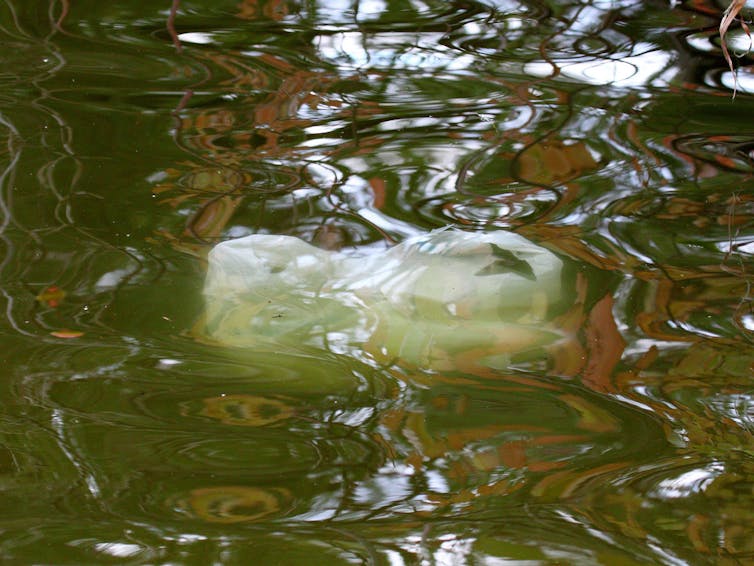
Flickr/Mr T in D.C.

Bans and levies work to fill the personal responsibility gap

Whilst heart-rending photos of plastic-struck albatrosses, whales, seals, and turtles have not altered consumer behaviour, bans and levies on bags have clearly been effective. Ireland’s imposition of a plastic bag levy, or “plastax”, originally at 15 Euro cents later rising to 22 cents, slashed personal use from 328 bags per person a year in 2002 to just 18 in 2010. There was a 95% reduction in plastic bag litter and 90% of shoppers were using long-life bags within a year.

The average Australian uses a staggering 345 plastic bags a year. On the encouraging side, lightweight check-out bags are now banned in South Australia, the Northern Territory and the ACT, where bag use and acceptability has since declined precipitously. Target banned bag use in June 2009.

Australia still has some way to go, considering bans were imposed as early as 2008 in China (which had a three billion a year pre-ban habit), a country which cannot boast a strong record of eco-advocacy. After deadly floods attributed to storm drain obstruction by plastic products, Bangladesh has also taken action, as has South Africa, Kenya and Uganda. The United Nations has called for plastic bag bans to go global.

Meanwhile, the Australian Retailers Association (ARA) argues that reusing durable bags will lead to cross-contamination and infection-risks. The ARA has never acknowledged that all consumers (including those who make shopping trips with privately purchased durable bags) pay to subsidise single-use bags by paying higher retail prices. Some argue that the substitution of lightweight plastic bags with bin liners, paper bags, cardboard boxes and durable bags that are used just once could exact greater environmental cost.

Don’t wait for policy: how to help now

While the debate on plastic bag ban and levy rages, we can individually help by:

  • Support plastic bag bans or levies: 70% of 15,000 EU residents polled in 2011 support such a restrictive policy;
  • Use bags made from long-life, sustainably-sourced materials that last years;
  • Bring your own green durable bags for grocery, takeaway, and even retail therapy; each needs to be used at least four times for a net eco-benefit, but they can be re-used over 100 times. As a lesser option, ask for biodegradable and compostable bags at the checkout;
  • Bring back damaged bags to recycling collection points;
  • Carry single items or a few items in your pockets or hands;
  • Refuse single-use lightweight bags even if they are apparently free;
  • Advocate for synthetic reusable bags as a must-have accessory for the eco-aware, as well as discounted groceries or Loyalty Points for declining bags;
  • Object to discardable plastic drink and food containers
  • Use newspaper for bin liners, or hose down unlined bins

Plastic, somewhat like diamonds, is passed over many generations – an eternity in human terms. Let us all try restricting its supply and constraining its use, for the sake of our living, breathing, world.

Comments welcome below.

Articles also by This Author

Sign in to Favourite

Want to follow The Conversation?

Sign up to our free newsletter to get the day's top stories in your inbox each morning, with a special wrap on Saturday.

Spinner
Become a friend of The Conversation and donate

Join the conversation

47 Comments sorted by

  1. Jude Williams

    Retired and still curious

    I was shocked to learn that the 'green' bags (now in a variety of colours) bought at supermarkets are not biodegradable. Now they're turning up in truck loads in second hand clothing stores. They are just profit making tools for supermarkets. Until a complete ban or a price is imposed on each bag, the problem won't go away

    report
  2. Felix MacNeill

    Environmental Manager

    Joseph you have committed the cardinal sin of being rational, evidence-based and even optimistic at the same time!

    Everybody in Canberra knows that the plastic bag ban herewas just a Greenie-feel-good-symbolic way of ending civilisation, punishing right-thinking-right-voting-citizens-for-daring-to-be-human, taking us back to living in caves, causing people to end up in the poor house because they now have to buy the occasional bin-liner and a general indicator of hatred of Judeo-Christian Western culture in favour of pagan-satanic-leftie-etc., etc. etc....and now you go trying to point out some facts! Have you no shame?

    report
  3. Let's Not Pretend

    logged in via Twitter

    There is so much emotion wrapped up in plastic bags. However, in Australia, there doesn't seem to be much hard evidence that plastic bags are the blight or the environmental menace they are made out to be.

    Litter is ugly and careless disposal of plastic bags can cause distress or death for indivdual animals, but I don't think future generations will reflect on plastic bag use. They'll want to know why we didn't act on greenhouse gas emissions, habitat destruction, land degradation and toxic emissions into our aquifers, rivers, coasts and oceans.

    Rather than fret about plastic bags, we should be more concerned about what we put in them. That's where the real and irreversible damage is occuring.

    report
    1. Felix MacNeill

      Environmental Manager

      In reply to Let's Not Pretend

      'Let's not Pretent', I think this is a falacious argument - if we were only able to EITHER deal with plastic bags or bigger (though partially-related) issues like greenhouse gas emissions, you would have a very fair point. But, last time I looked, we seem as a nation to simultaneously deal with a vast array of problems and enact complex legislation and policy to deal with multiple issues at once.

      You're dead right that we should worry more about what we buy and put in those bags, but reducing…

      Read more
    2. Let's Not Pretend

      logged in via Twitter

      In reply to Felix MacNeill

      "...reducing bag usage won't CAUSE us to behave worse in other ways"

      Are you sure? Biodegradable bags (of all kinds), cotton bags, paper bags and for-purpose bin liners require more resources and generate higher greenhouse gas emissions than standard use-once bags over a typical bag life-cycle.

      I'd like to think that the ban-the-bag campaign was 'consciousness raising', but I don't see that happening in the real world at all. What I see at the supermarket are green bags filled with imported…

      Read more
  4. lavinia kay moore

    child and family counsellor

    On reading this, I tried to remember when plastic bags became the thing we carried our goodies from wherever to home.
    As a child I know that my parents groceries were carried home in a cardboard carton, supplied by the shop who emptied it to fill uip their shelves.And that it was reused by my mother at subsequent trips to the supermarket.
    I remember using string bags and other self-supplied bags for my food shopping. Then we had big brown paper bags.
    then sometime later the ubiquitous plastic bags arrived.
    Does anyone know when that was?
    I always have used them over again. I wish not only plastic bags but a whole host of plastic stuff was banned....
    Cheap products like these really, in the end, turn out to be very costly for all of us.

    report
  5. Tony Xiao

    retired teacher

    In 2008, China banned the practice of offering free plastic bags in supermarkets, department stores as well as grocery stores, and prohibited the production and usage of plastic bags thinner than 0.025 millimeters.
    It's estimated that over the four years consumption has reduced by of 800,000 tonnes of plastic and more than 24 billion plastic bags.
    The policy of paying for plastic shopping bags has worked fairly well here in getting people to BYO. But I have a feeling that Australians are not as frugal.

    report
  6. timl

    logged in via Twitter

    I generally take my green bags to the supermarket and carry a backpack for other miscellaneous purchases, yet our household still seems to have a continually full cupboard for plastic bags, which are then reused as bin liners, etc.

    Now, if we were to somehow exhaust this somewhat magical supply of plastic bags I genuinely wonder what we'd do for bin liners. Presumably there are enviro-friendly products out there, but I've never gone looking for them since we've never needed them. With this in mind, I was wondering if anyone could recommend a biodegradable, enviro-friendly bin liner to use once we ween ourselves off the plastic bags?

    report
    1. Jodie Lia

      Ecologist

      In reply to timl

      You've just asked what I'm wondering too. I am the same as you, refuse bags constantly, take reusable green bags everywhere, but admit that we still use any plastic bags we do get for bin liners. The suggestion in the article to use newspaper for bin liners seems a bit ridiculous and unworkable, and while we can clean unlined bins after use, this does not remove the requirement of my (and I'm sure others) council that all general garbage needs to be bagged before being put in the bin.

      report
    2. Let's Not Pretend

      logged in via Twitter

      In reply to timl

      Biodegradable bin liners are available. You'd want something compostable. But...they cost more and they need more energy and raw materials tp produce. Biodegradable bags also result in higher greenhouse gas emissions. On top of that, they probably won't decompose in your lifetime if they end up in landfill. Nothing will.

      report
    3. timl

      logged in via Twitter

      In reply to Jodie Lia

      The newspaper idea also assumes that one reads newspapers in dead tree form. You can't line a bin with an ipad :-P

      report
    4. Ryan Farquharson

      Research officer

      In reply to Jodie Lia

      I was amused by the hysteria pre plastic bag ban in SA. Trolling through the comments on news sites, the bin liner issue was the most common.

      These days I re-use freezer bags from the green-grocer which work just fine because we're a low-waste household.

      report
    5. Bernie Masters

      environmental consultant at FIA Technology Pty Ltd, B K Masters and Associates

      In reply to Tricia Hogbin

      Tricia, newspaper is entirely recyclable so why use it as a liner for refuse that is going to landfill? Wouldn't it be better to use a 4 gram thin plastic bag that supermarkets are willing to give away for free?
      Apologies for being provocative but my point is that we are all being forced to make subjective judgements on this issue of thin plastic bags. Because there are so few hard facts but instead lots of emotion, I fear that we are making a symbolic gesture in banning supermarket bags that will provide virtually no worthwhile environmental benefit.

      report
    6. Sarah Nosworthy

      logged in via LinkedIn

      In reply to Bernie Masters

      Here's the thing - if you compost/Bokashi or similar, how much 'wet' waste do you have? I don't use a bin liner at all - I live in an apartment, it's a small under sink bin. Problem solved. With all wet waste in the bokashi, nothing smells, or is sloppy in the kitchen bin.

      So, no Bernie - neither are needed, and the plastic you got for free, where and what does it do next - I think that was the main point of the post above. Why not use cardboard boxes which we know for sure decompose - cause we can see it in a matter of months/years if we put one in a yard - we can't with plastic...

      report
    7. Luke Weston

      Physicist / electronic engineer

      In reply to Tricia Hogbin

      But, as another commenter mentioned above, this "line the bin with newspaper, not a bag" approach is, or may be, unacceptable according to the local council requirements for waste collection.

      report
  7. Lisa Ann Kelly

    retired

    Back in 1990, I received my first reusable cotton bag ( meant for taking to local markets), after participating in a beach clean-up. Previous to that, for approx five years, I had been taking my own brown paper bags, reusing store ones, into the supermarkets. Then I began to purchase reusable bags through animal rights groups and such.

    The inevitable quizzical looks on the faces of the grocery clerks and kids bagging my purchases is something I will always remember. I even had some of…

    Read more
    1. Alan W

      Scientist

      In reply to Lisa Ann Kelly

      Why is the 'bin-liner' argument ridiculous?

      Seems to me like I'd be changing one type of plastic bag which I currently get for free (shopping bags) with another type of plastic bag which I'd have to pay for (comercially available bin liners).

      Either way there's a plastic bag going into land fill.

      Further, as a unit dweller I won't be hosing my bin out any time soon. The thought of twenty apartments full of people all rinsing their bins out in the common outdoor areas is not a particularly pleasant one.

      Is there any way to recycle the plasticc bags that we end up with? If there was I'd be happy to make monthly trips to a local collection point to divest myself of all the plastic bags that don't make it as bin liners.

      report
    2. Lisa Ann Kelly

      retired

      In reply to Alan W

      Be kind to the planet and don't take plastic bags in the first place----that's the point. I have all sorts of bins in my huge house. Six of us live here. Plus two dogs. Somehow we manage to live without using grocery plastic bags as bin liners. You can do it, too. Give it a try. What can it hurt? Reuse your bread bags, plastic bags that wrap your six rolls of toilet paper. Use newspaper. Get creative.

      Did you read the entire article? The bags ARE NOT FREE. You are paying for them by paying higher prices at the market. Seriously. You thought they were free? And at what cost to wildlife, health of our oceans?

      report
    3. Sarah Nosworthy

      logged in via LinkedIn

      In reply to Alan W

      Alan, I live in an apartment with 115 other apartments.

      I use a bokashi to house wet decompostable waste. I freecycle the contents to those with gardens (and less consumption than their land size). I hose the bokashi when empty in my bin room (wow, not one of the 114 others were there, shock of all shocks!)

      My 'trash' bin has dry waste, the 'dirtiest' it gets is dusty from the occasional lint I don't put in the Bokashi. It's no longer lined with a free bag or a bought bag.

      All I can say, is let's be honest, the reason why I might not do the above is cause it's too hard... or I'm too lazy. But that's really not a good enough excuse not to make a change, and so I have.

      report
  8. George Naumovski

    Online Political Activist

    Paper bags is the best solution, they can be made from recycled paper and keep being recycled as new!

    report
    1. Let's Not Pretend

      logged in via Twitter

      In reply to George Naumovski

      Not if you take into account the amount of energy, resources and emissions that go into their construction and transport. The best option is the re-usable 'green' bag - but only if you re-use them dozens of times.

      report
  9. Chris O'Neill

    Telecommunications Engineer

    "These environmentally damaging bags – produced to be used once and then thrown away"

    All of my plastic bags are used at least twice. I only acquire enough free ones that I need for some other purpose. Any additional need for carrying, I do using reusable bags.

    None of the plastic bags I use entangle, drown, asphyxiate, and starve animals. None of them adorn trees and fences. None of them have gone into the Pacific. None of them have entered the environment as litter.

    "Most of us are aware…

    Read more
    1. Tricia Hogbin

      logged in via Twitter

      In reply to Chris O'Neill

      But how can you be certain that none of your plastic bags 'entangle, drown, asphyxiate, and starve animals etc?

      Just because you don't littler doesn’t guarantee your bags won’t end up as litter at some stage during the '50 generations is take to decompose'.

      Bins overflow, rubbish can be lost during transport, and waste blows from landfills, or someone you pass a bag onto may litter (or someone that person apsses the bag onto and so on).

      report
    2. Bernie Masters

      environmental consultant at FIA Technology Pty Ltd, B K Masters and Associates

      In reply to Tricia Hogbin

      I can be certain that none of MY plastic bags will kill wildlife as I store and use them very carefully but the problem of course is other people's bags over which you or I have virtually no control. But I raise two issues in response to your comment.
      First, the environmental campaign against plastic bags resulted from an incident in the Mediterranean several decades ago when 100s or 1000s of plastic bags were found to be polluting an area of marine environment. Since then, however, plastic bag…

      Read more
    3. Steve Hindle

      logged in via email @bigpond.com

      In reply to Bernie Masters

      You make some good points.
      A plastic bag starts from a few drops of oil from out of the ground and ends back in the ground where it eventually breaks down. (It is the irresponsible littering that is the real environmental problem with plastic bags).
      People gradually develop fatigue to all the environmental problems we should be facing. This makes it important to correct our bad environmental behaviors in order of most damaging to least damaging. This is something we don't do very well.

      report
    4. Chris O'Neill

      Telecommunications Engineer

      In reply to Tricia Hogbin

      "But how can you be certain that none of your plastic bags 'entangle, drown, asphyxiate, and starve animals etc?"

      I presume landfill has legal standards that have to be followed.

      "Bins overflow,"

      My bins don't overflow.

      "rubbish can be lost during transport,"

      There are laws against unsecured loads.

      "and waste blows from landfills,"

      My bags are tied-up.

      "or someone you pass a bag onto may litter (or someone that person apsses the bag onto and so on)."

      I rarely pass bags on to anyone and only to people I know who are responsible non-litterers.

      report
  10. Bernie Masters

    environmental consultant at FIA Technology Pty Ltd, B K Masters and Associates

    Joseph, the maths that you've quoted from the EU are wrong. The link in your article goes to a media release which states: "The total volume of plastic carrier bags produced in Europe in 2008 was 3.4 million tonnes". Volume measured in tonnes? I think not. More importantly, Australian plastic shopping bags weigh just under 4 grams so 3.4 million tonnes means that Europeans use 850,000,000,000 - 850 billion bags or 2800 bags per person!

    To give this plastic bag issue some perspective, Australians use 6 billion bags each year. These weigh 24,000 tonnes in total which is a fraction of one percent of the total waste stream produced by us Aussies. The call to ban plastic bags is all about symbolism and tokenism. It has nothing to do with solving a genuine environmental issue.

    report
    1. Philip Dowling

      IT teacher

      In reply to Bernie Masters

      The Planet Ark campaign to recycle Christmas cards was a similarly symbolic campaign.
      All of my Christmas cards were less than one week's worth of flyers and ads that make it into my letterbox,
      It puzzles me also why we need an ever continuing supply of reusable bags - from supermarkets, bottle shops, newspapers, libraries, etc.
      You go to the hardware store and they don't supply paper bags - to be environmentally friendly. But if you need three six screws you have to buy 50 or 100 in a hard plastic container.

      report
  11. Philip Dowling

    IT teacher

    We can only surmise that bags will take 50 generations to decompose SUCH A SCIENTIFIC TERM ...... SURMISE.
    non-biodegradable bag’s natural decomposition since it was invented by Swedish engineer Sten Gustaf Thulin in the early 1960s and patented in 1965.
    How many generations so far?
    Why were uv stabilised plastics invented.?

    report
    1. Luke Weston

      Physicist / electronic engineer

      In reply to Philip Dowling

      So why don't we just bury all the plastic bags in a hole somewhere, where they can't hurt wildlife?
      This would provide stable permanent geosequestration of what would otherwise end up as fossil-derived carbon dioxide.

      report
  12. Ross Headifen

    logged in via LinkedIn

    Ban the bags. It is that simple. People will complain for a few months then find something else to occupy their thoughts while they carry their reusable bags to the store and back. Why are we so afraid of change? the plastic bag was an item invented a few decades ago and times have changed since then. We are no longer in the 70 or 80s thinking resources are unlimited and waste is simpel 'taken away' We have more people, more waste and a lot more plastic bags. If they we re charged for like…

    Read more
    1. Bernie Masters

      environmental consultant at FIA Technology Pty Ltd, B K Masters and Associates

      In reply to Ross Headifen

      Ross, a ban on disposable supermarket plastic bags is guaranteed to:
      1. increase the sales of replacement bags such as bin liners
      2. require that the heavy duty reusable plastic bags that are some 30 times heavier than the thin disposable ones must be used at least 30 times before we see a net environmental benefit from a ban
      3. reduce waste going to landfill by about 0.1%
      4. make no meaningful difference to protection of the environment, conservation of finite natural resources or change people's behaviour in a positive way
      5. impose additional (albeit small) additional costs that will be felt more by certain segments of the population than others.
      A ban is symbolism at best, tokenism at worst. So sad that people can't put their heart and soul into campaigns that actually make a significant difference to how we live on this planet.

      report
    2. Philip Dowling

      IT teacher

      In reply to Ross Headifen

      People keep saying that plastic bags last for hundreds of years in landfill.
      Where is the proof?
      I discovered some thicker plastic bags that been filled with vegetation and left undisturbed on my place for less than twenty years. They had largely disintegrated when I came across them.
      Plastic bags filled with putrescent waste would normally be pierced and/or ripped in the various stages of transportation.

      report
    3. Philip Dowling

      IT teacher

      In reply to Philip Dowling

      I see all the true believers have again noted but ignored my question.

      It says it all really. Mindless trend followers who merely keep repeating nonsense to each other for fear of actually thinking independently and logically have not been able to answer this question.

      Engineers use testing to identify expected MTBF for computers. They admit the limitations of this testing. Automobile manufacturers similarly do testing.

      report
  13. Hugh Butcher

    Greenhouse Programs Leader

    While environmental programs like reducing plastic bags may be insignificant in the scheme of things, they are targeted at people that aren't normally 'environmentally' inclined. It's a foot in the door for bigger outcomes like organics recycling, and reduced energy and water use.

    BTW, Has anyone here googled the LCA of a plastic bag- I did...
    http://www.sustainability.vic.gov.au/resources/documents/LCA_shopping_bags_full_report%5B2%5D.pdf

    Pretty much any reusable bag has a better environmental…

    Read more
    1. Let's Not Pretend

      logged in via Twitter

      In reply to Hugh Butcher

      "BTW, Has anyone here googled the LCA of a plastic bag- I did... http://www.sustainability.vic.gov.au/resources/documents/LCA_shopping_bags_full_report%5B2%5D.pdf"; ... "And what does any of this information tell us? That the 'green bag' is the best option? NO!!!"

      Yes. I read that report years ago. As a matter of fact, in the single study that you mention, green bags scored highest in every category. They were the best option.

      In any case, rankings in any study like this depend on the assumptions…

      Read more
  14. Ross Headifen

    logged in via LinkedIn

    From reading the above posts it can be seen that many people do not understand the issue and are getting confused by all the tangent points of view. From an engineering point of view we need to break the problem down into the various parts then work on those one at a time in order to solve the whole problem. Otherwise as someone said above, people just get overwhelmed by the environmental problems of today and switch off.
    First we ought to ought to be making a product that will last though the…

    Read more
    1. Bernie Masters

      environmental consultant at FIA Technology Pty Ltd, B K Masters and Associates

      In reply to Ross Headifen

      Ross, until a few years ago, your statement "A landfill is not a hole in the ground but a sophisticated biodegradation chamber where many things are broken down to their base constituents again." would have been correct. Today, however, modern landfills are being designed to exclude oxygen and water so that no biodegradation can occur. Today, a well run and properly regulated landfill is sited in a clay-rich geological environment and individual cells are capped with clay to seal them off from the…

      Read more
  15. Andrew Tovey

    logged in via Facebook

    The 1 million bags per minute figure is quite a powerful one. Can you give a source for that? Would like to be able to use it but need an anchor

    report
  16. Safdar

    logged in via Twitter

    All of my plastic bags are used at least twice. I only acquire enough free ones that I need for some other purpose. Any additional need for carrying, I do using reusable bags.

    report