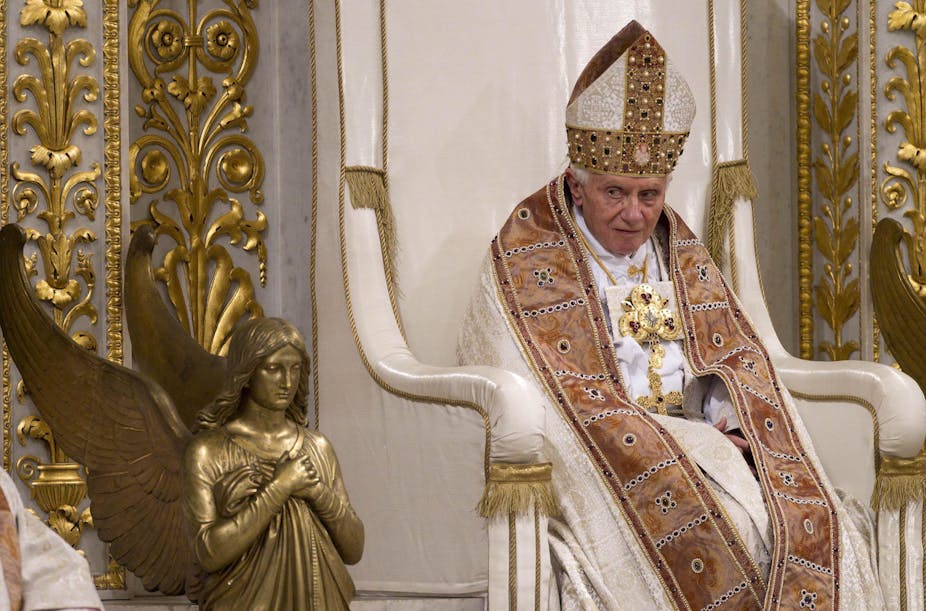
Pope Benedict XVI announced his historic decision to step aside as Pope yesterday. This is the first time in 600 years a Pope has resigned. And in 1415 when Gregory XII resigned, he did so not to retire, but in order that, after decades of schism, the church might once again have a single Pope.
At 85, Benedict is one of the oldest Popes in the church’s 2000-year history. His predecessor John Paul II was 84 when he died. This is arguably the first time that a Pope has resigned on account of the infirmity which accompanies old age.
The English version of his announcement states:
After having repeatedly examined my conscience before God, I have come to the certainty that my strengths, due to an advanced age, are no longer suited to an adequate exercise of the Petrine ministry.
This statement brings to public attention the mortality and fragility of the human person who occupies the office of Pope, who is charged by the church with exercising “the Petrine ministry”.
The ministry is demanding, because the Pope wields an extraordinary degree of authority and responsibility largely unknown in modern societies. Contrary to popular belief, the Pope is not himself infallible, although he does have the power to make infallible statements.
In stepping aside, Benedict – or Cardinal Joseph Ratzinger, as he will soon be known – has shown self awareness of his physical weakness, such that he considers he is no longer capable of exercising the powers and responsibilities with which he is charged. His statement continues:
In today’s world, subject to so many rapid changes and shaken by questions of deep relevance for the life of faith, in order to govern the barque of Saint Peter and proclaim the Gospel, both strength of mind and body are necessary, strength which in the last few months, has deteriorated in me to the extent that I have had to recognise my incapacity to adequately fulfil the ministry entrusted to me.
This public acknowledgement of papal frailty is all the more intriguing because of the church’s reputation. The scandalous revelations around the sexual abuse of children by priests and religious figures, and the way perpetrators have been protected, has led to intense criticism of the way in which the church has exercised power. At the heart of this criticism is the accusation that the Catholic Church is more protective of its standing as an institution, of the reputation of its bishops and clergy, than it is of the humans it serves. The resignation of an individual as Pope is a dramatic reminder of the frailty of all humans, and the consonant weakness of institutions and offices.

Catholic theology has long prided itself, however, on bringing together understanding of the nature of life – its beginning and its ending – with the concept of human dignity. It is this concern which has driven Catholic engagement in health, welfare, education and social justice, not least in aged care.
In the 21st century, when the health sciences have evolved to a point where humans with assured access to food, water and shelter can live longer than in any previous century, a theology of ageing has become more important than ever before.
Benedict’s resignation will draw attention to this development as no other event could. What happens when humans live to great ages, yet still confront deterioration in “both strength of mind and body”? This is a question that preoccupies ageing people and their carers, wherever frail health, dementia, or other conditions impair familiar mental and physical capacities.
Is there room in church and society for a theology of ageing which supports and enables human dignity for the aged, especially where mind and body are frail?
Recent research by Dr Stephen Ames on behalf of the Australian Anglican agency Benetas has highlighted the perception that with ageing, “one’s very self dissolves”. Ames writes:
If it is assumed that worth and personhood is defined in functional terms, then, as functionality unravels, so does the sense of personhood and worth … [but] Theology rejoices that personhood is not lost as we age.
Benedict’s resignation is a potent reminder that even the Pope is fallible, frail, and mortal. As his legacy is reviewed, and as speculation mounts about his successor, it is worth contemplating what his resignation might reveal about life in an ageing world.
David Clerke
Teacher
I wonder what effect this will have on Geoffrey Robertson's demand that he be prosecuted for involvement in child abuse scandals?
Anthony Nolan
Ruminant
Couldn't have asked a more pertinent question myself.
Trevor McGrath
Pharmacist Hobby:climatology
Any Lawyer paid the money will of course plead old age, or can't remember. But the person engaging the lawyer will always be able to remember to pay.... Funny that.
Venise Alstergren
Venise Alstergren is a Friend of The Conversation.
photographer, blogger.
Why do you think he's going to live in a monastery, if not to keep well clear of nasty interviewers and possible legal action?
PETER SHERLOCK: Your article is both nauseating and precious. But then, you do come from a Catholic institution, do you not? This is the year 2013. It is not two thousand years ago-although your policies are two thousand years old. As a gesture towards the year 2013 you could start your own personal lobby group to press for all religious institutions to renounce the massive…
Read moreCale B.T.
logged in via email @gmail.com
Eric Abetz is not a Roman Catholic.
Venise Alstergren
Venise Alstergren is a Friend of The Conversation.
photographer, blogger.
Really? Oh, that's right, he is Tasmanian and Dutch Reformed Church.
As penance I'll give out a few more names. Mathias Corman, Scott Morrison, David Clarke-aka Ratzinger's right, Kevin Andrews, Malcolm Turnbull, Peter Ryan (Nashos VIC), George Brandis, Cory Bernardi, Andrew Robb, etc, etc, etc.
Lynne Newington
Lynne Newington is a Friend of The Conversation.
Researcher
The International Tribunal into Crimes of Church and State in their Global Release February 14th, has something along those lines.
Not too many would want to know about that, in fact wouldn't even know it existed.
John Kelmar
Small Business Consultant
If more people in public office took this approach then we would have a better world - retiring when one realises that their mental and physical abilities have significantly diminished. Australian politicians and public servants, please take note.
Guy Curtis
Senior Lecturer at School of Psychology and Exercise Science, Murdoch University
As a psychologist who is frequently working in areas of organisational psychology, I think there will be an increasing demand for age-related capacity assessments in many jobs with the aging population.
Anthony Nolan
Ruminant
I reckon that most people of a certain age will just be routinely bullied out of the workforce by younger people just as they are now.
Trevor McGrath
Pharmacist Hobby:climatology
I agree, may be so, but throughout history, old age and experience and a long term view seems to hold the advantage for over those with only the short term in mind. Churning works well for the quick buck types, not the builders of empires. How the world turns out ....who knows. we will see how smart the next generation is by the way consumption patterns pan out. Cheers
Pamela H.
logged in via email @hotmail.com
Not where Liberal governments run things. They want people to literally work until they drop. Imagine a country full of Mr Burns's.
Michael Fry
Citizen
"What happens when humans live to great ages, yet still confront deterioration in both strength of mind and body?" Perhaps the Catholic Church will move to a meaningful examination of euthanasia. In its own time of course. My guess is that may take another 600-years.
Trevor McGrath
Pharmacist Hobby:climatology
Just what has euthanasia got to do with the head of the world's first and largest multinational corporation standing down. He is only the chairman of the board after all. Cheers
Pamela H.
logged in via email @hotmail.com
That'll be around the same time as they allow women priests and gay marriage. Never.
Chris Aitchison
logged in via Twitter
"This is arguably the first time that a Pope has resigned on account of the infirmity which accompanies old age."
If you believe that this was the reason, then I have a bridge to sell you...
Michael Shand
Michael Shand is a Friend of The Conversation.
Software Tester
"Catholic theology has long prided itself, however, on bringing together understanding of the nature of life – its beginning and its ending" - If you actually mean the Catholic Church has long prided itself on making claims to knowledge it either does not or could not possibly know, then yes
yes they are very good at making stuff up
Dianna Arthur
Dianna Arthur is a Friend of The Conversation.
Environmentalist
If not for the anticipation of a MSM drowned in popely analysis for the next few weeks, I do not have a problem with someone deciding to retire. Working up until death surely means that a number of popes, like other humans, develop dementia before the end and this would surely impact on the infallibility of said popes.
"Contrary to popular belief, the Pope is not himself infallible, although he does have the power to make infallible statements."
Someone please help me with this conundrum; the pope isn't infallible but his statements are?
How so?
Venise Alstergren
Venise Alstergren is a Friend of The Conversation.
photographer, blogger.
I was going to ask the very same question but ran out of time. Glad you did so.
Pamela H.
logged in via email @hotmail.com
Yawn. When Vatican city disappears on an alien spaceship, then it will be newsworthy. And this survivor of Catholicism will be smiling.
Venise Alstergren
Venise Alstergren is a Friend of The Conversation.
photographer, blogger.
Hehehehehe, well done.
Michel Syna Rahme
logged in via email @hotmail.com
Every persons misery and times of confusion, for me demands always empathy, I'm not ashamed of this love.
I do not love the church, but good love gives me hope for the people lost within it, that they will make it - as we both share hidden tears - my tears for their misery, their confusion, their tears, as they strain with the weight of their ageing outdated beliefs - but my tears also for their courage and bravery, and their yearning to do what is right, find truth!
Believers! Resignation…
Read moreVenise Alstergren
Venise Alstergren is a Friend of The Conversation.
photographer, blogger.
Your point?
Lynne Newington
Lynne Newington is a Friend of The Conversation.
Researcher
Michel, good love for the people lost within the church... and the tears..... etc.
That paragraph in part, are my own sentiments too.
I grieve for them [as well as myself}, how the beauty of the faith has been bastardized and exploited, by the institutional church.
Trying to do things right, brings one well and truly upon the mercy of these corrupt illigitimate son's of Christ.
When you see grown men, from the simple to judges, QC's, doctors princes ,kings and queens, across the full specrum, bending the knee and submitting to the spirtual power wielded over them, that's something far beyond words, [and I don't mean those seeking political gain, they're in a class of the own].
Pat Moore
gardener
Perhaps the retirement of this man signifies & parallels the retirement of the religion itself from public life? Judging from the widespread hostility/venting of much of public response since the paedophile/suppression exposures there is a growing intolerance towards the church. In these tumultuous times of extremities of suffering, corruption, a sense of powerlessness within populations to affect any meaningful political change yet a growing sense of emergency for that change, the Catholic Church…
Read moreIan McPhail
Adjunct Professor at Centre for Sustainable Business & Dev, USQ @ Dept Geog, Planning and Env Mgt, UQ
Sure the church analysts will get a great deal of fodder from this. Did he jump or was he pushed? But my interest is in the link between ageing and work.
'Official' retirement age is bollocks - although it has validity in social services and superannuation. But as one who retired at age 70, it was about right, or maybe I worked a little too long! But ageing and capacity to work become extremely individual, but having held senior executive positions, the idea of 'managing' a politics riven organisation with striving individuals into my eighties seems extraordinary. That some can is clearly true and should held as true in the workplace, but also those who can't through a transfer of emphasis from the outside world to the demands of the body, physical breakdown, chronic disease, or dementia need to be acknowledged. The Roman institution is a powerful organisation with a formidable bureaucracy and to be mentally strong is an absolute requirement for leadership.
Kelly Schofield
Intern
Just a shame that prior to resigning he didn't give out some "gifts" like US presidents traditionally do. He could have decreed that the church needs to share its wealth with the poor, mentioned that God no longer ws concerned with contraception, homosexuality. He might have even said that female clergy and married clergy are the new dogma.
Lynne Newington
Lynne Newington is a Friend of The Conversation.
Researcher
Not forgetting the rights of a father for his child-"without undue influence" according to the UN Convention on the Rights of the Child.
Who could believe he could ligitimize a child with the stroke of a pen, he had no part in creating!