The principle of prevention being better than the cure is at the heart of public health and social marketing efforts such as immunisation. But not everyone agrees and the challenge is how to address disagreement.
What I am about to say will almost certainly provoke ire, but here it is: immunisation can be dangerous to your health.
This truth is acknowledged in the Australian Academy of Science’s recent publication, The Science of Immunisation: Questions and Answers. Admittedly, the risks are small, maybe even “extremely small” as they state. But like many medications, there are risks – even if they’re written in small print.
But while in medical practice, the individual gets to read about the side effects and choose whether or not to take a drug or some other kind of therapy, in public health, this same option is not offered to that individual.
And as one might expect, public health agencies tend to emphasise the benefits and discount the risks. The Science of Immunisation report, for instance, tells us that “all vaccines in use in Australia provide benefits that greatly outweigh their risks”.
For personal medications, we choose for ourselves. But who makes the decision about what is good for us in public health? How do they make this decision? And why should we believe them?
Indeed, these questions are the heart of an important issue that confronts all public health and social marketing efforts. And it’s neatly crystallised in the debate about immunisation which has been going on for around 300 years.
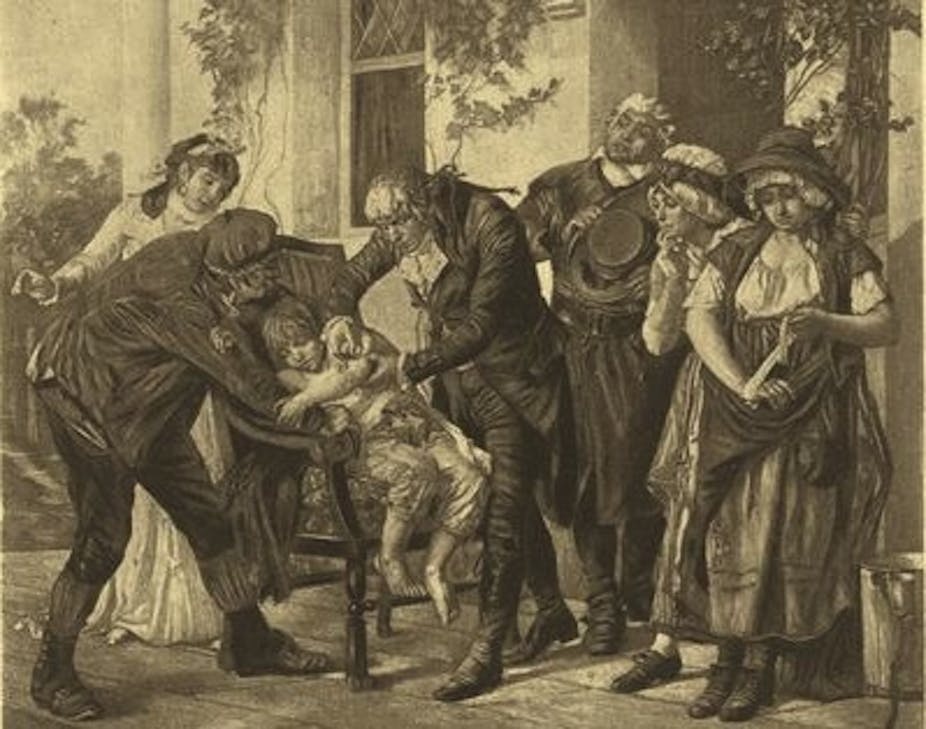
In the 1720s, the inoculation of English children with powdered scabs from smallpox sores to prevent later infection by smallpox was promoted. Smallpox was undoubtedly a dangerous disease killing up to a third of those infected. But inoculation could also be dangerous, leading to the deaths of up to 2%.
Then, as now, the key question for individuals was whether or not to immunise.
Voltaire famously characterised the balancing of risks in his Lettres Philosophiques
[Europeans consider] the English are fools and madmen. Fools, because they give their children the small-pox to prevent their catching it; and madmen, because they wantonly communicate a certain and dreadful distemper to their children, merely to prevent an uncertain evil. The English, on the other side, call the rest of the Europeans cowardly and unnatural. Cowardly, because they are afraid of putting their children to a little pain; unnatural, because they expose them to die one time or other of the small-pox.
Then Edward Jenner invented the original vaccine, inoculating his patients with cowpox to prevent infection by smallpox. His findings were mocked publically by religious and scientific authorities.
Today, scientific authorities and public health interests argue that the benefits of immunisation far outweigh the pain of the few who may suffer from vaccination. And from a public health point of view, they are correct.
So why then do people refuse to immunise? Why are so many people reluctant to vaccinate?
Unfortunately for public health agencies, people are notoriously bad at estimating risks and probabilities. Few, if any, read meta-analyses or systematic reviews, and many are very bad at understanding science and statistics.
So just as some people in the 18th century believed that Jenner’s original vaccination might give rise to cows growing out of the body and was against God, today some people believe that the MMR (measles, mumps, rubella) vaccination can give rise to autism.
But despite their misguided beliefs, they have some reason on their side that ought to be acknowledged, even if only to better guide public health programs.
The first is that there are some risks associated with immunisation. Maybe not the risks identified by the anti-vaccinators, but risks nonetheless. Second, and perhaps more importantly, the public health agenda asks individuals to sacrifice their rights to the greater good. Is this just?
Perhaps it helps to make this personal. If you or your child suffered the rare adverse reaction to a vaccine, is it fair that you bear this burden for the greater good?
Public health practitioners have to act pragmatically but promotion efforts are likely better guided by a realistic view of the intended audience. And such practical matters shouldn’t prevent scientists, philosophers and academics continuing to debate these important issues.
Greg Horgan
The Bush Philosopher
Thank you Stephen. It is really comforting to see some sense in this debate at last. I applaud your effort.
Karen Witcombe
logged in via Facebook
The obvious response, again making it personal, why should my child be exposed to preventable diseases because some people choose not to vaccinate?
Suzy Gneist
logged in via Facebook
Karen, I have to ask: If your child is vaccinated, then you have chosen to prevent them being infected by someone who hasn't been - why do you doubt the vaccination will protect your child if it is scientifically proven to do so? Or are you concerned about the consequences of the unvaccinated child dealing (or not) with the infection through natural immunity?
Gillian Cohen
Research Associate, School of Public Health, The Univerity of Sydney
Suzy, it's because vaccination works in part from herd immunity. to be effective, between 85 and 95 per cent of the population must be immunized to stop the spread of the disease. This is why children not immunized increase the risk for others, as they get the disease first and spread it.
the Australian Academy of Sciences this month released information to help inform people about vaccinations: http://www.science.org.au/nova/012/012key.html
Suzy Gneist
logged in via Facebook
Even though my children were exposed to several infections, they seemed to not catch them as easily (or at all) than those immunised. Could there be other factors than just the benefit of vaccination to explain this? (I think, a healthy lifestyle, natural resistance could also play a role). Reading the TC article on the effect of pollution on the increase of several conditions, is it not possible that those already compromised and in higher risk areas benefit more from such treatments? I'm certain other factors play an important role - we just don't understand them yet.
Elizabeth Hart
Independent Vaccine Investigator
Gillian, re your reference to the Australian Academy of Science’s publication “The Science of Immunisation: Questions and Answers”.
Read moreThere needs to be more transparency in relation to that publication. For instance, I understand that Professor Ian Frazer, who is co-chair of the Working Group for the publication, receives royalties from the sale of HPV vaccines in the developed world. This fact was acknowledged on his article “Catch cancer? No thanks, I’d rather have a shot!” published on The Conversation…
Laurie Willberg
Journalist
If one is vaccinated, believing that this confers immunity from a disease, why are they then afraid that they'll come down with said disease? Moreover, they further claim that they are somehow at risk from those who have not been vaccinated. This makes no sense whatsoever. What has never been satisfactorily explained is why 80% of vaccinated people will contract a disease and only 20% of unvaccinated ones will according to reports from impartial studies.
Read moreMany parents ask the question, why should…
Mark Amey
logged in via Facebook
Neither measles, mumps or chicken pox are 'mere inconvenience'. There was an extensive discussion about this in the comments on a recent article: 'Parents' decisions about vaccination and the art of gentle persuasion.'
Geoffrey Edwards
logged in via email @gmail.com
Speaking of shills, Laurie, maybe you should tell people what your potential conflicts are?
Gillian Cohen
Research Associate, School of Public Health, The Univerity of Sydney
I was surprised that a "journalist" would have written this comment, so I decided to do a google search. It wasn't until page three of my search that I came across any reference to Laurie except that wasn't a comment on "the Conversation". It was about winning a local potato bake competition. http://www.sltrib.com/sltrib/blogsbitebybite/54899180-60/potatoes-funeral-cheese-salt.html.csp Is this you Laurie?
On search page 7, I finally found reference to a home page for Laurie Willberg - http://www.homeopathyworldcommunity.com/profile/LaurieJWillberg - but it didn't work.
I guess that Laurie isn't a real (or at least not a working) journalist, and that is why there is no reference to the amazing claim that "80% of vaccinated people will contract a disease and only 20% of unvaccinated ones will."
Tim Scanlon
Debunker
Geoff and Gillain, it is not easy to find anything about Laurie unless you search for Laurie J Willberg. Once you do this you find that she is from Toronto, Ontario, Canada, is training to be a homeopath and "wants homeopathy to become the pre-eminent form of healing in this world."
The only pieces I can see with her name attached are comment posts on various newspapers, blogs, webpages and the like. She seems to like writing letters to the Toronto Sun and the only actual article I can find that she has written appears on a homeopathy site, "THE REBOUND EFFECT OF PHARMACOLOGICAL DRUGS FOLLOWS HOMEOPATHIC PRINCIPLES" Read if you want to see a lack of knowledge about medicine displayed. For someone claiming "journalist" as their profession, there certainly is a lack of digital evidence of her articles, draw what conclusion you will from that. I'm guessing that she is practising homeopathic journalism, where the less articles she writes, the more prominent her journalism.
Elizabeth Hart
Independent Vaccine Investigator
Laurie, re your comment that “most veterinary associations have had the decency to finally admit” that ‘annual boosters’ for canines are unnecessary.
Read moreI’ve been working on this matter since late 2008 and I can tell you it’s appalling the way the veterinary industry has fought against decreasing unnecessary vaccination of pets.
Many dogs (and cats) are still over-vaccinated. While effective vaccination of puppies with modified live virus (MLV) vaccines for diseases such as parvovirus is likely…
Laurie Willberg
Journalist
Elizabeth, you've done some excellent research and your website is exceptionally informative. I can only applaud your determination to demand accountability from public health officials and to expose conflicts of interest with industry.
Read moreThe recent Purdue study reveals shocking auto-immune damage done by vaccines,
http://www.dogsnaturallymagazine.com/purdue-vaccination-studies/
"The vaccinated, but not the non-vaccinated, dogs in the Purdue studies developed autoantibodies to many of their own…
Elizabeth Hart
Independent Vaccine Investigator
So now we have an A/Professor of Marketing, who has previously conducted marketing research for vaccine manufacturers, enter the fray, ostensibly to speak up for people who question vaccination.
Is this patronising effort The Conversation’s contribution to providing balance in this ‘debate’? What a joke…
Geoffrey Edwards
logged in via email @gmail.com
Actually, if you read the article you will probably agree that it is not about some spurious debate over the efficacy of vaccination.
It merely points out that there is an ethical issue at stake - personal liberty vs. public utility. It is an issue which has been present since the idea of innoculation arose.
Unfortunately, rather than engage in this discussion many people have resorted to impugning the motives of the health fraternity or abusing the word "science."
Proffesor Holden, like all who contribute to the Conversation has noted any relationships that may be considered a conflict of interests.
This is something that commentors do not do.
Laurie Willberg
Journalist
There seems to be a recurring theme on this blog to pillory alternative medicine and shill for the status quo of the pharma and chemical industries. Balance? Yeah, right.
A better title would be "How to Shill Vaccines (now that people have wised up)". You have to go somewhere else to find out what Doctors Don't Tell You and why 50,000 chemicals in the environment are not a good thing.
Themes include: accuse everyone who is not compliant as being "anti-science", "scientifically illiterate" an "anti-vaxxer", a "tinfoil hat wearing kook", a "conspiracy theorist", or my personal favourite, "promoting quackery".
Different day, same crap.
Mark Amey
logged in via Facebook
Prof Holden has stated his previous involvement in vaccine advertising campaigns, and, if you read the article it's essentially about benefits to the community vs risk to the individual. The same article could have been written about bicycle helmets, seatbelts in cars or fluoride in water.
Geoffrey Edwards
logged in via email @gmail.com
"Different day, same crap"
You know what the say, Laurie.
If the crap fits...
Patrick Stokes
Lecturer in Philosophy at Deakin University
Great article, Stephen.
I've never understood why anti-vaxxers continue to fight a battle they have already lost on the science rather than focusing on the ethics. Instead of asking interesting and pertinent questions about how personal autonomy intersects with collective good, they waste time insisting that vaccines cause autism (they don't) contain toxic levels of mercury or formaldehyde (they don't), etc.. Bodily autonomy, and its limits, is a complex, nuanced and deeply important question; why aren't the anti-vaccination voices tackling *that* rather than endlessly repeating debunked canards and promoting pseudoscience?
Geoffrey Edwards
logged in via email @gmail.com
Patrick,
firts thoughts,
Perhaps it points to the fact that many people, while intuiting the moral nature of their objections, do not recognise ethical considerations are something that is up for discussion: i.e., It may be that for many the idea that someone is operating on a different moral pardigm is not something they have considered.
It seems to me that if you engage on the assumption that there is no difference in moral outlook, then the point of argument rests on the facts that inform decision making in that context. Thus you argue the science rather than the true source of your opposition.
Suzy Gneist
logged in via Facebook
Thank you Geoffrey, I too see an underlying belief that because a part of society places science as the ultimate authority of what is right/wrong, un/desirable, etc, other world views are therefore insignificant or irrelevant. In many cases, ethics are a more relevant basis of decision-making for some than science (even if it carries a higher risk) and if there was an acknowledgement of the doubts and recognition of risks and outcomes this may be more acceptable to those who see the world through…
Read moreGillian Cohen
Research Associate, School of Public Health, The Univerity of Sydney
Suzy, Talking about loss of autonomy (from pushes to vaccinate) is not the same as talking about enforced isolation and imprisonment to avoid infection (Typhoid Mary is a well known example).
I argue that parents who insist on sending children to school un-vaccinated are actually imposing positive obligations on others in society - ie they are expecting others to bear the increased risk of potentially fatal illnesses. This imposition of "rights" of a small number of individuals over the majority of the population is an ethical issue worth discussing. But, it can't be done without considering the science except on an abstract level.
If we look at this in the abstract, are you saying that public good never out-weights personal rights?
Suzy Gneist
logged in via Facebook
Hi Gillian, I would say that the public good (which needs defining, I suppose) is a social contract between the individual and society. The terms of this contract depend on both parties understanding, and would differ a great deal. One could also argue the reverse, that those who perceive risks as higher impose their views on others by expecting everyone to conform to their own perception, even if circumstances and other life/genetic factors differ.
We are in/frequently at risk (depending on exposure) of those in society who drink and drive, yet those who do not conform to the expectations of the 'public good' are still at large until they break the social contract and actually hurt someone or are caught out. Should alcohol be banned for all eligible drivers because of these?
Mark Amey
logged in via Facebook
Suzy, the drink-drive analogy is simplistic, in that, the cause of strife, when it occurs, is usually readily identified, as the perpetrator is usually found at the scene (or, often, not far from the scene). Whereas with infectious diseases, there may be no smoking gun, because resources are usually tied up with treating the ill, rather than tracking down the sentinel case, besides, in the drink-driving scenario, there are laws and penalties which will be applied. In the case of preventable infectious disease, the only 'punishment' is the shaking of a few heads!
Suzy Gneist
logged in via Facebook
Of course it is simplistic, Mark, it was a metaphor to show the difficulty of establishing terms and outcomes of social contracts and not my personal opinion.
Suzy Gneist
logged in via Facebook
For the record, I find the metaphor of the 'free ride' just as simplistic.
Mark Amey
logged in via Facebook
Suzy, the analogy wasn't a criticism. The reality is that during outbreaks of infectious diseases, and bear in mind that many sufferers are infants who have not yet received their first immunization, the sentinel cases usually are the un-immunized, yet they (or their parents) receive no penalty!
Suzy Gneist
logged in via Facebook
Thanks Mark, I wonder if this has been proven (the sentinel influence) because I found it extremely difficult to get my un- and discontinued vaccinated kids to catch anything even in a widespread local outbreak of whooping cough or chickenpox - not even personal contact worked or only mildly, yet many of the vaccinated children were worse-affected. This led me to suppose that lifestyle differences like general exposure to toxins and diet may possibly play a significant role in their protection and are in reach of most parents in this country at least as an alternative (despite other cultural habits). Since they did not get sick, could they still transmit the infection to others and be 'to blame'?
Or is a responsible parent who acts to prevent disease by other means and only draws on medical assistance when necessary to protect their child and their contacts not an equally acceptable way of dealing with the perceived threats?
Tom Keen
BSc
Suzy,
"ethics are a more relevant basis of decision-making for some than science"
You can take a scientific approach to ethics - it is a commonly used approach by ethics committees. Science is simply a process. In fact, it is the *only* process or "way of knowing" where the primary aim is subjectivity reduction.
Patrick Stokes
Lecturer in Philosophy at Deakin University
Tom: Going to have to disagree with you on that last point. By definition there's no 'scientific' way of doing ethics, unless we're using 'science' in the broad 'wissenschaft' sense (they still use that term in Europe, hence my line manager on an EU-funded philosophy project a couple of years ago was officially the 'Scientist in Charge'!). The empirical sciences, by their nature, have to try to be purely descriptive and hence cannot get into normative questions. Science and moral philosophy concern themselves with different sides of the fact/value, is/ought divide.
That said, moral deliberation has to take facts into account, so in questions like that of vaccination we can't do the ethics without the science. So I don't think Suzy's quite right to say "ethics are a more relevant basis of decision-making for some than science." It's not one or the other; we use science to determine the empirical facts and then use moral reasoning to make decisions.
Tom Keen
BSc
Thanks Patrick,
Yes I agree that there probably isn't a scientific way of "doing" ethics. I think you made the point I was trying to make more succinctly in your second paragraph - my interpretation being that many questions in ethics require scientifically-derived quantifications/qualifications of "what is" and "what could be", so that we know the bounds of the is/ought type arguments. It isn't one or the other, and they certainly aren't mutually exclusive.
Suzy Gneist
logged in via Facebook
Isn't it a prejudice of Western science/academia to expect all to conform to its rules, even non-science subjects, for them to be seriously considered or valued?
Ethics are practised in many ways and on many levels - and not always universally applied even by the same person. (ref. Marc Bekoff, 2008, INCREASING OUR COMPASSION FOOTPRINT, Zygon, vol. 43, no. 4)
Elizabeth Hart
Independent Vaccine Investigator
Patrick, I argued about vaccination from an ethical perspective in my detailed and referenced letter to Federal Health Minister, Tanya Plibersek, titled “Questions re the Ethics of Australian Government Mandated Vaccination”, which queries the arbitrary second dose of the Measles/Mumps/Rubella (MMR) vaccine: http://users.on.net/~peter.hart/Letter_to_Minister_Plibersek_re_MMR_vaccine.pdf
Read moreI raised this matter on the discussion thread of your article “No, you’re not entitled to your opinion” https…
Patrick Stokes
Lecturer in Philosophy at Deakin University
Elizabeth: As I explained last time, my response to you was simply that I am not going to comment on scientific questions I am not qualified to discuss. There's nothing patronising about that. If you want to make an ethical argument, for instance an argument in terms of bodily autonomy or cost/benefit (something you started to do at one point but seemed to conflate with other points), let's hear it. But that's not what you did: you wanted to argue about safety and efficacy, and I'm not the person to do that. To reiterate, amateurs like myself simply aren't equipped to argue about purely scientific questions.
Elizabeth Hart
Independent Vaccine Investigator
Patrick, you admit that “amateurs like myself simply aren’t equipped to argue about purely scientific questions”. Well you certainly aren’t equipped to argue about vaccination, so why have you taken it upon yourself to enter the vaccination debate?
Read moreIt appears to me the whole point of your article “No, you’re not entitled to your opinion” https://theconversation.edu.au/no-youre-not-entitled-to-your-opinion-9978 was to attack Meryl Dorey and the Australian Vaccination Network, and impress the likes…
Patrick Stokes
Lecturer in Philosophy at Deakin University
Actually, Elizabeth, I haven't "enter[ed] the vaccination debate" at all. Firstly: there's no 'debate' about whether the benefits of vaccination outweigh the risks. If there was, as you say, I would not entitled to participate in it. But a conflict between massive consensus within the peer-reviewed research and marginal dissent outside it does not count as a 'debate' in any serious sense. (I've been avoiding the whole 'argue by posting a bunch of links' thing, but here's an article from today's Guardian…
Read moreGillian Cohen
Research Associate, School of Public Health, The Univerity of Sydney
Thanks Patric for your recent response to Elizabeth Hart. I will send a link to an article for anyone interested to view the philosophical argument about at what point respect for individual autonomy can be accepted over mass vaccinations. (there are some, but not many).
Basically Elizabeth, there are three main grounds of objection to vaccination:
Read more(1) Religious; (2) Free Riding; Both of which accept scientific facts about vaccination.
(3) the third category are called in this article, people…
Patrick Stokes
Lecturer in Philosophy at Deakin University
Thanks for posting that article, Gillian - particularly interested to read it, as it uses Schechtman's narrative identity approach, which is something I've done a lot of work on - her work turns up in all sorts of interesting places (as does Marya Schechtman herself, who I can report is positively delightful in person). I can see how her 'reality constraint' might work here, though it's taking that concept well outside its original scope of applicability.
Elizabeth Hart
Independent Vaccine Investigator
Patrick, as a citizen in our supposedly democratic society, I am entitled to demand transparency and accountability on any matter I wish.
I am under no obligation to obey the questionable dictates of often industry-funded ‘experts’, or ill-informed pundits such as yourself.
As you say, “this isn’t a game”. It seems to me there are some very serious abuses of professional authority occurring in our society in regards to over-vaccination of people/children, and I intend to pursue this matter further.
Chris Booker
Research scientist
This question is nothing new. In fact, it's the reason many countries have vaccine-induced injury compensation programs. You should take a look over these articles, for example with particular relevance to Australia:
A no-fault compensation scheme for serious adverse events attributed to vaccination.
Kelly HA, Looker C, Isaacs D.
Med J Aust. 2011 Jul 4;195(1):4-5. No abstract available.
(subscription necessary)
or regarding this whole issue from the point of view of liability claims for…
Read moreReema Rattan
Editor at The Conversation
Here's a free article about it by Heath Kelly:
https://theconversation.edu.au/ending-the-vaccine-blame-game-time-for-a-no-fault-compensation-scheme-1952
Chris Booker
Research scientist
Thanks Reema, I think everyone posting comments here should take a look at this article.
Gillian Cohen
Research Associate, School of Public Health, The Univerity of Sydney
Thank you for the article. I remember having to complete an assignment for my Masters in Public Health on the ethics of compulsory vaccination. I really wanted to argue that vaccination should be compulsory with a minimal number of exceptions for the rare instances of real allergy.
After reading a wide variety of ethics papers and updating myself on the science of vaccination, including herd immunity, I regrettably came to the conclusion that making it compulsory (at least in the western world…
Read moreSuzy Gneist
logged in via Facebook
How would you establish the risk of allergy before beginning vaccinations, particularly at the very young age at which vaccination is commonly started? I didn't find out that my son had a significant reaction until after he had his first immunisation at 9 months of age. It wasn't possible to know this beforehand, so how can it be positively proven and used to exclude particular children? I would think this difficult to resolve - particularly if the individual parents are solely responsible for the outcome of his/her decision to vaccinate or not.
Sue Ieraci
Public hospital clinician
Gillian Cohen's point is crucial - the real difference between individuals deciding to medicate themselves, and communities being vaccinated, is the phenomenon of herd immunity. This overall reduction in circulating pathogens protects the unimmunised.
In a civil society, some rights are sacrificed to greater societal benefit. And vaccination is an easy one, since the benefits so far outweigh the risks.
Sue Ieraci
Public hospital clinician
Reply to Suzy Gneist: while it is impossible to be 100% sure in advance of the presence of allergy to a particular vaccine component, the most common reactions are relatively easy to predict - they are egg proteins (only present in a minority of vaccines).
In the same way that egg allergy can;t be predicted until the child is exposed to eating egg, the allergic reaction can be treated, and the allergen can be either avoided or pre-treated in future. It is well-know that egg allergy reduces and generally disappears with age.
Mark Amey
logged in via Facebook
In reply to Suzy. It is difficult to work out just who will have an allergic reaction to vaccine components, and the infant who doesn't react to the 2, 4, 6 month vaccines, may react to a vaccine later in life. the good news is that modern vaccines contain much less allergenic substances than earlier versions and most allergic reactions are quite mild.
I work in Neonatal Intensive Care, and our preterm graduates are in the group who will react, not through allergy, but by, possibly experiencing apnoea post-immunization, therefore, these children are admitted to a day-stay ward, and monitored for eight hours post jab.
Suzy Gneist
logged in via Facebook
Thank you Mark, observation is a proactive response to a parent's concern or perceived risk. As a lay-person I found it difficult to establish what a significant negative response of a 9-month old who never had any major issues before actually looked like, but he was in considerable distress after receiving a triple and two single administrations in one day (although probably more than 8 hours later, as the jabs happened in the morning and the response got worse by evening). Could the multiple vac's also be a factor in the level of response and make it difficult to pinpoint the exact cause of the individual's reaction?
@Sue, he has never been allergic to eggs by the way, other factors/substances may play a role too.
Russell Hamilton
Librarian
"It’s the same as the person who leaves the pub when it’s time for their round ... This “free rider” behavior in non-vaccinators appears to be part of a larger avoidance of personal responsibility and individualized culture we live in today. Everyone wants their rights respected, but there is not much discussion on responsibilities that go with rights"
Gillian, I think that's the wrong way to go ... people I know who didn't vaccinate took exceptional time, trouble and responsibility to see that their children had the healthiest childhood they could provide. They are the ones who will seek out unpasteurised milk, enrol their kids at Steiner schools etc. Totally different to "the person who leaves the pub when it’s time for their round "
Ian Musgrave
Senior lecturer in Pharmacology at University of Adelaide
Russel wrote: "...people I know who didn't vaccinate took exceptional time, trouble and responsibility to see that their children had the healthiest childhood they could provide. They are the ones who will seek out unpasteurised milk"
This is the very opposite of providing a healthy childhood.
Russell Hamilton
Librarian
I think you are missing my point, Ian. In reply to Gillian, I make the point that I think that most anti-vaccination parents don't do this because they are short on a sense of responsibility, but in fact, take their responsibilities as parents very seriously and go to a lot of trouble to provide the best circumstances for their children as they can manage.
You may think that they have taken a wrong decision about vaccination, but it is also wrong and unhelpful to criticise them for some lack of responsibility. In the case of my nephews, nieces and their children, I've never seen more healthy children/people - lucky, maybe, but they also take a lot of trouble to be healthy.
Mark Amey
logged in via Facebook
Russel, I'm not sure how 'sending one's kids to a Steiner school' is doing the best for their kids. I won't comment on unpasteurised milk!
Suzy Gneist
logged in via Facebook
In your opinion it may be, Ian, possibly you base your profession on this worldview also. But I too agree that reducing processed input (additionally shortening food miles) and selecting a clean natural diet (of which raw milk can be a part - we do have the technology and hygiene to make its consumption safe, although this does not increase its shelf-life) to boost natural childhood immunity is a valuable alternative to medicating risks apart from other benefits.
Geoffrey Edwards
logged in via email @gmail.com
Russell,
"Totally different to "the person who leaves the pub when it’s time for their round "
- You are looking at the analogy in the wrong way. Free Riders are people who benefit from something without any input or responsibility themselves.
It is not a question of wether they are good parents who love their children and take steps to ensure their health, and it is not neccesarily selfish, un-ethical, or anti social behaviour - depending on the context.
A free-rider is simply that…
Read moreIan Musgrave
Senior lecturer in Pharmacology at University of Adelaide
Susy: "In your opinion it may be, Ian"
It's not opinion, it's facts. The fact is that raw milk, even with modern hygiene standards, carries a much higher risk of infection than pasteurised milk, for a non-significant change in nutrition.
Ian Musgrave
Senior lecturer in Pharmacology at University of Adelaide
Russell wrote: ".. but in fact, take their responsibilities as parents very seriously"
If this were true they would not be shunning vaccination and exposing their children to health hazards.
Russell Hamilton
Librarian
Hmn, some people seem to have trouble following an argument. Mark, I am not saying that Steiner schools or unpasteurised milk is better for children, but that people who seek these things out are doing so because they think that they are doing the best for their children. They are not careless.
Geoffrey, a person who leaves the pub to avoid buying their round is doing so only to escape their reciprocal obligation. I don't think that that is any part of the motivation of parents who don't vaccinate.
I think Ian's statement that "This is the very opposite of providing a healthy childhood" would better phrased "This could be the very opposite of providing a healthy childhood". Whatever, not to be able to see that some non-vaccinators do that because they are trying to be responsible parents seems to betray some inability or unwillingness to understand other people.
Mark Amey
logged in via Facebook
I'm sorry Russel, I don't think that I'm having much trouble following the argument, at all. I speak to non-vaccinating parents around once a month. They are all so well informed that they haven't seen, or bothered to look at, any of the information that's freely available from NSW and Commonwealth Health Department websites.
Russell Hamilton
Librarian
Mark, you are having trouble following my argument, because I haven't mentioned anything about being well-informed, another issue altogether.
Suzy Gneist
logged in via Facebook
Hi Ian, I'm interested, can you point me to a study of these facts?
Read moreI grew up in Europe and it is still common that those living near a dairy farm come to pick up their milk in the morning for personal consumption. It is quite legal I believe, the rest of the milk is collected, treated and consumed further away. I am not aware of an increased risk connected to this at all, and apart from the taste, I would think unadulterated milk has other advantages. Of course risk of disease is much lower in…
Geoffrey Edwards
logged in via email @gmail.com
Russell,
"Geoffrey, a person who leaves the pub to avoid buying their round is doing so only to escape their reciprocal obligation. I don't think that that is any part of the motivation of parents who don't vaccinate."
- You are again focussing on the particular aspects of the examples rather than the essential feature that makes both an example of the "free-rider" problem.
Obviously, the motivations of someone leaving the Pub to avoid paying for his drinks are completely are different to…
Read moreMark Amey
logged in via Facebook
Russel, one would think that being well informed is part of doing what's best for one's children.
If not, I'll desist!
Suzy Gneist
logged in via Facebook
Mark, maybe one issue is that people do not trust the information they receive on government websites or from scientific discourse. This could be based on perception (like conflicting interests) or real issues (like corruption). If so, the lack of trust needs to be addressed by all parties - and this requires acknowledging other than one's own persuasions.
Russell Hamilton
Librarian
Good grief!
Geoffrey, Gillian wrote: "The people who choose not to vaccinate are “Free Riders”. They are taking the benefits of vaccination, but not taking any risk. It’s the same as the person who leaves the pub when it’s time for their round".
I object to that, and you say "No one is arguing that your friends are morally equivalent to a cheapskate who drinks and make merry before skipping out with their wallet intact."
Geoffrey Edwards
logged in via email @gmail.com
Russel,
I also wrote: "The analagous point is the benefit gained, not the motivation."
If you still don't get it, then so be it.
Ian Musgrave
Senior lecturer in Pharmacology at University of Adelaide
Suzy wrote: "Hi Ian, I'm interested, can you point me to a study of these facts?"
Read moreAm J Epidemiol. 2007 Feb 15;165(4):425-34. Epub 2006 Dec 8.
Shiga toxin-producing Escherichia coli infection in Germany: different risk factors for different age groups. http://www.ncbi.nlm.nih.gov/pubmed/17158472
Foodborne Pathog Dis. 2012 Apr;9(4):293-7. Epub 2012 Feb 23.
Sale of raw milk in northern Italy: food safety implications and comparison of different analytical methodologies for detection of foodborne…
Russell Hamilton
Librarian
Mark, I'm sure we can all agree that "being well informed is part of doing what's best for one's children." But do you know of anyone who wants to be mis-informed? People want to be informed, but very few are educated about how to research and deal with information.
Russell Hamilton
Librarian
Geoffrey, before I start banging my head on the desk .... I'm not disputing the concept of 'free-riders' and that non-vaccinators benefit as free-riders. My whole point is objecting to Gillian's "It's the same as .." - it's not the same as the person who skips their round, because the motivations are different.
Geoffrey Edwards
logged in via email @gmail.com
Russell,
"...it's not the same as the person who skips their round, because the motivations are different."
Fact: their motivations are different
Fact: they are both examples of "free riders."
One fact does not cancel the other.
Only one fact is important in the context.
Guess which one.
Hmmm.... what's that noise?
Mark Amey
logged in via Facebook
'People want to be informed, but very few are educated about how to research and deal with information.'
Given that most households are bristling with PCs. laptops, iPads and smartphones, I would think that most folk would be able to access some info on vaccination. Perhaps Suzy hit the nail on the head when she spoke of mistrust of government websites.
Russell Hamilton
Librarian
"Only one fact is important in the context"
Geoffrey - I think we have a "two cultures" situation.
Patrick Stokes
Lecturer in Philosophy at Deakin University
Russell and Geoffrey: some ethical theories say the consequences of an action alone matter, and others say the motivation of the agent alone matters. So I guess you're both right. Or both wrong. Glad we got that cleared up. :)
Ian Musgrave
Senior lecturer in Pharmacology at University of Adelaide
Mark wrote: "Given that most households are bristling with PCs. laptops, iPads and smartphones, I would think that most folk would be able to access some info on vaccination."
If you do a Google Search for "vaccination information Australia" the first and third sites that come up are anti-vaccination sites. Getting high quality information from the internet is not as easy as you would think.
Geoffrey Edwards
logged in via email @gmail.com
Patrick,
My next step was to suggest that the difference may be whether you consider that intention or consequence are the morally relevant factor or, like many people, make the judgement based on a little bit of both.
Too my mind from strict utilitarian calculation they are obviously both free riders and "the same." But I also noted further up that I don't consider them "morally" equivalent.
I think that many of us who are not ethicists use elements from both.
Two people are convicted of stealing: One stole to feed their family. The other to cause he wanted the cash to buy new shoes.
In both cases the crime is the same, but our the sum of our moral judgement will often be different. Both guilty of the same crime but intuitively we do not deem them to be morally equivalent.
Unless you're total...
Patrick Stokes
Lecturer in Philosophy at Deakin University
Geoffrey: yes you're quite right. I'm a pluralist in these matters, personally.
Russell Hamilton
Librarian
"Getting high quality information from the internet is not as easy as you would think"
Lord, Ian and I agree on something.
Patrick Stokes, who brought the word 'alone' into this? On the basis that when confronted with a choice it's usually best to try to have both, I'll agree that consequences of an action matter, and the motivation of the agent also matters.
Suzy Gneist
logged in via Facebook
thanks Ian, interesting material. personally I've only had such bad experiences from dodgy restaurant food, never from raw milk, but since we drink it rarely, and certainly not as under 3 year olds, that may have been a mitigating factor.
Andrea Fogarty
logged in via email @sydney.edu.au
Laurie, could you further explain and reference this statement please?
"What has never been satisfactorily explained is why 80% of vaccinated people will contract a disease and only 20% of unvaccinated ones will according to reports from impartial studies"
Which vaccine? Which disease? What studies?
Comment removed by moderator.
John Newton
Author Journalist
May I introduce another voice into this discussion. American GP Dr Richard Moskowitz whose position is summarised below:
'I am deeply troubled by the air of fanaticism in which vaccines are imposed on the public and serious discussion of them is ignored or stifled by the medical authorities as if the question had already been settled definitively and for all time'
And laid out at thoughtful length here:
http://vran.org/about-vaccines/general-issues/doctors-speak/the-case-against-immunizatons/
I would be most interested if those who understand these issues far better than do I could read Moskowitz's article and comment on it.
I must admit to being a little disturbed at the characterisation of all who express some doubts about mass immunisation as wild-eyed crazies which, if you read his article, you will have to agree Moskowitz is not.
Geoffrey Edwards
logged in via email @gmail.com
"...you will have to agree Moskowitz is not."
No, not "wild eyed." But simply delivering your ideas in a calm manner does not make them any more reasonable.
Sadly, he makes the initial appeal to moral considerations before immediately proceeding to argue that the science is inconclusive.
He describes his own sense of unease and links this to a few acontextual data points to construct his particular narrative
I don't think he adds to the debate in a meaningful sense.
Gillian Cohen
Research Associate, School of Public Health, The Univerity of Sydney
Hi John, my first thought on skimming this article was, which journal was this published in? (ie. How credible is it?) And I started looking for the Journal of the AIH, March 1983 – I couldn’t find it. I found the American Industrial Hygiene Association Journal –I thought this was a stretch, but I checked out their March 1983 edition – no paper by By Richard Moskowitz, M. D.
I did a google scholar search, again, only references to the article you have provided but no reference to the AIH article…
Read moreSue Ieraci
Public hospital clinician
John Newton - your link is to an opinion piece by a 73 yr old ex-GP whose website says "Since 1974, I have practiced homeopathy more or less exclusively."
The opinion piece opens with a puzzling statement: "I have always felt that the attempt to eradicate entire microbial species from the biosphere must inevitably upset the balance of Nature in fundamental ways that we can barely imagine."
But vaccines do not eradicate microbes - they induce the recipient to mount an immune response to fight…
Read moreLucy Kaldor
Research officer
Interesting and valuable contribution to this conversation.
Thank you Stephen.
Leo Kerr
Consultant
This article illustrates the level to which these conversations normally degenerate - it becomes the type of slanging match also associated with any article even remotely related to climate change. For the record I have been vaccinated and have also had my kids vaccinated although I confess this was a difficult decision. I would speculate the reasons that people choose alternative medicines over 'evidence based' is due to a loss of faith in the medical establishment. The decades long questionable…
Read moreTom Keen
BSc
"the medical industry has been called into question by the profit motive that now seems to be a primary driver."
As opposed to companies and practitioners involved in "alternative medicine" approaches? The *only* thing these entities do is profit, as there is almost no evidence that any of their approaches work.
Trent Yarwood
Infectious Diseases Physician at Queensland Health and Associate Lecturer at University of Queensland
I must confess that I'm a bit confused by the thesis of this article.
Doctors and public health practitioners should tell patients who are uncertain about vaccination that there is risk, but it is small.
Um...
Doctors should tell all their patients - irrespective of their attitude towards the treatment - of the potential side effects of any treatment they give, whether it be a preventive intervention (where you could argue that the balance is even more in favour of full disclosure of side…
Read moreElizabeth Hart
Independent Vaccine Investigator
Trent, re your comment "Vaccination is *not* mandatory, and guardians are free to chose if they feel the risk of side-effects are too great not to proceed. Informed consent is part of all medical care - public health or clinical and to suggest otherwise is misleading."
I wonder what public hospital clinician Sue Ieraci has to say to that...?
Elizabeth Hart
Independent Vaccine Investigator
Trent, revisiting your comment: “Vaccination is *not* mandatory, and guardians are free to choose if they feel the risk of side-effects are too great not to proceed. Informed consent is part of all medical care - public health or clinical and to suggest otherwise is misleading.”
Read moreI’ve been trying to find out how ‘informed consent’ is obtained from parents of babies/children before vaccination. I think this is very much a grey area, particularly as immunisation is generally required to qualify for…
Mark Harrigan
Dr
The fact that this article did not even touch on the fact of herd immunity being a vital part of what drives the overall public health benefit of immunisation - and yet drew a comparison between individual decisions to take medications relating to a personal condition (where herd immunity is irrelevant) - makes it's thesis totally dishonest and its conclusions invalid.
All it has done is given a leg to the anti-vaccine denialist crowd.
The author should be ashamed and the article be either withdrawn or rewritten.
Peter Hewson
Citizen
Lots of intelligent and erudite comments above. Very nice, very detached. I'm just going to be blunt.
I'm old enough to remember what happened to people before vaccines were freely available in the 60's. Apart from the deaths there were those paralysed by polio and others left with miserable lives. Not just in their hundreds but in their many, many thousands.Maybe a re-release of the news footage may be worthwhile.
If parents risk their kids lives so be it. but I have no tolerance for them…
Read moreMark Amey
logged in via Facebook
Thanks Peter, I'm only 52, but my dad remembers his eldest brother dying a bloody painful death of tetanus in 1942, the same year that penicillin (clostridium tetani is still usually sensitive to penicillin) was made available, but prior to immunizations.
I do remember an old aunt, who had a promising career as a golfer cut short by polio. She only ever walked in a frame, or forearm crutches many months after the acute illness.
T Packer
Science Researcher
I fully understand the 'public good' intent inherent in childhood vaccinations. And support it in principle. But clearly a parent should be concerned if the medical establishment doesn't understand the mechanisms and causes of 'the rare adverse reaction to a vaccine'. Have missed this material if it exists? If not could someone please do and publish this research, explain it to parents, and develop tests or procedures to exclude susceptible individuals. Wouldn't that be good for everyone involved? Or is it too hard or is it simply more expensive than a 'trust me, I'm know what's best for you' marketing campaign.
Don't treat me as stupid and then I won't have to ignore you.
Sue Ieraci
Public hospital clinician
T Packer - there is lots known about the rare adverse reactions. They are most commonly Type I hypersensitivity ("allergy"), with some other reactions relating to inflammatory or autoimmune reactions. This is easy to find - there are no secrets or conspiracies to hide them.
Autism and MMR have been looked at extensively since the scandal of Wakefield (who only looked at twelve children any, who were referred by lawyers who wanted to sue). Due to this attention, there has been plethora of investigation here - which does NOT show a relationship between vaccination and autism.
Who is treating you as stupid? Who have you asked about the rate adverse reactions? Has any informed person claimed that there aren't any? Why would you think that paediatricians and early childhood nurses would have an interest in harming children and keeping it secret? Don't treat them as stupid and they might not ignore you.
John Newton
Author Journalist
Tank you Sue Ieraci - I asked for informed comment on the article and got it
Stephen S Holden
Associate Professor, Marketing at Bond University
Thank you all for the conversation. It was immensely gratifying to see the many intelligent and thoughtful comments that were offered.
As some noted, my article is primarily one about ethics and about the conflict between the ‘common good’ (utilitarian ethics) and individual rights (Kantian ethics).
I note that one commentator (Suzy Gneist) suggested that an important issue is defining the ‘common good’. I heartily agree and this is a key question in an academic paper written by myself…
Read morePeter Hindrup
consultant
I was keeping out of this, but thought that this article might add a little fuel to the fire.
November 28, 2012
Share
UK Medical Journal slams Tamiflu as possible Scam
November 28, 2012.
If you live in the western world and pay taxes, you’ve purchased more than your share of the anti-flu drug Tamiflu. And while you probably weren’t even aware that you paid for it, compliments of stockpiling governments around the world, you also probably weren’t told that there is no evidence Tamiflu even works. Now, a UK medical journal is suggesting the globe boycott and sue the drug’s manufacturer Roche until it makes public its data on the drug.
http://www.whiteoutpress.com/articles/q42012/uk-medical-journal-slams-tamiflu-as-possible-scam/
Reema Rattan
Editor at The Conversation
While I don't disagree that Tamiflu's effectiveness is in serious doubt, Peter and I have published articles about it on this site, it is not a vaccine so I'm not sure of its relevance to the discussion here.
Sue Ieraci
Public hospital clinician
No fuel in that, Peter Hindrup.
Here's why:
1. Tamiflu is an anti-viral, not a vaccine
2. Your link is to a news story, not a research paper
3. The story says that the Cochrane review found that Tamiflu reduced flu symptom duration by just under a day, but they weren't able to make other findings because the full results were not released.
There are lots of papers assessing the effectivess of oseltamivir ("Tamiflu"). But this thread is about vaccination.
Peter Hindrup
consultant
Thank you, Reema and Sue both. I have learned a little, and anyway knew I ought keep out of this discussion!
Lisa Hodgson
Director
What if, by vaccinating our children, we are undermining immunity and weakening the human gene pool? Would this be for the greater social good? http://childhealthsafety.wordpress.com/2011/08/26/new-survey-shows-unvaccinated-children-vastly-healthier-far-lower-rates-of-chronic-conditions-and-autism/
Mark Amey
logged in via Facebook
Lisa, thanks for muddying the waters with a whole lot of unsubstantiated BS!
Sue Ieraci
Public hospital clinician
Lisa Hodgson reports the results of a push-poll conducted by an anti-vax organisation - hardly scientific - nor credible, Ms Hodgson.
In the past, the only way children could become immune to the range of infectious diseases was to survive the infection intact - and many didn't. Now, they can be exposed to the same antigens without having to suffer the infection (through vaccines) and get their immunity primed anyway. How could this possibly be construed as "undermining immunity"?
Elizabeth Hart
Independent Vaccine Investigator
Peter, on Tamiflu, see more re the BMJ's open data campaign via this link: http://www.bmj.com/tamiflu .
The Tamiflu story is the BMJ's "first open data campaign initiative"... It's about time the (often industry-funded) journals started getting proactive in this area...
The BMJ's Tamiflu site links to correspondence with the World Health Organisation and the Centers for Disease Control, organisations which are major players in the vaccine industry.
The BMJ says: "This open correspondence…
Read moreDavid Donaldson
adult educator
It was useful for Holden to remind us that govt authorities frequently neglect to explain the basis of their recommendations/requirements. Combine that general failure with the know-it-all feeling that medical people must have after such exhausting processes to qualify, now how can public health people want or be able to explain themselves?
btw, Stephen, offer article to colleague for editing-proofing before publishing?
Lisa Hodgson
Director
Ms Ieraci,
I did not "report" on anything merely provided a link to contribute to this *philosophical discussion.
"Now, they can be exposed to the same antigens without having to suffer the infection (through vaccines) and get their immunity primed anyway. How could this possibly be construed as "undermining immunity"?"
Here's another link suggesting that vaccinations are not all they're cracked up to be.
"Our results underline the importance of Ptx in transmission, suggest that vaccination may select for increased virulence, and indicate ways to control pertussis more effectively."
http://wwwnc.cdc.gov/eid/article/15/8/08-1511_article.htm
Perhaps vaccines undermine immunity by creating new and unusual virus strains?
Mark Amey
logged in via Facebook
You conveniently omitted this statement in the conclusion of the article:
'The effect of pathogen adaptation on disease impact may depend on factors such as vaccine coverage and the quality of the vaccine used, which may differ between countries. A relatively weak vaccine used in the Netherlands may have exacerbated the effect of the emergence of ptxP3 strains on disease impact (3). Our results underline the important role of Ptx in the transmission of B. pertussis and suggest that an effective way to control pertussis is the improvement of current vaccines to induce Ptx-neutralizing antibodies which persist longer.'
'Perhaps vaccines undermine immunity by creating new and unusual virus strains?' No 'new and unusual virus strains' were created in the Netherlands. This statement deliberately misconstrues the conclusion of the article.
Sue Ieraci
Public hospital clinician
Ms Hodgson - how can a vaccine possibly create a new virus strain?
Vaccines consist of bacterial or viral particles, antigens or inactivated toxins. They don't do anything to microorganisms - they induce the body to make an immune response.
You appear to be confusing vaccines with antibiotic resistance. Again, the antibiotic doesn't cause the organism to mutate, but selection of resistant organisms can occur. The actual mutations occur spontaneously.
It's advisable to read up on the physiology of immunity before making these sorts of assertions.
Lisa Hodgson
Director
Ms Ieraci, Mr Amey,
you two need to get over yourselves. I did not assert, nor conveniently omit anything, nor deliberately misconstrue. Did you both not see the question mark?
Ms Ieraci,
can selection of a virus strain occur? Can mutation of a virus occur?
Mr. Amey,
I love that you quote about differing vaccine qualities between countries. An that you quote about a relatively weak vaccine in the Netherlands. Many so-called "anti-vaxers' might just rest their case there.
Mark Amey
logged in via Facebook
Oh, so a question mark excuses your deliberate attempt to misrepresent the article cited.
Ms Ieraci, and myself, will have to get 'over ourselves' then.
Sue Ieraci
Public hospital clinician
Ms Hodgson:
I will assume that your question marks mean that you are asking me questions, so I will answer them for you:
"Can selection of a virus strain occur?"
The term selection generally refers to the case of antibiotic resistance, where a spontaneous mutation that is resistant is selectively favoured. The antibiotic doesn't cause the mutation - it just kills the strains of the organism that are sensitive to it.
"Can mutation of a virus occur?"
All living cells can - and do - spontaneously mutate. Antibiotics don't cause the mutations, and vaccines don't do anything to micro-organisms - they simply prime the innate immune system.
Ms Hodgson, if your knowledge of this area is so limited, why not do a bit more reading and a bit less commenting?
Lisa Hodgson
Director
Ms Ieraci,
I used the word *selection in a much broader sense, Darwinian if you like. From what I have already read the answer to this question is yes of course viruses go through the natural selection process. Mr Amey agrees that it did in fact happen in the pertussis virus as referenced above. Hence my suggestion that vaccines could conceivably compromise human immunity by creating new and unusual viruses and bacteria.
Are you saying this is not possible?
BTW your passive aggressive backhanders are becoming quite ugly. I have as much right to comment here as you do.
Mark Amey
logged in via Facebook
'Perhaps vaccines undermine immunity by creating new and unusual virus strains? '
I believe that Dr Ieraci, and my, issue with this statement is that it is clearly wrong.
'BTW your passive aggressive backhanders are becoming quite ugly. I have as much right to comment here as you do.' The way I read Dr Ieraci's comments about your posts is simply as one of disagreement. I think it's odd that you view this as 'passive aggressive'.
Elizabeth Hart
Independent Vaccine Investigator
Lisa, I'm confused about pertussis vaccination too. In this regard I recently forwarded the following enquiry to Associate Professor Ruiting Lan, University of New South Wales:
Read moreProfessor Lan
I have recently read your JID Brief Report regarding the Australian pertussis epidemic in 2008-2010 (1) which states
"B. pertussis isolates collected from 4 Australian states during an ongoing pertussis epidemic that began in 2008 were classified using SNPs, MLVA, fim3, prn, and ptxP typing. SNP cluster…
David Donaldson
adult educator
"Russell wrote: ".. but in fact, take their responsibilities as parents very seriously"
With respect, my observation is that what they take very seriously is themselves. Kudos is gained by posing as a responsible parent, struggling against the mistaken mass of opinion.
From the warm feeling of being right, it is a small step to self-righteousness, where it becomes impossible for the upholder to take in what others are saying.
Everyone should take a good morning walk to clear the head, please.