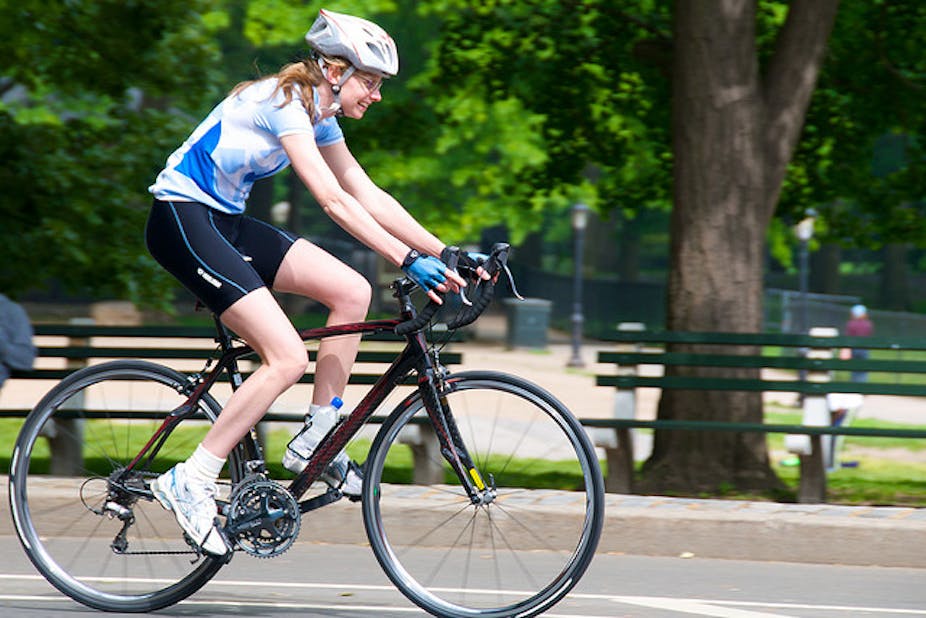
Putting a lid on the debate: mandatory helmet laws reduce head injuries

Since mandatory bike helmet laws were introduced in 1991, researchers, cyclists and campaigners have debated the law’s role in cyclist safety and the desirability of bike riding. A new analysis reveals rates of head injuries reduced by almost a third after the laws were introduced. We spoke with the…

Ed_yourdon
A re-analysis of the data shows there’s a good case for keeping helmet laws.

Since mandatory bike helmet laws were introduced in 1991, researchers, cyclists and campaigners have debated the law’s role in cyclist safety and the desirability of bike riding.

A new analysis reveals rates of head injuries reduced by almost a third after the laws were introduced. We spoke with the lead author of the study Jake Olivier, Senior Lecturer at UNSW’s Prince of Wales Clinical School, about the evidence used in the bike helmet debate:

My involvement in this research began when the Voukelatos and Rissel paper came out last year in the Journal of the Australasian College of Road Safety. The paper said rates of cyclist head injury had decreased more in the period before the mandatory helmet laws were introduced than after.

When I read it initially, I thought the article had some interesting methods. But on closer inspection, the authors' analysis looked weak.

It came out later that there were some data errors, which were pointed out by Tim Churches. The errors turned out to be real and Voukelatos and Rissel were given a chance to respond. They didn’t, so the journal retracted the paper.

At that stage, I decided to take Voukelatos and Rissel’s basic idea and do a more comprehensive and statistically rigorous analysis.

What was your methodology?

In order to find out whether there was a reduction in head injures, we looked at the ratio of head to arm injuries – and this is what Voukelatos and Rissel did.

Any major drop in cycling rates would have resulted in a drop in head and arm injury rates. So the comparisons we made were “exposure free”, meaning the variations in cycling numbers wouldn’t affect the analysis.

What periods and regions did you examine?

We looked at data from New South Wales from eighteen months before the legislation and then eighteen months after its introduction. It’s the same data source that Voukelatos and Rissel used. (The Daily Telegraph ran a story today saying it was new data but this isn’t true).

When Tim Churches corrected the mistakes from Voukelatos and Rissel’s paper, he came to the same conclusions we did.

What are the key findings from your re-examination of the data?

We found a 29% reduction in bicycle-related head injury attributable to the introduction of the mandatory helmet law.

There has been some debate about whether the head-to-arm injury ratio was the best methodology. So we also looked at the ratio of head to leg injury, to see if we could observe the same effect among cyclists, and we did.

We then repeated those two analyses on pedestrians. The helmet law was directed at cyclists not pedestrians, so if we found a big drop in pedestrians, that would be an indication of general road safety improvements.

But we did not see a reduction in pedestrian head injury at all relative to limb injuries.

So the reduction in head injuries seems to have been isolated to cyclists and that drop appears to be real.

How does your analysis compare with the existing data on the introduction of mandatory bike helmet laws?

There are some conflicting reports out there. And a lot of these have been dogged by problems of confounding variables: Is the decline in head injury a result of general road safety improvements? Is it because of other things that are happening in the community?

We developed our analysis to account for all that – and this sets our methodology apart from what’s been done in the past.

Based on our analysis, I think the question of whether mandatory helmet laws reduced head injury should no longer be debatable in NSW. We should maintain mandatory helmet laws.

Did cyclist numbers reduce after the mandatory helmet laws were introduced?

The Roads and Traffic Authority (RTA) commissioned a few reports around the time the helmet law was introduced. One that came out in 1991 found the number of child cyclists reduced by around a third but there seemed to be an increase in adult riders. The overall numbers appear stable around that time.

So the numbers of cyclists overall may not have changed much, with more adults cycling but fewer children cycling – our model accounted for that.

Our conclusions remain the same regardless of the numbers of cyclists. But there is certainly active debate about whether it stopped people from cycling or not, and whether those that stopped cycling took up other activities and returned to cycling after our study period.

Are helmets currently a barrier to cycling?

Helmets aren’t a major barrier. There’s a widely cited survey by the Cycling Promotion Fund and the National Heart Foundation that suggests it is one of many coming in as the tenth most selected barrier. However, there were some problems with their methodology in terms of finding the primary barriers to cycling.

The researchers asked, “What do you find are the barriers to cycling?“ and gave the respondents a list of choices, allowing them to tick as many as they wanted. The problem with that is you don’t get an idea of what the main barrier of cycling is for these people.

The results showed around 16% said the helmet law was a barrier to cycling and it was ranked the tenth most common barrier. So when you consider that this might not be the main barrier, the actual figure is likely to be much lower than 16%.

How can we improve cycling rates?

We need to separate cyclists from pedestrians and motorcars, increase education programs and work to make the roads safer in general.

If we can increase cycling numbers in Australia we will get a “safety in numbers" benefit, but we are far from reaching cycling participation rates to achieve that.

Improving road infrastructure for cyclists would certainly increase safety. But on top of that, we need to make sure every rider has a helmet on top of her head to get the maximum safety benefit.


The Conversation has previously published articles on both sides of the mandatory bike helmet debate: Chris Rissel argued ditching bike helmet laws would encourage more people to cycle and the public health benefits would outweigh the increased risk of head injury and Max Carmon outlined the benefits of mandatory helmet laws in protecting cyclists against head trauma.

Articles also by This Author

Sign in to Favourite

Want to follow The Conversation?

Sign up to our free newsletter to get the day's top stories in your inbox each morning, with a special wrap on Saturday.

Spinner
Become a friend of The Conversation and donate

Join the conversation

83 Comments sorted by

  1. Andrew Kirk

    logged in via LinkedIn

    It's interesting that, in an article about bicycle safety, the accompanying picture shows a woman wearing a helmet (sensible), yet also wearing music earphones - a practice that detracts from safety far more than the helmet she is wearing helps!

    report
  2. Troy Barry

    Postgraduate student

    In terms of the effects on cycling numbers, it would be interesting to see the effects not only in Australia before and after introducing mandatory helmet laws, but in the amount of cycling activity in Australia relative to other comparable nations over the same timeframe. Considering the two comparisons together could help isolate the effects of helmet laws.

    report
    1. Jake Olivier

      Senior Lecturer, School of Mathematics and Statistics at University of New South Wales

      In reply to Troy Barry

      Interesting point, Troy. Our analysis utilised NSW data and I would encourage researchers in other Australian states and other countries to do the same analysis in their setting.

      report
  3. Dorothy L Robinson

    logged in via email @gmail.com

    The new analysis doesn’t show that helmet laws reduce head injuries, only that there might be some small benefit in the event of a crash.

    Unfortunately, there is very strong evidence that helmet laws increase the likelihood of crashing, because of risk compensation and reduced safety in numbers. Table 2 of the paper “Head injuries and bicycle helmet laws” Accident Analysis and Prevention, V28, 463-75, 1996 shows that the risk of a child cyclist suffering a head injury increased by 27%, and the…

    Read more
    1. Jake Olivier

      Senior Lecturer, School of Mathematics and Statistics at University of New South Wales

      In reply to Dorothy L Robinson

      Dorothy,

      Thank you for a summary of your past work on mandatory helmet laws. However, it is important to point out our paper isn’t just another rehash on the subject, but it is also a paradigm shift in the way MHL data is analysed.

      As mentioned above and worded more succinctly in our paper, our analysis is “exposure free” meaning neither the exact number of cyclists on the road nor the number of cyclists wearing helmets is needed nor does it affect our results. This is based on an assumption of…

      Read more
    2. Dorothy L Robinson

      logged in via email @gmail.com

      In reply to Jake Olivier

      Unfortunately, Jake, the amount of cycling (or “exposure”) is vitally important. The observational surveys point to a decrease of 33% in the amount of cycling. You say head injuries fell by 32.8%. Therefore the law did not change the risk of head injury per km cycled. Instead (presumably because of risk compensation and reduced safety in numbers) cycling became dangerous. The risk of arm and leg injuries per km cycled increased, without any reduction in head injuries per km cycled.

      Risk compensation…

      Read more
    3. Jake Olivier

      Senior Lecturer, School of Mathematics and Statistics at University of New South Wales

      In reply to Dorothy L Robinson

      Dorothy,

      The models we have chosen are in fact "exposure free" and the drop that we attribute to MHL is in addition to general road safety measures. Regardless of the fluctuations in the number of cyclists of different age groups post MHL, the drop in bicycle related head injury would still be 0.725 (95% CI: 0.539-0.974). A quick computation of the maximum likelihood estimates taken from the negative binomial generalised linear regression would demonstrate that. We discuss the conflicting reports…

      Read more
    4. Nigel Perry

      Computer Scientist at University of Canterbury

      In reply to Jake Olivier

      Jake,

      Dorothy and you are arguing different issues, both of which could be true. Your argument is that the ratio of head to leg injuries improved. You argue this is a paradigm shift, unfortunately this is not exactly true as similar analyses have been performed in New Zealand in an attempt to remove the "exposure" factor (probably as few serious people would today argue that MHLs do not decrease bicycling due to a combination of factors). The NZ results did not produce any conclusive magic bullet…

      Read more
    5. Harvey C

      Cyclist

      In reply to Nigel Perry

      Interesting Nigel, as NSW data confirms your hypothesis.

      Hospital data on children injuries in NSW shows that the risk of head injuries increased by 5% after the helmet law, while the risk of non-head injury increased by 46%.
      http://www.cycle-helmets.com/robinson-head-injuries.pdf

      The rise in the risk of non-head injuries indicates a significant increase in the risk of accidents.
      It is incorrect to claim that head injuries declined from a decline in the ratio of head to leg or arm injuries.

      report
    6. Harvey C

      Cyclist

      In reply to Nigel Perry

      Could the study authors please tell us which data source shows that adult cycling increased in NSW after the helmet law?

      There is evidence that, like child cycling, adult cycling decreased significantly in NSW after the helmet law. For example, between 1991 and 1996, the number of cyclists dropped by 48% in Sydney.
      Walker M. Bicycling in Sydney: law compliance and attitudes to road safety. Velo Australis; 1996; Fremantle, Western Australia.
      This is similar to a 44% drop in the number of children cycling measured by the RTA two years after the helmet law.

      In Melbourne, adult cycling was measured 29% lower one year after the helmet law.
      http://www.cyclehelmets.org/papers/c2022.pdf
      How could adult cycling have increased in Sydney? Where is the supporting data?

      report
    7. Harvey C

      Cyclist

      In reply to Nigel Perry

      I’m puzzled by the headline claim made in this article and in the media that head injuries were reduced by 29%. What is odd is that the study itself does not even claim that. The study claims that the ratio of head to arm or leg injury was reduced by “up to 29%”.

      To claim that head injuries fell assumes that the risk of accidents did not increase. Hospital data on children injuries in NSW shows that accidents per cyclist increased significantly after the helmet law, as the risk of non-head injury…

      Read more
    8. Jake Olivier

      Senior Lecturer, School of Mathematics and Statistics at University of New South Wales

      In reply to Harvey C

      Harvey,

      There was a decline in bicycle related head injury hospitalisations in NSW which I mentioned above, “In terms of actual numbers of head injuries, we noted 1288 bicycle related head injuries in the 18 month period before the law and 866 in the 18 period thereafter.” There was a decline in bicycle related head injury hospitalisations for both children and adults.

      report
    9. Jake Olivier

      Senior Lecturer, School of Mathematics and Statistics at University of New South Wales

      In reply to Harvey C

      Harvey,

      Please read the following. The timing of this report is important as data was collected only a few months after the adult helmet law went into effect.

      Walker M, 1991. Law compliance and helmet use among cyclists in New South Wales, April 1991. Consultant Report 1/91. Road Safety Bureau, NSW Roads and Traffic Authority, Rosebery, NSW.

      The summary page clearly states an overall increase of 6% in adult cyclists post-law. This increase is attributable to a “22% increase in numbers in Sydney and a 9% decrease in numbers in rural New South Wales.” Since over 60% of the NSW population lives in Sydney, a 22% increase is quite important.

      report
    10. Jake Olivier

      Senior Lecturer, School of Mathematics and Statistics at University of New South Wales

      In reply to Harvey C

      Harvey,

      We have never made the claim “the risk of accidents did not increase” nor have we claimed the opposite. The reason for choosing our model is that increases or decreases in risk do not affect the ratio of head to arm injuries (our analysis of NSW hospitalisation data supports this). I’ve even stated as much in a response to a comment that follows Jan Garrard’s excellent article. This issue is rooted in a misunderstanding of ratios and the lack of comparability for unrelated percentages…

      Read more
    11. Raphael Grzebieta

      University of New South Wales

      In reply to Harvey C

      Dear Harvey C.,

      How about revealing who you are (like all of us have) so that we can identify what if any conflicts of interest you have. It is obvious from your recent numerous postings that you have decided to flood the website with comments which clearly favour anti-helmet law lobbyists. This is quite mischievous of you.

      report
    12. Harvey C

      Cyclist

      In reply to Jake Olivier

      There was a nominal decline in head injuries from hospital data gathered by Dorothy Robinson as well (Table 2, page 465).

      Dorothy's study did adjust the head injury count for the number of cyclist, to assess the risk per cyclist.

      As the number of child child cyclists dropped significantly, even though the head injury count was lower after the helmet law, the risk of head injury per cyclists was higher.

      report
    13. Harvey C

      Cyclist

      In reply to Raphael Grzebieta

      Sorry to be annoying Raphael but there is no conflict of interest.

      I am not an academic. I am not in competition in any way with any academic research or academic institution.

      I am simply a cyclist struggling to understand the rationale behind the helmet law. . I have lived in countries where cycling was normal, unrestricted and safe. In Australia, cycling is marginalised, victimised and perceived as dangerous. Considering that comparable developed countries (except NZ) have no adult helmet law, enjoy safer cycling and benefit from higher level of cycling, I am puzzled by this policy.

      report
  4. Joe Rafalowicz

    logged in via Facebook

    I tend to agree with broad argument of Dorothy L Robinson. When I lived in Copenhagen, riding without a helmet was a natural part of life for all people - young, old, poor, rich, female, male. I observed the strong cycling infrastructure was responsible for the safety of the riders, and contributed to their willingness to cycle.

    I also believe that wearing a helmet is the main barrier to cycling, particularly for young people and women - though this is only an opinion from anecdotal observation, which cannot refute the survey. However it would be interesting to hear some qualitative investigation of barriers to cycling.

    Therefore, while the study might be correct in the sense that 'in Australia right now wearing a helmet reduces injuries', public policy to do with cycling should focus on creating an environment that is so safe that helmets do not need to be worn.

    report
  5. Moz Moz

    Geek

    <i>Based on our analysis, I think the question of whether mandatory helmet laws reduced head injury should no longer be debatable in NSW. We should maintain mandatory helmet laws.</I>

    Actually, based on your analysis, pedestrian helmets should be made mandatory. The research shows that they would have more benefit than cyclist helmets (there are more pedestrians, and hence more pedestrian injuries).

    report
  6. Chris Rissel

    Professor of Public Health at University of Sydney

    Dear Jake, you may not have been informed by your colleagues correctly about the initial work done by Voukelatos and myself. You say "The errors turned out to be real and Voukelatos and Rissel were given a chance to respond. They didn’t, so the journal retracted the paper."

    This is completely untrue as we wrote 4 different responses to the Journal in reply to the comments by Mr Churches, in response to the 4 seperate reviewers and stipulations of what was acceptable to write by the Editor. We corrected…

    Read more
    1. Raphael Grzebieta

      University of New South Wales

      In reply to Chris Rissel

      Dear Chris, you likewise have incorrectly stated what happened. You did get a fair hearing but chose to ignore the reviewers and Journal Editors continued request to adequately correct your results multiple times. This is the extract from the February 2011 Journal edition http://www.acrs.org.au/srcfiles/ACRS-Journal-22No1WebLR2.pdf:

      “As indicated in the November 2010 issue of the journal (http://www.acrs.org.au/srcfiles/ACRS-21-4Web.pdf , the response from Dr Alex Voukelatos and A/Prof. Chris Rissel…

      Read more
    2. Jake Olivier

      Senior Lecturer, School of Mathematics and Statistics at University of New South Wales

      In reply to Chris Rissel

      Chris,

      As per your statement "Getting people more physically active should be the main policy imperative", outside of repealing MHL, I would gladly hold that torch with you. With regards to barriers to cycling, I have commented above about the recent Cycling Promotion Fund and the National Heart Foundation survey which includes a hyperlink to their report.

      http://www.cyclingpromotion.com.au/images/stories/MediaReleaseDocs/CyclingPromotionFund_Riding_a_Bike_for_Transport_Survey_Report_2011.pdf

      Read more
    3. Edward Stratton-Smith

      Lawyer

      In reply to Jake Olivier

      Jake,

      I confess I do not fully understand all of the statistics you cite but the question of whether MHLs are a barrier to cycling must be asked of people who do not cycle. Your survey asked participants who cycled in the past month. What do non-cyclists say? That is a more important question.

      In determining whether MHLs are necessary or advisable, it is useful to look at how much a helmet may reduce the incidence of head injury, to the extent it can be measured, as you have done. However, I would…

      Read more
    4. Raphael Grzebieta

      University of New South Wales

      In reply to Edward Stratton-Smith

      Edward, firstly we did not do the survey, so it is not ‘our’ survey. Let's get that right. The citation that Jake quoted is from the Cycling Promotion Fund and the National Heart Foundation survey. Their survey included more than 40% of respondents who do not own or have access to a bike and said they prefer other forms of recreation and exercise activities to cycling or don’t like cycling at all. Just under a quarter (I presume of 40% non-cyclists respondents) felt cycling was not a safe form of…

      Read more
    5. Dave Kinkead

      logged in via Facebook

      In reply to Raphael Grzebieta

      Raphael,

      I'd like o hear your perspective on the relative effectiveness of various cycling safety interventions. In the Garrard study you mentioned, it seems that cycling with a helmet in Australia is far more dangerous than cycling without a helmet in the Netherlands and Denmark.

      How have MHLs changed the cycling fatality rate per 10^8kms here in Oz - were they previously much higher than 4 to 7 per 10^8km? How does the safety effect of MHL compare to policies like separate bike lanes and strict liability that the dutch have used to get their fatality rates down to 1.1 per 10^8km?

      report
    6. Dorothy L Robinson

      logged in via email @gmail.com

      In reply to Jake Olivier

      Jake cites research showing that people don't cycle because they think it's unsafe.

      Why is cycling considered unsafe? Because it really is hazardous, or because cyclists are required by law to wear a helmet therefore it **must** be dangerous?

      I remember the adverts promoting helmet laws that made people think that they would die of head injuries if they cycled without a helmet. It's no wonder people think cycling is unsafe. This appears to be another way in which helmet laws have discouraged a healthy, environmentally-friendly mode of transport.

      report
  7. Max Cameron

    Professor (Research) at Monash University

    Congratulations on a definitive piece of research that puts the question of the effectiveness of mandatory helmet laws (MHLs) to rest. I find this area of research, policy and public reaction fascinating. It is a complex area of public policy. Looking at all the comments and objections to the research, I think there are many questions that arise:

    1. Do bicycle helmets prevent (reduce the risk of) (some) (severe) head injury in crashes?
    2. Does a MHL increase helmet use and (if 1. is true) prevent…

    Read more
  8. Barry Calderbank

    logged in via Facebook

    A serious question, Jake. Some cities have public bikes - you can simply ride one from one bike depot to another, with depots strategically placed around the CBD. I suspect there'd be good reason not to have public helmets to go with the bikes. Which raises the question of whether people would have to use their own helmets and, assuming that is so, carry them around. Isn't the helmet compulsion a significant problem for the sort of public bike programs that'd make sense in our busier CBDs at least? I've seen these schemes operate overseas and they appear to be well used - but without helmets.

    report
  9. Dave Kinkead

    logged in via Facebook

    Jake,

    Thanks for contributing to the helmet debate. I would like to hear your response to a specific issue that is pertinent to any scientific work that supports public policy.

    Your argument for bicycle helmet laws amounts to the following:

    P1 - intervention X results in beneficial consequences for the individual subjected to it
    P2 - intervention X has relatively few costs associated with it
    C - it is therefore justified that the state mandates intervention X

    The support you provide for P1 is…

    Read more
    1. Paul Richards

      Paul Richards is a Friend of The Conversation.

      In reply to Dave Kinkead

      A comparison with any city that has a good cycling culture, will see the primary concern is for people. Not cars and large vehicles.

      The cities with the best figures for public health due to cycling as part of peoples daily activity are cycle friendly cites, the life expectancy rises and quality of life improves. Simply by reducing lanes, diverting cars and making cites again about people. Trade increases in the shops, people come and buy, sit and have coffee, and generally use the public space…

      Read more
  10. Ben Hughes

    logged in via Twitter

    Although more data and research is always a good thing, this hardly addresses the core of the helmet law issue: should decisions about personal safety be dealt with in law?

    How many deaths and serious injuries would be prevented if we completely banned motorcycles? Or alcohol?

    This is a question of liberty, not safety.

    report
  11. Nigel Perry

    Computer Scientist at University of Canterbury

    Jake et al,

    As I've commented in the thread between Dorothy Robinson and yourself, the noble goal of eliminating confounders by being "exposure free" appears to have eliminated too much. The result of this is your conclusion is unsustainable, regardless of the validity of the data.

    However the issue of whether MHLs should exist at all is far wider than any localised impact on injury rates, so your particular analyses is probably moot.

    It is widely accepted that bicycling provides a health and…

    Read more
  12. Tim Wightman

    logged in via Facebook

    The most frustrating omission from this recurrent argument is not whether mandatory helmet wearing laws are beneficial or not. (I believe they are not). The more important point is the loss of personal freedom, to choose how we live our lives, to make our own intelligent analysis and choice of the situations that affect our individual existence. Instead, we are treated like mindless zombies. For that reason alone, these invasive nanny-state laws should be abolished as soon as possible, regardless of the research.

    report
  13. Chris Gillham

    Journalist

    If the true negative impact of the helmet law on public cycling participation is irrelevant to this "exposure free" study, what is its point?

    Unless there's something pretty amazing in the unavailable raw data, the evidence points to more accidents/injuries per cyclist overwhelming a slight decrease in the proportion of head injuries.

    For a different perspective on the Walter et al study, see http://www.cycle-helmets.com/cycle-helmet-injuries-nsw.html

    report
    1. Raphael Grzebieta

      University of New South Wales

      In reply to Chris Gillham

      The commenter misunderstands what is meant by "exposure free" - what is meant is that there is adjustment in the statistical model for variations in cyclist numbers after the introduction of the helmet law. It does not mean, as the commenter seems to think, that variations in cyclist numbers were ignored. The adjustment was done by treating limb injury hospitalisation rates in cyclists as a proxy for cyclist numbers/exposure, month-by-month.

      Also, the web page referred to by the commenter includes…

      Read more
    2. Jake Olivier

      Senior Lecturer, School of Mathematics and Statistics at University of New South Wales

      In reply to Chris Gillham

      There are several misconceptions regarding our study that I’d like to elucidate. Measures of exposure are included in our model in the form of population size or number of accidents reported to the RTA. However, the exposures cancel out when considering the ratio of head to limb injuries. This can be illustrated by letting x and y be the number of bike-related head and arm injuries respectively at any given unit of time. Further, let n be a common measure of exposure to both. Now an estimate of the…

      Read more
    3. Nigel Perry

      Computer Scientist at University of Canterbury

      In reply to Jake Olivier

      Jake,

      I am sorry; but there is no misconception, at least here, on this issue. As I explained earlier by providing a simple counter-example canceling out the exposure does not work. Repeating the flawed assertion does you no service.

      While at any *particular* given unit of time the exposure cancels, you cannot compare the resulting ratios at *different* points of time unless you can show that there is zero correlation between exposure and injuries.

      Not only have you not done this, but much research…

      Read more
    4. Dave Kinkead

      logged in via Facebook

      In reply to Jake Olivier

      Jake / Raphael,

      Would you care to share your thoughts as to how effective the evidence says helmet laws are compared with other safety measures. I ask because helmet laws seem to be the primary focus of cycling safety in Australia and have resulted in a fatality rate, cited by Raphael, of 4-7 per 10^8km and serious injury rate of 128-317 per 10^8km.

      Yet most European countries have achieved much lower rates without helmet laws by focusing on preventing collisions in the first place. The Netherlands for example, has fatality and serious injury rates of 1.1 and 14 per 10^8 kms. (Oddly enough, those same countries also have much higher cycling participation rates) Doesn't it make sense to focus on safety interventions that actually produce results?

      Love to hear your replies from this and other questions I have asked here.

      report
    5. Chris Gillham

      Journalist

      In reply to Raphael Grzebieta

      I'm fully aware that "exposure free" means an adjustment in the statistical model, but I'm pointing out that the adjustment is wrong.

      The model is effectively based on the theory that "any major drop in cycling rates would have resulted in a drop in head and arm injury rates" (quoting this article).

      What happens to the theory if the rate of accidents/injuries per cyclist on the road increased after MHL because of various factors including risk compensation - as was the case?

      If all of my response…

      Read more
    6. Jake Olivier

      Senior Lecturer, School of Mathematics and Statistics at University of New South Wales

      In reply to Nigel Perry

      I apologise, Nigel, you are correct in that I did not clear up all your misconceptions. Instead, I only cleared up those relating to our paper and not your misconceptions regarding statistical science. Counterexamples are useful in deterministic fields such as pure mathematics or computer science. Statistical science is governed by the laws of probability and is the basis for most scientific fields such as biology, psychology, medicine, geology, economics, political science, public health, population…

      Read more
    7. Nigel Perry

      Computer Scientist at University of Canterbury

      In reply to Jake Olivier

      Jake,

      Let me deal with the last comment first: my apologies but my poor wording has led you to misinterpret. I was not implying that you were taking a political/religious stance, but rather than such stances are common and those who take them will take your categorical conclusion based on non-categorical analysis as a reinforcement of their position. So my apologies, no slight intended.

      Hopefully with that cleared up we can get back to the meat.

      You are correct, I am both a pure mathematician…

      Read more
  14. Alan Todd

    logged in via Facebook

    What Walter et al found was a small change in the ratio of head to arm and head to leg injuries for cyclists in NSW over a thirty six month period before and after mandatory helmet legislation was introduced. This was unsurprising, and the effect was not very marked. Nigel Perry has quite correctly shown that this is consistent with the possibility that cyclists head injuries pro rata actually increased following the legislation. In short, the strength of Walter et als methodology - removal of…

    Read more
  15. Anony Mous

    Have just been back in Australia a few months after living in the UK for 15 years. Was a non-helmet wearer in the UK, cycling to work reguarly in London and on the occasional jaunt to Europe. I cycled about 30,000 km over this time - without a helmet and without any head injuries. Coming back here, I find it quite hard to adjust to having to wear a helmet. Firstly, I find them quite awkward and uncomfortable on my head. Also, you cannot fit a cap comfortably underneath - to provide some shade from…

    Read more
  16. Richard Grassick

    logged in via email @gmail.com

    Dave raises an important question about other safety measures. By citing other European countries, and their differing approaches to safety, it puts helmet laws in an appropriate sociocultural context. I would argue that this context is a much more important determinant of which safety measures hold our attention than any medical analysis.

    Arguments about the efficacy or otherwise of the helmet protecting the cranium do not simply apply to cycling - they can also be equally valid to children learning…

    Read more
  17. Harvey C

    Cyclist

    Could the study authors please tell us which data source shows that adult cycling increased in NSW after the helmet law?

    There is evidence that, like child cycling, adult cycling decreased significantly in NSW after the helmet law. For example, between 1991 and 1996, the number of cyclists dropped by 48% in Sydney.
    Walker M. Bicycling in Sydney: law compliance and attitudes to road safety. Velo Australis; 1996; Fremantle, Western Australia.
    This is similar to a 44% drop in the number of children cycling measured by the RTA two years after the helmet law.

    In Melbourne, adult cycling was measured 29% lower one year after the helmet law.
    http://www.cyclehelmets.org/papers/c2022.pdf
    How could adult cycling have increased in Sydney? Where is the supporting data?

    report
    1. Jake Olivier

      Senior Lecturer, School of Mathematics and Statistics at University of New South Wales

      In reply to Harvey C

      Harvey,

      Please read the following. The timing of this report is important as data was collected only a few months after the adult helmet law went into effect.

      Walker M, 1991. Law compliance and helmet use among cyclists in New South Wales, April 1991. Consultant Report 1/91. Road Safety Bureau, NSW Roads and Traffic Authority, Rosebery, NSW.

      The summary page clearly states an overall increase of 6% in adult cyclists post-law. This increase is attributable to a “22% increase in numbers in Sydney and a 9% decrease in numbers in rural New South Wales.” Since over 60% of the NSW population lives in Sydney, a 22% increase is quite important.

      report
    2. Harvey C

      Cyclist

      In reply to Jake Olivier

      Good point about the time frame Jake. Let's focus on the period one year after the helmet law.

      I am sure that you aware of confounding factors, but perhaps not all readers are. In statistics, apparent correlations can be misleading. One example is that drinking coffee is correlated with lung cancer. Yet there is no explanation for how coffee could possibly cause lung cancer. The explanation is that coffee drinkers tend to smoke as well. Smoking is the counfounding factor.

      Any apparent correlation…

      Read more
    3. Harvey C

      Cyclist

      In reply to Jake Olivier

      Going beyond the few months, after the helmet law, Walker repeated the 1991 survey in 1992. It was intended to replicate as closely as possible the design of the second survey in April 1991. It says that "the excellent weather at the time of the second survey was repeated for this third survey ... the conditions for a fair comparison between the second and third surveys have been obtained". It states that the number of cycists observed decreased across age groups and in both rural centres and Sydney…

      Read more
    4. Harvey C

      Cyclist

      In reply to Harvey C

      something went wrong with truncated reply. reposting full comment

      Good point about the time frame Jake. Let's focus on the period one year after the helmet law.

      I am sure that you aware of confounding factors, but perhaps not all readers are. In statistics, apparent correlations can be misleading. One example is that drinking coffee is correlated with lung cancer. Yet there is no explanation for how coffee could possibly cause lung cancer. The explanation is that coffee drinkers tend to smoke…

      Read more
    5. Tim Churches

      logged in via email @gmail.com

      In reply to Harvey C

      Harvey,

      You quote the results of the April 1991 and April 1992 RTA surveys of cyclists in NSW, but the RTA survey was repeated again in April 1993, using the same methodology and the same sampling locations (and thus the results of the 1991, 1992 and 1993 surveys can be validly compared). The results of the 1991, 1992 and 1993 surveys are summarised in table 3.1 on page 16 of the 1993 survey report by Smith and Milthorpe. The counts of adults riders observed were as follows:

      April 1991: 6829
      April…

      Read more
    6. Tim Churches

      logged in via email @gmail.com

      In reply to Harvey C

      Harvey,

      Regarding changes in adult cyclist numbers following the introduction of helmet laws in NSW, what we said in our paper was that "...the estimated overall change in [adult] cyclist numbers in NSW was close to zero (Walker, 1990, 1991, 1992; Cameron et al., 1992, 1994; Smith and Milthorpe, 1993)."

      report
    7. Harvey C

      Cyclist

      In reply to Tim Churches

      That's not the full quote from the study published here:
      http://handle.unsw.edu.au/1959.4/50858

      The full sentence is:

      "While the reduction in numbers of teenaged cyclists has been widely cited in the few years immediately after legislation, the opposite was observed among adults and the estimated overall change in cyclist numbers in NSW was close to zero (Walker, 1990, 1991,1992; Cameron et al., 1992, 1994; Smith and Milthorpe, 1993)."

      report
    8. Harvey C

      Cyclist

      In reply to Tim Churches

      This fails to address the key initial point, which is that the claim in the study that adult cycling increased after the helmet law is not supported by credible data.

      report
    9. Tim Churches

      logged in via email @gmail.com

      In reply to Harvey C

      Harvey,

      As noted above, the numbers in the RTA survey reports show an approximately 10% increase in NSW adult cyclist numbers observed in the same places between September 1990 and April 1991 (with the adult helmet law coming into effect in the middle of this interval, in January 1991), followed by a 9% dip from April 1991 to April 1992, and then a full recovery of that dip by April 1993, such that the number of cyclists observed was slightly higher than in April 1991. It is likely that such alternating…

      Read more
    10. Harvey C

      Cyclist

      In reply to Tim Churches

      This still fails to address the key initial point mentioned above, which is that the claim in the study that adult cycling increased after the helmet law is not supported by credible data.

      Additionally, Dorothy Robinson has provided a more comprehensive set of data on cycling numbers in a long comment above. This might be a better basis to discuss the impact of the helmet law on cycling numbers.

      report
    11. Harvey C

      Cyclist

      In reply to Tim Churches

      This still fails to address the key initial point mentioned above, which is that the claim in the study that adult cycling increased after the helmet law is not supported by credible data.

      Additionally, Dorothy Robinson has provided a more comprehensive set of data on cycling numbers in a long comment above. This might be a better basis to discuss the impact of the helmet law on cycling numbers.

      report
    12. Tim Churches

      logged in via email @gmail.com

      In reply to Harvey C

      Harvey,

      What we say in our paper is entirely consistent with the data reported in the NSW RTA cyclist surveys of 1990 to 1993, as has already been discussed at length in the comments above.

      report
    13. Harvey C

      Cyclist

      In reply to Tim Churches

      No it is not. The paper states "While the reduction in numbers of teenaged cyclists has been widely cited in the few years immediately after legislation, the opposite was observed among adults and the estimated overall change in cyclist numbers in NSW was close to zero"

      There is no clear evidence that adult cycling increased after the helmet law. As you have explained above, the data from the NSW RTA cyclist surveys of 1990 to 1993 is inconclusive for adults.

      There…

      Read more
  18. Harvey C

    Cyclist

    I’m puzzled by the headline claim made in this article and in the media that head injuries were reduced by 29%. What is odd is that the study itself does not even claim that. The study claims that the ratio of head to arm or leg injury was reduced by “up to 29%”.

    To claim that head injuries fell assumes that the risk of accidents did not increase. Hospital data on children injuries in NSW shows that accidents per cyclist increased significantly after the helmet law, as the risk of non-head injury…

    Read more
    1. Jake Olivier

      Senior Lecturer, School of Mathematics and Statistics at University of New South Wales

      In reply to Harvey C

      Harvey,

      We have never made the claim “the risk of accidents did not increase” nor have we claimed the opposite. The reason for choosing our model is that increases or decreases in risk do not affect the ratio of head to arm injuries (our analysis of NSW hospitalisation data supports this). I’ve even stated as much in a response to a comment that follows Jan Garrard’s excellent article. This issue is rooted in a misunderstanding of ratios and the lack of comparability for unrelated percentages…

      Read more
    2. Harvey C

      Cyclist

      In reply to Jake Olivier

      Thanks for detailed reply Jake.

      I understand that the ratios are not exposure related.

      I am confused by what you are trying to say though.

      You state that
      “we noted a 25% drop in the head/arm ratio and a 29% drop in the head/leg ratio after MHL”

      This is the impression I got from the study.

      But then the last sentence says
      "Lastly, the 25% or 29% drop we quoted is a drop in bicycle-related head injury in addition to decreases in limb injuries and not necessarily a relative drop in head injuries only"

      This is confusing. It seems to contradict the first statement.

      The study press release states:
      "Most comprehensive analysis yet reveals a decline of up to 29% in bicycle-related head injuries immediately after NSW mandated helmet use"

      Could you please clarify where does this come from in the study?

      report
    3. Harvey C

      Cyclist

      In reply to Jake Olivier

      "We have never made the claim “the risk of accidents did not increase”

      You may not have made this claim explicitly, but you made it implicitly by jumping from a reduction in the ratio of head injuries to a reduction in head injuries in the study press release.

      This has nothing to do with the "exposure-free" nature of the model used in the study.

      The press release says :
      "Most comprehensive analysis yet reveals a decline of up to 29% in bicycle-related head injuries immediately after NSW…

      Read more
    4. Harvey C

      Cyclist

      In reply to Jake Olivier

      The study press release claims :
      "What we found provides compelling evidence that the legislation has served its purpose in reducing bike-related head injuries and any repeal of the laws would only put lives at risk"
      http://www.eurekalert.org/pub_releases/2011-06/uons-tio062211.php

      How are these assertions supported by the study?

      The study does not address what might happen if the helmet law is repealed. Why make such a strong unsupported statement? The best evidence we have of what might…

      Read more
  19. Harvey C

    Cyclist

    I’m puzzled by the claim that there was no similar reduction in ratio of head injuries for pedestrians. This is really odd as several data sets show a similar decline in the ratio of head injuries to total cycling injuries for pedestrians and cyclists. This should not be surprising as the helmet law was introduced at the same time as other significant road safety measures like a crackdown on speeding and drink driving.

    A helmet advocate, who promoted helmet wearing and believed in the helmet law…

    Read more
    1. Harvey C

      Cyclist

      In reply to Harvey C

      adding last sentence that was truncated:

      Additionally, the most significant statistical effect from the underlying data in the study was for pedestrians (P below 0.02, table 2 on page 5). Doesn’t that mean that the helmet law reduced the number of pedestrian head and arm injuries? How can this be less significant than for cyclists?

      report
    2. Jake Olivier

      Senior Lecturer, School of Mathematics and Statistics at University of New South Wales

      In reply to Harvey C

      Harvey,

      The Bruce Robinson conference paper has nothing to do with NSW data and utilises WA data exclusively and, as best as I can tell, was not peer-reviewed.

      report
    3. Jake Olivier

      Senior Lecturer, School of Mathematics and Statistics at University of New South Wales

      In reply to Harvey C

      Harvey,

      The model comparing head and arm bicycle related hospitalisations is our primary analysis. All of the other analyses, including the 3 other plots and others mentioned in the text, were performed as a sensitivity analysis. These additional analyses were needed to verify our primary analysis. Specifically, we wanted to see if that drop in head injury was consistent for other body part injuries for cyclists (which we found) and if it was consistent for pedestrians (which we did not). Your interpretation…

      Read more
    4. Luke Turner

      logged in via Twitter

      In reply to Jake Olivier

      Jake,

      If general road improvements were the reason for the decline in pedestrian head and arm injuries at the time of the helmet law, then how can you be sure that these same unknown factors did not cause the change in the cyclist head-to-limb injury ratios?

      Also considering that (by your own admission) you have not provided evidence that the risk of head injuries declined with the helmet law (only that the head-to-limb ratios declined) how can you possibly maintain then that "repealing [helmet legislation] cannot be justified"?

      report
    5. Harvey C

      Cyclist

      In reply to Jake Olivier

      Thank you Jake for the detailed explanation of the meaning of the variables within the study.

      report
    6. Harvey C

      Cyclist

      In reply to Jake Olivier

      My main concern is that a similar reduction in head injuries for pedestrians was reported by several other studies. This study oddly stands out from the rest.

      From Dorothy Robinson study on injury data for NSW children, Table 3 on page 465 reports on death and serious injuries (DSI), which should be the greatest concern when it comes to assessing the impact of the helmet law. The data shows that the risk of DSI declined by 21% for pedestrians while it increased by 21% cyclists. This is at odds…

      Read more
  20. Harvey C

    Cyclist

    There seems to be an odd discrepancy between the underlying data in the study and the claim that the ratio of head injuries fell by 29%.

    The graphs of the ratio of head to arm and leg injuries from the underlying data are shown here http://helmetfreedom.org/762/emotive-irrational-experts-claim-victory/
    The underlying data provides no strong evidence of a change in the ratio when the helmet law was introduced.

    It seems that the 29% headline claim is not the result of the underlying data, but…

    Read more
    1. Jake Olivier

      Senior Lecturer, School of Mathematics and Statistics at University of New South Wales

      In reply to Harvey C

      Harvey,

      Along with other readings I mention, might I suggest the following text that details how to fit a log-linear model.

      Dobson, A.J., Barnett, A.G., 2008. An Introduction to Generalized Linear Models,
      third ed. Chapman and Hall/CRC, Boca Raton.

      The personal blog you mention is not a peer-reviewed criticism of our paper and does not warrant mentioning on this scholarly website. Regardless, the details presented in our paper and those give by my co-authors and myself on this website adequately address those issues. Please read through them objectively.

      report
    2. Harvey C

      Cyclist

      In reply to Jake Olivier

      I am aware of linear regression models. I have had no problems making sense of the stats in the many other studies I have looked at. This study is different; it seems particularly abstruse.

      Could you please point out which part of the study address my concerns. My main challenge is not a lack of objectivity, it is to make sense of an abstruse study. This makes it difficult to make sense of the study results, and to relate them to a common sense explanation.

      The common sense issue I am…

      Read more
  21. Chris Gillham

    Journalist

    A significant portion of the conversation above was censored by the editors in mid October due to a post by prominent statistician and researcher Dr Dorothy Robinson which included four words against which the article authors took offence.

    Postings by various members have been deleted even though they bore no reference or relationship to the four words, for which Dr Robinson has publicly apologised.

    Since I've also been censored and I protest at debate being stifled through intimidation, below…

    Read more
    1. Tim Churches

      logged in via email @gmail.com

      In reply to Chris Gillham

      Chris, the authors of the study (including me) requested that the editors of The Conversation remove or edit a single post by Dorothy Robinson which contained an assertion about the authors which could be construed as defamatory. Apparently, due to technical limitations of The Conversation web site, deleting that post also deleted all posts and comments indented underneath it, which included yours. You have not been deliberately censored, you are just the victim of an arbitrary technical limitation of the web site.

      report
    2. Chris Gillham

      Journalist

      In reply to Raphael Grzebieta

      OK, I apologise if you infer that I meant you had personally used censorship or intimidation.

      I should alternatively have expressed it as "Since I've also been deleted and I protest at debate being stifled through removal of posts in this way, below is my response etc."

      I have a right to disagree with the removal of Dr Robinson's post, particularly after her apology, and the resultant deletion of posts by other members. You wanted her post removed because of a few colourful words for which she…

      Read more
  22. Luke Turner

    logged in via Twitter

    ** Two of my previous comments were deleted, so I have paraphrased below **

    The scope of this study is far too narrow to support the claim that "repealing the law cannot be justified". In fact the study does not even provide evidence that the helmet law has reduced head injury "rates" (in any meaningful sense of the word "rate"), let alone consider all the other negative side effects of making it illegal to bicycle without a helmet.

    The authors have examined the changes in: (1) the ratio of head…

    Read more
    1. Paul Richards

      Paul Richards is a Friend of The Conversation.

      In reply to Luke Turner

      Yes you are right Luke, and as I see it all comes down to humanising cites.

      This needs to be done and will mean helmets will be unnecessary. A cultural change as well as a literal change to street scape is the direction other progressive cites have chosen. New York city has embarked on it, our cites will follow. Here and now the 'free' thinking car culture is hanging on more aggressively than Europe.

      http://www.smh.com.au/national/go-naked--and-well-all-be-living-on-easy-street-20090513-b3e1.html

      report
  23. Karl Stade

    logged in via Facebook

    Lid on the debate? More like fuel on the fire. :P

    report
  24. Harvey C

    Cyclist

    The study press release claims :
    "What we found provides compelling evidence that the legislation has served its purpose in reducing bike-related head injuries and any repeal of the laws would only put lives at risk"
    http://www.eurekalert.org/pub_releases/2011-06/uons-tio062211.php

    How are these assertions supported by the study?

    The study does not address what might happen if the helmet law is repealed. Why make such a strong unsupported statement? The best evidence we have of what might…

    Read more