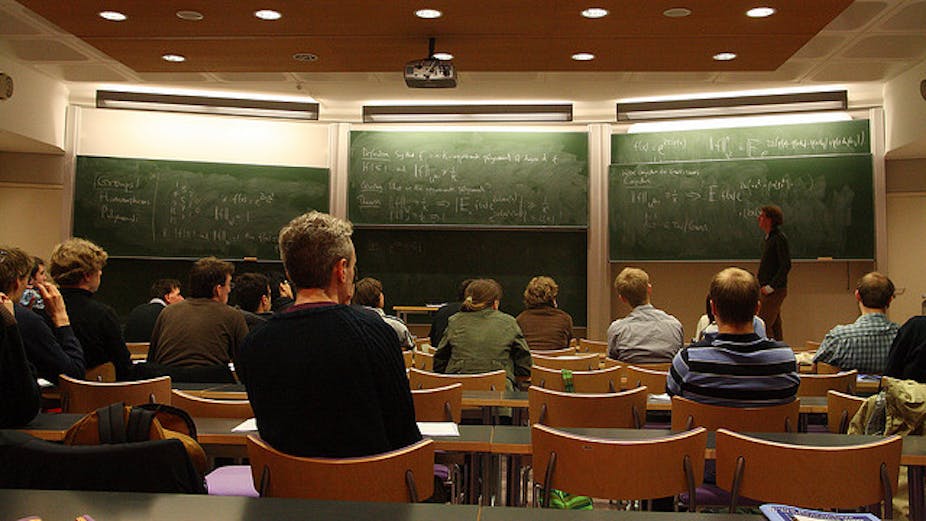
Demand for trained mathematicians is growing but enrolment is maths courses is in steep decline.
Failing to tackle the problem puts the country at risk of producing the scientists and engineers needed to tackle the great problems of our age, like climate change and technological innovation, said Australia’s National Science and Mathematics Education and Industry Adviser, Dr Roslyn Prinsley.
In this Q+A, Dr Prinsley, who began in her role last week, outlines her vision.
The number of people studying maths and science is dropping and one recent study showed the number of female students studying no maths for their HSC more than doubling in ten years. What do you think of that?
The fact that the demand in Australia for maths graduates, at the minute, is outstripping supply is a major issue for this country.
From 1998 to 2005, the demand for mathematicians increased by 52%. From 2001 to 2007, the number of enrolments in a mathematics major in Australian universities declined by 15%.
On the global scale we are falling behind too. In 2003 the percentage of students graduating with a major in mathematics or statistics in Australia was 0.4%. The OECD average was 1%.
So there’s a major mismatch going on and that should be clear to anybody.
Obviously, if we want to increase the number of maths graduates to meet that demand we have to increase numbers of both boys and girls because we want our best boy and best girl mathematicians to meet that challenge.
I do understand there are a whole range of reasons why girls are dropping out and boys aren’t doing maths either. There are issues, for instance, such as advanced maths no longer being a prerequisite for various university courses.
So if girls (and boys) don’t see a requirement to do maths, or the value in maths and they don’t think they’re very good at maths they will probably take another option and do something they think they’re better at to get a higher ATAR mark. Maths is hard and there needs to be a reward at the other end.
Having said that, there is a reasonable amount of research that has been done on girls and maths which shows that, contrary to some people’s perceptions, there is no difference in the capability of girls and boys to do maths.
However, there is a difference in their self-perception of their capability and their interest in maths.
So boys, even though they may have the same capability as girls, tend to think they have a greater capability.
Girls tend to think they have less capability than their actual capability. Something needs to be done about that.
If we could make maths more interesting for girls and increase their confidence at an early age, we could turn that around.
What are some of your goals and what do you hope to achieve in your role?
I think there is a poor understanding across a large sector of the Australian population about maths and science and how important they are for the future of Australian society and the world.
So part of my role and part of what I’m hoping to do is to create much greater awareness across the population as a whole and particularly within those students whom we need to impact.
Second of all, if we have fewer people doing maths and science, we have fewer maths and science teachers and that’s a vicious cycle. It has been shown again and again that an inspiring teacher is a key to increasing student interest in mathematics and science.
So I think there needs to be some particular work done getting many more of our best mathematicians and scientists to become teachers.
We won’t be able to sustain much needed innovation in this country if we don’t have enough good scientists or mathematicians.
Why do we need good mathematicians? What are some of these areas of innovation?
In every walk of life, we need people to do be able to do quantitative things, whether that be the person who works out the correct level of radiation to give a cancer patient or the person who works out how to make sure an aeroplane lands safely or a water engineer who is working in flood prevention or a meteorologist predicting the weather. Obviously there are also the financial and commercial sectors too, which require sophisticated mathematical analysis.
All of those require quantitative skills and we don’t have enough people who can do those things.
Virtually every sector needs people with quantitative skills who understand maths.
Your role covers not just maths, but maths and science more generally. Are we seeing the backward trends you identified in maths in those other areas too?
We are. We do know that between 1992 and 2009, the proportion of Year 12 students taking physics, chemistry and biology fell by 31%, 23% and 32% respectively.
In fact, we need more scientists, considering the sorts problems we are facing such as food security and climate change and the need for innovators to address those problems which require certain maths and science capabilities.
Engineers have a significant role, too, in powering economic growth and are in particularly short supply. We need to graduate 20,000 per year to meet national requirements but we are only graduating 9,000 per year.
One of your tasks is to create much greater awareness. How are you going to do that?
I am planning to talk to the employers from industry and other sectors to understand where the shortages are now and where they see that they will be in the future. I would like to see employers work with us to develop an awareness campaign involving the public, private and non profit sectors to increase participation, collaboration and achievement in maths, statistics, engineering and science.
Examples abound in other countries of such awareness campaigns, and Australia cannot afford to be left behind. For example, in the US, Connect a Million Minds is a five-year, $100 million philanthropic initiative to address America’s declining proficiency in science, technology, engineering and math (STEM), because this puts the US at risk of not competing successfully in a global economy.
It is largely sponsored by Time Warner Cable to create awareness of the issue and to inspire students to develop the science and maths skills they need to become the problem solvers of tomorrow.
It also concerns me that the general population has such a poor understanding of science.
You only need to look at the way people think about medicine or climate change to realise that they’re putting their own uninformed opinions before informed scientific understanding about how things work. Examples are people who don’t believe in vaccinations or climate change deniers. These types of misconceptions endanger the wellbeing of the planet.
Better education in science and maths will result in better understanding of issues which are important to every Australian.
Peter Farrell
teaching-principal at Zeerust Primary School
At about the time I hit a decade of teaching I undertook a postgraduate certificate in primary mathematics teaching through RMIT Uni. I took the course because I thought I could do maths better than I had been. The Victorian govt paid 80% of the fees and I paid 20%. I also incurred a return of service obligation. The course involved a mix of residential and on-line delivery.
The course was timely, extremely useful and affordable. It dealt with the big concepts in maths at different grade levels…
Read moreSin Fong Chan
Educator
Many qualified teachers are good in their fields but they are not good presenters and unable to deliver the materials across, let alone excite the audience to pursue the subjects further.
Unfortunately, mathematics and science teachers are pretty nerdy in their earlier lives at university, and they may have certain image problems when they stand in front of a class of students, particularly the female students.
Students study English or a particular language because they use or have to use…
Read morePeter Farrell
teaching-principal at Zeerust Primary School
The post grad certificate I referred to above was about primary mathematics teaching. Not only did it cover the big mathematical concepts applicable to school students but also how to put these across to students.
My suggestion is that experienced teachers could undertake say, a post graduate certificate in secondary chemistry teaching.
In some ways this might be a little easier nowadays with the move towards a national curriculum. Imagine a course where professional teachers from around the country could work together to improve their understanding of, and the teaching of secondary school chemistry.
I rarely ever use textbooks in my teaching - at least the teachers undertaking this training might feel confident enough to get rid of the textbook or at least use it in a more imaginative way.
Adrian Dudek
PhD Candidate at Australian National University
In 2010, I graduated with an honours degree in mathematics, as did many of my friends. We were told for many years that "mathematicians can do anything" and that "there are endless career options awaiting us". I was lucky to find a job (although I've since returned to do a PhD), but the others weren't and so returned to full-time study. In fact, they felt lied to by the tenured academics who promised them a bright future to keep them in the course. I've heard them explicitly tell other people not…
Read morePeter Farrell
teaching-principal at Zeerust Primary School
Teaching is a real life job and there is a desperate need for them!
Peter Farrell
teaching-principal at Zeerust Primary School
Should have said, teaching is a real life job and there is a desperate need for maths and science teachers.
Wish there was an edit function!
Adrian Dudek
PhD Candidate at Australian National University
Indeed! That seems to be the one example that keeps getting thrown around. But most mathematicians do not have the communication skills to teach at a school. The students rarely identify with them and this only accentuates the gap.
Of course, there are some mathematicians who would do great things at schools. But for those who can't teach or think it's below them, what are the alternatives?
Peter Farrell
teaching-principal at Zeerust Primary School
That's why my suggestion might work. I am suggesting we use experienced teachers, possibly from fields other than science or mathematics, to take on this professional learning. These guys already have the teaching and classroom management its just a matter of learning some new material and techniques. Secondary teachers working outside their fields do this a lot. At least this would be a formal process where quality could be more even.
Tracey-Ann Palmer
PhD Student
Adrian, do you believe this may be the case for science too? I am looking into this for my PhD.
Adrian Dudek
PhD Candidate at Australian National University
It really depends on the type of science. I think most science is pretty safe.
I complain about there being a lack of maths jobs, but that's because my degree focussed on pure maths and so was rather abstract. Somebody with a degree in statistics and data analysis would find a job more readily. I guess it would be good if it were all made black and white.
At the moment, I'm trying to complement my PhD by applying for every scholarship/grant/award under the sun to try and stand out from the rest of the herd.
Trish Campbell
PhD Candidate
Great idea, Peter. I would love to see teachers from other fields take on professional learning in maths and science, which could help make kids more aware of their relevance in other areas. An alternative to extra training for teachers is to get the mathematicians and scientists into the schools, which is being done through the Scientists in Schools/Mathematicians in Schools program run by the CSIRO: http://www.scientistsinschools.edu.au/
As a mathematician (and yes, most people would probably describe me as a nerd), I have found the opportunity to inspire kids has been very rewarding and the kids love it!
Andrew Norton
Program Director, Higher Education at Grattan Institute
Yes, there has been a serious problem with the maths and science lobby groups misrepresenting the employment situation for their graduates, with the federal government also contributing to the problem with their now reversed price promotion of maths and science courses.
While there may be some shortages for specialised high-level skills, as well as for teachers of maths and science, generally bachelor-degree graduates in these disciplines have below-average rates of professional and managerial employment.
Sin Fong Chan
Educator
It is easier said than done. Our brains don't work that way. One good in teaching arts discipline may find it difficult to learn or be trained in mathematics or science subjects, or vice versa.
For example, I am good in many areas, but just can't get myself interested and therefore proficient in biology and organic chemistry.
Learners / students have different learning styles and capacities. Teachers were students of yesteryears. To many, mathematics and science are far too abstract and trivial. If teachers never developed an interest in mathematics and science when young, their foundations would be poor, and it is unlikely they can do well in further education training.
Mike Hansen
Mr
Thanks for that comment Andrew.
One of the side effects of this over hyping of shortages in maths/science graduates is that the new graduate who cannot get a job starts wondering "What is wrong with me. I am reading all these articles about skills shortages in my area and I cannot get a job". It can be very deflating until they find out that the jobs do not actually exist. Then it just becomes depressing.
I actually have a maths degree which I acquired a few decades ago. It was not much different then - no jobs so I ended up with a career in IT. I have never regretted the maths degree but pre internet no one was telling me that there was a gold pot at the end of the rainbow.
Interestingly I have come across lots of electrical engineers of my generation who made careers in software engineering. There must have been some over hyping of careers for electrical engineers at the time that resulted in a glut.
Mike Hansen
Mr
Sorry but this article is bullshit.
Stop writing articles that say "The fact that the demand in Australia for maths graduates, at the minute, is outstripping supply is a major issue for this country." unless you are prepared to quantify and qualify the statements.
Articles like this can have devastating consequences for kids who make decisions to enrol in courses and then find 4 or 5 years later that the jobs do not exist.
Universities are run as businesses and they hype the job opportunities…
Read morePeter Farrell
teaching-principal at Zeerust Primary School
Welcome to my world.
I studied aquaculture and what a waste of time that was....
Mathematics is a way of seeing the world. Like it . Study it. Then get a job where mathematics emphasizes your quantitative literacy and go with that.
You'll be doing the world a large favour!
Sean Manning
Physicist
I think you are correct in blaming the marketing departments in universities for some of this misinformation.
For example; I was told that companies are 'screaming for Photonics graduates' (which, luckily I was interested in anyway). As it turns out there are perhaps a hand full of jobs being advertised each year and most are short term contract positions in universities.
That said, I think more people should have mathematics training, as it improves their critical thinking and logic. Which can only make them better in what ever area they work in.
What we really have a shortage of are mathematically literate people. Not mathematicians.
Ead Roberts
Human
If maths was so good at improving critical thinking we wouldn't have ridiculous uncritical stories like this one getting published!! Why not interview the head PR manager at Coke and ask if people should consume more soft drink? If the main (only?) destination open to maths graduates is teaching maths so as to produce more maths graduates who can go into teaching, then the folly of the entire exercise should be plain for all to see.
Maths is important, but it has been hyped out of all proportion and is actively making millions of people (read students and primary teachers) miserable every year. What we really have a shortage of is critical thinking. Not mathematicians or mathematically literate people.
Sean Manning
Physicist
That is a very cynical and, frankly, ignorant view. Rather than go into why I simply suggest you read the book Innumeracy (http://www.amazon.com/Innumeracy-Mathematical-Illiteracy-Its-Consequences/dp/0809058405) it articulates the point far better than I could.
Ead Roberts
Human
Well I'm not sure which of us is better illustrating ignorance Sean - one of the hallmarks of understanding an idea is being able to explain it. Rather than handballing your criticism, which of my points is so clearly in error?
Sean Manning
Physicist
Fine
"If maths was so good at improving critical thinking we wouldn't have ridiculous uncritical stories like this one getting published!!"
The validity of this claim is based on your personal opinion that the article is ridiculous. Your personal opinion is not sufficient to rebuke my claim that mathematics improves critical thinking.
I anticipate that you will counter this with asking me to validate my original claim that mathematics improves critical thinking. Well I don't need to because…
Read moreEad Roberts
Human
That's more like it Sean! It's not much of a "Conversation" if you just direct people to books you like.
"The validity of this claim is based on your personal opinion that the article is ridiculous. Your personal opinion is not sufficient to rebuke my claim that mathematics improves critical thinking."
You seem to have (illogically?) latched onto only a partial quote Sean. I didn't describe the article as simply 'ridiculous', I said it was a "ridiculous uncritical stor[y]". The point of my…
Read moreSean Manning
Physicist
To refine my point re: critical thinking; I was coming from the perspective that the logic implicit in mathematics is the underpinning of critical thinking. I recognise that critical thinking is a higher order process and involves more than just logic. But without logic there is no critical thinking, period.
I share your feelings about the quality of mathematics training and agree it could, no should, be done better. My feelings come from a more general place where mathematics training, when…
Read moreEad Roberts
Human
So perhaps we have found enough common ground to agree that this article could have been a better exemplar of critical thinking...
I agree with much more of what you say here - although I am not so concerned about maths not being compulsory in the final years. Only 0.5% of the workforce use higher order maths, so it seems unnecessary to 'train' 100% as if they are all going to become part of this 0.5%. After all, if brain surgeons manage to acquire their most important skills post-school, then so can all the STEM folk.
I am inclined to believe that it is this kind of wrong headed emphasis on maths that actively works against producing a more functionally numerate (broadly conceived) populace. Schools persisted with Latin for decades before finally realising that it was doing more harm than good - it turns out people can become fluent English users without it...
Ho Trieu Ngoc Luan
logged in via Facebook
Brain surgeons acquire more and more skills post-school after more and more years of practice but to gain a practice in brain surgery I am pretty sure that brain surgeons need to have some competency in mathematics and logics.
Read moreI think a background in mathematics benefits a person's work. His/her work can be carried out more properly and quicker.
Children who know mathematics learn to use the hand-held calculators quicker and can tell if results on the LED display are wrong when some bits are dead…
Ead Roberts
Human
I think we are largely in agreement Ngoc, so I wont waste time quibbling over minor differences. Where I do strongly disagree, however, is the notion that maths education is some kind of panacea to all of the world's problems. This is just more of the hype typically attributed to maths and it is utterly unjustified. Arguably the biggest role maths plays in society is as a screening device - a thinly disguised attempt at a meritocratic IQ test. With this function being diluted by maths not being…
Read moreHo Trieu Ngoc Luan
logged in via Facebook
"..there was no mass mathematics education going on at the time (of the industrial revolution).." Perhaps at that time the maths level of the populace is sophisticated enough so government at the time devoted more time, money and effort on encouraging technologists, industrialists, scientists in their invention, innovation and results of their effort culminate in the industrial revolution.
If maths education did not make any inroads into teaching people Boolean algebra then I doubt we could have…
Read moreEad Roberts
Human
There's a lot there that is pretty speculative Ngoc, and I suspect you'd struggle to find many who would describe things the way you have. I'm also pretty confident that there aren't many software engineers who can perform Boolean algebra - they don't have to, just as designers don't have to be software engineers to use CAD software. Not everyone needs Boolean algebra to be productive members of society, or even to work in the IT industry. One of the problems of hype is that people stop believing it once they see it to be false - this may be a factor in why so many people are climate change deniers, for instance. If they spent years being made to feel stupid by maths, being told they'd never amount to anything without it, and then discover that they actually have done fine without it, then maybe they can't trust all those "experts" after all? See how a little speculation can go a long way? :-)
Ho Trieu Ngoc Luan
logged in via Facebook
Cases mentioned in my previous post refer to the case of "vanguard" scientists and innovators who can bring a country to the next level of science and technology and industrialization, especially the digital and telecommunication revolution. Nowadays IT or computer programmers are just pickers of the fruits of the hard work of those "vanguard" scientists, it is just like children who bypass the time table or slide rule with hand held calculators being able to do from simple arithmetic operations…
Read moreEad Roberts
Human
No. The vanguard is a tiny fraction of the tiny fraction who use higher order maths. These people will always pursue maths regardless of how little or much they get exposed to in school. Brain surgeons get trivial exposure to their specialisation in school yet somehow me manage to churn them out, and the next great breakthrough/advancements will not be born in classrooms either. Genius does not come from doing maths in school - in fact some say schooling excels at quashing brilliance... I would argue that kids are better left with a positive experience of maths so that they might want to pursue more later, than to be fed toxic levels of tedious irrelevant bumph year after year that puts them off for life.
Ho Trieu Ngoc Luan
logged in via Facebook
Genius, whether in higher order maths or otherwise, have ideas that create technical changes influencing life of billions of people, creating millions jobs. But we are not talking about genius, we are just worrying about the Average Level of Maths Competency of normal people being insufficient to get the economic and business benefits of those technical changes.
Ead Roberts
Human
"'vanguard' scientists and innovators" have next to nothing to do with "the Average Level of Maths Competency of normal people". I've lost track of which you're most concerned about... maybe you have too! ;-)
Ho Trieu Ngoc Luan
logged in via Facebook
If demand outstrips supply why mathematicians' wages are pitifully low if they are lucky enough to get jobs in mathematical fields.
Gavin Moodie
logged in via LinkedIn
I agree with other commenters that data are needed to substantiate the claim that the demand in Australia for maths graduates is outstripping supply. I do not include as data selective surveys of mathematics lecturers interested in increasing their dwindling enrolments nor selective surveys of employers interested in depressing wages.
Graduate Careers Australia surveys bachelor graduates some 4 months after they complete their program. It found that in 2012 some 76% of the graduates available…
Read moreSean Manning
Physicist
If, I as a teacher, I could get paid at an appropriate level for someone with a PhD I'd seriously consider teaching. As it is I would be taking a pay cut so I am completely unmotivated to do so.
Jess Moore
logged in via Facebook
Thanks Roslyn for talking to the Conversation on this topic. What about a building a network available to school and university teachers of inspiring speakers (and potentially mentors) in business, communications, IT, academia who studied university maths and value the skills it provided? Such a network, could allow teachers at big and small schools alike access at low cost to speakers with inspiring career paths, something which is difficult for schools currently due to the relatively small numbers…
Read moreJess Moore
logged in via Facebook
There are some great examples of much smaller scales where people have successfully reversed similar trends. For instance, our physics honours year in 1998 was the first to have equal numbers of girls and boys. This was achieved by the efforts of a couple of the academics who organised an annual weekend away for the 2nd and 3rd year female undergrads to hang out and chat with the female grads, during which various guest speakers spoke on how their physics training had led them to an interesting career.
Melbourne University has a large find an expert database for industry, media, students and academic collaborators, but I haven't heard of any large scale speakers networks that have been set up for schools/universities to promote different study and career options.
Roslyn Prinsley
National Science & Mathematics Education & Industry Adviser at Office of the Chief Scientist
Thank you everyone for these comments to date!
I am very intersetd in reading them and there are some great ideas and real issues to be considered!
Jamie Peck
logged in via Twitter
Hi Roslyn,
Are you able to address the question posed by readers above? In particular, what evidence do you have for the assertion that "the demand in Australia for maths graduates is outstripping supply"?
Some of the information posted above seems to refute this.
John Henstridge
Principal Consultant Statistician at Data Analysis Australia
As an employer of mathematical graduates (currently 16) I can make several comments.
Firstly, the shortage of graduates in australia is real - I am thankful that the decline in New Zealand is not as bad as in Australia and about half my recruitment in recent years has been from New Zealand. Hence to say there are no mathematical jobs is simply not true. Australia needs to at least double its output of mathematical science graduates.
Second, most jobs outside of teaching and academia are…
Read moreSunanda Creagh
Editor at The Conversation
Very interesting points you make here, John. Thanks for commenting.
Andrew Norton
Program Director, Higher Education at Grattan Institute
John - Perhaps maths majors are not all suitable for the kind of work you have, in which case there is a problem with the precise kind of maths education they are receiving (not applied enough, in your experience). But every measure we have of their employment says that maths majors are either having more trouble getting work than other graduates (the graduate destination survey) or have more trouble finding work matching their skills (the census).
Either way, I would not be encouraging more students to enrol in a university maths departments if a job is their goal. If they have mathematical aptitude, engineering would be a better option.
John Henstridge
Principal Consultant Statistician at Data Analysis Australia
Andrew - Thanks for your comments. As you say, not all mathematics graduates are suitable for our work. However only part of that is due to the area of mathematics. Our work is 80% statistical in one sense, but the biggest requirement is the analytical thinking that comes with a mathematical training AND a willingness to work on someone else's problem. The transition from academic mathematics, where the focus is often on the essence of a problem often chosen to cleanly illustrate a point,to the…
Read morePeter Farrell
teaching-principal at Zeerust Primary School
An organisation called, The Song Room, works to promote musical education. It does this by funding professional musicians/singers to come into schools and work with both students and teachers on developing their skills and attitude about the performing arts. The artist comes up about every three weeks and runs a session - modelling good practice it to both the teacher and the class. In the intervening weeks the teacher runs practice sessions based upon the modelled lesson. In this way even a non…
Read moreHo Trieu Ngoc Luan
logged in via Facebook
If mathematics and quantitative skills are needed so much for innovations and for other professions in all sectors and in every walk of life or for studying other academic subjects then the Education Department can make your job of creating greater awareness across the population as a whole much easier by increasing the weight of mathematics in ATAR, a certain minimum level of competency in mathematics is mandatory for HSC (similar to English), and making a certain level of university mathematics a prerequisite for some tertiary diplomas and degrees. This policy is quite popular in countries which are not suffering from the shortage of mathematicians.
Peter Farrell
teaching-principal at Zeerust Primary School
I think this is a very good idea. Generally people, organisations and/or societies measure those things that are important to them.
Ead Roberts
Human
I think it's a terrible idea. How about those courses that think maths is relevant pre-requisite make maths a pre-requisite? Oh wait, they already do that. Why would you want to tinker with such a blunt tool as the ATAR? If I'm passionate about drama and want to pursue theatre studies, why should I be forced to do maths just to compete to get into the course of my dreams? Maths IS NOT beneficial to EVERYONE. Millions of people are living perfectly fulfilling lives without any maths qualifications and having blissfully forgotten whatever useless maths was shoved down their throat at school. Start recognising that education is just another marketplace of ideas, and if your ideas aren't catching on, chances are you have a crap product - or a very niche one.
Ho Trieu Ngoc Luan
logged in via Facebook
It is not a terrible idea at all if you know how to implement the idea wisely. Firstly, I think we need to separate students into stream by their faculty or career choice and this can start from year 10 onward. Stream A are for students choosing science subjects requiring strong mathematical background such as physics, engineering, statistics... or just pure and applied mathematics...Stream B is reserved for students doing science subjects requiring good background in the application of mathematics…
Read moreJames Hill
Industrial Designer
Mathematics, if viewed as a language, the language of nature, might be better received by those educators, who seem to have fallen into either of the Two Cultures of CP Snow, which migh tbe facetiously described as the number dunces and the nerds, to reflect current, vulgar jargon.
Read moreMathematics uses the same centres of the brain as language and this fact destroys the basis for the continuing artificial division between science and the humanities, which evolved in to 1800's arms races between the…
Ngoc Luan Ho Trieu
logged in via Facebook
"...and Mathematics, as a language, should also become a skill that belongs to all, so that communication and progress might increase..."
I like this! Very true! When human language fails to express wonderful beautiful flights of human thoughts and human reasoning, one just has to rely on the language of mathematics.
It is just like poets who use poetic language to speak for many feeling,s buried at mysterious well hidden corners of their heart and soul, and inexpressible in daily language.
robert hart
phone monkey
I think one has to be a bit circumspect about these claims of maths/science shortage, particularly in a resources/services type economy like Australia. Paul Keating talked about the need to develop industries capable of producing "elaborately transformed manufactures" many years ago, but the warnings were ignored. I may be wrong here but I get the distinct impression that this perennial bleating about skill shortages is based on two main motivations:
(i) preserving the jobs of university lecturers
(ii) providing a desperate, just in time , supply of skilled personnel available at the whims of the mining sector.
The only real way to address these problems is from the ground up. We need to abandon the lunacy of the Neoliberal economic paradigm and embrace the ideas of Modern Monetary Theory.
For a full explanation:
http://bilbo.economicoutlook.net/blog/