


One of the debates that has escaped scrutiny since Prime Minister Julia Gillard announced the Expert Panel on Asylum Seekers last month is what our annual refugee intake should actually look like.
I acknowledge this is potentially controversial in terms of racial profiling and minimising the tragedy of the numbers displaced from some conflicts - such as in the Democratic Republic of Congo - for ones that are closer to our regional interests but less critical in terms of humanitarian emergency - such as the Sri Lankan civil war of 2008.
But for an interim period, as we develop long-term approaches towards burden sharing and protection obligations, priority should be given to the urgent resettlement of asylum seekers already within our region, particularly populations located in transit countries such as Indonesia and Malaysia.
Pulling our weight in the region
Based on an analysis of the annual reports published by the Department of Immigration and Citizenship since 1997 (see the table below, click on the image to englarge), the Australian government has not historically prioritised refugees from within the Asian region.
In 2010 Asia was first preference for intake scheme for the first time – but the percentages between Asia, Middle East and Africa intakes were within 2-5% - which is not a great difference for 6000 visas.
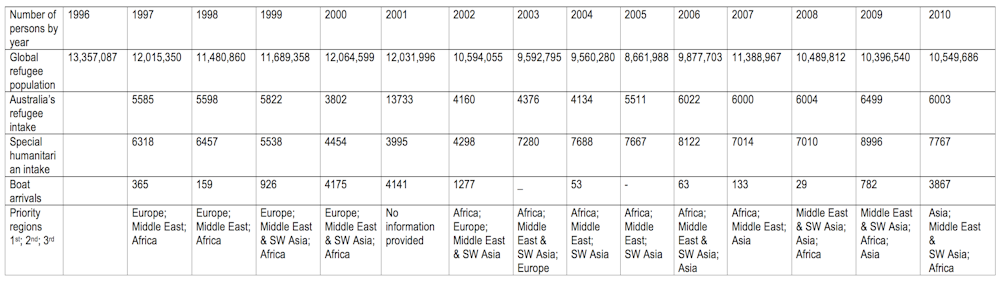
Since the end of the Indochinese refugee crisis, and in particular the conclusion of the 1989 Comprehensive Plan of Action (CPA) in response to this crisis, the Australian government has given the majority of refugee places to asylum seekers from the former Yugoslavia, the Middle East and Africa.
Protracted conflicts within Asia such as the civil wars in Afghanistan, Sri Lanka, and Myanmar (which contributes to the largest cause of population flows within the region) have not been a resettlement priority for the Australian government.
As a result, Australia’s refugee intake has not had enough of an impact on the regional problem.
Changing priorities
Prioritising the resettlement of those already within the region would reduce the regional burden significantly, therefore reducing the number of asylum seekers who take to boats and increased good will within the region. This new priority would result in a very significant decrease of the relevant populations of concern in Malaysia and Indonesia without increasing overall refugee intake. The effects could be further pronounced by a modest additional increase to the intake level.
Prioritising refugees from Asia should be dependent on status determination by the UNHCR. If necessary, the Australian government could deploy immigration officials to transit countries such as Indonesia and Malaysia to assist with the processing in the short term.
Given the current severe unrest in the Middle East (and this is a high source region for those seeking asylum by authorised boat entry into Australia), this region should retain second preference for the proportion of refugee visas.
A longer-term strategy would be to then increase Australia’s humanitarian intake overall which – as the table demonstrates - has maintained static growth since the mid-1990s. A high proportion should be dedicated to regional resettlement, then humanitarian resettlement for regions beyond our own, for example Central and East Africa. The present 50:50 proportion of refugee visas and Special Humanitarian Visas could be shifted to 70:30 to accommodate the needs of our region and beyond.
Heading off objections
There are three potential objections to this scheme.
First, it could be argued that the scheme will cause an increase in the number of people arriving in the region to seek refugee status declaration.
In this case, there is the option of providing a “cut-off date” for which this resettlement scheme will apply and broadly publicise its application. This was done during the 1989 CPA – the source and transit countries were given assistance to report through print and radio the dangers of boat passage and the prima facie refugee cut off date.
There is an additional option of providing temporary protection visas rather than permanent residency visas. Such visas need not be deterrent focused, but may instead be oriented towards accommodating the potential for return to source country once peace (and the risk of not facing death, torture or cruel treatment) is established.
There is also an option presented by scholars such as James Hathaway and R. Alexander Neve (not without objections) for states such as Australia to fund and assist with the provision of temporary protection visas in countries that are in close proximity to the source country or in the region.
Second, there will be the claim that transit and other resettlement countries will not cooperate.
The broader response to asylum seeking within the region needs to shift from criminal deterrence to development assistance. By pursuing the problem from a whole of government perspective, including development policy, the policy provides a “win-win” for Australian and transit countries.
A development focus was a core part of the European Union’s Regional Refugee Protection program for countries hosting large numbers of refugees in the African region, which has had success in reducing the number of people seeking asylum beyond first transit country.
Regional resistance to international refugee law is grounded in development and social cohesion concerns. These concerns could be addressed with giving assistance to transit countries and by seeing resettlement in Asia as a development problem for which further assistance could be provided.

Third, there will be criticism that the processing task will be immense.
The UNHCR in Kuala Lumpur has 130 professional staff to deal with 80,000 people of concern to their office.
The UNHCR Jakarta office has a significantly smaller population of concern with 5,000 registered refugees and approximately that same number of others of concern, but much fewer professional staff than in Malaysia. The result is that the refugee status determination process is excruciatingly slow in both countries, which proves disheartening for many, creating the desperation that pushes people to the people smugglers.
A comprehensive plan should therefore involve investing in more UNHCR staff in the region, providing Australian officials to assist with processing, and regularly training staff within transit countries such as Indonesia and Malaysia in asylum processing. All are options that benefit short-term and long-term goals for burden sharing in the region.
Read the rest of The Conversation’s asylum seeker coverage:
Asylum seekers and Australia: the evidence
The Conversation panel on asylum seekers: meet the experts
Infographic: global refugee populations 1975-2010
Refugees and asylum seekers in Malaysia: the good, the bad and the unexpected
What does the Australian public really think about asylum seekers?
Resettling refugees: the evidence supports increasing our intake
What role does Australia play in accepting the world’s refugees?
Who are Australia’s ‘boat people’, and why don’t they get on planes?
Uncomfortable truths: busting the top three asylum seeker myths
There’s no evidence that asylum seeker deterrence policy works
There’s more to regional collaboration than the Malaysia Arrangement
How immigration policy harms asylum seekers’ mental health
Asylum seekers in Indonesia: why do they get on boats?
Preventing deaths at sea: asking the experts on asylum seekers