


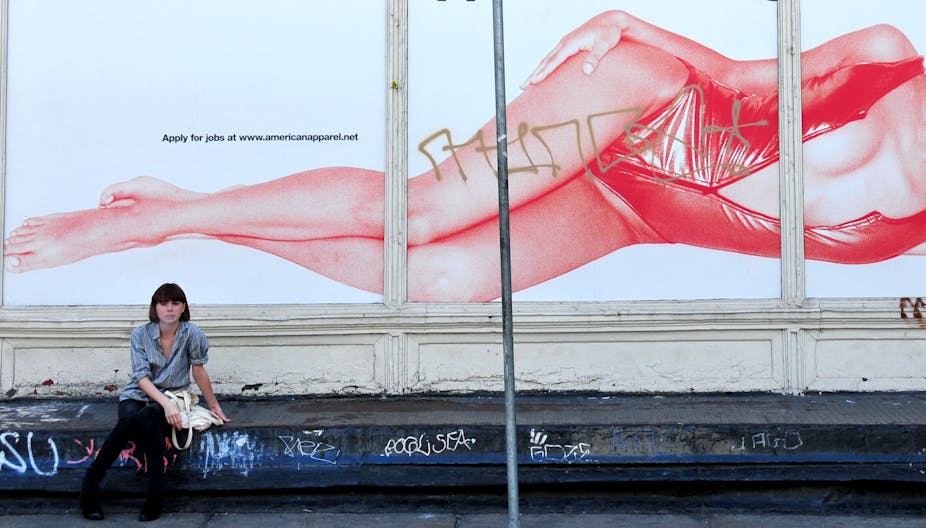
Body image may be the western world’s ugliest export. Images of thin, toned women and hyper-muscular men are conveyed via television, magazines, movies and the internet to the global market.
The ideal dictated by the mass media is virtually impossible for people to achieve without excessive dieting, excessive exercise, or both. As a result, cultures that used to regard bulk as a sign of wealth and success now have a growing prevalence of eating disorders.
Back home, body image dissatisfaction is increasingly recognised as an important target for public health action. Research evidence links body dissatisfaction to physical and mental health concerns for both men and women – and exposure to the media has been shown to play a significant role.
So how can we rein in advertisers? The United Kingdom’s Advertising Standards Agency has commenced banning ads that appear unrealistic – is it time time for Australia to do the same?
Australians’ body image
Among Australian women, body dissatisfaction mainly manifests with concerns about weight, even in those who are underweight or a healthy weight. This is reflected in unhealthy weight-loss practices (crash dieting, fasting, laxative misuse, vomiting) across all weight ranges.
For men, body image dissatisfaction is more likely to constitute a desire to be larger and more muscular in addition to being thinner.

Among Australian high school girls, research has found that approximately 75% chose an ideal figure thinner than their own.
Among adolescent boys, a third wished to be thinner, while more than a third desired to be larger than their current size.
In a community sample of Australian adults, 47% and 24% of healthy weight women and men respectively believed themselves to be overweight.
Impacting both genders
While extensive research has explored the body image of women, studies on the media’s influence of male body satisfaction have been somewhat ignored. This is despite evidence that there is a growing use of idealised male body stereotypes by the media. This has also been reflected in the increase in sales of male grooming products and continued growth of the men’s health and fitness movement.
Similar to women’s magazines, men’s publications are now filled with articles that concentrate on their readers’ worries and inadequacies. As images of men became more prevalent in the media, a new sociocultural standard of beauty for men seems to have emerged: a hyper-masculine, muscled, powerfully shaped body. The question is whether this standard will punish men as much as the super-thin standard has punished women.
Women perceive their figures as heavier than their ideals and as heavier than men’s preferences. The reverse is also true for men. Research has found that across Austria, France and the US, the ideal body for men was 13kg more muscular than themselves and they estimated women preferred a male body about 14kg more muscular than themselves.
Younger audiences are more susceptible to body-image disturbance than older audiences. People from a higher socioeconomic status are also more likely to suffer from body-image disturbance than those from lower socioeconomic status.
While physical attractiveness may remain more important to women than to men, some men may place their health at risk, as some women do, in order to attain the cultural ideal. Recently, the pressures on men to obtain and maintain a certain body type have been increasing.
Body dissatisfaction experienced through exposure to idealised images of men in the media is only the beginning of possible outcomes such as anabolic steroid use, eating disorders, and muscle dysmorphia.
So where to from here?
The Australian Government’s National Body Image Advisory Group made recommendations in 2010 about the way forward in making young people more resilient to appearance pressure. As a result, the government set up a voluntary code of conduct for the media, advertising and fashion industry. This initiative also included a new set of awards which rewarded the efforts of those in industry that promoted positive body image.
Two years on, magazines aimed at young women such as Dolly and Girlfriend seem to be making some progress in this area, but by and large, this “voluntary code” has failed to have an impact on how the industry operates.

In fact, we’re at a point where Victoria’s Secret models who are portrayed as the ultimate perfection are claiming they “need” to be air-brushed to look better.
And so deeply ingrained are these perceptions of ultimate beauty that when we do see a model who doesn’t fit into that industry stereotype such as Australian plus size model Robyn Lawley, it makes global news.
It appears that despite growing acknowledgement that body image is a great concern for both men and women, we are unlikely to see any great change with a voluntary code of conduct. Perhaps the only way to finally start making changes is to enforce mandatory laws regulating advertisers’ use of unrealistic body images.