


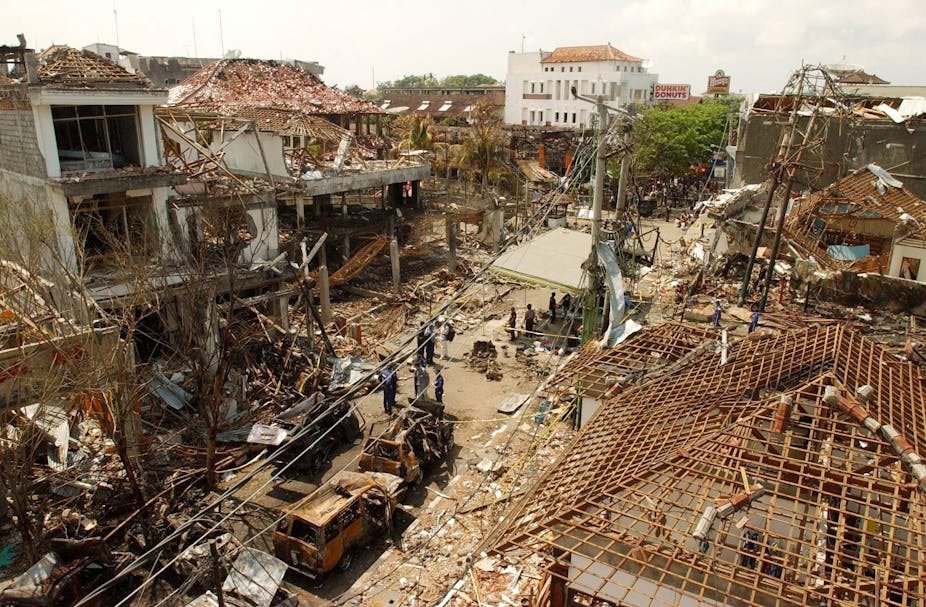
This week marks the tenth anniversary of the 2002 Bali bombings. Although more than 120 Australian civilians have been killed by terrorists overseas since 2000, and the embassies in Jakarta, Iraq and Phnom Penh have been targeted, no subsequent instance of terrorism has come close to matching the impact that October 12 2002 had on the Australian psyche.
The event
The final death toll of the Bali bombings was 202 individuals, comprising mainly Western tourists including 88 Australians. However, the main target was not necessarily Australian citizens.
Just prior to the detonation of the two bombs which obliterated the Sari Club and Paddy’s Pub, another was exploded outside the US Consulate in Denpasar. Although this caused only minor injuries and minimal property damage, its symbolic significance was in targeting an enemy.
Amrozi bin Nurhasyim (executed for his role in the bombings) told interrogators immediately after the event that those behind the operation regretted killing so many Australians. To those responsible, the primary concern was to kill as many Americans as possible as “revenge for what Americans have done to Muslims”.
The audio released by Osama bin Laden claiming the bombings were revenge for Australian involvement in East Timor would appear to be have been political opportunism.
The threat to Australia
The bombings were executed by members of Indonesian terrorist organisation Jemaah Islamiah (JI). Jemaah Islamiyah is a neo-jihadist organisation divided between four wings throughout Southeast Asia which aimed to establish an Islamic state in Indonesia.
JI also operated in Australia under the banner of Mantiqi 4 from the early 1990s up until the 2002 Bali bombings. Their membership comprised the first neo-jihadists to have operated in Australia.
Twins Abdul Rahim and Abdul Rahman Ayub who immigrated to Australia from Indonesia provided the leadership component of the network, believed to have numbered around 30, which included a number of Indonesian citizens and several caucasian Australian converts.
Although an individual was specifically dispatched by senior JI figure Hambali to train and discipline Mantiqi 4 - conducting at least one training camp in 1999 - the group remained largely underdeveloped. For many years, Mantiqi 4 largely acted only as a fund-raising arm for the other three wings of JI.
However, in 2000, on request from Hambali, Mantiqi 4 became an “operational cell” when Jack Roche was sent by the group’s leader for overseas training. He trained in Afghanistan for two and a half weeks and was given cash by both Khalid Sheikh Mohammad (the mastermind of the September 11 attacks) and Hambali (the conduit between JI and al Qaeda), who have both now been captured.
According to court documents, Roche was instructed to recruit two white Australian Muslims who were to go to Afghanistan for training. One was to be trained in explosives, the other in weapons which could be used for sniping. While he conducted surveillance on potential targets including the Israeli Embassy, the plan was aborted due to a combination of incompetence and internal group disagreements.
The response
A significant outcome of the Bali bombings has been a strengthening in Australian-Indonesian relations. Ten years ago the political links between Australia and Indonesia were relatively poor, yet today ties are far more robust.

Counter terrorism co-operation has been a significant element in this process. Although progress was being made prior to the events of October 12, including the signing of Memorandum of Understanding on Terrorism earlier that year, the bombings starkly reminded both governments that fighting violent extremism was in the national interest of both governments.
The Australian-led investigation into the bombings (conducted in partnership with Indonesian authorities and named Operation Alliance) delivered quick and transparent results and led both Indonesia and Australia to value cooperation.
Indeed, a close working relationship between Australian authorities and Indonesian counter-terrorism forces (predominantly Detachment 88, the special unit created following the Bali bombings) has developed over the last decade. The training and assistance provided by Australia has enabled Detachment 88 it to reach a point where its counter terrorism capability may now outstrip that of the AFP.
The organisation has arrested more than 700 individuals for terrorism offences, successfully prosecuting the majority, and its operational competency was dramatically illustrated by its successful elimination the Noordin Top network (who led the JI faction behind the Bali bombings). However, its achievements are somewhat tempered by persistent claims of human rights abuses and the volume of threat which seems capable of obstinate regeneration, illustrated by events such as the uncovering of a previously unknown neo-jihadist training camp in Aceh.
While the neo-jihadist threat to Indonesia has continued to manifest since the first Bali bombings, and there remains a smaller but equally persistent threat to Australians in Indonesia, the threat to those on Australian soil from neo-jihadism has changed significantly. Around the period of the Bali bombings the threat to Australia came from international terrorist groups attempting to recruit from within the Australian community.
The threat now predominantly emanates from home-grown extremists, and while small in scale when compared to the problem faced by Indonesia, the threat to Australia remains persistent.