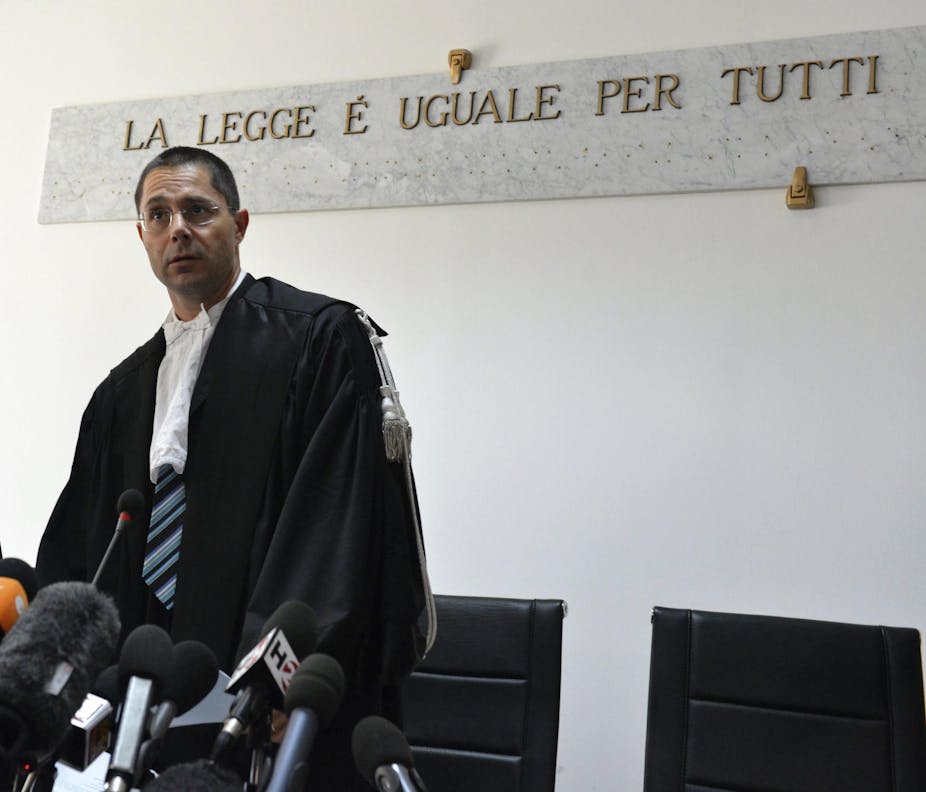
Researchers worldwide have condemned an Italian court’s judgement that six scientists and a government official are guilty of manslaughter for underestimating the risk of an earthquake accurately.
The case, in which seven members of the country’s Major Risks Committee were sentenced to six years jail for underestimating an earthquake that killed 309 people in the town of L'Aquila in 2009, has implications for all scientists, said University of Sydney astronomer Bryan Gaensler.
“This brings a lot of troubling precedents,” he said.
“It raises all sorts of questions about the nature of uncertainty, about the accuracy of models and the responsibilities of scientists.”
Scientists can’t give frank advice if they are to be held criminally liable for a shortcoming in any model which is a work in progress and which uses a lot of assumptions, he said.
“There are many aspects of our lives where we rely on predictions. No theory is fool proof, no prediction is 100% sure and there are a range of day-to-day assumptions we make about vaccines, weather forecasts, the safety of getting in cars or aeroplanes. People have to understand that models have limitations.”
Professor of Seismology, Earth Physics at the Australian National University, Brian Kennett, said that even if the judgement is appealed, it “will have a major inhibitory effect on any group worldwide making pronouncements about future risk.”
“Earthquakes are intrinsically unpredictable and it’s possible the Italian group may have been too reassuring in the light of that fact,” he said.
“However, lives are at risk because building stock is inadequate. The quickest way of saving lives is to build better. People are reluctant to spend the extra five or 10% to make a building earthquake proof.”
The finding will encourage more caution on the part of scientists in making predictions, which may not be helpful, said Prof. Kennett.
“You will then be more likely to make no pronouncement rather than the wrong pronouncement,” he said.
Wayne Peck, senior seismologist in the Seismology Research Centre at Environmental Systems and Services told the Australian Science Media Centre that communicating earthquake hazard risk to the public was already complex.
“To err in one direction leaves them open to being charged with being "too reassuring” but to err in the other leaves them open to being accused of being alarmist. Either way, minor nuances in the language used can be interpreted differently by different audiences, leaving the experts in a no win situation."
Professor David Spiegelhalter, Winton Professor of the Public Understanding of Risk at the University of Cambridge, said the “bizarre verdict will chill anyone who gives scientific advice, and I hope they are freed on appeal.”
“The lesson for me is that scientific advisers must try and retain control over how their work is communicated, and are properly trained to engage with the public,” he told the UK Science Media Centre.
Prof Bill McGuire, Professor of Geophysical and Climate Hazards at the University College London, said the verdict was extremely alarming.
“If this sets a precedent then national governments will find it impossible to persuade any scientist to sit on a natural hazard risk evaluation panel. In the longer term, then, this decision will cost lives, not save them.”
Sean Manning
Physicist
I await with trepidation the law suits that will be filed in the future if the climate models are wrong and we either over prepare for runaway global warming thus wasting money or, worse, we underprepare and there is loss of life as well as economic hardship.
Fred Pribac
logged in via email @internode.on.net
The climate warming timescales are too long for this to be a marked problem.
By the time folks can determine that a systematic bias is unlikely to be due to normal climactic variation superimposed on the predicted warming signal the culpable scientists and possibly even their embedding agencies will be long gone!
Guido Tresoldi
logged in via Twitter
As an Italian speaker I have been reading reports from Italy on this case. The issue is not that they didn't predict an earthquake. They were part of an organisation that was responsible to advise citizens on likely risks of natural disasters. Just before the devastating earthquake (there have been plenty of little earthquakes before then) they assured the population that they had nothing to worry about and literally said 'you can safely sleep in your beds'. Now that is reckless. In a highly seismic part of Italy, where there have been shocks for months that statement was unwise. It was like saying to people in a high bushfire area on a extreme hot high fire risk day to keep on doing what they wanted and don't worry about the risks. If they said that there was some risk and to be alert they would not have been accused. Saying that a prison sentence is ridiculous. Perhaps being sacked from their positions would be more appropriate.
Sara Blake
Aspiring Plantician
Guido, if what you have reported in your comment is the case, and I must admit I haven't researched the scientists or the nature of their roles in this, then it certainly changes the game. Initially when I learnt of the jail sentences, I was outraged, but your comment has certainly put it in perspective. I think failure to act/inform can be more dangerous than over-information.
I'd be very interested to know the reasoning behind why they decided the likelihood of risk was low enough to not warn the residents, given what you have stated. Surely putting people out of their homes for a few days 'just to make sure they are safe' would be worth the hassle and inconvenience - heck, and the lives...although I say that from my armchair in the safety of my tectonically-stable house!
Marc Hendrickx
Geologist
Some relevant comments from Roger Peilke Jnr...
Written pre verdict.
http://sciencepolicy.colorado.edu/admin/publication_files/2011.36.pdf
Sara Blake
Aspiring Plantician
Thanks Marc. This gives me more perspective on the issue.
Sadly, I think scientific communication to the public has a long way to go, particularly in communicating to those without a formal understanding of how the scientific method actually works.
Marc Hendrickx
Geologist
Sara,
Here's a link to RPJs latest post on this that provides some more background.
http://rogerpielkejr.blogspot.com.au/2012/10/mischaracterizations-of-laquila-lawsuit.html
Robin Bell
Research Academic Public Health, at University of Newcastle
Not sure what the problem is here. Other professionals are held responsible for their work and advice, as are company directors etc.
If scientist give their advice with accurate statements of confidence and uncertainty then they will be ok. Why should we expect scientific advice to be a special case outside the usual laws and protections for consumers and the public interest.
It seems that some of us on one hand are saying "why don't people pay attention to what we say", and on the other hand are saying "but don't hold us responsible when we get it wrong". Thats like an engineer designing a bridge and when it falls apart saying, yeah, always a chance of that happening.
Sean Manning
Physicist
The problem is that non-scientists have a difficulty understanding or appreciating uncertainty. The greater the uncertainty in the measurement, the less responsible you are for mistakes in prediction.
We may well be annoyed that the weather man did not predict rain on our washing day, but most will appreciate that weather is a difficult beast to predict. The methods for earthquake prediction are regarded to be pretty awful, probably more so than weather, so it is not appropriate to hold them to account.
Engineering is a terrible counter example. By definition it is not science, primarily becasue the uncertainties are very small.
Robin Bell
Research Academic Public Health, at University of Newcastle
Thanks Sean. Having training in both science and law I have a different view of things perhaps. If this was just about science it would be silly, of cource.
Read moreBut its not about the science, i.e. the case is not about predicting earthquakes: "Prosecutors and the families of victims alike say that the trial has nothing to do with the ability to predict earthquakes, and everything to do with the failure of government-appointed scientists serving on an advisory panel to adequately evaluate, and then communicate…
Eric Glare
HIV public speaker and volunteer
Robin Bell can you explain for us how you would enumerate a prediction that you had data for without using something akin to relative risk over time? You seem to be splitting something that isn't scientifically distinguishable but I can see that strategy might get you over the line in a court of law. Wasn't it very easy at that time in L'Aquila to predict that there would be more earthquakes because they were having plenty? Surely what the scientists were being asked was not that question but about…
Read morePera Lozac
Heat management assistant
Witches, wizards and shamans around the world would loose their head in old days after making a wrong call. Scientists claim to be better than their magic-practicing counterparts but they refuse to bare any responsibility for their predictions and theories that can influence other people’s lives. How strange is that? On the other hand 6 years is a bit excessive to be honest - maybe 50 lashes in a public square would be more appropriate, unless of course someone calls the Spanish Inquisition....oups.