


Melbourne Researchers Rewrite Big Bang Theory sang a recent headline in the Sydney Morning Herald. It was one of many suggesting the Big Bang theory had been somehow overthrown.
As the principal investigator in the research team whose work those stories were centred on, I would like to explain our research in a little more detail (and accuracy) than the popular press. I’ll also provide a personal perspective of my experiences around the media interest.
The research in question was conducted by myself, Andrew Martin and Chun-Hsu Su from the University of Melbourne, and Andrew Greentree from RMIT University.
Without doubt, the complexities of the science involved do not lend themselves to easy headlines or straightforward media stories, which perhaps contributed to the problem in this case. I will explain the science as straightforwardly as possible, but if you get lost, jump ahead to the section “What the media said”.
The science
The physical model upon which we conducted our research was quantum graphity. This is a model of spacetime that has its origins in a 2006 paper by Tomasz Konopka of Utrecht University and colleagues.
Konopka’s paper proposes a mechanism to explain how spacetime emerged, and ultimately stands as a quantum theory of gravity. The theory’s underlying mathematical framework is based on graphs with quantum mechanical degrees of freedom.
The name “quantum graphity” stems from the fact the underlying framework is based on graph theory, and that it is a proposed model of quantum gravity.
Quantum graphity
In quantum graphity, the early universe is a state represented by a graph in which every node is connected to every other, a complete graph, as per the image below. Because of this, the shortest path between any two nodes is only one hop.
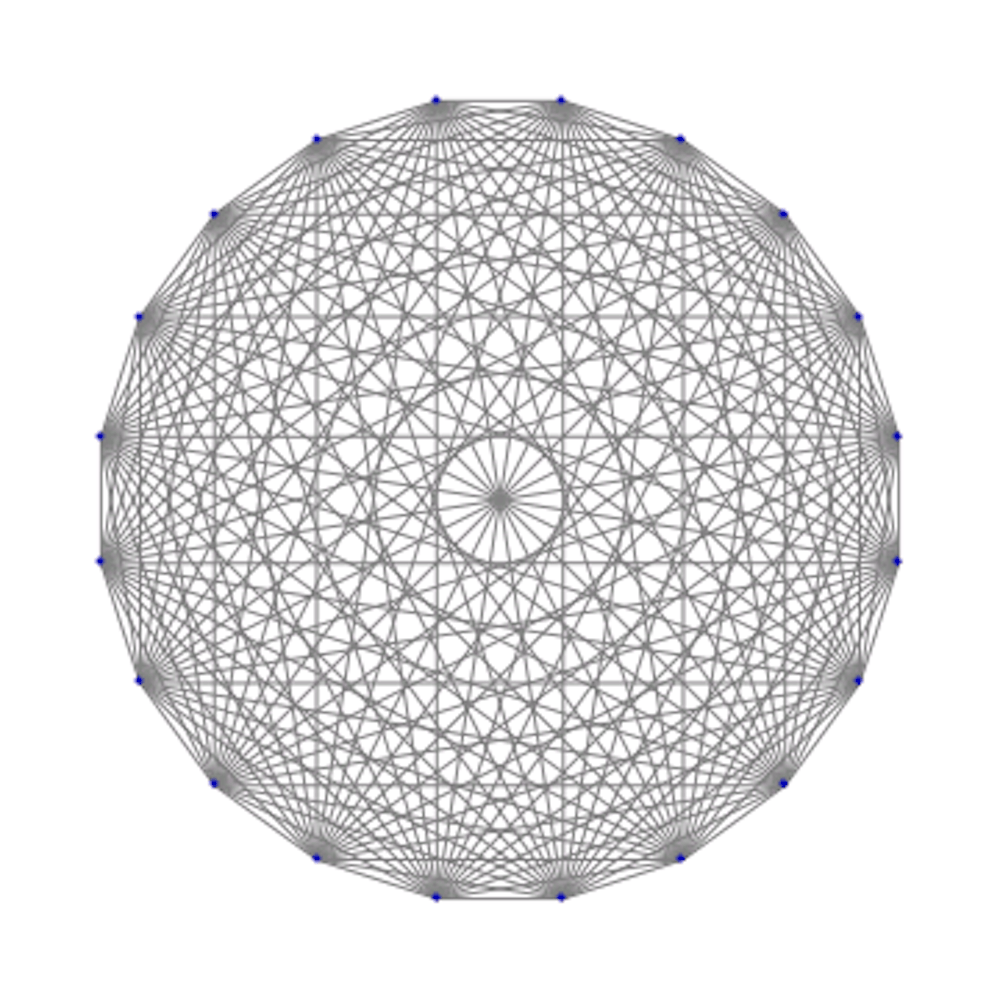
As the universe cools, the links between the nodes begin to break. As these links break, the shortest path between two nodes is no longer just one hop, but two, three, four hops, and so on.
As different pairs of nodes are separated by different number hops, the notion of distance and hence space emerges.
The energy of the graph states are described by an equation known as the Hamiltonian. Under certain parametrical constraints of the Hamiltonian, the graph of the lowest energy, known as the ground state, has the properties of being low dimensional, symmetrical, and uniform, representing ordinary flat spacetime.
But the energy landscape of the quantum graphity Hamiltonian has many local minima, much like the valleys of a mountain range. In our research we show that, as the universe cools, it is more likely to settle into a metastable configuration of local energy minimum, rather than the true ground state.
Some of these configurations should manifest as structures with defects or “cracks”, and in fact the details are very reminiscent of what is observed with crystal growth from a high temperature liquid phase.
Our prediction
We then went on to show the effects these defects will have on a type of particle known as a boson, of which light is an example. These effects include scattering, reflection, refraction, and a type of lensing similar to, but not exactly the same as, gravitational lensing.
We propose that these effects may be observable, and hence be used as a test of the quantum graphity description of spacetime. So it is possible that, in the catalogue of gravitational lensing events that have been observed, there are some which do not follow the predictions of general relativity and, if discovered, may be due to defect scattering from a “crystal” of space that is different from the space nearby.
Predictions are important, because a theory tenuously reigns in the realms of philosophy, unless it can empirically be tested.
What the media said
So as you can see, the science is a little more complicated than just “Researchers rewrite the Big Bang theory”. In fact, as Geraint Lewis rightly pointed out on The Conversation, nowhere in our paper do we even mention the Big Bang.
What we are talking about here is at an even more fundamental level. Quantum graphity is a model which says that spacetime is an emergent property of the interactions of many, many microscopic quantum systems.
If it was found to be correct, it would radically change our understanding of the origins of the universe, including its earliest moments, which the current theory of the Big Bang cannot explain.
The caveat here is that much more work needs to be done – not least of all, experimental verification of the model. Also, any revised model of the origin of the universe should be compatible with the wealth of data that supports the Big Bang model.
A personal rollercoaster
The media attention that our research garnered caught me by surprise. It has been a bit of the proverbial rollercoaster ride this last week. It started with elation when I discovered the Australian Associate Press was interested in our research, and then lows when some in the online community had accused us of [deliberately sensationalising](http://letterstonature.wordpress.com/2012/08/21/how-to-overhype-a-science-press-release/](http://letterstonature.wordpress.com/2012/08/21/how-to-overhype-a-science-press-release/) our research.
Scientists are in a difficult position: we are accused of sitting in our ivory tower when we do not engage the public and we risk being accused of sensationalism when we do.
When we do engage, there is a fundamental disconnect between the language we use to describe our work to other scientists, and that used to explain to the general public. Sometimes the translations do not work effectively and the emphases are lost, especially when struggling to condense complicated science down to an easily digestible chunk.
In hindsight, would we do anything differently with our media release? Yes. The initial title “Big Bang challenged by big chill” picked up one aspect of our research, and not even the main aspect.
This title was suggested by the media office to gather interest, which it certainly did! We had wanted to emphasise the “cracking” in our predictions and the bulk of the press release certainly does that.
We decided that this title conveyed our excitement and would entice readers to read the article without being misled. This was probably too naïve and we should have worked with our media offices more to refine the title.
That our release was transformed into “Melbourne researchers rewrite Big Bang theory” – as mentioned – by the Sydney Morning Herald was beyond our control and highlights the care that scientists need to take when communicating with the non-scientific community.
Gains and losses
I feel I should take this opportunity to address a false claim that I told journalists in interviews, that the Big Bang theory was going to be overthrown by quantum graphity, in order to hype up the story. I would like to be clear: I do not think this, and I never said this.
One of the goals of a quantum theory of gravity, such as quantum graphity, is to explain the earliest moments of the universe. This will fill in the gaps of the Big Bang theory, not replace it.
Overall, the feedback I have received from both the academic and public community has been overwhelmingly positive. The media attention has drawn the general public into a conversation on the fundamental questions of physics, which I think is a good thing.
We should question the fundamentals of our field and we should bring our debates into the public wherever possible. Our research does not rewrite the Big Bang theory, but it does provide a test for quantum graphity.
If it proves correct then it will highlight a new and richer understanding of our universe and its origins.
Further reading:
‘Melbourne researchers rewrite Big Bang theory’ … or not