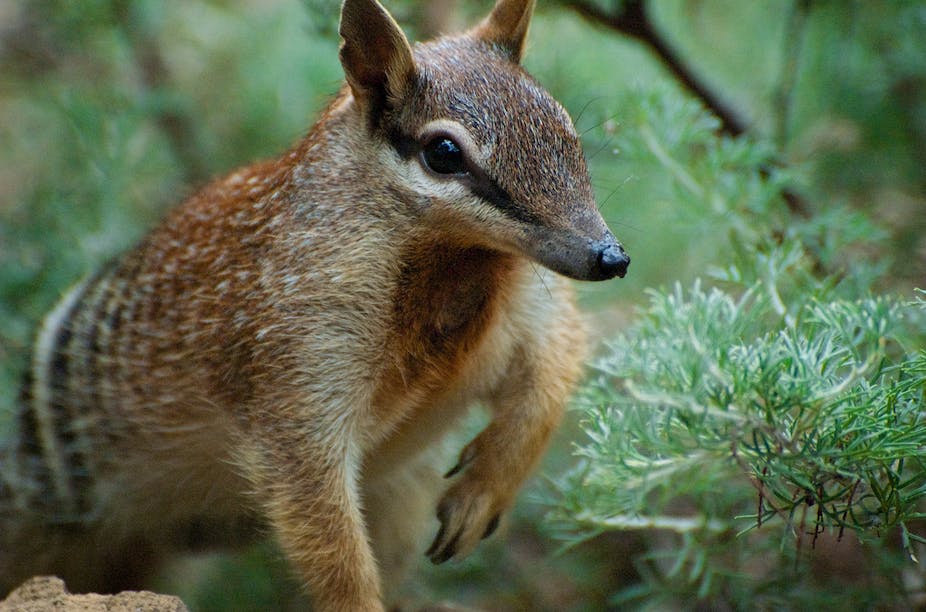
Tim Flannery, in his Quarterly Essay After the Future, is right to deplore the sudden abrogation of responsibility for threatened species by state and federal governments. The tragedy is that neglecting endangered species is the wrong thing to do on so many counts. It does not reflect the popular will of the people. And it is counter to what is happening elsewhere in the world.
To take the last point first. In Hyderabad recently the Conference of Parties to the Convention on Biological Diversity – which includes representatives of nearly all world governments – agreed to double the funding for the Global Environment Fund (GEF) to $10 billion a year. Although still less than required for improving the status of all threatened species and for protecting critical habitats, this was still a big step forward.
Significantly, India and several African countries also agreed to contribute to the GEF.
The world is taking a serious interest in saving species. And with good reason – there is increasing evidence that biodiversity loss has an influence on ecosystem service provision on a par with drought, ozone loss, acidification and climate warming. Species conservation is an investment in natural capital that provides enormous returns.
So why are Australian governments turning off threatened species? While Australia did contribute $23 million to the GEF through AusAid in 2011-12, here at home there is no coordinated national pool of funds for threatened species. The carbon fund and Caring for Country are lotteries in which winning tickets are too often captured by local agendas unrelated to the risk of species loss.
And the states and territories have always been poor cousins. While they have long employed threatened species managers – often deeply committed individuals who have devoted decades to retaining species for future generations – the operating money has usually had to be gleaned from a reluctant Commonwealth.
Since 2009 that money has been ever harder to obtain. That was when Peter Garrett got up at the INTECOL conference in Brisbane and said that funding would be given to protecting landscapes not species. I wonder if it weighs on his conscience, and those of his advisers, that this statement led directly to extinction of the Christmas Island Pipistrelle, the first mammal extinction in a generation.

For many senior bureaucrats, Garrett’s statement was a license not to care, to make muscular decisions not to fund, supposedly on the basis that this is what the elected government wanted. I have actually attended a meeting of senior “conservation” managers in Brisbane who were only half joking when they said they would like species to go extinct because of the trouble they caused.
The real trouble is that Garrett’s statement was built on two myths.
The first is that threatened species funding does not work. Bunkum. Australia has a remarkable record of bringing animals back from the dead. All around the country there are animals and plants that were reduced to near extinction. But through thorough research, clever management coupled with diligent monitoring, and sustained commitment from both government and the local community, the small numbers have increased until extinction is now improbable.
Saving species can be expensive – small amounts smeared across many species just leads to wastage – but it works. We could abandon some species – a decision for the public not public servants to make. But for a relatively tiny amount we could save all of them.
Part of the perception is that the lists are not kept up to date. For instance there are 28 species or subspecies of bird on the EPBC lists that do not meet IUCN Red List criteria. Erroneously listed species waste resources and erode confidence. However the problem is with the listing process, not the efforts of threatened species managers. The conservation status of over 100 birds is better than it might have been without conservation funding. Poor administration of a clumsy Act is no excuse for abandoning threatened species.
The other myth is that people do not care. Work by Charles Darwin University PhD student Gill Ainsworth shows that is wrong. In a survey designed to avoid bias, 75% said they would become upset if a bird became extinct (compared to 7% who disagreed); 74% said that people have a moral obligation to protect threatened birds (compared with 5%); and 47% said that the needs of threatened species can come ahead of people compared with 15% who thought the opposite.
There is a political opportunity here for the major parties to differentiate themselves. Though the Greens have organised a Senate inquiry into threatened species funding in Australia (submissions due 14th December), Tim Flannery is right – the Greens do not own threatened species. That is why the Australian Wildlife Conservancy is attracting corporate support. That is why many of the poorer respondents to Gill’s survey were willing to give money to threatened species protection if asked.
Ultimately of course threatened species protection is a political question. But it is also has deeper moral implications. What we do with our biological inheritance defines who we are as a people. Most countries are proud of their rare species and try to prevent extinction. For Australia our biodiversity should be seen as much a natural blessing as our mineral resources.
Chris McGrath
Senior Lecturer at University of Queensland
Thanks for writing such an interesting and thought-provoking article Stephen. Nice numbat picture too!
David Arthur
n/a
Thanks for this, Professor Garnett.
I was unaware that Mr Garrett had abstracted the concept of conservation to the point of "conserving ecosystems"; I see that there can be a great deal of abrogation of responsibility through economist-speak such as this.
I'd argue that a useful definition of a healthy ecosystem is one in which endangered species recover. Please comment on the notion of using endangered species as the "keystone species" for ecosystem management.
Neville Mattick
Grazier: Biodiversity is the key.
We need to "value nature" in an economic sense so that stewardship can be rewarded.
Most of the land (Australia's case) is in private hands and their is a gulf of education between the facts in this article and the comprehension of what a farmer or grazier has in their temporary possession.
From little things big things grow and if a dollar value is attached to holistic land use then people will begin to reflect wider public wishes in their understanding and stewardship of the landscape.
Due to decades of careful relationship (four generations) my farm is unique and rarely replicated on the scale held here, suffice to say it is deafening an hour prior to dawn as everything is winding up for the day.
Still it isn't just birds, we have a deep respect for the smallest organism, plant, largest Brown Snake, micro-climate etc, but they (birds) are nice to look at!
Stephen Garnett
Professor of Biodiversity and Sustainability at Charles Darwin University
David you are quite right that a healthy ecosystem is one that has all its species. However healthy ecosystems can equally well be defined by their structure or their dominant species or simply lack of weediness, soil erosion etc. You are also right that threatened species can be flagships for ecosystems. A well-managed threatened species can be a vehicle for conservation throughout its range.
Also, as you point out Neville, successful stewards of threatened species should be rewarded by those who value them - i.e the wider population of Australia. In fact threatened species can be a vehicle for supporting rural, regional and remote communities, communities which are currently draining away towards the cities for want of employment opportunities. In this sense threatened species can sit alongside other rural industries in a green economy.
Keith Bradby, Director, Gondwana Link
Director
Thanks to both Stephen Garnett and Tim Flannery for progressing this important debate. I supported the thrust of Minister Garrett's Brisbane statement on an increased systems level focus, but am concerned that the pendulum may be rapidly swinging from one extreme to the other. It is not about saving species or systems, its about its about finding the efficiencies and synergies between both approaches and securing much greater funding. Across Gondwana Link we use the Conservation Action Planning…
Read moreMatt Hall
Researcher
Many thanks to Stephen for this article.
Without knowing the details of Minister Garrett's statement this is a hard one to judge. But it's important to note that a withdrawal of funding for in-situ species conservation and/or rehabilitation is contrary to Article 8 of the Convention on Biological Diversity (see below). Whilst the CBD is legally fairly toothless, it's an important message that the government is explicitly flouting international law through its current conservation policies.
Article 8
Each Contracting Party shall, as far as possible and as appropriate:
(d) Promote the protection of ecosystems, natural habitats and the maintenance of viable populations of species in natural surroundings;
(f) Rehabilitate and restore degraded ecosystems and promote the recovery of threatened species, inter alia, through the development and implementation of plans or other management strategies;
See http://www.cbd.int/convention/articles/?a=cbd-08 for full text
Bernie Masters
environmental consultant at FIA Technology Pty Ltd, B K Masters and Associates
Sorry, Stephen, but, while your article attempts to address a very important issue, it misses a number of crucial points. As poor an environment minister that Garrett was, the reality is that he was only ever a celebrity MP who, like the dog chasing a car and not knowing what to do when the car actually stopped, he had little understanding of what was needed to protect the nation's environmental values. For example, almost half of the $2.25 billion of Caring for our Country money was pre-determined…
Read moreMax Finlayson
Director, Institute for Land, Water and Society at Charles Sturt University
Thanks Stephen. This is an important issue, and as you say, we have done well with some species, and I support efforts to continue this, especially where we can get to the nub of the issue and address the real causes of species loss. But at the same time we need to be looking across landscapes and also focus on our ecosystems. It is surely not one or the other. And we should not forsake the funding for one to support the other. Now I'm told that there is just not enough money....
Marilyn Hoey
Consultant
Good article on a critical issue. Does anyone know how much is allocated in the Federal budget for issues such as this and broader animal protection issues? I have a recollection that it was roughly 0.001 percent. If this is correct (and I'm sorry I don't have a reference for it) surely this is something that we need to tackle politically. I wonder if the new Animal Justice Party will be taking this on?
Greg Miles
Conservation lobbyist
Hi Stephen
There is a third myth. I have been a World heritage protected area land manager in the north (including Christmas Island {not WH}) for 30 years. It is a myth to think that pouring millions of dollars into landscape-scale habitat management is going to stop the rot. Almost no amount of money is going to stop the spread of African Grasses, Mimosa pigra, Para Grass, Salvinia, toads and cats and pigs etc in Kakadu alone!! Let alone at the broader landscape scale. And even if this happened…
Read moreChris Owens
Professional
As the debate on old growth logging illustrates, public opinion may be overwhelmingly on the side of preservation, however the government will support their backers and financiers every time. In Victoria the two issues collide with leadbeaters possum. Already endangered, the possum numbers were slashed in half on Black Saturday. The Baillieu Govt response was to salvage log the burnt forests and thereby remove future hollows and stags and ramp up logging in the remaining habitat in the central highlands…
Read moreStephen Garnett
Professor of Biodiversity and Sustainability at Charles Darwin University
Max and Keith have spoken in defence of landscape conservation. I agree entirely that it should not be either species or landscapes - rather, as I gather Keith is trying to do with Gondwanalink, I think threatened species can be used as key motivators and indicators of success of landscape conservation. But Keith you are also right that the pendulum has swung too far - in fact it almost instantaneously swung too far because it became a means to save money and I am glad that this is now being recognised even among those who thought it necessary.
John Rodger
Director Wildlife Biodiversity CRC Bid
Stephen Garnett's conversation starter and Tim Flannery's essay are both timely and right. Threatened species need innovation, broader thinking and the broader community not just the experts to be involved. And they need resources.
We have national strategies, recovery plans and all are just policies without teeth of resources. Most critically resources are needed not just for on ground works but to address the many knowledge gapes in how best to respond to the diverse threats species and…
Read moreJohn Rodger
Director Wildlife Biodiversity CRC Bid
Other than correcting my spelling error. Its obviously gaps not gapes. Knew one would slip through.
The only point I would add, that I probably didn't make explicit enough, is as commented by Stephen this conversation should not be a seen as a choice between species or landscapes. Conservation is a complex system and thus needs many elements and types of expertise to be applied depending on the problem. Intact landscapes didn't protect the frogs from fungal disease.
Peter Garrett AM
Federal MP, Minister for School Education, Early Childhood and Youth
The Conversation has recently featured a series of articles on protection of endangered native species including ‘Saving Australia’s Endangered Species-a policy gap and political opportunity’ by Professor Stephen Garnett.
Like a seer divining motive from afar Professor Garnett muses on whether it “weighed” on me and my advisers’ conscience that a statement I made in a speech given in August 2009 http://www.environment.gov.au/minister/archive/env/2009/sp20090817.html namely, that we need to consider…
Read moreStephen Garnett
Professor of Biodiversity and Sustainability at Charles Darwin University
Can I say first, Minister, how much I appreciate you taking the time to respond in public to my article, and doing so at such length. It is rare and refreshing to have such direct engagement.
In some ways, in doing so, you have answered my question – the loss of the bat evidently does weigh heavily. I had always imagined that for you, of all ministers, the loss of the pipistrelle was a personal tragedy as well as being a tragedy for all of us. I recall feeling at the time how unjust it was that…
Read moreJohn Woinarski
Professor (conservation biology) at Charles Darwin University
A too-early death brought the English singer-songwriter Nick Drake a fame and significance that he never received in life. It is the mould of many doomed artists, whose existence was troubled, and whose fate was loaded with unrealised and unrealisable potential. Like all premature deaths, it brings a haunting regret to those it touched: Could it have been prevented?; What if we’d intervened earlier?; What promise was lost?; Whose fault was it?
Extinctions may generate the same reaction…
Read moreGrahame Webb
Adjunct Professor, Environment & Livelihoods at Charles Darwin University
In reading the recent interchange about who is "to blame" for the lack of timely and appropriate intervention in the case of the Christmas Island Pipistrelle ... I would put the blame firmly on the gulf that exists between the real risk of biological extinction of a species, using all available information, versus the implied risk by various "packaged programs" purporting to assign risk of extinction accurately.
For example, Stephen quotes: "Part of the perception is that the lists are not kept…
Read moreStephen Garnett
Professor of Biodiversity and Sustainability at Charles Darwin University
Under the IUCN guidelines the local status does not have to match the global status. For three birds - the Beach Stone-Curlew, Black-necked Stork and Sarus Crane - the local Australian IUCN Red List status is Least Concern but they are threatened or Near Threatened globally. That means that Hawksbill Turtles do not need to be listed as threatened if the data do not justify local listing - though I notice that the EPBC site mentions steady declines at Millman Island. Globally the IUCN site <http…
Read moreGrahame Webb
Adjunct Professor, Environment & Livelihoods at Charles Darwin University
Stephen ... I perhaps did not make my concerns about the gap between "categories of threat" in the IUCN criteria and the real risk of threat in terms of the need for immediate conservation action very clear. The problem is not that "national" and "global" assessments should give different results. Saltwater crocodiles are basically extinct in Thailand, Cambodia and Vietnam but perhaps almost completely recovered here in the NT. It does raise the rather tricky issue that if the Australian population…
Read moreStephen Garnett
Professor of Biodiversity and Sustainability at Charles Darwin University
Perfectly valid points Grahame. A couple of papers that might be of interest. The first <DOI: 10.1111/j.1523-1739.2008.00905.x> was an analysis tracking status over time showing that taxa moved through the various IUCN categories at the rate one might expect from Near Threatened to Critically Endangered, but then failed to go extinct at the rate that one might anticipate. At least part of the reason was that a lot of conservation effort is applied to Critically Endangered species so that the most…
Read moreGrahame Webb
Adjunct Professor, Environment & Livelihoods at Charles Darwin University
Good points Stephen, and the papers very interesting. The species that I have been dealing with tend to be tenacious survivors that can easily bounce back from an 80% decline if the habitat is intact and the harvest pressure is lifted off them. The crocs that have problems are not the harvested species as such, but rather species that continue to get caught and either drowned or killed in fishing nets and traps, that are operating 24/7 to feed people in so many countries. Protecting the crocodiles (nationally or internationally through CITES) stops legal trade, but just does not stop the killing. They are essentially commercially extinct (not worth hunting for their own right), but very much subject to by catch. Interesting problems!
Bruce Boyes
Consultant
In a project in South-East Queensland I sought to integrate threatened species recovery planning with landscape-scale conservation in a local government planning context. Threatened and other significant species were identified for each ecosystem in two local government areas using the Queensland Government's Regional Ecosystem (RE) definitions and mapping. Threats to the species in each RE were identified and ecosystem management principles developed to address these collective threats. In one of…
Read moreGeoffrey Watson
Unemployed
As "a member of the public" I find this whole conversation pretty disheartening. surely we have moved on from attitudes of man as master of the planet by now?
My philosophy as an environmentalist is that we are *part* of nature, not master of it. Statements like "What we do with our biological inheritance defines who we are as a people" are just appallingly arrogant - similarly "Zero-tolerance" to extinctions.
John Rodger
Director Wildlife Biodiversity CRC Bid
Geoffrey I don't believe any in this conversation would disagree that we humans are part of nature and not its masters. Where we are coming from is the ethical imperative to act effectively to prevent avoidable extinctions and draw on the best evidence and tools to do this in the most effective ways.
Geoffrey Watson
Unemployed
Thank you. I realise now that my uneasiness is more about the focus of this ethical imperative. Surely it is about mitigating human actions that may lead to extinctions, not about assuming an overall responsibility to control extinctions per se. This is just man assuming control of nature in another guise.
For instance, I understand that the reasons for the demise of the Christmas Island bat are not fully understood, so why should this be seen as a *moral* or *ethical* failure, it was just lack of knowledge, and an understandable decision to make protection of habitats preferable to protection of individual species?
Grahame Webb
Adjunct Professor, Environment & Livelihoods at Charles Darwin University
Geoffrey raises an interesting point - what mix of morality, ethics and pragmatic problem-solving, based on current knowledge, should be the paradigm in conservation. Wayne King raised this moral dilemma about an endemic ground-dwelling boa on Round Island, off Mauritius. The habitat was eroded by feral animals and was seen as a real threat to the boa. Pragmatic efforts to eradicate the feral animals (rabbits and goats from memory) using 1080 and other methods (from memory) were held up for two years by animal rights and welfare activists, who felt there was an ethical and moral problem and took legal action to stop them. By the time the green light for feral animal eradication was gained - the boa was extinct. There's of course no guarantee the program would have been successful, had they eradicated the feral animals early, based on current knowledge - so the boa may have gone extinct anyway. So who in the end was morally and ethically right or wrong?
Greg Miles
Conservation lobbyist
That is an excellent example Graeme. I suspect that is some countries the EPA legislation would find the animal rights people a contributing factor to the boas extinction and should therefore be taken to court for vexatiously preventing the protection of CITES listed species!
But there is another way - especially with an 'easy keep' animal like the boa. They should have been put in a 'safe house' captive breeding situation, many years before they became so rare. This can be done by the private sector at no cost to the Governments. At least then we would have the opportunity to reintroduce the boas if and when the animal rights people came to their senses and the ferals are removed. Or it might be possible to introduce the boas to a nearby similar island, not cursed with ferals.
John Woinarski
Professor (conservation biology) at Charles Darwin University
Let me try to focus on one part of the argument: what responsibility do, or should, we (humankind) have for the natural world, and in particular for trying to prevent the extinction of other species?
In part, as noted by Grahame Webb, this question has been muddied by attention to animal individuals rather than species, following the concerns of philosophers such as Peter Singer who argue for the rights of (and prevention of cruelty to) sentient animals, and of some religious beliefs (such as…
Read moreGrahame Webb
Adjunct Professor, Environment & Livelihoods at Charles Darwin University
John's four options are well articulated, and my guess would be that most biologists would relate to Option 4 as a laudable goal that has a ring of precaution about it. However, it is not biologists, ascribing to Option 4 that are causing extinctions. As I wrote somewhere else: "That poverty is the worst environmental threat is obvious but chilling. Obvious, because if we slipped towards poverty ourselves at some stage we would start killing critically endangered animals to feed our children. Chilling…
Read moreBrynn Mathews
logged in via LinkedIn
A very interesting discussion that, at times, reminds me of rearranging the deckchairs on the Titanic whilst heading towards destruction. After almost 20 years in govt environmental protection agencies in Tasmania, Victoria and Queensland, and the last 4 years in a local catchment management group (Mitchell River, Qld) scrabbling for money in a diminishing funding pool. A biodiversity survey I organised in the catchment headwaters in July 2012 found essentially good habitat but almost no small…
Read moreGreg Miles
Conservation lobbyist
Thanks Brynn
If what you say is correct and small mammals are disappearing from the Cape - then that suggests a much bigger problem than we Territorians figured. And this raises valuable areas for interstate research to look for commonalities and inconsistencies in order to narrow down on the cause of mammals losses. We are still guessing here in the Top End. After 30 years in Govt environmental protection agencies in the north, I have come to the view that in the past 50 years, the overall…
Read moreBrynn Mathews
logged in via LinkedIn
Further to Greg Miles comment on my input to this topic, given the lack of a history of biodiversity surveys on Cape York savannah country c.f. Kakadu (I reckon it's probably due to the absence of large scale uranium mining proposals on Cape York in the 1970s and EISs, but that's perhaps not much of a trade-off) there's even a debate about whether Cape York ever had a comparable native mammal population to the Top End of the NT. So are we seeing a reduction from bugger-all to less than bugger-all…
Read moreCaroline Copley
student
Four possible responses of John Woinarski- nos. 3 or 4 at least cover the most important implications of biodiversity loss, which is the potential impact on ecosystems and thus fundamentally life links as we know them on the planet. 3 or 4 because without preserving species we may lose extremely or somewhat but nonetheless vital links in the ecosystem network.
Read moreBiodiversity is linked to soil carbon and nutrient cycling for example.
Can't believe you didn't say 5- because we need them, probably…