

The documentary Maximum Tolerated Dose (showing in Melbourne tonight and Sydney on February 12) offers a “look inside modern animal experimentation with the animals who lived through it and the people who walked away.”
Like the scientists and technicians featured in the film, Australian researchers subject animals to surgery and other procedures, which often result in pain and death. Of particular concern are experiments performed on non-human primates, such as infecting macaques with HIV, passing electric shocks through marmoset brains, inducing high-blood pressure in pregnant baboons, overdosing baby marmosets with opiates and deliberately making baboons diabetic and wounding them.
No matter what the benefits, many critics of animal research (including ourselves), see experimentation like this as abhorrent and unethical. If these acts were committed against people, they would amount to torture. Indeed, it is arguably morally indefensible to cause such harm to animals particularly to the animals that are most like us.
Out of step
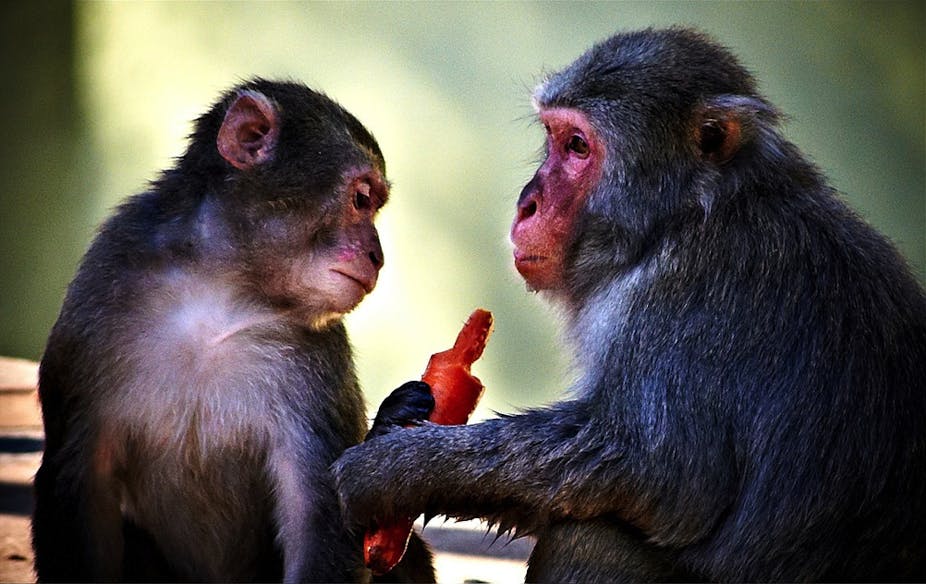
Non-human primates have a close resemblance to humans – they belong to the same biological order as ourselves. These animals have larger brains than other mammals, the capacity to feel and express complex emotions, and some can communicate in a symbolic language.
While it’s not simply similarity to humans but a shared capacity to suffer that should guide our concern for an animal’s welfare, non-human primates are granted somewhat special consideration in the laboratory environment compared to other animals.
Some countries have banned the use of an important group of primates, the great apes – gorilla, orang-utan, chimpanzee and bonobo – in research altogether. New Zealand granted apes the right to not be used in research, testing or teaching over ten years ago, but their use is still allowed in Australia.
The National Health and Medical Research Council (NHMRC), which funds research on non-human primates, has a Policy on the care and use of non-human primates for scientific purposes. Although it appears to offer primates better protection than other animals, much of the wording of the policy is very loose; terms such as “where possible”, “the most appropriate”, and “should consult” leave considerable room for interpretation.
Breeding colonies and importation
Australia has three government-funded primate breeding facilities at two sites: the National Marmoset and Macaque Facilities at Churchill (Victoria) and the National Baboon Facility in Sydney. Animals are also imported from Indonesia. Humane Research Australia estimates that between 2000 and 2009, at least 648 non-human primates were imported for research purposes.
Importing non-human primates is problematic for a number of reasons. The pigtail macaques imported from Indonesia, for instance, are threatened by the destruction of their habitat (commercial timber harvesting, conversion of land to agriculture), and pollution.
While the NHMRC prohibits importation of primates taken from the wild for research purposes, it doesn’t forbid taking animals from the wild to replenish breeding stocks.
Like all research involving animals, there’s secrecy and a lack of transparency around primate research. The exact location of the Australian breeding facilities is not publicly available information, and we don’t know what research is undertaken, how it is justified, at which research institutes, the conditions animals are subjected to, or what happens to them once the research project is complete.
The NHMRC policy states that the breeding colonies generally won’t accept animals that have been used for scientific purposes, noting “In most cases, euthanasia will be the only option.”
Ending primate research
Ideally, we’d like research involving non-human primates to stop, with the exception of observational research in the animals’ natural habitat. This would mean closing down breeding colonies and ceasing live imports. But short of that, we can take a number of interim measures to better protect these animals from exploitation. They include:
having baboons, macaques and marmosets included in the direct benefit clause of the NHMRC policy that currently applies only to the great apes,
an unconditional ban on the use of great apes in research,
banning the importation of primates for research purposes,
funding retirement sanctuaries that allow former research participants to enjoy a good quality of life (if they are not so traumatised or ill that euthanasia is the most humane option),
creating a national data base for animal research, so research is not duplicated,
implementing a strengthened NHMRC policy that adequately considers “the views of people in the community who oppose the use of non-human primates for scientific purposes“, which is what it is supposed to do, and specific requirements that put the onus of proof for the lack of suitable alternatives firmly on research applicants, accompanied by tight monitoring, and
guaranteeing greater transparency and a requirement that information (in plain English) on the number and species of animals used, the aims of the research, the procedures employed, justification why alternatives could not be used, and the fate of the animals after completion of the research is publicly available. If the University of British Columbia can release statistics of animals involved in research, other universities can do so as well.
The primates used by medical research are sensitive and intelligent beings. We owe them a decent life, not confinement, suffering and untimely death in the lab.
Mike Swinbourne
logged in via Facebook
Monika,
I understand your position, but I would like to suggest that to be consistent you would have to reject all research that has been undertaken to date using primates, including any research which assists in human medicine. Unfortunately, if we were to do so there would be gaping holes in our knowledge.
You, me, and all the people you deal with in your role in aged care benefit from animal research, including the use of primate. It would be hypocritical to call for an end to this research while deriving the benefits of research from the past. Indeed, I would like to suggest that research in the past was conducted with a lot less ethical and humane considerations for the animals involved.
Are you prepared to throw all that knowledge away for your principles, or do principles only extend so far?
Monika Merkes
Honorary Associate, Australian Institute for Primary Care & Ageing at La Trobe University
Hi Mike
Read moreThank you for starting the conversation.
What is consistency, what is hypocrisy? There are areas in our lives that aren’t black and white. As a vegan, to be 100% consistent I would have to stop eating. For me to be able to live, other beings suffer or die. As has been pointed out in another article here on The Conversation, animals such as insects and mice die in the production of grains and vegetables. I try to be thoughtful and minimise suffering.
When I became a vegan I decided to…
Geoffrey Edwards
logged in via email @gmail.com
"I would like to suggest that to be consistent you would have to reject all research that has been undertaken to date using primates."
It is one thing to suggest that, but you would need to actually argue it as well. What is it that is inconsistent with an end to research on primates while still making use of knowledge gained from prior research.
The moral premise operating is the capacity for suffering.
"...it’s not simply similarity to humans but a shared capacity to suffer that should…
Read moreMike Swinbourne
logged in via Facebook
Yes, really.
Let me start this by suggesting that I have no problem with animal research. I have been involved in it myself. That is why we have ethics committees - and despite the emotive and evidence-free assertions in the article, I happen to believe they do good work and provide an important oversight for researchers.
However, the way this has been presented by the authors suggests that the past (and current) use of primates for scientific research is unethical and immoral, and should cease…
Read moreGeoffrey Edwards
logged in via email @gmail.com
"to single out primates is anthropomorphic"
I agree. If we are generally talking about animal suffering, it is a little arbitrary to end at primates. However, I think the author does go someway to acknowledging this:
"While it’s not simply similarity to humans but a shared capacity to suffer that should guide our concern for an animal’s welfare, non-human primates are granted somewhat special consideration in the laboratory environment compared to other animals."
- She acknowledges that…
Read moreMike Swinbourne
logged in via Facebook
Geoffrey
The quote you provided directly undermines and contradicts the point you are trying to make.
"While it’s not simply similarity to humans but a shared capacity to suffer that should guide our concern for an animal’s welfare, non-human primates are granted somewhat special consideration in the laboratory environment compared to other animals."
To me, this is very clearly suggesting that the authors believe that primates are somehow special in comparison to other animals. The 'capacity…
Read moreGeoffrey Edwards
logged in via email @gmail.com
"To me, this is very clearly suggesting that the authors believe that primates are somehow special in comparison to other animals."
I don't agree there. The first half of the quote again:
" it’s NOT simply similarity to humans but a shared capacity to suffer that should guide our concern for an animal’s welfare"
1) primates should NOT be treated specially as a matter of principle.
2) The fact that they are in practice, as described by the author, is simply a statement of fact.
"suggest…
Read moreMonika Merkes
Honorary Associate, Australian Institute for Primary Care & Ageing at La Trobe University
Hi Mike and others
I can assure you that I do not think that I have all the answers. As you write, this is a complex issue. The word limit for articles in The Conversation doesn't allow for all aspects of the complexity to be fully explored - and rightly so, it's unlikely many people would read lengthy articles in this forum. But there is the comments section, and it's great that people like you and others who post here engage in a conversation.
Thanks for the joke, I hadn't heard it before :-)
Monika Merkes
Honorary Associate, Australian Institute for Primary Care & Ageing at La Trobe University
Hi Geoffrey
Thanks for the vegan joke ... I didn't know any vegan jokes before your and Mike's comments.
Rob Buttrose
University of Melbourne
We don’t believe that primates are special in comparison to other animals in the sense that their suffering is more important or deserving of greater consideration than that of other animals. Suffering is suffering whatever being experiences it and equal suffering merits equal consideration.
I would argue nonetheless that in a given situation or environment, because of their intelligence and highly social nature – i.e. their similarity to us – primates will often suffer more than other animals…
Read moreDenise Wilson
Denise Wilson is a Friend of The Conversation.
Retired teacher
Mike. What would be achieved by refusing medication researched in the past ? Isn't it a bit like saying all Europeans should go back to Europe now that we have become aware of how aboriginal people were treated during the white invasion.? Saying sorry and modifying our behaviour would seem appropriate and ethical for us in the present.
Denise Wilson
Denise Wilson is a Friend of The Conversation.
Retired teacher
Mike. Banning experiments on primates is a good place to start awareness and change and as Rob Buttrose says the most likely area to gain public support. Don't knock it. Human compassion moves outwards from our immediate family, then to our neighbours and friends, other cultures and then our closest animal relatives.
Colin MacGillivray
Retired architect
Good overview of an ethical minefield.
A doctor offers a person "in the community who oppose the use of non-human primates for scientific purposes“ two treatments for a terminal illness. One was created by testing on apes and is almost certain to work, the other tested on slugs has only a one in ten chance of success.
That would test anyone's commitment to an ethical belief.
Monika Merkes
Honorary Associate, Australian Institute for Primary Care & Ageing at La Trobe University
Hi Colin
You're right, it is an ethical minefield.
Your example makes assumptions that I see differently: how would we know that the treatments tested on non-human primates would work better than those tested on other animals? Animals are a different species to us, and we can only guess how a treatment tested on animals may work in humans. We've seen this for example in the AIDS vaccine research.
Sue Ieraci
Public hospital clinician
A previous TC discussion in this area pointed out that primates are rarely used as experimental animals, compared with - say rodents.
The we have the question of whether it is more or less ethical to kill rats than primates in research.
Finally, is it more or less ethical to intentionally kill rats and mice that invade our homes and food stores than to intentionally kill them to learn something important?
The absolute ethics are a minefield. HOwever, it is possible to work towards a few principles:
- minimise suffering for all experimental animals
- minimise use of experimental animals at all
- ensure that no experimental animal is "wasted" in poor quality research that is not likely to answer an important question.
Monika Merkes
Honorary Associate, Australian Institute for Primary Care & Ageing at La Trobe University
Hi Sue
I fully agree with your suggested principles (though I think we need to go further). Regarding the 2nd and 3rd, would you agree that much broader sharing of information about animal research is required, so that at the planning stage of a project the researchers can relatively easily and quickly find out whether similar research has already been undertaken elsewhere, what the results were, etc.? If so, do you (and others) think that a national database, as we suggest in the article, is the way to go? Or are there other ways to achieve better sharing of information to avoid duplication of research and minimise use of animals?
Sue Ieraci
Public hospital clinician
Hi, Monika
Yes, I think that data registries could be useful here.
The same would go for human subjects - neither people nor animals should be subject to tangible risk unless the research has a good chance of showing something useful.
Monika Merkes
Honorary Associate, Australian Institute for Primary Care & Ageing at La Trobe University
Hi Sue
Agree. For humans, a start has been made with the Australian New Zealand Clinical Trials Registry (ANZCTR) http://www.anzctr.org.au/, though I understand it's not compulsory to register clinical trials there.
Dale Bloom
Analyst
Data obtained from experiments on animals is highly unreliable.
The animal has been taken from its natural environment, and given food, water and shelter. The animal no longer has a natural physiological state, and then experiments are carried out on the animal, to see how much it is affected or changed from its natural physiological state.
However, the animal was not in its natural physiological state to start with.
As well, being kept in captivity can be highly stressful for the animal…
Read moreJohannes Manning
Retired veterinarian
Monika it does seem to me that you are twisting the facts a bit to fit a philosophical position. I followed the links you provided. I don't think that I can follow the complexity of the papers, but in two cases it seemed like you missed some important facts. The paper about "electric shocks through the brain" is actually about something called intracerebral micro stimulation, in which tiny electrical currents (too small for you to feel) are used to activate the brain cells in a certain way. I know…
Read moreRob Buttrose
University of Melbourne
Craniotomies were performed on the marmosets and they were subsequently killed. The paper states "the key motivation behind the present study was to define the extent of the primary motor cortex(M1) in the marmoset". I did not see anything about treatments or life saving cures. It is this type of invasive fundamental research we particularly object to, given the impact on the animals involved. It seems Ms. Burman out at Monash has been doing this kind of work on marmosets for many years now in…
Read moreSandra Mornington
Nurse
http://www.youtube.com/watch?v=ogBX18maUiM
This treatment was invented by a group that included Dr. John Donoghue. He started his research in monkeys, in the same part of the brain (motor cortex) as the paper mentioned by Monica. What was learned in those experiments is now being used to help paralysed people recover some independence. My point? Many papers don't report on cures, they repersent basic research to understand how the body works. They may seem of no use to you, but without them, no one can proceed to develop such amazing things. Rob, by taking one study only, form what you say is a series that is going on for many years, and picking one statement, you may be doing a big injustice. You look to me like ayoung person full of strong opinions, who is seeing a complex issue as black and white. Have some faith, the people doing research are good human beings like you and me, they just see the probelm from a different perspective.
Denise Wilson
Denise Wilson is a Friend of The Conversation.
Retired teacher
Beautifully put Rob.
Denise Wilson
Denise Wilson is a Friend of The Conversation.
Retired teacher
Sandra what do you say to those who make the claim that there is almost always a more humane method than animal experiments that have better more valid outcomes for human health? Also what is your opinion of animal experiments on eg. Cosmetics, household sprays and cleaning products etc.
Rob Buttrose
University of Melbourne
You miss the point as so many do.
I agree that much scientific research, including fundamental research, is useful or potentially useful for human health and well-being. I also agree that advancing human health and well-being is a worthy aim. But it can't be done at any cost. It is not reasonable for example that the government devote 50% of GDP to medical research. Such a level of financial commitment would save many more lives than present, but simply, it’s not worth it given all the other…
Read morerory robertson
rory robertson is a Friend of The Conversation.
former fattie
Spare a thought for the monkeys used in US experiments to confirm the obvious: that added sugar (50% of which is "fructose") is a key driver of obesity and diabetes in humans.
US scientists recently produced diabetes in Rhesus monkeys within 6-12 months simply by letting them drink 75grams of fructose at their leisure each day via a 15% mix of standard Kool Aid in 500ml of water (http://www.kraftbrands.com/koolaid/ ; http://onlinelibrary.wiley.com/doi/10.1111/j.1752-8062.2011.00298.x/abstract…
Read moreRob Buttrose
University of Melbourne
Thanks for the information Rory.
A great deal of trivial, repetitive animal research like this surely goes on. Given the lack of significant benefit and impact on the animals involved, such experiments are highly unethical and should cease immediately. There is no doubt that the animal experimentation industry has a lot to answer for and should be brought to account for many of it actions - particularly in the US but here in Australia too.
If only the public knew the extent and nature of animal research. If only there were not so many barriers to the public finding out what goes on.
Sue Ieraci
Public hospital clinician
Well put, Sandra. It is hard to argue that research should only show direct clinical benefit, as the basic research is required first. And, when it comes to brain connections, I can see a reason for wanting to use a primate model rather than rodents.
It still comes down to minimising animal use, minimising suffering, and ensuring that no animal dies without the work having a good chance of adding to important knowledge. It does appear, from looking at the marmoset research, that Burman's team IS producing useful data.
There is still a lot to be discovered about brain function and disease. How does one get to the clinical research without doing the basic research first?
Denise Wilson
Denise Wilson is a Friend of The Conversation.
Retired teacher
Sue and Sandra. Do our species have the right to make that decision to sacrifice a fellow primates life and freedom to gain knowledge or health benefits for humans.
Peter Hindrup
consultant
Denise:
That people have been, and probably are, wiling to experiment upon humans ought to answer that question.
Ask people why they drive a big four wheel drive fitted with bull bars and *many will answer: 'Keeps my family safe', which in my view ought debar them from driving anything!
Yes. I have asked 'many', and been in debates on this.
Sandra Mornington
Nurse
Hi Denise
I have heard some arguments like that, but have not been convinced by them. The question ofr me are, first, who do you believe when there are two opposing views, and second, the lack of clarity and detail in some of the rguments against the use of animals.
In on ehand I see that lots of people with medical formation also do medical research, in many cases using animals. These are by most standards people whocare about the others, and who have little to gain professionally. They would…
Read moreSandra Mornington
Nurse
Rob, this is where I say that you are entitled to your opinion, and I am entitled to mine, and that your arguments did not do much to change mine. IN fact, maybe you don't notice this, but the things you write come across as rather cold. It is like hearing a general speaking of acceptable causalities before starting a battle. You know that unless animal research continues, people who are paralysed/ have heart disease/ have multiple sclerosis/ are blind (pick your disease) will in 10 years still be…
Read moreRob Buttrose
University of Melbourne
Sandra,
You claim that the benefits or potential benefits of research on animals justify the harm done without really offering an argument as to why this is the case, except, it seems to me, to say that we are humans and they are not. I believe I have a better, non-speciesist (http://en.wikipedia.org/wiki/Speciesism) argument why the benefits do NOT justify in most cases the harm done.
What thinking about experimenting on human prisoners has “to do with it” is that it is a test of our moral…
Read moreJohannes Manning
Retired veterinarian
"I am sure you would be glad if someone had developed it, even if it involved illegal experiments on non-consenting humans."
Whoa! is this how you tackle all your "philosophical" arguments- by insulting and bullying people who disagree?
And I thought that this site was monitored to avoid personal attacks. If this is the standard of the conversation, this will be my last posting.
Robert, I echo here the question posed by one of the other people who replied to your article: why exactly should anyone pay attention to your strange arguments? What exactly do you teach in Melbourne University? I noticed that your reply never answered the question about what are your qualifications...
Rob Buttrose
University of Melbourne
The reason why anyone should pay attention to my "strange" arguments is I believe that they are logical and cogent or at least they are arguments unlike many opinions here. If you want the reassurance of an authority figure or figures, I can give you a guarantee that my views are not unusual in the animal ethics literature. I have read extensively that literature. Have you? Give me some credit for being much more informed about it than you.
You misunderstood when I said
Read more"I am sure you would…
Denise Wilson
Denise Wilson is a Friend of The Conversation.
Retired teacher
I am so pleased that Rob had the patience and forbearance to reply to your letter Johannes. I have been perplexed about how you could possibly misinterpret the point he was making. You said in an earlier letter that you didn't understand the complexity of some papers quoted. It may be that you need to be a little more meticulous in your approach to reading because you certainly misunderstood Robs very carefully structured argument. You seem very defensive rather than logical about the issue of animal experimentation and I found your reply to Rob quite arrogant and offensive and fail to understand your accusations of bullying.
Johannes Manning
Retired veterinarian
Robert, and Denise; I won't go point by point, but there is one thing you might consider. I am a vetereinarian and I have worked with wild monkeys in both Africa and South America. Even though I can follow the details of the drugs and surgical procedures I can't, as I said, pretend that I can understand the entire context behind those papers. My question to you was to what extent you can provide an informed view of those papers. As I tried to point out there were some basic mistakes- you mixed intracortical microstimulation with electric shocks to the head, and so on- something I happen to know about entirely due to my condition. Maybe we should all be all a bit acknowledging of limitations in our knowledge, and try to give the benefit of doubt to others who have studied these topics in more detail.
Denise Wilson
Denise Wilson is a Friend of The Conversation.
Retired teacher
Johannes. We are here to discuss the ethics of experimenting on animals - any laboratory experimentation. An academic analysis of a particular paper is irrelevant to this discussion. You are chasing red herrings .go to the Humane society website and look at their photos online. Can you justify this,?
Sue Ieraci
Public hospital clinician
Just thinking generally about the ethics of humans killing animals: what do the authors think of the destruction of animals considered to be "pests"?
What is your view of mouse traps and rat poison? Is it ethical for a householder, or a person managing a grain silo, to control rodents by trapping or poisoning them?
Considering that the majority of experimental animals are rodents (correct me if I am wrong) and also a large number of agricultural and household "pests" are rodents, how do we reconcile the two situations?
Denise Wilson
Denise Wilson is a Friend of The Conversation.
Retired teacher
Sue. This is a terrible dilemma isn't it. I know it's getting off the track here but I worry about this too. I am interested in environmental issues and groups working to save threatened species. It is difficult to come to terms with the slaughter of feral animals to protect the habitat of indigenous ones.
Monika Merkes
Honorary Associate, Australian Institute for Primary Care & Ageing at La Trobe University
Hi Sue
I agree with Denise, terrible dilemmas.
Mouse traps and rat poison - personally, I try to coexist with the rodents in and around my house, trying to make the place rodent-proof, though that's easier said than done. I've had water damage in the house from rodents biting through pipes. Should I be overrun by rodents, I'd consider traps and poison as self defense.
Grain silos - again, making containers rodent proof and trying to keep the animals away as much as possible, but in the end we have to eat and we need grain. Even if we stopped eating grain we'd need to eat other plants, and the issues are similar.
In regard to 'pest' animals, I don't know what the best solution would be.
There is also another dilemma for many people who have companion animals - what do we feed our dogs and cats? I'm still struggling with that one.
Rob Buttrose
University of Melbourne
Hi Sue this is a good question.
Broadly stated, our view is that causing harm to animals is wrong even when it advances human welfare. This is a sweeping principle, too sweeping to be really reasonable and not surprisingly it needs to be qualified. So there are exceptions. To qualify the principle we might say instead “It is wrong to cause unnecessary harm to animals.” Is this an improvement? Yes it is if you spell out what is meant by “unnecessary”. And here there will be different interpretations…
Read morePeter Hindrup
consultant
I some scepticism about the level of concern in the general community regarding the use of animals, or primates in scientific experiments. My contention is that the evidence indicates otherwise.
Denise Wilson writes: ‘Human compassion moves outwards from our immediate family, then to our neighbours and friends, other cultures and then our closest animal relatives.’
If so, then how is it that there is little if any community reaction to the drone killings, the destruction of sovereign states, torture, or the brutal and dehumanising treatment of the Palestinians?
These are people, humans, not like or similar to humans, their pain is as great as ours would be, the horror greater than that of a laboratory experiment.
It seems to me that people are largely indifferent to the suffering of others, or that of animals.
Denise Wilson
Denise Wilson is a Friend of The Conversation.
Retired teacher
You reinforce my point. Some people are unable to feel compassion beyond their kin. For a society to move towards halting animal experimentation people are more likely to relate to their fellow primates than eg. Rodents or reptiles.
You have also made an unfounded assumption that the horror for a Palestinian is greater than that of an animal in a laboratory experiment.
Peter Hindrup
consultant
Denise:
If an animal in a laboratory experiment in a laboratory experiment suffers the horrors to which the Palestinians have been subjected to over the past 60 odd years, then it is time all such laboratories, whatever good they may do, were closed down!
1: experiments, I assume, are conducted on only a few of the animals in each facility.
Read more2: I assume that the experiments are structured. That they have a beginning and an end.
3: that the husbandry of the research animals is of high quality…
Denise Wilson
Denise Wilson is a Friend of The Conversation.
Retired teacher
Peter you need to read more about animal experimentation both now and in the past. Your assumptions are incorrect. I gather you assume humans are more important than animals. What is your philosophical reasoning behind this?
I also wonder what area of consultation you are involved in?
Peter Hindrup
consultant
People, particularly kids welfare ahead of an animal? Absolutely!
I have read of experimentation, the points listed earlier still stand.
Area of competence? Mechanical engineering.
Denise Wilson
Denise Wilson is a Friend of The Conversation.
Retired teacher
Peter. Can you explain why you believe humans are more important than animals?
Peter Hindrup
consultant
Denise:
I didn’t say that humans were more important than animals.
I was making the point that the vast majority of people do not care about animal welfare generally, nor for the welfare of other people, or groups of people.
Further, I was making the point that lab animals in general, suffer relatively short periods of pain, as opposed to a human group such as the Palestinians who have been systematically abused, murdered, raped, imprisoned, starved, denied medical supplies…
Read moreDenise Wilson
Denise Wilson is a Friend of The Conversation.
Retired teacher
Peter, I suggest you have a look at the current WSPA website photos of experiments being carried out on a domestic cat. We are not talking here about the right to defend a child against an animal attack or the slaughter of an animal for food and skin as primitive societies had to do for survival. Animals have been tortured and abused for in various ways for hundreds of years and modern experiments torture animals often from birth to death.it is not limited to a few animals or to short term experiments…
Read moreDenise Wilson
Denise Wilson is a Friend of The Conversation.
Retired teacher
Correction... The photos are not on the WSPA website as I stated above but the PETA website.
Denise Wilson
Denise Wilson is a Friend of The Conversation.
Retired teacher
PS. " Humans for lab experiments? I could provide a list of those for whom I would have no sympathy and lose no sleep over ".Extraordinary that you would think it ok in your subjective opinion to experiment on certain human beings. Jews perhaps? I am lost in the jungle of your tangled arguments.
Denise Wilson
Denise Wilson is a Friend of The Conversation.
Retired teacher
Last comment directed to Peter .
Rob Buttrose
University of Melbourne
It seems one species of primate - the chimpanzees - are not like us in all aspects of cognitive functioning . In short-term memory peformance, they are better!
http://www.newscientist.com/article/dn12993-chimps-outperform-humans-at-memory-task.html
Sandra Mornington
Nurse
Rob, what does short-term memory have to do with this? I don't think that short-term memory is something that counts as a high cognitive achievement, since cockroaches, bees and goldfish also have it.
Denise Wilson
Denise Wilson is a Friend of The Conversation.
Retired teacher
So interesting to follow the discussion between Rob and Sandra. Thank you both. It seems to me that the practical outcomes of both philosophies would be the same. Both views admit exceptions or provisos. The difference being the belief or not in the inherent or divine superiority of humans over other animals therefore granting them the right to control them or utilise them to human advantage. I personally don't think humans are inherently superior and grapple with the ramifications of this.
I think Robs reference to the chimp study is not making the point that the more intelligent the animal the more unethical to exploit them for research. I suspect he is merely taking the opportunity to make alight hearted reminder that chimps and humans are closely related to awaken some compassion in those
that are not yet intellectually involved in the issue.Correct me if I'm wrong Rob!
Rob Buttrose
University of Melbourne
Exactly right Denise re the chimp study. I think what we see in the video is a wondrous thing and I wanted to share it with others.
Compassion and respect for all life is what it is about. Some people have it , others don't. If you don't have it , you can think it is just obvious that animals should suffer and die to benefit humans. As we have seen, argument probably won't change that perspective much. Perhaps "closer encounters" , with the animals we have been talking about in this conversation, will.
Micah Stone
Pharmacist
The Conversation is a great concept, but it needs fine tuning. This article and the subsequent discussion are the best evidence of this. I am usually content to just cruise along and roll my eyes when I see something bad, but in this case I simply could not keep it to myself. This is my first post to the Conversation, and hopefully I will never feel tempted to do it again.
The article starts with a rehash of a badly researched newspaper article from Melbourne's The Age, all the way down to picking…
Read moreRob Buttrose
University of Melbourne
I see arrogance and not much argument from a first time poster. A whole lot of opinion without substantiation. If you want to attack me for not being credible, I could ask what you as a pharmacist have to offer the debate that people should take notice of? Are you expert or even knowledgeable about ethical theory? Are you knowledgeable about animal experimentation? It seems to me that your claim our article and the one in The Age were "badly researched" and "the scientific or philosophical points are presented so badly " amounts to no more than that you disagree with them. Reasons and arguments please.
Denise Wilson
Denise Wilson is a Friend of The Conversation.
Retired teacher
Micah. I can understand that someone whose livelihood depends on the development of pharmaceuticals might disagree with a case raised against animal experimentation. I wonder how much of your training was devoted to alternative research techniques. The failure of many of animal experiment outcomes to be appropriate or even safe for humans along with modern technology and increased understanding of animal suffering means that alternative research methods are becoming more widely used.
Lastly I would like to add, In the same way that you in your last paragraph used the phrase ..."What WE have here..." I also (ill advisedly) used an almost identical phrase - "WE are here....". To have avoided being inclusive of others with not necessarily the same view, " I " am here - to discuss the ethics of experimentation on animals. ( any animals!) would have been wiser.