Sea levels continue to rise, but not uniformly: CSIRO

Global average sea levels continue to rise but readings vary greatly depending on when and where they are taken, a leading expert on coastal impacts of climate change has said, warning that selective sea level readings do not give an accurate overall picture. CSIRO observations show the global sea level…

Tide
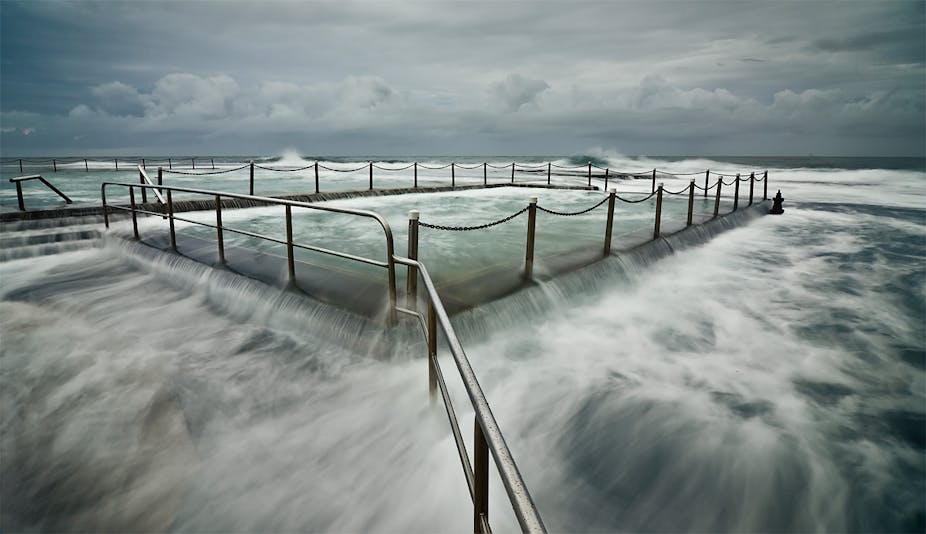
The rate at which sea levels are rising can change depending on when or where the measurements were taken, scientists say. Flickr/Brentbat

Global average sea levels continue to rise but readings vary greatly depending on when and where they are taken, a leading expert on coastal impacts of climate change has said, warning that selective sea level readings do not give an accurate overall picture.

CSIRO observations show the global sea level rise since 1993 has been between 2.8-3.2 mm per year, near the upper end of predictions made by the Intergovernmental Panel on Climate Change (IPCC), said a CSIRO expert on coastal climate change, Dr Kathy McInnes.

“But there is a huge amount of variability in the rate of rise,” said Dr McInnes, a contributing author to the IPCC second, third and fourth assessment reports and a lead author on an IPCC Special Report on Extremes.

“If you go back to around the 1930s and 40s you get a declining trend. If you go back earlier than that, you see acceleration. If you look at records later than that, you see acceleration.”

Dr McInnes' comments follow recent media reports that sea level rises are decelerating, which referred to research by the principal coastal specialist at the NSW Department of Environment, Climate Change and Water, Phil Watson.

Mr Watson’s findings were based on readings of long tide gauge records taken at Fremantle, Auckland, Fort Denison and Newcastle and found a “consistent trend of weak deceleration at each of these gauge sites throughout Australasia over the period from 1940 to 2000.”

However, Mr Watson said the media report had misrepresented his findings.

“Unfortunately the Australian article, Sea-level rises slowing: tidal records, misrepresented my research work by saying that “global warming is not affecting sea levels”,” he said, adding that his department had sent a letter to the editor about the report.

“My research analysed trends in historical regional sea level data but did not draw conclusions about the impacts of global warming on sea level rise,” he said.

A longer term data set was needed to get an accurate picture about sea level rises, said Dr McInnes.

“One of the points [Watson] makes in the paper is that because of natural climate variability, which influences the sea level record, it may take 10 – 20 more years of records to determine more conclusively the role of global warming on recent sea level trends,” Dr McInnes said.

Sea levels around the Australian coast rose an average of 5 – 6mm per year between 1993 and early 2011, CSIRO observations show, well above the 20th Century average of 1.7 mm per year.

Sign in to Favourite

Want to follow The Conversation?

Sign up to our free newsletter to get the day's top stories in your inbox each morning, with a special wrap on Saturday.

Spinner
Help evidence based journalism become the norm and donate

Join the conversation

33 Comments sorted by

  1. James Szabadics

    Technical Development and R&D Manager, Plantation Timber Industry

    The Author writes:

    QUOTE
    CSIRO observations show the global sea level rise since 1993 has been between 2.8-3.2 mm per year, near the upper end of predictions made by the Intergovernmental Panel on Climate Change (IPCC), said a CSIRO expert on coastal climate change, Dr Kathy McInnes
    ENDQUOTE

    If this was true then the IPCC upper end of sea level rise would be 28 to 32cm this century. First I have heard that IPCC think 32cm is near the upper limit of sea level rise this century. Where are the 1m figures coming from and do the IPCC reject them?

    report
    1. James Szabadics

      Technical Development and R&D Manager, Plantation Timber Industry

      In reply to timl

      High end of IPCC prediction from AR4 is 59cm not 32cm as claimed in the article
      http://www.ipcc.ch/publications_and_data/ar4/syr/en/spms3.html#table-spm-1

      And if you look at the next link you can see 28 to 32cm is the LOW end of IPCC projections

      http://www.cmar.csiro.au/sealevel/sl_proj_21st.html

      The 1m figure was not from IPCC AR4 but was pre Copenhagen hoopla , i wondered if the IPCC reject such extreme estimates.

      http://www.guardian.co.uk/environment/2009/mar/11/sea-level-rises-climate-change-copenhagen

      report
    2. timl

      logged in via Twitter

      In reply to James Szabadics

      You've answered your own first question, "where are the 1m figures coming from?". The second one "... and do the IPCC reject them?" will have to wait for the AR5 report. The 1m results you refer to, however, are not necessarily inconsistant with the AR4 results, as the AR4 results explicitly state that they do not adequately account for rapid ice melt.

      report
    3. Byron Smith

      PhD candidate in Christian Ethics at University of Edinburgh

      In reply to James Szabadics

      It is important to note that projections to 2100 are *not* made by taking current rates and multiplying by 100 (or 90). This is where the question of acceleration or deceleration come in (which must be carefully distinguished from rising and falling). It is possible for sea level to be rising at an accelerating or decelerating rate. Of course, the rate of acceleration/deceleration are also important. Given the various contributing factors to SLR (thermal expansion, glacial melt, dynamical ice flow…

      Read more
    4. Byron Smith

      PhD candidate in Christian Ethics at University of Edinburgh

      In reply to Byron Smith

      An edit function would be useful.
      come in --> comes in
      are also important --> is also important

      And to think that I was once an English teacher...

      Here are the key findings of the Critical Decade report:

      • A plausible estimate of the amount of sea-level rise by 2100 compared to 2000 is 0.5 to 1.0 m. There is significant uncertainty around this estimate, the largest of which is related to the dynamics of large polar ice sheets.
      • Much more has been learned about the dynamics of the large polar…

      Read more
    5. Byron Smith

      PhD candidate in Christian Ethics at University of Edinburgh

      In reply to Byron Smith

      <a href="http://www.skepticalscience.com/news.php?n=896">This report</a> is also worth looking at, which estimates the ultimate likely sea level rise from a moderate amount of warming based on paleoceanic records.

      "This study marks the strongest case yet made that humans – by warming the atmosphere and oceans – are pushing the Earth's climate toward the threshold where we will likely be committed to four to six or even more meters of sea level rise in coming centuries. [...] Unless we dramatically curb global warming, we are in for centuries of sea level rise at a rate of up to three feet per century, with the bulk of the water coming from the melting of the great polar ice sheets – both the Greenland and Antarctic Ice Sheets."

      report
    6. Sherry Mayo

      logged in via Facebook

      In reply to James Szabadics

      The IPCC estimates explicitly excluded contributions from melting ice sheets such as Greenland and the West Antarctic ice sheets because at the time the report was written it was felt that the uncertainties in predicting the amount of melting was too great to usefully include it. If you read the report carefully it highlights this.

      There has been a lot of work done on the ice-sheet melt issue since the IPCC report was put together, including access to new satellite ice-sheet mass-balance data. As a result the newer estimates of sea level rise are now including ice sheet melt - there are still uncertainties of course but these have been reduced with new measurements. Also remember that uncertainty cuts both ways.

      report
    7. Byron Smith

      PhD candidate in Christian Ethics at University of Edinburgh

      In reply to Sherry Mayo

      These are all important points to remember in this discussion.

      A small clarification: the IPCC AR4 included the melting of ice sheets, but not "dynamical ice flow". Imagine a large pile of ice cubes sitting on a slightly angled table at room temperature. The volume of the ice will be declining as the cubes slowly melt (and this is relatively easy to calculate), but due to the incline, some of the cubes may start to slide off the table. This is more difficult to model.

      report
    8. John Nicol

      logged in via Facebook

      In reply to Byron Smith

      Do you seriously think that Skeptical Science is a reputable site to which you can refer someone on the science of carbon dioxide's effect on the climate, which after all is thew whole basis of any of these discussions. The ice may well melt and the seas may well rise, but this cannot be predicted from the models used to project "global" warming based on the incorrect assumption that carbon dioxide increases will cause a significant increase in global temperatures. The present non-warming/cooling period was not projected even ten years ago by the climate models but it was predicted by solar physicists about thirty years ago.
      JOhn Nicol jonicol18@bigpond.com

      report
  2. John Dawson

    logged in via Twitter

    Can someone clarify the last sentence? Where did the 5-6 mm per year come from? what observations over what period?

    report
    1. Sunanda Creagh

      Editor at The Conversation

      In reply to John Dawson

      Hi John,
      My apologies. I should have made it clearer that the CSIRO says those observations are from between 1993 and early 2011.

      Have changed the last par to read:
      "Sea levels around the Australian coast rose an average of 5 - 6mm per year between 1993 and early 2011, CSIRO observations show, well above the 20th Century average of 1.7 mm per year."

      report
    2. John Dawson

      logged in via Twitter

      In reply to Sunanda Creagh

      Thanks Sunanda.

      Assuming that your observation sites include the ones Mr Watson tracked at Fremantle, Fort Denison and Newcastle, do you dispute his findings at these sites? If not, how do you account for the apparent discrepancy between his finding a small deceleration in sea level rise and your finding a large acceleration in sea level rise? Is it primarily an issue of which sites are observed or which period is compared, or something else?

      report
    3. Sunanda Creagh

      Editor at The Conversation

      In reply to John Dawson

      Hi again,
      I have no view on this issue as I am just a news reporter. I have asked Dr Kathy McInnes to respond to your questions.
      cheers
      Sunanda

      report
    4. Neil White

      Researcher (Sea level) at CSIRO

      In reply to John Dawson

      John

      The 5-6mm/year from 1993 to 2011 comes from satellite altimeter data and also from the National Tidal Centre's set of high quality baseline tide gauge stations. I can't find the figure I was looking for online, but the table on page 5 of this report: http://www.bom.gov.au/ntc/IDO60201/IDO60201.201105.pdf (or <a href="http://www.bom.gov.au/ntc/IDO60201/IDO60201.201105.pdf">this report from the NTC</a> - sorry, I'm new here and am not sure how they handle links) gives an idea - high trends (up…

      Read more
    5. James Szabadics

      Technical Development and R&D Manager, Plantation Timber Industry

      In reply to Sunanda Creagh

      For a global picture of sea level change trend you can see this:
      http://sealevel.colorado.edu/content/map-sea-level-trends

      It is interesting to see how regional the changes are, sea levels are falling in some places and rising in others.

      Sea levels in northern Australia have risen 120m since the peak of the last glacial period 19,000 years ago - (average of 6.31mm/yr) a lot of that rise was early in the period when albedo of the earth was huge due to continental ice sheets.

      Southern Australia is closer to no change, most of the northern sea (with a noteable gap in gulf of carpentaria) is where the change is occuring recently. Globally sea level change appears very regional.

      Global average rise appears to have decellerated even further through 2010/11 continuing the decelleration that started in 2006. Note the large gap between trend and recent running average.

      http://sealevel.colorado.edu/

      report
  3. Douglas Cotton

    B.Sc.(Physics), B.A.(Econ), Dip.Bus.Admin

    Sea levels can reflect past temperature rises that started melting ice over a decade ago. The good news just out is that the Greenhouse Warming Theory has now been debunked in a peer-reviewed experiment - see http://www.biocab.org/Wood_Experiment_Repeated.html

    This helps confirm what I have been saying on http://earth-climate.com that it is the heat coming from the core and the crust which determines a base temperature similar to those in caves and mines. Solar insolation is only temporary and…

    Read more
    1. Pawel Rakowski

      hydrogeologist/groundwater modeller

      In reply to Douglas Cotton

      It looks like you have an endless supply of pseudo-science Douglas. Peer-reviewed experiment? do you mean published at http://principia-scientific.org/. Truly, it's highly regarded webside where you can find 2 (two!) publications and 3 videos. I wouldn't call it peer-review standard. It's poor even for bloggers standard.
      The experiment was truly ground-braking, Nasif S. Nahle showed that original Woods experiment can be repeated and that conclusions are valid. In the real greenhouse most of the…

      Read more
    2. Douglas Cotton

      B.Sc.(Physics), B.A.(Econ), Dip.Bus.Admin

      In reply to Pawel Rakowski

      Pawel - sorry about the delayed response. I do actually agree that no experiment in a box simulates the atmosphere, which is why the IPCC should have ignored the theory about CO2 based on experiments in such boxes over 100 years ago. The atmosphere does not obey the Second Law of Thermodynamics - because uniform pressure is not a possible result over a significant altitude differential. Hence "warm air" does not fall back to earth. So we only need to consider radiation. But there aren't as yet…

      Read more
  4. John Stanley Cook

    The disappointing aspect of this article is that it makes claims about measurements by CSIRO whereas I suspect that CSIRO has made very few of the measurements upon whci it relies. Much has depended on considerable efforts by hydrographic and geodetic authorities over longer than CSIRO has existed. CSIRO would deserve more respect if it gave a reasonable acknowledgement of the sources it has used.

    report
  5. John McLean

    logged in via email @connexus.net.au

    According to John Chruch (and my own research confirms it) sea level at Fremantle is very much a reflection of ENSO conditions, with a delay of a few months. This makes perfect sense - it's the Pacific and to a lesser extent the Indian - Ocean sloshing around according to the ENSO.

    Other points worth noting
    1 - ENSO drive sea level is common among the Pacific Islands, in fact I'v ebeen told that take the ENSO away and there's been negiligible sea level change there in the last 10 (or is it 15 ?) years.

    2 - Tidal guage data is useless unless one has first confirmed that there's no isostatic movement. A few years ago I checked Victoria's tidal monitoring data and I rejected about 4 of the 9 stations because of land movement and I rejected data at Williamstown because it seems to be from a new tidal guage after 1 January 1970. Don't tell me you didn't know of these problems?

    report
  6. Nick Drew

    Executive Manager

    It is a great shame that the author points out the limitations of selecting a particular period to suit your argument but then does the same thing. Dealing with uncertainty and complexity and providing guidance to the general community demands a higher standard fo scientific rigour.

    report
  7. Toby James

    retired physicist

    John, I would be interested to learn how and to what extent plate tectonic effects are are taken into account in evaluating global sea level changes. Uncertainties in sea level dynamics are bound to be problematic if they are determined by comparison with 'floating land masses'.

    report
    1. Doug Cotton

      In reply to Michael J. I. Brown

      Still waiting for any valid criticism of my (revised) site. Before you say the energy from 2,000 nuclear tests is insignificant, please note that, being underground, it is something that can build up over months or years before escaping through the surface. In contrast, use of fuels above ground, in the air or wherever creates relatively temporary heat, like solar insolation itself. Furthermore, underground explosions could very well lead to air or water filling a cavity where there was once solid…

      Read more
    2. Doug Cotton

      In reply to Michael J. I. Brown

      Michael - I guess Media Watch has better peer-reviewers than Watson - IYHO.

      It seems to me that, given that NASA sea surface data shows mean temperatures for the 12 months ending 31 July 2011 being less than mean temperatures for the 12 months ending 31 December 2003 then at least we can say there has been no accumulation of heat between these two 12 month periods at sea surface levels.

      Hence it would not be surprising if the rate of increase of sea levels is actually declining - and may even soon be zero or negative - like the temperature gradient since 2003 when El Nino had passed us by. We have to expect some time lag before ice stops melting because ice will retain heat for a while.

      report
    3. Michael J. I. Brown

      ARC Future Fellow and Senior Lecturer at Monash University

      In reply to Doug Cotton

      More (largely) off topic pseduo-science posts from Douglas Cotton.

      The more Douglas Cotton posts, the more I wonder if he is some variant of an internet troll. Why continue posting when there is no evidence anyone believes you?

      The mistakes on his website and in his posts have been pointed out many times. Basically, Douglas Cotton always presents a series of half thought out ideas, with no attempt to use relevant theory (including calculations), no attempt to properly use all the relevant data, and no cross checks against multiple sources. A few misrepresentations always come along for the ride (e.g., his comment on Media Watch).

      report
    4. Doug Cotton

      Manager

      In reply to Michael J. I. Brown

      As best I am aware, any errors or doubtful claims on http://climate-change-theory.com have been corrected or removed, so let's just talk about what is left.

      There IS quantification of (1) the core to surface temperature gradient, eg 300 deg.C at 10,000 m down to about 10 deg.C at surface - in Germany anyway, (2) the "break out" temperature - with a mean of about 9 degrees C. (3) the temporary mean warming by solar insolation of about 12 degrees during the day (3) the relative acceleration due…

      Read more