
The “spin” sometimes found in media reports emphasising the benefits of new medical treatments has more to do with the abstracts of studies published in scientific journals than misrepresentation by the media, according to a new French study.
In a study of 70 press releases relating to the results of clinical trials, published in PLOS Medicine, a team of researchers led by Isabelle Boutron from the University of Paris found 47% contained spin.
The researchers also found 40% of study abstracts published in scientific journals contained spin, with 51% of the news stories that were written as a result carrying the same spin found in the press release and abstract.
The results highlight a tendency for press releases and associated media coverage of controlled trials to place emphasis on the benefits of experimental treatments, the researchers said in a statement.
“This tendency is probably related to the presence of spin in conclusions of the scientific article’s abstract,” they conclude.
Researchers are being taught to “sex up” press releases, said Amanda Wilson, from the School of Medicine and Public Health at the University of Newcastle.
Dr Wilson also runs Media Doctor Australia, a site dedicated to improving the accuracy of medical news reporting.
She said while American pharmaceutical companies were very good at eliciting favourable news coverage, in Australia this is not the case, and it’s researchers and research institutes that are instead seeking influence.
“This is an international phenomenon as media profile becomes currency for researchers,” Dr Wilson said.
“It’s dog eat dog, you’re fighting for funding constantly and having a media profile or a paper published in the media increases your currency as a researcher. You can’t survive without that.”
Dr Wilson believes spin is being encouraged, but argues those responsible should be held to the ethical foundations of research.
“We have extremely tight guidelines on ethical practice in research, so you would never lie or spin to a funding company, or the ethics committee, you wouldn’t deceive patients in a trial, you would never lie to a journal or fudge results, but when it comes to releasing the information to the media and the public you’re encouraged to do that.”
Ian Haines, Adjunct Clinical Associate Professor at Monash University, agreed abstracts written about expensive new therapies in particular are often not an accurate reflection of the study’s findings.
“The lack of access to the primary data and the frequent conflicts of interest between the authors and the company sponsoring the study are cause for deep concern,” he said.
Professor Haines has in the past argued for independently written abstracts of articles and full access for the reviewers and readers to the raw data.
“So many readers, medical and otherwise only have time to read the abstract and/or press release and it is vital that it is accurate and not full of spin, misreporting or selective reporting.”
He added that reporters also need to ask more questions and not accept media releases verbatim.
Sean Lamb
Science Denier
Exhibit A
http://newsroom.melbourne.edu/news/n-902
Sean Manning
Physicist
could, may, could, may.... so what did they do?
Sue Ieraci
Public hospital clinician
Spot on, Sean Lamb.
News story title says "able to predict"
Investigator says " This test could assist"
Neuroskeptic
logged in via Twitter
Yes, press releases and abstracts are sexed up, but that's the <i>role</i> of those forms of communication: they are sexed up on purpose.
The media's job however is to communicate the truth which means treating press releases and abstracts as the unreliable, biased sources they are, not taking them at face value or just rewriting them as a news piece.
To blame press releases for bad medical journalism is to let journalists off too easy - of course press releases are bad. They're press releases. The job of journalists is not to be fooled by them.
Sue Ieraci
Public hospital clinician
Now that so many research publications are freely available over the net - but mostly only in abstract form, the simplified (dumbed-down) messages are more influential than ever before.
When medical journals were only paper-based, the abstract was a succint summary at the top, always followed by the entire paper. Now, a huge number of abstracts are available, with the full papers frequently behind a paywall.
The other issue is that interpreting scientific research needs skills beyond reading…
Read moreGeoff Russell
Computer Programmer, Author
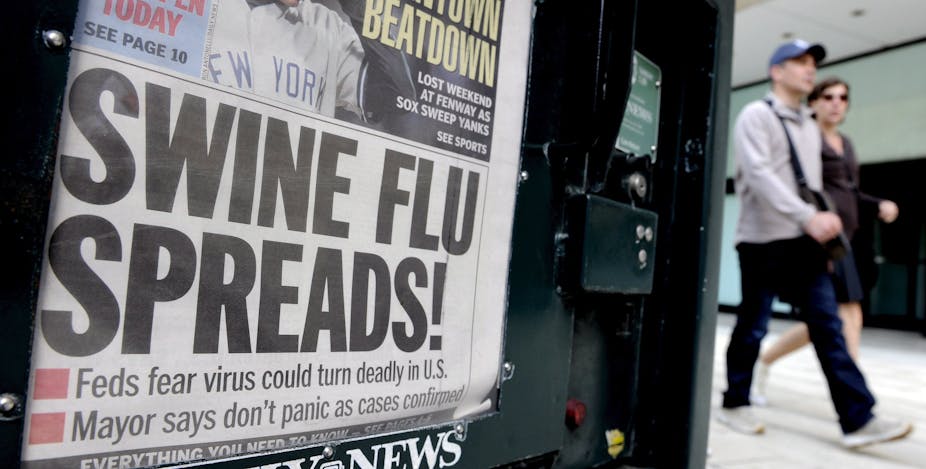
Story is fine and has an important message. But that Swine Flu photo?
Swine flu killed 284,000 people http://bit.ly/QBjx5q and unlike "normal" seasonal flu, about 80 percent of the victims were under 65 and included 44,000 children.
Compare the claims that Swine flu was a beat up with the incompetent ABC Lateline beat-ups over Fukushima ... death toll zero and lives saved by the nuclear power stations during the tsunami, perhaps a thousand. Make no mistake the media still have plenty to answer for.
Diana Taylor
retired psychotherapist
Want a good example? See another conversation article "The cognitive benefits of literary analysis" https://theconversation.edu.au/the-cognitive-benefits-of-literary-analysis-9547#comments
Rosemary Stanton
Nutritionist & Visiting Fellow at University of New South Wales
Another problem is that an abstract does not provide a declaration about the authors' conflict of interest. At an NHMRC forum on COI, I asked a former editor of the MJA if his journal would consider including the COI on the abstract. He said 'no' because journalists should pay for access the full paper to discover if any COI existed.
Before we damn journalists alone, there are some topics where contributors to the comments in The Conversation also appear only to have read the abstract.
Tim Scanlon
Debunker
This isn't really new to scientists: http://www.phdcomics.com/comics/archive/phd051809s.gif
I've noticed this the most in the medical field. You see them in the media all the time with a new (insert disease here) cure. When you listen/read to the last little part of the news article you realise that the study is only preliminary and has a least a decade of trial work to go before human testing for safety, before we could even think about whether it does anything. I.e. it isn't news, it is hype.
Katie Harris
logged in via Twitter
Here's an interesting example of how the words chosen - even just for the title - can make such a huge difference to how research is used/misused... http://news.anu.edu.au/?p=1045