
Few would deny that innovation is important to the prosperity and growth of the national economy. Around the world governments are keen to see more innovation occurring with the anticipation that this will boost economic activity. Since the 1980s attention has been given by governments to the enhancement of their country’s National Innovation System (NIS).
The meaning and misunderstanding of the National Innovation System
There are many definitions of NIS but most deal with the existence of a network or networks of institutions across public and private sectors that interact with each other in order to foster innovation and diffuse new technologies. A key part of this process is the role of publicly funded research, and the role of the university sector.
The concept of the NIS emerged from research being undertaken in the 1980s by European and American academics such as Professors Bengt-Ake Lundvall, Christopher Freeman and Richard Nelson. Their interest lay in understanding the interrelationship between investment in science and technology and economic competitiveness. Their hope was to provide government policy makers with new tools and theories with which to manage science and technology policy.
In a paper published in 2007 in the journal Industry and Innovation Lundvall noted that while the concept of the NIS had taken hold strongly since its emergence some thirty years previously, there remain some abuses and misunderstandings. Of concern was the tendency to overestimate the role played by university research in technology transfer. The success of a few high profile cases from the United States in the fields of pharmaceuticals and biotechnology had led many to seek more general relationships between universities and industry.
According to Lundvall universities were being viewed as “immediate sources of innovation” with pressure for them to generate applied outcomes and engage in commercialisation projects. Yet most universities are not configured for such a role and play a potentially more important function via education of future scientific and engineering personnel.
Lundvall also raised concerns over what he saw as “a narrow definition of innovation system where the focus is on science based innovation”. Of more relevance was the need to view the NIS as a much wider system that involves interactive learning and where science is but a part of a much larger context.
At the core of the NIS is how firms within given industries interact and how they adopt and diffuse innovation and new technologies. While invention is important, the willingness to be a first follower or early adopter of new ideas is equally important. As Lundvall noted in his paper: “Early followers and early users have an important role to play in the innovation system as a whole since they host processes that are as important for the overall innovation process as the pioneer firms.”
He cautioned against focusing too much on science at the expense of experience-based learning within industry. There is a need for the NIS to focus attention not only on high-technology industries, but also on low to medium-technology sectors.
Measuring NIS performance – GERD, BERD, HERD and GOVERD
The measurement of how well an NIS is performing is complex. Some of the common measures used are investment in research and development (R&D) and the number of patents generated, researchers employed, engineering and science degrees issued and scientific papers published. Also included are measures such as the proportion of firms that generate new technological products and measures of collaboration between firms.
Of the common measures of NIS performance are those relating to R&D. There are four main indicators: i) Gross expenditure on R&D (GERD); ii) Business expenditure on R&D (BERD); iii) Higher Education expenditure on R&D (HERD) and iv) Government expenditure on R&D (GOVERD).
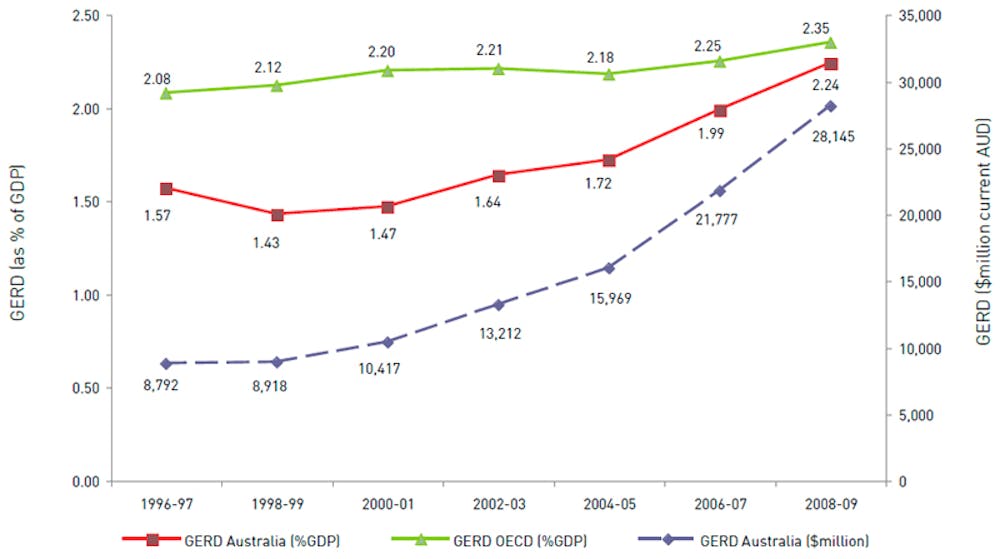
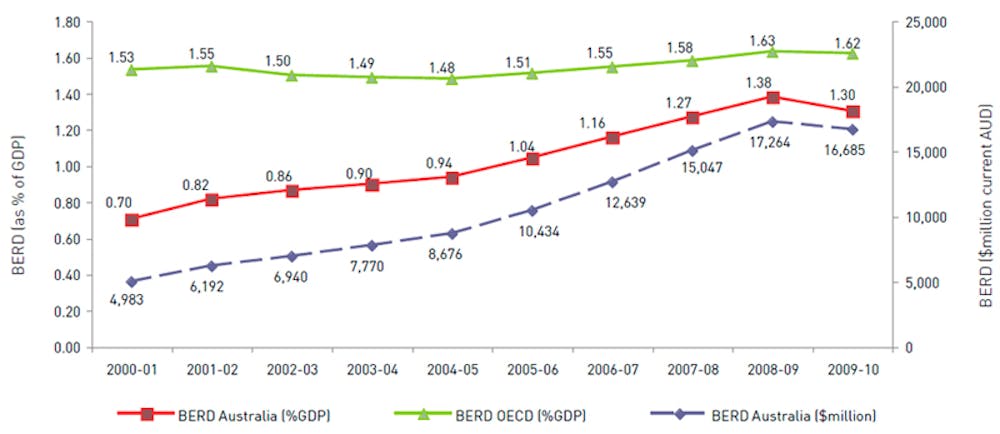
Australia spends around $28.2 billion per year on R&D, or around 2.24% of GDP. Our business community’s expenditure on R&D is in the order of $16.7 billion per annum or about 1.3% of GDP. The university sector’s expenditure is in the order of $8.2 billion per annum and that of government around $3.4 billion per annum.
These figures place Australia close to the OECD average and we rank 12th out of 31 nations in relation to our GERD and BERD, and 9th and 10th in relation to our HERD and GOVERD. As illustrated in the figure below, Australia’s GERD over the past twenty years has been steadily improving.
When we look at our BERD performance, as shown in the following diagram, it can be seen that our business community’s investment in R&D has also been steadily rising. However, over the past decade it has lagged behind the OECD average.
Mining is no longer a low-tech sector
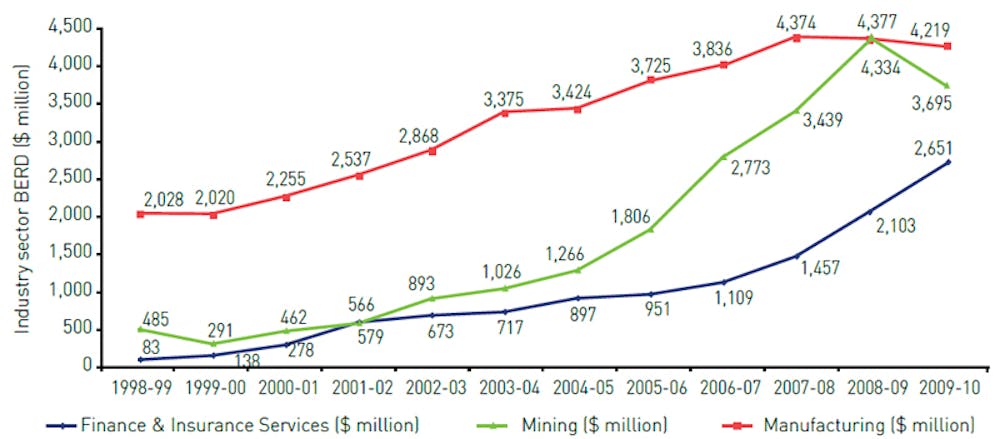
One of the more interesting trends from an examination of the BERD data is the rising level of R&D investment by the mining sector over the past twenty years. As illustrated in the graph below, the mining industry has significantly increased its level of investment in R&D since the 1990s. Even though this investment experienced a rapid decline in the 2008-2009 Global Financial Crisis (GFC), it has effectively caught up with manufacturing.
With the advent of major oil and gas projects now emerging side-by-side with mining, the level of R&D investment by Australia’s resources sector is likely to increase. This is particularly the case for offshore gas projects such as are now taking place in Western Australia.
These projects involve significant technical complexity. This promises opportunities for innovation, R&D and technology transfer. The challenge for Australia is to secure R&D benefits from this investment pipeline rather than seeing all the value added work undertaken overseas.
Australia’s Innovation System – university research
In 2009 the report “Powering Ideas: An Innovation Agenda for the 21st Century” was released by the then Minister for Innovation, Industry, Science and Research Senator Kim Carr. This laid out a strategy for enhancing Australia’s NIS over a ten year period. Seven priority areas were identified.
The first two of these relate to the research capacity and skills base. These refer to the number of world class research clusters operating within our universities. Also the number of higher degrees by research (HDR) completed each year.
In order to measure these areas the government introduced the Excellence in Research for Australia (ERA). This used the now abandoned system of ranking academic journals as the primary means of measuring quality. Assessing our international research performance continues to be fraught with measurement problems.
For the HDR performance measures the process was easier to assess. However, the government’s report on progress published last year observed that Australia would only meet its anticipated research skills demand by increasing the number of international students enrolling in HDR programs.
Whether such students can be attracted to Australia in what has become a more difficult international market for our universities remains to be seen. Further, once they graduate their ability to remain in Australia after graduation and find meaningful places in our R&D system is less clearly understood.
Doctoral students are generally attracted to universities out of an interest in the specific research being undertaken within particular fields. They are seeking not only a qualification, but access to world class researchers from whom they can learn, and the opportunity to link to industry or research projects upon which to build their own careers.
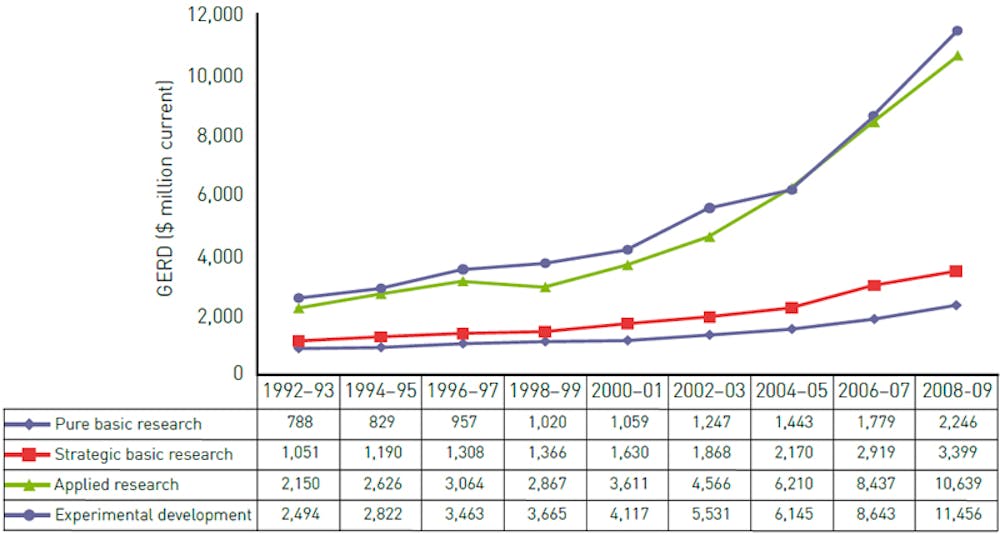
One thing that will be important is the level of research funding for universities and other public R&D centres. As shown in the graph below the level of GERD since the early 1990s has increased steadily. However, continued funding will be required although it is anticipated that there will be increasing competition amongst institutions for available grants and mounting pressure for tangible benefits to be demonstrated.
Business investment in innovation and R&D
Within the business community the Australian government’s targets for the NIS are to increase the level of investment in R&D, and to see a 25% increase in the number of businesses engaged in innovation over the next decade. In 2009-2010 the most significant levels of BERD were to be found amongst the manufacturing, mining and financial and insurance services sectors across Australia.
The Australian government uses the number of businesses registered for the R&D tax concession as a key indicator. Innovating businesses are defined as those that have introduced at least one type of innovation during the year. According to the most recently published data around 45% of Australia’s businesses are active innovators in areas such as the development of new products and services, operational processes, management or marketing techniques.
This does not seem particularly high, particularly as the definition of what constitutes innovation activity is fairly broad. As Lundvall observed, there should be as much attention given to fostering innovation in low and mid-tech industries as there is in their high-tech counterparts. Low and mid-tech industries include electrical goods, furniture, motor vehicles, plastics and food processing.
Linkages and collaboration
The success of an NIS is the ability to link businesses together with universities and facilitate the flow of ideas and the diffusion of technology. The Australia government’s objective is to double the level of collaboration between universities and the business community over the next ten years. At the same time they aim to increase the level of international collaboration in research being undertaken by Australia’s universities.
As illustrated in the following graph the proportion of businesses that engage in collaboration with universities and other publicly funded research centres is low. More collaboration can be found between firms and their customers or suppliers, or with outside consultants and even other firms including competitors.
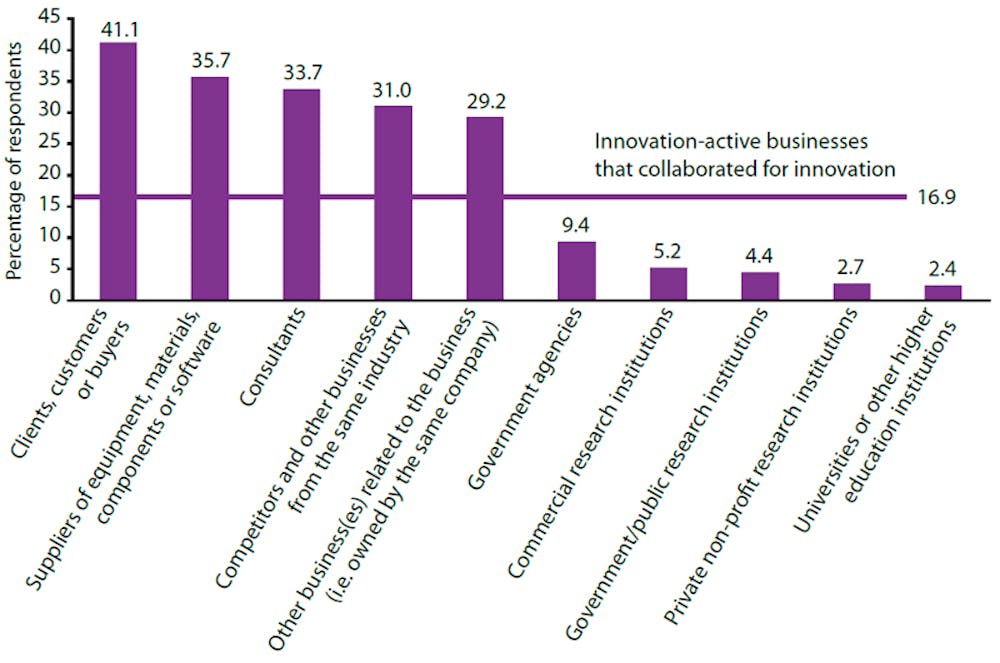
Australia’s level of collaboration around innovation is ranked highly for SMEs (5th in the OECD), but quite low for large firms (23rd in the OECD). Encouraging greater collaboration between SMEs and universities is going to require some substantial changes to the way in which university research is recognised and rewarded. For example, the decision to reduce the number of ARC Linkage grant rounds from two to only one per annum is not going to make it any easier for SMEs to participate in such projects.
Better mechanisms for enhancing the connectivity between universities and SMEs are needed. Here the focus should not only be on R&D from a relatively narrow scientific perspective. It must, as Lundvall has suggested, focus on the facilitation of knowledge exchange and learning. The owner-managers of SMEs will benefit from industry outreach education programs designed to enhance their knowledge. Such programs need to focus on teaching them about the nature and practice of applied innovation and commercialisation. This is as much, if not more about business skills as it is about science and engineering.
Building a smarter nation
Australia’s economic future will depend upon how effectively it develops its NIS. The challenge is not just in maintaining our international competitiveness in science as measured by peer reviewed publications. It is in how well we connect together the academic, policy and practice communities within our nation. As things currently stand our performance is not terrible, but there should be no room for complacency.
Grendelus Malleolus
Senior Nerd
Dammit Tim, I just submitted my paper on innovation on Sunday night (not for any of your units!) - this would have been a very useful broad-scope reference!
Sigh, my timing as always is appalling.
Tim Mazzarol
Winthrop Professor, Entrepreneurship, Innovation, Marketing and Strategy at University of Western Australia
Hi Grendelus,
Sorry to hear about the timing of your paper. However, I am pleased to see you are studying innovation. It is a much misunderstood subject area and needs more discussion and research.
Kind regards.
Grendelus Malleolus
Senior Nerd
Thanks Tim, actually there is genuinely no really bad timing here - as a result of you writing this piece I now know of a local academic to contact if my organisation can be motivated to pushing further innovation in our sector and that is far more convenient than an additional reference.
Robert Dalitz
Adjunct Fellow, Office of UWS Innovation at University of Western Sydney
Nice article Tim. I am also an innovation researcher and generally agree with your observations abotu the NIS. But, although I am an R&D person, I really see R&D as a fairly peripheral to Australia's innovaiton performance.
Read more1) We mainly have low/medium tech industries. These are users of other's technology usually. The focus should be on absorptive capacity - search capabilities, the ability to absorb knowledge, and then the ability use it commercially. We tend to focus on search (public research…
Tim Mazzarol
Winthrop Professor, Entrepreneurship, Innovation, Marketing and Strategy at University of Western Australia
Hi Robert,
Thank you for the feedback. I fully agree that the key to much of this is entrepreneurial activity and innovation that is focused on commercial outcomes.
Australia is actually quite good at what might be called "technology scavenging". We have a long history of adopting new technologies and also processes and practices from around the world. This "absorptive capacity" is a strength.
On the issue of linking SMEs more into our Unis, it feel that a conventional science-driven model…
Read moreRobert Dalitz
Adjunct Fellow, Office of UWS Innovation at University of Western Sydney
Agree - Australia is very good at adopting and adapting things done elsewhere. Which is more about trechnical consultants and specialised suppliers than public researchers. But government can 'control' academics etc and so focuses on them. To me most SMEs aren't going to ever get much out of universities and people like us. They need a climate that encourages innovation and relatively easy access to the expertise to take up and modify technologies etc.
Read moreThe driver of growth is small fast growing…
Gavin Moodie
Principal Policy Adviser
Does the author mean: 'Australia’s level of collaboration around innovation is ranked highly for SMEs (5th in the OECD), but quite low for large firms (23rd in the OECD)'? His subsequent comments on encouraging greater collaboration between universities and SMEs suggests that Australia's performance in SME collaboration is problematised rather than ranked highly.
If the problem is collaboration with small enterprises perhaps intermediate organisations would be useful such as German Frauhoffer institutes for manufacturing and Australian rural industries research and development corporations.
Tim Mazzarol
Winthrop Professor, Entrepreneurship, Innovation, Marketing and Strategy at University of Western Australia
Hi Gavin,
The ranking is out of 31/32 OECD countries. So 1st is best and 33rd is worst.
What the data suggests is that our SMEs are much more collaborative than our larger firms. Yet this is mostly with their customers and some key suppliers. It is logical for SMEs to seek to engage with their customers.
My own research highlights this and suggests that most innovation within SMEs is driven by engagement with leading customers. Together they often co-create the new products and services…
Read moreIain Wicking
Director
The real issue for me is that this tends to be observed from a siloed perspective rather than an integral value chain perspective, which in turn underpins the design to product (and service) process of innovation . Without an underpinning national innovation 'framework' you cannot close the innovation chasm and then cannot enable systemic innovation across the nation and all its sectors. As has been commented above innovation is more than just products. The framework would deliver a collaborative intersection of all participants along the innovation value chain. I've written about this but it requires a national vision - the enabler for the framework exists.
Tim Mazzarol
Winthrop Professor, Entrepreneurship, Innovation, Marketing and Strategy at University of Western Australia
Hi Iain,
I agree that the NIS must be viewed as a whole and in its totality it is a system. The concept is that of a series of interconnected elements that are not linear but involve the ongoing creation, diffusion and adoption of innovative ideas and technologies.
The Government's approach is in many respects understandable. To analyse a complex system we often need to dissect it and look at each of its constituent parts. Measuring inputs and outputs such as money invested in R&D then patents…
Read moreGerard Dean
Managing Director
Tim
Always good to read your stuff. Noted your comment about mining. Could it be correct that I heard or read something to the effect that BHP Billeton make a big percentage of income by licensing and selling mining technology around the world?
I worked in Red Dog country back in '74. Even then the place was hopping. I remember being amazed by the tonnage moved by the trains bringing ore to Dampier compared with the slothful Victorian Railways moving our wheat crop down to Geelong. Things have…
Read moreTim Mazzarol
Winthrop Professor, Entrepreneurship, Innovation, Marketing and Strategy at University of Western Australia
Dear Gerard
Thank you for the comment. I am not sure about BHP-Billiton's licensing, but it would not surprise me. Rio Tinto has a state of art mining control centre here in Perth which controls among other things, robot Haul Pack trucks in the north west. Also, when you look at the technology that Shell is planning to bring to the LNG developments in the North West by way of floating LNG processing plants, it is clear that mining and energy is a technology intensive sector.
On a personal note…
Read moreMichael James
Research scientist
Who makes those "robot Haul Pack trucks"? Who made the software and owns the IP? (A google search using those terms gets me nowhere.)
Komatsu, Mitsubishi, Liebherr, Caterpillar, Hitachi?
Who makes the giant tyres? The engines (one thing I learned is that these giant trucks are actually electric drive trains!)
Is there is a single thing about these vehicles that is developed by BHP-B or any of the other miners? I seriously doubt it. So is this an example of "high techology" that should even be mentioned other than to show how little Australian industry rises to the challenge for providing for its own (kind of) largest mining company in the world?
Tim Mazzarol
Winthrop Professor, Entrepreneurship, Innovation, Marketing and Strategy at University of Western Australia
Hi Michael,
I think you make a good point that Australia's role in the manufacture of some of this technology is limited. However, that is not the key point that I was making.
The resources sector is bringing to Australia billions of dollars worth of projects with complex engineering technologies. There is opportunity for our industry to participate in this and we have had an active policy of Australian Industry Participation (AIP) for a long time. Major firms such as BHP-Billiton and Chevron…
Read moreMichael James
Research scientist
I mention it because you know the old saw about who makes the real money out of mining booms, esp. gold rushes? And who is the only one left standing after it runs out? It is the people who sold the spades etc. The tool makers/sellers, the shop owners and the whole provision chain. I'll bet there is hardly an Australian company in it (and I don't mean a few metal bashers).
Robert Dalitz
Adjunct Fellow, Office of UWS Innovation at University of Western Sydney
Michael,
I can only agree with Tim. Part of the issue with mining, as with oil and gas, is that the scale and specialisation is so great that only a few players worldwide can make these things. Australia makes a lot of great mining technology, but so do other nations that have a more advanced highly transformed manufacturing sector. A company that has been doing this for decades will dominate because the costs of learning how to make huge, highly robust and specialised pieces of mining kit are…
Read moreTim Mazzarol
Winthrop Professor, Entrepreneurship, Innovation, Marketing and Strategy at University of Western Australia
Hi Robert and also Michael,
From some recent research I'm doing into supply chains within the WA resources sector I can say that we do have a number of very competitive Australian firms that are winning work on these major projects. However, there are many highly specialized projects that must be sourced from offshore simply because there is nobody in Australia who can supply.
It is also worth noting that many of these components or "packages" involve elements that require customization and…
Read moreGerard Dean
Managing Director
Some good points raised about the equipment in mines however I have an angle to consider.
In our industry, the beverage canmaking industry, there are 2 or 3 manufacturers worldwide for each type of equipment in a plant. I won't bore you with the detail, but the tooling (just the metal tool) that punches the tab and the aperture on top of a lemonade can is made by either Stolle or DRT, likewise the vision inspection is made by Pressco or Applied vision and the automatic inspection systems are made…
Read moreGerard Dean
Managing Director
One other thing for Mr Dalitz
I was bought up in the Wimmera on a wheat farm near DImboola and not far away lived a Dalitz family. One of the family went on to become world famous in physics, Richard Dalitz.
Seeing that you are into innovation, and the Dalitz family were renowned innovators in the farming area, any relation?
Sorry to ask this personal question, however there is a mix of innovation in the question - a bit anyway.
Gerard Dean
Ex Wimmera Boy
Robert Dalitz
Adjunct Fellow, Office of UWS Innovation at University of Western Sydney
Gerard,
Sorry it taken a few days to reply. Yep, my dad was from Dimboola and Richard Dalitz was a cousin (of my dad). I went to his place in Oxford whilst living in the UK. He was very nearly a Nobel winner apparently. Interesting fellow. Especially as he and his wife left Australia just after WWII and the Australia I grew up in was totally different to his. It reinforced how much Australia changed after the war. Only 6 high schools you could get to uni from, food without any taste, no Asians etc.
Gerard Dean
Managing Director
Hey Tim
One thing I remember when I went to West Australia back in the seventies, and it has to do with pride in place of manufacture, was the sign on many products 'Made in Western Australia". The sign had a graphic of the state outline with a gear in the middle, from memory,
Initially it struck me as odd, because I had never seen Made in Victoria, however after spending a few months up north and finally accepting I was an 'Eastie", I understood.
I imagine it no longer exists. Still, it does tap into what you say is "leadership" or 'vision', where people are made aware of something that is made by their neighbours.
As usual, your articles get us thiniking.
Gerard Dean