Snapping an atom’s shadow? Now that’s a first

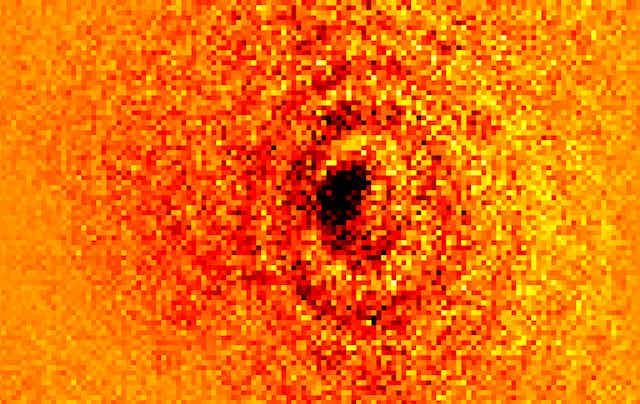
As the image above illustrates, my colleagues and I at Griffith University have been able to photograph the shadow of an atom for the first time – the culmination of five years of work by our team. The image, and attendant paper, are published today in the journal Nature Communications. So, in a nutshell…

Jj8nqc63-1341355427
A world-first image with implications for everything from quantum computing to microbiology. Kielpinksi Group/Centre for Quantum Dynamics

As the image above illustrates, my colleagues and I at Griffith University have been able to photograph the shadow of an atom for the first time – the culmination of five years of work by our team.

The image, and attendant paper, are published today in the journal Nature Communications.

So, in a nutshell, how did we get the image? The following analogy might help.

On a sunny day at the beach, your shadow is a constant companion. Holding your hand up will block the bright sun, but a few rays will still penetrate the thinner parts of your fingers.

If we were to take a closer look using a microscope we would see dark strands of tightly wound DNA in the nucleolus (composed of proteins and nucleic acids found within the nucleus) of the skin cells. Looking closer still, we might wonder: how small can something be and still cast a shadow?

The picture leading this article shows the shadow cast in a laser beam by a single Ytterbium atom suspended in empty space. At Griffith University, we have has pioneered the use of Fresnel lenses (a type of lens for large aperture and short focal length – producing an ultra hi-res miscroscope) to capture high-resolution images of atoms.

Our lens is like a smaller versions of the lenses used in lighthouses – both have many separate segments all working in concert to focus the light.
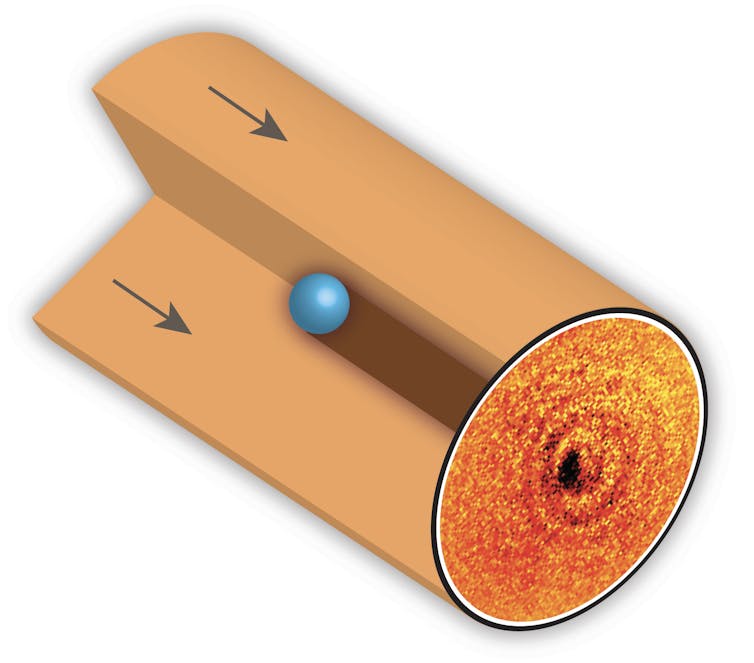
Single Atom Shadow Experiment Kielpinksi Group/Centre for Quantum Dynamics

The figure above shows how a laser beam (orange) passing by a single atom (blue) leaves a dark shadow in its wake, with the actual picture of the single atom shadow shown on the right end.

Since a single atom casts a very small shadow, our advances allowed us to be the first to take a picture of this effect. The size of the shadow is set by the wavelength of light, which is about a thousand times larger than the actual atom.

We hold the Ytterbium atom in empty space by removing one of its electrons and using high voltage electricity to fix its position. Ytterbium was chosen because we could build lasers of the right colour to be strongly absorbed by the atom.

Implications

Our work has implications for research ranging from quantum computing to microbiology. In quantum computing, light is the most effective method for communication, while atoms are often better for performing calculations.

In observing the shadow from a single atom we have shown how to improve the input efficiency in a quantum computer. Single atoms have well-understood light absorption properties. We used this knowledge to predict how dark the shadow should be for a given amount of light.

Since Dutch scientist Antonie van Leeuwenhoek’s first observations of red blood cells in 1674, absorption microscopy has played a prominent role in biology. X-ray and ultraviolet light are very useful for imaging cells but can also damage them at high dosages.

By knowing how much light is required to achieve a particular image quality, our work will be useful to predict when a little damaging light is enough to take a good image.

We’re pleased to be the first to capture a snap of the long shadow from an single atom’s dark side.

Sign in to Favourite

Want to follow The Conversation?

Sign up to our free newsletter to get the day's top stories in your inbox each morning, with a special wrap on Saturday.

Spinner
Help evidence based journalism become the norm and donate

Join the conversation

13 Comments sorted by

  1. Will Thurston

    Research scientist

    Hi Erik,

    Nice image! What is responsible for causing the concentric ring like bands around the main dark shadow? Is it due to diffraction of photons by the edge of the atom, or an artifact of the Fresnel lens?

    Thanks,
    Will.

    report
    1. Erik Streed

      Lecturer in Physics at Griffith University

      In reply to Will Thurston

      We're pretty sure the rings are an artifact of subtle changes in the optical wavelength filter were are using. They only occur in some of the photos and we weren't able to get them to consistently appear or disappear. Similar features can occur in Bose-Einstein condensate imaging. The main dark spot has a signal-to-noise ratio of only 5, so any reliable examining more subtle features will have to wait for our next round of system upgrades to be complete.

      report
  2. Reg Corleonis

    Writer

    Is that the shadow of the nucleus or the entire atom?

    report
    1. Gordon McDonald

      logged in via Facebook

      In reply to Reg Corleonis

      It's the shadow of the entire atom. They are using violet light (369.5nm) to excite an electronic transition within the atom. Nuclei usually require much higher energies than visible light to be excited.

      However, one notable exception is Thorium 229, which is expected to have a nuclear transition at roughly ~350nm.

      report
  3. John Nicol

    logged in via Facebook

    Congratulations Erik to you and your team.

    I have long admired the physics team at Griffith and used to visit there regularly in order to be recharged and inspired to work harder in my own field of high resolution optical spectroscopy. I learned a lot from the Griffiths Team and also received a lot of help from many members of the department at the time, many of whom have possibly moved on, Max, Bill, David P and later Robert and others who you may know had set up an excellent group which has…

    Read more
  4. Christian Jacobs

    Researcher

    Hello Eric. I'd like to congratulate you and your team and thank you for providing the world with this image. I'm curious as to why you posted one of the images with the rings if you're pretty sure they're not part of the atom. Could you provide us with any images that don't contain the rings?

    report
    1. Erik Streed

      Lecturer in Physics at Griffith University

      In reply to Christian Jacobs

      It was the highest resolution image we took and the one that looked the best. Most of the other images are at ~ 4x lower resolution because we were optimising the image capture for fitting rather than display purposes. We've done more work at it does appear that the rings are related to lensing/phase shifting behaviours the atom. http://arxiv.org/abs/1208.5091

      report
  5. Yoron Hamber

    Thinking

    A particle of matter right :)
    Casting a shadow. What about a photon? But that's a point particle? Still :) Can it cast a shadow?

    report
    1. Erik Streed

      Lecturer in Physics at Griffith University

      In reply to Yoron Hamber

      Photon size depends on their wavelength so they're really not well thought of as point particles. Optical photons are rather large compared with the size of an atom, x-rays are similar in size to atoms. A shadow can be thought of as an absence of photons. Since photons interact extremely weakly with each other it would be very hard for a photon to block or redirect other photons.

      report
    2. Yoron Hamber

      Thinking

      In reply to Erik Streed

      Heh, as I suspected.
      That da**'d pimpernel, just goes to prove that you can't trust a photon..

      report
  6. Ruturaj Gole

    logged in via Facebook

    It is an atom of which element exactly? Is it possible to attain a shadow of a molecule so as to know how do two atoms in a covalent bond appear?

    report
    1. Erik Streed

      Lecturer in Physics at Griffith University

      In reply to Ruturaj Gole

      The atom is of isotope 174 of element Ytterbium. The optical absorption from a single dye molecule was imaged about 18 months prior to this. Optical effects in molecules generally come from the shared electrons rather than specific atoms within the molecule. To resolve the atoms in a single molecule in a similar fashion would require an x-ray laser source that doesn't exist yet.

      report