
Soy versus dairy: what’s the footprint of milk?

Are soy milk’s environmental attributes based on substance or froth? Is soy a sustainable solution in the dairy debate? Comparative environmental analysis of different food groups is like comparing, well, apples and oranges. Reports such as the Food and Agriculture Organization’s (FAO) Livestock’s…

56x8k435-1345440935
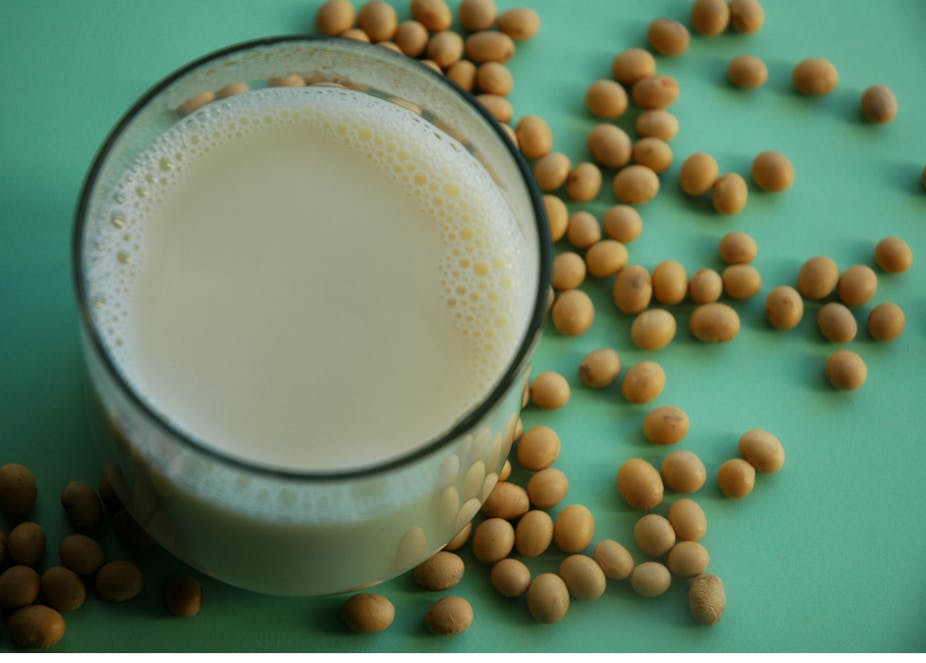
Soy might seem simply better, but what do the figures say? mc5556/Flickr

Are soy milk’s environmental attributes based on substance or froth? Is soy a sustainable solution in the dairy debate?

Comparative environmental analysis of different food groups is like comparing, well, apples and oranges.

Reports such as the Food and Agriculture Organization’s (FAO) Livestock’s Long Shadow document the negative environmental impacts of cattle and dairy production and consumption.

If cattle are major emitters of the intensive greenhouse gas methane and use large amounts of water, are protein alternatives such as soy less harmful to the environment?

Soy, of course, is much more than soy milk. According to the CSIRO, “60 per cent of all products at the supermarket already contain soybean”. (Look at the ingredients lists on breads, flours, oils, pet food and sausages, for example.)

The Federal Department of Agriculture, Fisheries & Forestry’s (DAFF’s) Australian Food Statistics (2011) report states that Australia produced 47kt of soybeans in 2010-11 and imported $36M worth of oilseeds in 2010-11 (soybean is classified as an oilseed rather than a pulse).
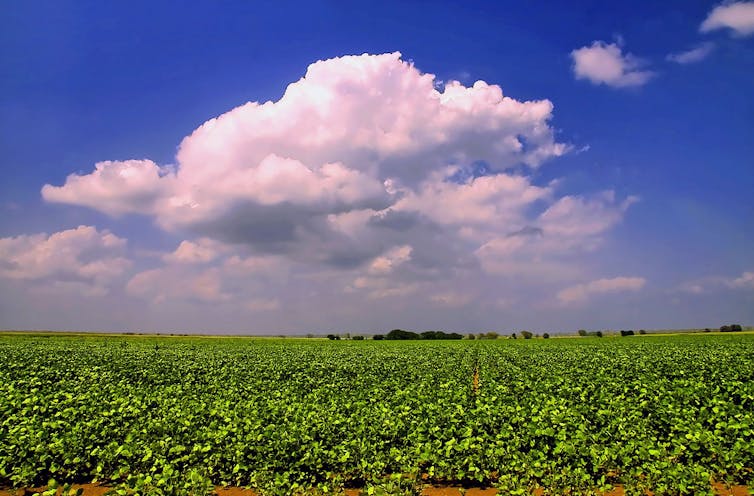
In 15 years, world production of soya has doubled. Carol Von Canon

According to Dr Andrew James, who leads CSIRO’s soybean breeding program, the vast majority of whole-bean soy products Australians consume – such as tofu, soy milk and many baking products – derive from Australian grown beans. However, the soy components used in processed foods generally come from imported soy protein powder, isolate or lecithin.

“We also import 500 to 800,000 tonnes of soybean meal. A crude guess is that would cost about $600 a tonne. That’s $500 million or more,” says Dr James.

Australians have been developing a taste for soy milk over the last decade. A Soy Australia report showed in 2009 Australians drank three litres each of soy milk a year. This is a 50% increase on 1998.

The report also claimed that most of the soy milk production in Australia is based on imported soy protein or soy protein isolate, a refined form of soy protein made from defatted soy flour.

Says Dr James: “If the milk is made from whole beans it will be Australian-grown beans that are used. If made from protein powder or isolate then that will be imported.”

In 2010-11, Australians drank 2296 ML of “dairy milk”, and 2061 ML in 2005-06. The annual average 2005-07 milk consumption per Australian was 230kg (approximately 223 litres).

Soy milk, soy-based drinks, soy dairy-free products and energy bars showed the strongest growth. Traditional foods like tofu have seen a decline in the past couple of years.
It takes less energy to produce soy beans than cows' milk. Melissa Powers

Australian data on the environmental impact of the dairy and soy industries is not as comprehensive as from other countries such as Sweden, Denmark and the United Kingdom. While there are international differences in production, life cycle analysis research is informative.

A recent Swedish study showed a span of 0.4 to 30kg of CO₂ equivalents produced per kilogram for different food items. The lowest emissions per kilogram were from legumes, poultry, and eggs. The highest were from beef, cheese and pork.

Cornell University scientist, David Pimentel, has found it takes about 14 kilo-calories (kcal) of fossil-fuel energy to produce 1kcal of milk protein using conventional milk production. Organically produced milk might require a little less than 10kcal of fossil-fuel energy per kcal.

In comparison, Pimentel’s data suggests that in a conventional soybean production system, one kcal of fossil energy invested produces about 3.2kcal of soybean. For 1kcal of fossil energy invested in organic soybean production, you get an average of 3.8kcal of soybeans. This means it takes between .26 and .31kcal of fossil fuel to make 1kcal of soybeans (contrasted with 10-14kcal to make 1kcal of dairy milk protein).

Pimentel states that soy protein accounts for about 35% of those kilocalories, so it appears that making soy protein is more energy-efficient than dairy protein.

Soy milk, of course, is the sum of its parts and whether using ground soy beans or soy isolate, other ingredients are added to make the liquid that consumers use in their coffees and cereals. These extras include calcium and oil. So the production process and its energy and water components need to be considered.
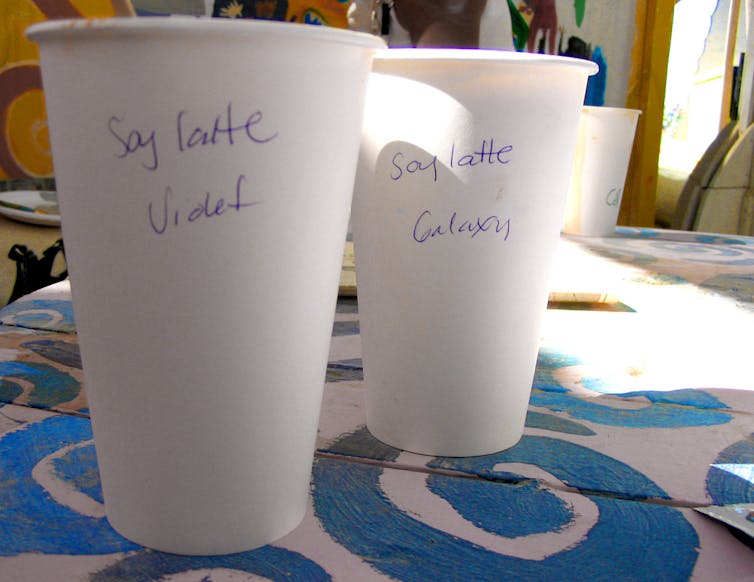
Soy beans have a low and energy footprint, but then there’s the footprint of converting beans to milk. gallixsee media/flickr

A 2010 “current and possible futures” study into greenhouse gas emissions across the top 45 food commodities in the UK recommended dairy milk and products be replaced by soy-based milk products.

A recent Dutch study comparing the water footprints of soybean and equivalent animal products found that soy milk and the soy burger have much smaller water footprints than cow milk and the average beef burger. The water footprint of the soy milk products analysed in this study was 28% of the water footprint of the global average cow milk. The water footprint of the soy burger examined was 7% of the water footprint of the average beef burger in the world.

Another important environmental parameter to consider is how much phosphorus is used to produce food. Modern agriculture is dependent on phosphorus derived from phosphate rock. It’s a non-renewable resource, and current global reserves may be depleted in 50 to 100 years. Meat and livestock production are associated with high phosphorus use and a vegetarian diet demands significantly less phosphate fertilizer than a meat-based diet.

The genetic modification (GM) debate is a series on its own, but it is relevant to note that all soybeans grown in Australia are GM-free, according to CSIRO’s Dr James. He compares this to the US, Canada, Argentina and Brazil, where over 90% of the soybeans grown are genetically modified.

Dr James says that if the soy milk bought in Australia states it is made from whole soybeans, it is “most likely” made from non-GM Australian soybeans. If the label says it is made from soybean isolate, it is “most probably imported from the US”.

Coffee anyone?

Articles also by This Author

Sign in to Favourite

Want to follow The Conversation?

Sign up to our free newsletter to get the day's top stories in your inbox each morning, with a special wrap on Saturday.

Spinner
Help evidence based journalism become the norm and donate

Join the conversation

46 Comments sorted by

  1. Mister Anderson

    Student

    Brilliant article! As a vegetarian (for emissions reasons among others) I constantly hear the argument that soy products use more water and energy than dairy and meat. I always assumed that it was a non-argument and I'm glad that you've given me a perfect resource to refer my dairy guzzling, meat chomping friends who like to rub vegetarianism in my nose :)

    (Still working on the cheese thing though, it's just too damned tasty!)

    report
    1. Paul Goodsell

      Eco-Warrior / Business Owner

      In reply to Mister Anderson

      Hopefully you soon realise that your taste buds aren't an appropriate moral factor, and go vegan. ;)

      report
    2. Ian Donald Lowe

      Seeker of Truth

      In reply to Mister Anderson

      The principal soluble carbohydrates of mature soybeans are the disaccharide sucrose (range 2.5–8.2%), the trisaccharide raffinose (0.1–1.0%) composed of one sucrose molecule connected to one molecule of galactose, and the tetrasaccharide stachyose (1.4 to 4.1%) composed of one sucrose connected to two molecules of galactose. While the oligosaccharides raffinose and stachyose protect the viability of the soybean seed from desiccation (see above section on physical characteristics) they are not digestible…

      Read more
    3. Stuart Burns

      Researcher, Broadcaster, Horticulturist

      In reply to Paul Goodsell

      Moral reasoning makes all eating perilous. How many individual animals die per kg of soybeans?

      report
    4. Helen Marston

      CEO Humane Research Australia Inc.

      In reply to Mister Anderson

      And this doesn't even begin to mention the inherent cruelty involved in breaking the strong maternal bond between the mother and her calf so that humans can steak their milk. What could possibly be more cruel than having your newborn taken away from you and sent to slaughter?

      Few people seem to acknowledge that just like other mammals - humans, dogs, monkeys - cows must be kept in a constant state of pregnancy/lactation.

      Dairy production is an extremely cruel industry and with so many alternative options now available there is absolutely no excuse to treat other creatures this way.

      report
    5. Daniel Kinsman

      logged in via Twitter

      In reply to Stuart Burns

      So because we can't eliminate harm entirely, we shouldn't even bother trying to minimise it?

      report
    6. Stuart Burns

      Researcher, Broadcaster, Horticulturist

      In reply to Daniel Kinsman

      How can we even measure harm in that context?

      Is the suffering of one cow greater than the suffering of a dozen mice, or two rabbits, or a hundred thousand aphids?

      And is the net amount of animal suffering altered at all by farming animals?

      Because animals in their natural states don't usually get the palliative care humans get when they age, they are likely to be eaten alive by other animals, or just die painfully.

      Pain is simply a stress response, evolved over time to help animals avoid damaging environments. We put some kind of emotional interpretation on that stress, when in fact all organisms exhibit stress responses. Only when they approach our own stress responses do we take any notice.

      report
  2. Jarrad Whitaker

    Tertiary Student

    Nice article. :) It would be nice to expand on the GM-point to compare the energy usage of GM vs. non-GM soy protein production.

    report
  3. John Newton

    Author Journalist

    Apart from anything else I would be most suspicious of any figures supplied by Professor Pimental, based on past performance.

    For example: a figure of 100,000 litres of water to produce one kilogram of beef is cited in many papers published by Professor Pimentel.

    But to get through that amount of water, a pasture fed steer would have had to consume 12,500 tonnes of water - 25,000 litres per day - for the 500 days of its life.

    Such a figure, even when applied to feedlot cattle, taking…

    Read more
    1. Geoff Russell

      Computer Programmer, Author

      In reply to John Newton

      The Pimentel figure isn't wrong, its just based on certain assumptions, like all other figures. Visit the South East in SA and you will see that many beef paddocks have been laser levelled to reduce run off to make sure that no water gets into rivers and streams for wildlife and that as close as possible to 100% goes into raising feed for beef. Under such conditions allocating every scrap of water that falls on the land to its product is reasonable. In other areas it isn't. The UNFAO figure for Australia…

      Read more
    2. Ian Donald Lowe

      Seeker of Truth

      In reply to Geoff Russell

      ^ Sophistry of the highest order.

      Water that falls on land isn't all taken up by whatever plants are on the land, even if it is laser leveled. (Water has been known to move through soils, don't you know?)

      Cow milk isn't entirely healthy for humans but at least it's not poisonous in it's raw state. (The only way fecal matter can enter milk is through sloppy dairy management procedures.) (The modern dairy herd is a genetic nightmare geared for milk production and they have many health issues, yes but not all cows are equal when it comes to soundness and suitability.) Soy beans are poisonous in the raw state. Soy Bean is an oil crop, extracting the oil leaves you with a tasteless, edible by-product. Enjoy your tofu burger by all means but I prefer beef and I prefer milk to some manufactured milk substitute. I don't force my meal choices upon you, so a little reciprocal respect would be nice for a change. Just for a change.

      report
    3. Geoff Russell

      Computer Programmer, Author

      In reply to Ian Donald Lowe

      You don't force your food choices on me, but you certainly do on the cow and her many calves.

      report
    4. Paul Goodsell

      Eco-Warrior / Business Owner

      In reply to Ian Donald Lowe

      Milk substitute? Why must cow milk hold the monopoly over something, say, you add to coffee? I add soy to my coffee. I don't do it as means of substituting something else. I do it because I desire a certain flavour and consistence in my coffee. Same with, say, a veggie pattie. I don't try to emulate meat... I desire something of a certain kind to compliment certain kinds of other things.

      report
    5. Ian Donald Lowe

      Seeker of Truth

      In reply to Paul Goodsell

      Yes, manufactured (made by man) "Soy Milk" is a milk substitute.

      Regarding the issue of cows and calves Geoff, I see a lot of emotion in your posts but I don't see much understanding of how dairy farms operate in the real world. Even I am unsure of modern dairy practices but traditionally, only unwanted calves are sold after weaning as yearling beef. No-one eats milk-veal any more, do they? Also, once a calf is weaned, the cow can be kept in production through a number of seasons so the need to impregnate the cow only arises when the cow starts to dry off an go into heat. Cruelty to animals is relative. The dairy herd is maintained in size for many years and this limits the need for supplemental feeding. The herd is kept healthy and well fed because this increases milk production. If we all stopped eating beef and drinking milk, the cattle population of Australia would be destroyed and the carcasses pushed into mass graves, or burnt on funeral pyres. How kind is that?

      report
    6. Geoff Russell

      Computer Programmer, Author

      In reply to Ian Donald Lowe

      Your knowledge of dairy farming is about 2-3 decades out of date.

      Calves these days are typically removed from their mother about 12 hours after birth and given colostrum replacer rather than real colostrum ... for which there is now a boutique "health food" market so is much too valuable to feed to calves who are destined for slaughter anyway. After a week the males and any unwanted females go for slaughter. Dairy herd replacement rates are about 25% in Victoria but can go up to 40% during drought…

      Read more
    7. Daniel Kinsman

      logged in via Twitter

      In reply to Ian Donald Lowe

      I doubt we will manage to convince the entire population to stop consuming meat and dairy overnight.If demand decreases gradually over time, farmers will simply stop breeding cattle.

      report
    8. Ian Donald Lowe

      Seeker of Truth

      In reply to Geoff Russell

      If what you have said is true, then there is very much wrong with the dairy industry today* and that needs to be addressed. But dicrediting, destroying and removing thousands of years of human interaction and villainizing rich, natural food sources in favour of the corporate crop of choice - the Soy Bean; toxic in it's natural state, cannot be eaten raw; that's just some suicide cult pact that I will never sign up to. Only an insane person would.

      *Much of what has happened to the dairy industry in the last 40 years has been against the wishes and best interests of most dairy farmers (mostly gone now) and what is left now is a struggling, mechanised industry, trying to compete against global imports.

      report
    9. John Newton

      Author Journalist

      In reply to Daniel Kinsman

      And what then of the animals that have been part of our ecology for many thousands of years?

      “All natural ecosystems have animals that eat the vegetation as well as one another, and are integral to the ecological balance”.

      If you read The Covenant of the Wild (Stephen Budiansky), you'll read a pretty good argument that animals chose domestication

      report
    10. Geoff Russell

      Computer Programmer, Author

      In reply to John Newton

      There is nothing natural about having 1.4 billion cattle on the planet (or 7 billion people!). There has never been such a population of herbivores on the planet for
      millions of years (it has been proved for a couple of million, but is probably totally unprecedented). We are currently using about 6 times more biomass than the megafauna of the pleistocene ... and most of that is being consumed by livestock (58%) ...

      http://iopscience.iop.org/1748-9326/5/4/044001/

      About 3% of factory farmed chickens can walk normally toward the end of their 6 week growing period. The rest suffer some degree of abnormal gait ... crippling and pain. Did they choose this? Or do free range chickens put their head on the killing block? The idea of species making choices is just a basic category mistake. Individuals make choices, not species.

      report
  4. Geoff Russell

    Computer Programmer, Author

    Thanks Judith. But I have one quibble ... "The lowest emissions per kilogram were from legumes, poultry, and eggs. The highest were from beef, cheese and pork." you are pretty much quoting the abstract, but the actual data in the table (Table 3) don't really support the abstract. Beef has a 30 kg-CO2eq/kg footprint
    and the low foods like wheat and potatoes come in under 1 kg-CO2eq/kg. Eggs are more than double this at 2.5 and chicken comes in at more than 4 times this at 4.3. Pasta imported from Italy and then cooked came in at 1.1.

    report
  5. Robert Davy

    person

    Thank you for the enlightening article.
    I recently attempted to compile information on water use of dairy vs soy in the Australian context. Industry figures show that to produce one cup of dairy milk requires 200 litres fresh water - this would fill up a bathtub. The water footprint from the average person's dairy consumption is about twice the average per capita household water consumption. Much of this water is provided through irrigation. Soy milk uses much less water. Of course, soy is not the only alternative, but there is a lot of data on soy agriculture so it provides a convenient comparison.
    My estimate for the per capita milk consumption was a bit low due to the old figures from 1998. The article is here if anyone is interested.
    http://canberravegan.blogspot.com.au/2012/07/milking-dry-murray-darling.html

    report
  6. Lisa Talya Strover

    logged in via Facebook

    Interesting article. I grew up on soy milk but gradually switched over to dairy over the last few years, mostly because it's cheaper. Does anyone have the figures on fossil fuel consumption for the overall production of soy milk (from farm to supermarket shelf) compared to dairy milk?

    report
    1. Geoff Russell

      Computer Programmer, Author

      In reply to Lisa Talya Strover

      It's not hard to work out transport emissions but you can look them up in a study a fews years back (http://www.ceres.org.au/foodmilesreport )

      That study found that it generates 66 gms-CO2eq per kilo to move stuff 300 kms. Now look at the article ... beef was estimated at 30 kg-co2eq per kilo. So consider any food with production emissions of 1 kg-co2/kg. The difference is 29 kg-co2/kg ... divide by 66gms and multiply by 300 ... voila ... to give legumes the same carbon footprint as beef, load them onto a truck and drive it 131,700 kilometers. For pasta (1.1) to have the same footprint as chicken (4.3) you'd need to drive it ... 14,545 kilometers.

      What matters most in terms of your climate footprint is WHAT you eat (plant good, animal bad), where it comes from is of far lesser importance. But backyard tomatoes just taste better!

      report
    2. John Newton

      Author Journalist

      In reply to Geoff Russell

      Geoff - (plant good, animal bad) is somewhat simplistic response to what really is a very complex argument - whether you are a vegetarian or not.

      Could I direct you firstly to an article of mine - actually an extended review of a very interesting and thorough book on this topic; and then to the book itself.

      You may not agree with Fairlie's conclusions but at least then you'll see it's not simply a case of (plant good, animal bad)

      http://www.theaustralian.com.au/life/food-wine/chewing-it-over/story-e6frg8jo-1226093262311

      report
    3. Geoff Russell

      Computer Programmer, Author

      In reply to John Newton

      From a strictly environmental viewpoint, plant good animal bad is simplistic but close enough to make reasonable decisions. I did email what I thought was Fairlie's publisher trying to do a book swap, but to no avail. In any event, from what Monbiot wrote and by your reference to protein quality in your article, I doubt Fairlie's book is as really very thorough.

      Consider ... here's a 125 page research paper entitled "Explaining Child
      Malnutrition in Developing Countries" by a couple of experts…

      Read more
    4. John Newton

      Author Journalist

      In reply to Geoff Russell

      Geoff - I'll get back when I've read your offerings. In Fairlie's defence the book is subtitled 'a benign extravagance' and he is attempting to refute some of the wilder vegan claims, responding as a farmer. and suggesting that yes we have to eat less meat but it would be madness to take animals out of the landscape.

      Modern practices of husbandry, production and processing - including dairy - are disgusting but can we get back to a more humane way of farming? To Joel Salatin's "my animals have…

      Read more
    5. Daniel Kinsman

      logged in via Twitter

      In reply to Lisa Talya Strover

      Interesting, I would like to know why soy milk is more expensive than dairy milk, especially given that this article indicates it is less resource intensive.

      report
  7. ross Jacka

    Domestic Harmony

    I worked in a factory that packaged soy milk in the past and on of the employees told me that the soy milk was so acidic that they'd had to had food grade caustic to get a neutral pH.

    report
    1. Geoff Russell

      Computer Programmer, Author

      In reply to ross Jacka

      The ph of plain soy milk is about 6.4-6.5, so yes a little acidic. But rather less than beef at 5.1-6.2 or blueberries (yum) at 3.7. Food grade caustic is ... food grade ... because you can use it in food and it's used in all manner of food. As the toxicologists say: The dose maketh the poison.

      report
    2. Ian Donald Lowe

      Seeker of Truth

      In reply to Geoff Russell

      The pH you refer to is the adjusted pH after the additive of a caustic substance, Geoff.

      Food grade caustic is... caustic soda.

      report
  8. Tim Scanlon

    Debunker

    Soy can't replace dairy.

    For starters dairy actually tastes good. Soy milk tastes like someone has strained normal milk through a sweaty footy sock and then added a bunch of sugar to take the edge off.

    The next part is that dairy is far superior nutrition wise to soy milk. Aside from lactose intolerance, milk is just in a class of its own and has no comparison. http://www.msnbc.msn.com/id/43672735/ns/health-diet_and_nutrition/t/skinny-milk-nutrition-cow-goat-rice-or-soy/#.UDx-wMFmQrM
    http…

    Read more
  9. Shona Walter

    Master in Environment and Energy law

    Fairly good overview of the subject, but the main criticism would be not expanding enough upon the differences in production between the dairy industry in northern Europe and say Aust. and NZ.

    It was interesting to see examples taken from Dutch and British studies done on dairy production, but these are hardly comparable to dairy production in New Zealand. I have no personal experience of dairy production in Australia, so I won't comment here.

    Personal observations of dairy farms in the Netherlands…

    Read more
  10. Steve Brown

    logged in via email @yahoo.com.au

    How much does soy consumption add to a country's health care costs compared to dairy consumption?

    The ill effects of the non fermented form are pretty well documented, especially it's effect on thyroid.

    report
    1. Stephen Prowse

      CEO at Wound CRC

      In reply to Steve Brown

      Can you please provide a link to a real reference that describes the ill effects of soy consumption? How do they compare with the health costs associated with the (over) consumption of sugar, fat and salt (no references needed)?

      report
  11. David Paxton

    Veterinarian

    This is a useful conversation, thank you. There is much more to it than the environment, obviously. Industrialised dairy farming is cynically exploitative. If cows and calves are sentient (they are) it is also a heartless and cruel industry. On the matter of safety, eating is necessarily a risk/benefit exercise. I have begun drinking soy milk, about a litre a day. I knew I tended to be lactose intolerant but never did anything about it since I didn't do the shopping, even though I increasingly disliked the taste of the manipulated product we call milk. Now I share the shopping and stock up on soy milk. No more gurgling stomach ...revolutionary. Soy beans may not be cute but, until evidence to the contrary, I don't think they are sentient.

    report
  12. David Oakenfull

    food scientist

    Great article. To go back to the GM issue - I have on my pantry shelf a pack of UHT soy milk (from Aldi's). The ingredients list says it's made from soy protein isolate which, as you say, has most likely been imported from the US where most of the soy crop is now GM. This means the product most likely contains genertically modified protein which, according to the Food Standards Code, must be declared on the label. There's no such declaration on this product, neither have I seen it on any other brand of soy milk. Maybe this is something the ACCC should be investigating?

    report
  13. Blair Donaldson

    logged in via Facebook

    Judith's article could have been interesting but it was ruined by false comparisons and mixing, incidentally related subjects.

    If the consumption figures are accurate, dairy farmers don't have to worry much about losing market share to soy milk. A 50% increase over a decade to 3 L is nothing compared to the increase in population over that time. And anyway, the fresh milk market is only a part of the overall dairy production in Australia.

    Regarding environmental issues, an interesting recent…

    Read more
  14. Joe Gartner

    Tilter

    When you can make Gorgonzola or le dauphin cheese from soy is the day I'll start eating it. Sure, drink your manufactured smug-milk all you like but I consume food for taste as well as health benefits and I refuse to bow to political correctness when it comes to cheese. The planet be damned! I will have my cheese, and if cows have to stand around all day farting and expressing milk I'm happy with that.

    report
    1. Geoff Russell

      Computer Programmer, Author

      In reply to Elizabeth Raine

      This is part of the ecological and carbon footprint of pig and chicken meat ... very little Brazilian soy is
      eaten by people.

      report