Sunscreen, skin cancer and the Australian summer

With the long, hot Australian summer comes the imperative to manage the country’s enormous skin cancer risk. Along with the growing raw numbers (11,545 skin cancer cases diagnosed in 2009) and rates of melanoma, the numbers of non-melanoma skin cancers (NMSC) are going off the charts. Men are disproportionately…

9b7thvft-1358292872
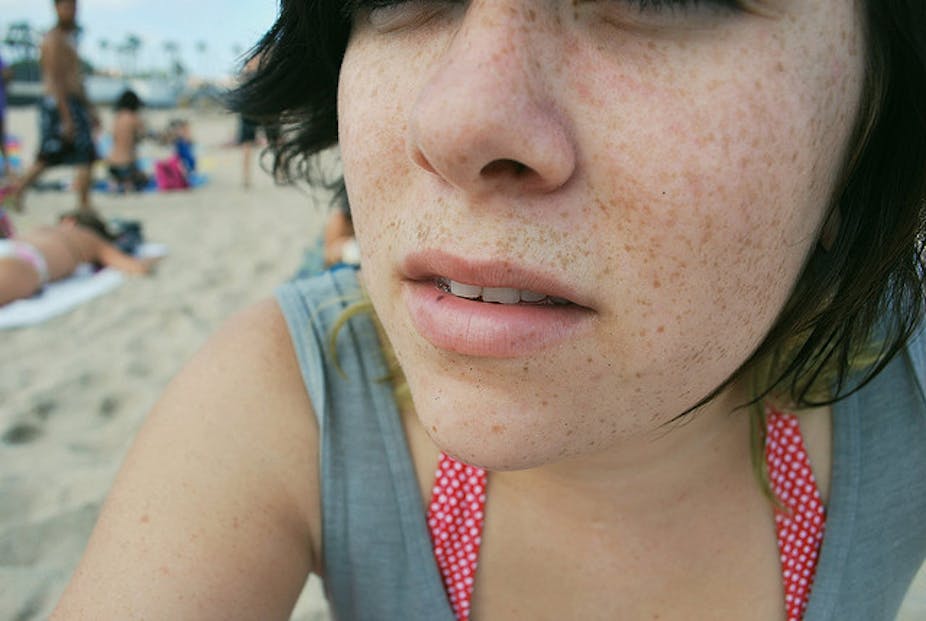
Sunscreen shouldn’t be your only defence against the sun – clothing, hats, sunglasses and shade are equally important. Flickr/stray kat

With the long, hot Australian summer comes the imperative to manage the country’s enormous skin cancer risk.

Along with the growing raw numbers (11,545 skin cancer cases diagnosed in 2009) and rates of melanoma, the numbers of non-melanoma skin cancers (NMSC) are going off the charts. Men are disproportionately affected, with one in 14 blokes diagnosed with melanoma before the age of 85, compared with one in 23 women.

Two months ago the Medical Journal of Australia reported the total number of NMSC treatments increased from 412,493 in 1997 to 767,347 in 2010, and the authors estimated the number of treatments would increase to 938,991 by 2015.

The costs estimate – which I understand doesn’t include the patient’s out-of-pocket expenses – was over half a billion dollars in 2010. This is an enormous health burden unique to Australia and our friends across the Tasman.

Slip, slop, slap was born to help Australians adapt to the unique environment in which we live. More recently we’ve added seek (shade) and slide (on sunglasses) to slipping (on the shirt) and slapping (on the hat). But it’s the slopping on of sunscreen that has caused the most controversy in the almost 20 summers during which I’ve been banging on about skin cancer.

Almost every summer I’ve been brought in to the newest debate about the dangers, the changes, the failings or the confusions about sunscreen. And this summer is no different.

This summer attention has focused on the introduction of the new standard of SPF50+. When it comes to SPF50+ the story is a reasonably simple one. A little better than SPF30+ is good – but we still need to put enough of the stuff on to achieve the claim on the bottle.

Sunscreen is usually applied in half or less of the dose necessary to achieve the sun protection claimed on the bottle.

A number of debates about sunscreen have raged over the past 20 years. Michael Newman

What does the SPF number mean?

SPF stands for Sun Protection Factor and the number reflects how protective a sunscreen is against UVB radiation, which causes sunburn and increases skin cancer risk.

SPF15, for example, filters about 94% of UVB radiation, leaving about 1/15th of the radiation getting through. But it also means skin that would normally burn in 10 minutes in the midday summer sun would take about 150 minutes or 15 times as long before the burn would occur. So the lotion “screens” but does not “block” the sun.

For SPF30+ it’s the same story: about 1/30th gets through so 96.7% of the UVB rays are filtered out. And with SPF50+ – you guessed it – 1/50th gets through, or about 98% is filtered out.

So while there might sound like a world of difference between the numbers 30 and 50, we’re talking just 1.3% improvement in UVB protection.

The new standard applying to sunscreens claiming an SPF in excess of 30+ will require a better standard of UVA protection and this is probably the most important advance in this recent change. Also, misleading claims of sunscreen being “waterproof”, “sweat proof” or the term “sunblock” are no longer allowed.

Sun protection

It’s important to understand that sunscreen is a useful adjunct to other sun protection measures. Rather than being our first line of defence, it should be the last. Not only do we seldom use enough, but it’s easily sweated off and rubbed off as we towel down or rub water from our eyes.

But why should we bother to mess about with the funny white creams anyway? Can’t we just wear protective clothing, hats and use shade, or better still stay indoors?

Well, of course we can and should use all these strategies. But sunscreen is a sun protection strategy proven by randomised controlled trial to prevent skin cancer.

Sunscreen manufacturers are no longer allowed to claim their products are waterproof. Flickr/bookgrl

The Nambour study conducted in South East Queensland in the early 1990s found the use of sunscreen (then the old SPF15+) reduced the risk of squamous cell carcinomas (the second most common non-melanoma skin cancer) by 12% and melanoma by about half.

So, as we get closer to seeing SPF50+ sunscreen land on the shelves of our local shops remember the famous all-encompassing 1998 life advice speech of disputed origins “Wear sunscreen” – and heed the advice. It’s still a good tip.

Here are a few other simple sunscreen tips:

  1. Sunscreen shouldn’t be used as the first and last defence against the sun. Don’t forget the other “S”s – Slip on a Shirt, Slap on a Hat, Seek some shade and Slide on your sunnies.

  2. Don’t throw out the old SPF30+ sunscreen. Cancer Council Australia recommends using any water resistant, broad-spectrum sunscreen with an SPF of at least 30, so use up what you have.

  3. Whether it’s current SPF30+ or the new SPF50+ sunscreen, put plenty on. About a teaspoon for each limb and a teaspoon for the front of the body and one for the back.

  4. Reapply every two hours. Regardless of the SPF, all sunscreens can be washed off, towelled off or wiped away when we rub that last wave out of our eyes.

  5. Learn to read the UV index. Under UV three you can get some safe sun time and a little vitamin D.

Articles also by This Author

Sign in to Favourite

Want to follow The Conversation?

Sign up to our free newsletter to get the day's top stories in your inbox each morning, with a special wrap on Saturday.

Spinner
Become a friend of The Conversation and donate

Join the conversation

19 Comments sorted by

Comments on this article are now closed.

  1. Pera Lozac

    Heat management assistant

    This text was more marketing material for sunscreen than a serious scientific report on the topic. However I am curious in new developments of studies looking at development of free-radicals due to chemical reaction between the chemicals in the sun-screens and human skin, promoted by UV radiation or just heat. Also, studies of effects of absorption of metal oxides used in sun-screen (nano particles and general sub-micron particles) through the skin pores and their effect on chemical process in the human body. Some useful information can be found here:

    http://en.wikipedia.org/wiki/Potential_health_risks_of_sunscreen

    Does anyone have any links to papers covering these topics?

    Thanks

    report
    1. Russell Hamilton

      Librarian

      In reply to Pera Lozac

      Pera raises an interesting question: nano particles. I stopped using sunscreens when I heard they contained nano particles.

      report
    2. Pera Lozac

      Heat management assistant

      In reply to Russell Hamilton

      Nano particles are still a big unknown but there are a number of papers indicating problems with carrier chemicals. These are not solids (ie metal oxides) but chemicals used to create a useful emulsion with correct viscosity, including other additives and perfumes. Initial studies were looking how UV radiation causes the chemical breakage of these chemicals and formation of free radicals that are known cancer precursors. These studies were driven by an alternative interpretation of melanoma statistics…

      Read more
    3. Sue Ieraci

      Public hospital clinician

      In reply to Russell Hamilton

      We have been through all this before:

      "Tine to Dispel the Fear of Nanoparticles in Sunscreen" on TC in December: http://theconversation.edu.au/time-to-dispel-the-fear-of-nanoparticles-in-sunscreens-108565

      The author of this article gives the effectiveness of sunscreen use, cautions about over-estimating the additional effectiveness of 50+, and gives this tip:

      Here are a few other simple sunscreen tips:

      "Sunscreen shouldn’t be used as the first and last defence against the sun. Don’t forget the other “S”s – Slip on a Shirt, Slap on a Hat, Seek some shade and Slide on your sunnies."

      Somehow, the two commenters here have missed the main message of the article. But let's not let the facts get in the way of ideology.

      report
    4. Sue Ieraci

      Public hospital clinician

      In reply to Pera Lozac

      Pera Lozac, you seem to have missed the fact that sun damage is caused by the formation of free radicals in the skin. That is the reason for applying non-absorbed blocking materials to the surface of the skin.

      Do you think that, by battling against the use of sun screen, you will improve the health of Australians?

      No point continuing this line - you are arguing against a straw man.

      report
    5. Russell Hamilton

      Librarian

      In reply to Sue Ieraci

      "Somehow, the two commenters here have missed the main message of the article. But let's not let the facts get in the way of ideology"

      No, the message of the article was perfctly clear, and my only 'ideological' quibble is caution. Unlike Sue, I think science constantly discovers new things which cause previous scientific 'facts' to be revised. So I'm cautious about putting any newly invented potions on or in my body. Maybe in 50 years time we'll find that nanoparticles weren't so safe, maybe we won't. I'm just cautious enough to hold off a bit longer. Instead of using sunscreens, which I used to use and lie out in the sun all day long, I now don't use them and only go in the sun in the very early mornings or very late afternoons.

      report
    6. Pera Lozac

      Heat management assistant

      In reply to Sue Ieraci

      Sue we meet again. I am not fighting against anything - I am fighting for the truth and every truth has more than one side. A straw man or not - I did mentioned in several places that the damage is caused by free radicals. The question is how the free radicals are generated.

      Your approach to science is equal to evangelical approach to religion - there only my way or highway.

      I am sorry but I never approached my science like that. Single minded myopic approach to any problem can never bring any clarity. Think about it for a second before next time you start spilling your imagined superiority hidden behind the anonymity of your keyboard.

      report
    7. Sue Ieraci

      Public hospital clinician

      In reply to Pera Lozac

      Pera - I'm curious - what type of science do you practice?

      report
    8. Sue Ieraci

      Public hospital clinician

      In reply to Pera Lozac

      Then why do you describe yourself as an "assistant" and not a "practitioner"?

      report
  2. Gavin Moodie

    logged in via LinkedIn

    I thank the author of this piece, which I read as a public preventative health message which I found useful.

    report
  3. Pauline Harvey

    Project Manager

    One of the things that the Cancer Council needs to get across to people is the fact that sun damage in cumulative. Most people are of the opinion that your get burnt, you peel, your colour returns to normal and then the cycle repeats itself. People don't realise, and it needs to be made clearer, that the damage is increasing every time people are exposed to UV. Instead of 0+1-1=0 it needs to be shown as 0+1+1+1 etc. Then there may be signficant improvement.

    report
    1. Mandy Lupton

      Lecturer in education

      In reply to Pauline Harvey

      In terms of your point, Pauline, a dermatologist once advised me that once I have applied sunscreen and had the maximum sun exposure for the day, I couldn't just reapply and expect to be protected.

      report
  4. Malcolm Nearn

    logged in via LinkedIn

    Oh dear. Such a lot of misrepresentation in both the article and the comments. However long you spend in the sun if you double the SPF you halve the amount of damaging radiation that reaches the skin. This has been clearly spelled out in the Australia/New Zealand Sunscreen Standard, AS/NZS 2604 since 1997. The Australian Cancer Society has been a member of that Standards sunscreen committee all of that time. It is the amount of ultraviolet that penetrates the sunscreen that damages, not the amount…

    Read more
    1. Tim Comber

      logged in via Facebook

      In reply to Malcolm Nearn

      Also people of my generation rarely wore hats as children and getting burnt was just part of summer. So I would expect us baby boomers to inflate the statistics due to damage when we were young.

      report
  5. Carol Duncan

    logged in via email @live.com.au

    Vitamin D deficiency has also risen as people get more paranoid about getting any sun on their skin at all. Vitamin D deficiency could be the precursor to many issues including cancer. Personally I don't use sunscreen, I prefer to cover up if necessary but I also get some sunshine on as much of my skin for at least 10-20 minutes a day between 10am and 2pm for the healthful UVB rays.

    report
  6. Gary Cassidy

    There are still a lot of people who don't use sunscreen at all or only occasionally (and spend considerable time with exposed skin in the sun). SPF50+ sunscreens won't help them at all.

    report
  7. Richard Hockey

    logged in via Facebook

    "The Nambour study conducted in South East Queensland in the early 1990s found the use of sunscreen (then the old SPF15+) reduced the risk of squamous cell carcinomas (the second most common non-melanoma skin cancer) by 12% and melanoma by about half." What you missed out was that this finding was not significant, not surprising given the low incidence of melanoma and its relatively small association (but still significant) with sun exposure. The cancer lobby groups IMO are quite dishonest in using the bogey of melanoma to promote sun smart practices when the gains to be made are in reality with NMSC.

    report
  8. Gary Cassidy

    Is the UV index a linear scale?

    Say the UV index is 9 and I properly apply 30+ cream to block out 96.7% of the UVB rays, what UV index would that be equivalent to exposing unprotected skin?

    report