
Swan struggles to help the poor in a straitjacket of his own making

Labor’s budget continues a path set since 2007. It shows the technocratic skill of a government clever at policy detail; but also one unable, or perhaps unwilling, to challenge the economic straitjacket it has adopted since the 1980s. That leaves a budget that makes life fairer for the majority, but…

Kcjy8cx7-1336540968
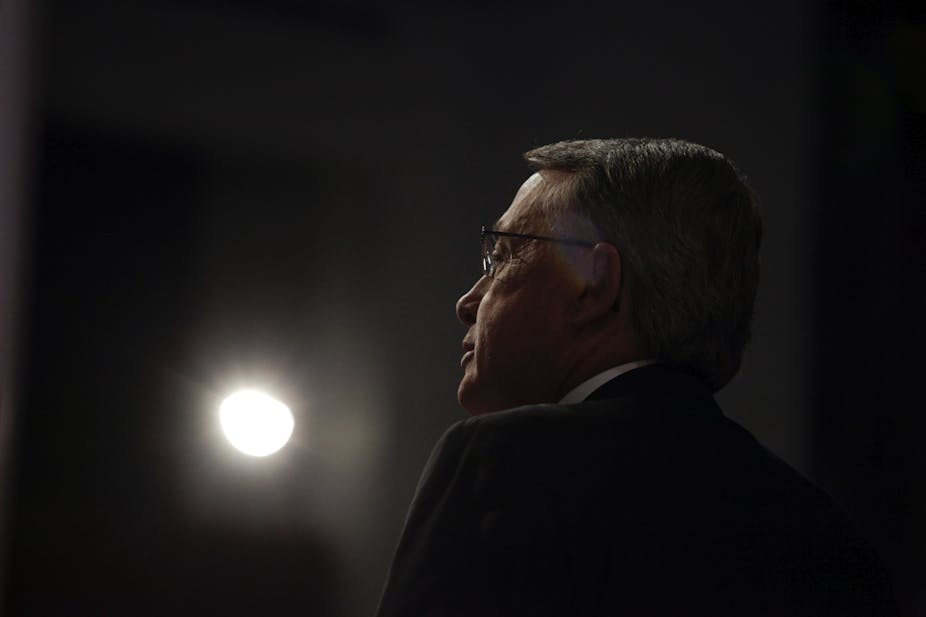
Swan would have an easier time if he were more honest with voters about what Labor is trying to achieve. AAP/Lukas Coch

Labor’s budget continues a path set since 2007. It shows the technocratic skill of a government clever at policy detail; but also one unable, or perhaps unwilling, to challenge the economic straitjacket it has adopted since the 1980s.

That leaves a budget that makes life fairer for the majority, but at the expense of an increasingly marginalised minority. It reflects the politics of a party more committed to core values than it is credited for, but also much more timid in actually pursuing them.

That logic is at the centre of this budget. There is a clear, continued commitment to a fairer society. The budget increases tax revenues largely from high profit companies and high income earners, and it expands payments to, and lowers taxes for, low and middle income families. Combined, these changes will have a substantial redistributive impact. But it shies away from even modestly difficult political territory, and so reinforces a worrying division between the deserving and undeserving poor.

These achievements are all the more impressive because they come despite Labor accepting two political straitjackets initially imposed by conservative economists, but increasingly willingly accepted by Labor. It can simultaneously leave observers in awe of its ability to manoeuvre so skilfully in such a confined political space; and yet deeply disappointed by just how little room Labor has left itself. In this sense, it’s a budget for the technocratic true believer.

Smoke and mirrors

The first straitjacket is Labor’s iron clad-promise to achieve a surplus. Unwilling to make the argument that employment and growth are more important than reducing debt, Labor has abandoned its brief adventure in defending Keynesian economics and the need for a larger role for the state, and instead embraced the logic that underpins the austerity drive in Europe.

But having put on the straitjacket, Wayne Swan has proved almost Houdini-like in avoiding the most important negative consequences. The cuts have generally hit the rich rather than the poor; and have been structured to do everything possible to promote employment while reducing debt.

There are two sides to the Houdini act. The cuts come from those areas with the weakest link to consumer spending – defence contracts for largely imported machinery and tax concessions for the savings of high income earners.

Alternatively, the new spending goes exactly where it is most likely to improve confidence and spending – to low and middle income families, the same target as the highly successful stimulus payments.

This is exactly what the old Keynesian model suggests, but wrapped in the clothes of austerity. The effect is topped off by some clever rearranging, extra spending happens just before and just after the financial year, maximising the surplus while minimising the effect of withdrawing funds.

The “deserving poor”

Discussions of welfare often focus on government payments. But promoting employment has always been the core pillar of Labor egalitarianism. As is clear from a quick glance at Europe or the US, unemployment is the bedfellow of poverty.

But this only leads to Labor’s second straitjacket. While the party has accepted the need for redistribution, in line with its historical values, it has increasingly abandoned another key element of the social democratic project, a commitment to a right to a decent standard of living. Labor’s defence of equity is limited to what we might call the “deserving poor”.

New spending targets families with children. This is an important group, and indeed the steady increase in family payments since the 1980s has been responsible for a significant decline in child poverty, just as Labor’s increase in the age pension has reduced deprivation amongst the old. But for groups with less public sympathy support has been hard to come by.

Labor excluded the unemployed from the stimulus. It has not only accepted, but extended the Northern Territory intervention. It not only accepted work for the dole, but has now extended “welfare reform”, reducing payments to many single parents.

There is a small increase for some of those on the lowest payment, but much less than for other more “worthy” groups. This is a clear sign that Labor has given up the struggle for the right of Australians to be free of poverty and treated with dignity, and instead reinforces the neoconservative logic of workfare.

But even here, there are some clever tricks. People often fit many categories. So while single parents may get less as single parents, they receive more as families with children; and they receive extra assistance with child care as potential workers, looking for jobs or undertaking education and training. It minimises the impact of policies that marginalise the “undeserving poor”, but it also tends to reinforce this division.

Dancing on a pinhead

It helps to explain why it is that Labor can seem so at sea and so disappointing, while at the same time appearing to have made real achievements (particularly in retrospect).

It’s the product of increasingly technocratic true believers, who fight for redistribution, while denying they are really redistributing. Who target payments to prevent child poverty while talking only about “cost of living”, and who covertly promote stimulus while appearing to embrace austerity.

You can be impressed by how expertly they dance on a pinhead, yet wonder why they don’t lift their head, argue on principle, and perhaps gain a little more room to move.

Join the conversation

8 Comments sorted by

  1. Norm stone

    Project Manager

    I agree that the social measures have no real depth or breadth but maintain this is evidence that these modern fearless leaders are not true believers and not Labour people but labour people. This is perhaps the ALP we have when we can't have an ALP. I don't "...wonder why they don't lift their heads (and) argue on principle ..." because everything we know about them convinces me that they have none. If the ALP was indeed a "...a party more committed to core values than it is credited for..." we would have some better outcomes from the biggest mining boom in history and the best terms of trade for decades. Being in power is the highest priority for all our leaders, and all are prepared to compromise until they are blue in the face. Yes politics is supposed to be the art of compromise and Julia has has so honed her skills at this as to become utterly compromised.

    report
  2. Peter Miller

    Digital Artist/Sound Designer/Composer at Scribbletronics

    The real problem is that nothing is about policy or principles anymore, it's all about pandering. The straightjacket of 'modestly difficult political territory' isn't 'increasingly willingly accepted by Labor' - Labor simply has no choice. No major political party can make difficult decisions any longer for fear of ramifications at the polling booth by an increasingly opinionated and pouty population - that's why the smoke & mirrors. Labor has turned into the kind of parent that tries to get the kids to go to the dentist by using promising them lollies if they behave. They're more afraid of the kids throwing a tantrum than they are concerned about their teeth.

    report
  3. datreus

    logged in via Twitter

    'yet wonder why they don’t lift their head, argue on principle, and perhaps gain a little more room to move.'

    It is simply because politics in our nation is now a trial by media spectacle. Ju-liar could raise the dead and heal the sick and you would still see everyone from News Corporation to your community paper claiming that she did so by stealing money from National Treasures who keep our great nation afloat in a world of Communist economic chaos.

    To argue on principle would be to provide…

    Read more
  4. Philip Harrington

    Principal Consultant - Climate Change

    Nicely observed, Ben, but like your other corrrespondents, I find it hard to uncover any evidence that this government has any principles. Another way to interpret your story is that they are running a conservative, neoliberal agenda - trying to outflank Tony Abbott on the right - yet employing more spin that Shane Warne to try and pretend they are really 'true believers'. A hand-out here and a hand-out there...while they continue to beat up on 'boat people', single mums and other disposable people. In my field, Labor has abandoned the insulation industry, solar hot water industry, PV industry, now the green buildings industry...all while wanting us to believe (and, stupidly, taking political pain for the belief) that their carbon pricing scheme will actually make some difference on climate change. Which, of course, it won't.

    Technocrats get things right. How can we accuse the government of that?

    report
  5. Ben Spies-Butcher

    Lecturer

    Thanks for the comments everyone. I understand the cynicism towards Labor and the current Budget. But I think this can be exaggerated in the present, and things often seem better in hindsight. This budget has increased taxes on wealthy corporations and increased spending to low and middle income families. Sure it might have been better to fund education and health rather than just hand out cash. But this does reflect the broad direction Labor governments usually go in, and it is done against opposition…

    Read more
  6. datreus

    logged in via Twitter

    Ben, I think you're kind of proving my point. Labor's win in 2007 was not because suddenly our conservative population warmed to radical notions, it's that 'Kevin '07' was a simple slogan with easy to remember alliteration. Labor won on media, with Kevvie using amazing Twitters and things to the point that the media sideshow was far less vicious towards him than would have been imagined.

    I fully support your point of view that Labor are yellow chickens who have backslid into the turgid middle…

    Read more
  7. wilma western

    logged in via email @bigpond.com

    The same treasurer has been responsible for all the present govt's budgets. The article points out some of the ways in which this budget moves towards greater sharing of national wealth and its adroitness. So the govt was more "more principled and radical in 2007" when popular opinion was more in favour of action to reduce greenhouse gas emissions a.k.a."the greatest moral challenge of this century" ? But the same government decided to defer action on the ETS when things got hard thanks to Greens…

    Read more
  8. Peter Redshaw

    Retired

    A budget is more than a government meeting the services and infrastructure of a simply a given year. A budget has to also be framed as to ensure the economy has the capability to meet the nations future needs as well. This means appropriate investment in services and infrastructure to meet that need. In this budget this government fails that test, but in that this government is no different to all past governments and better than some.

    Howard was very good at having a budget surplus while having…

    Read more