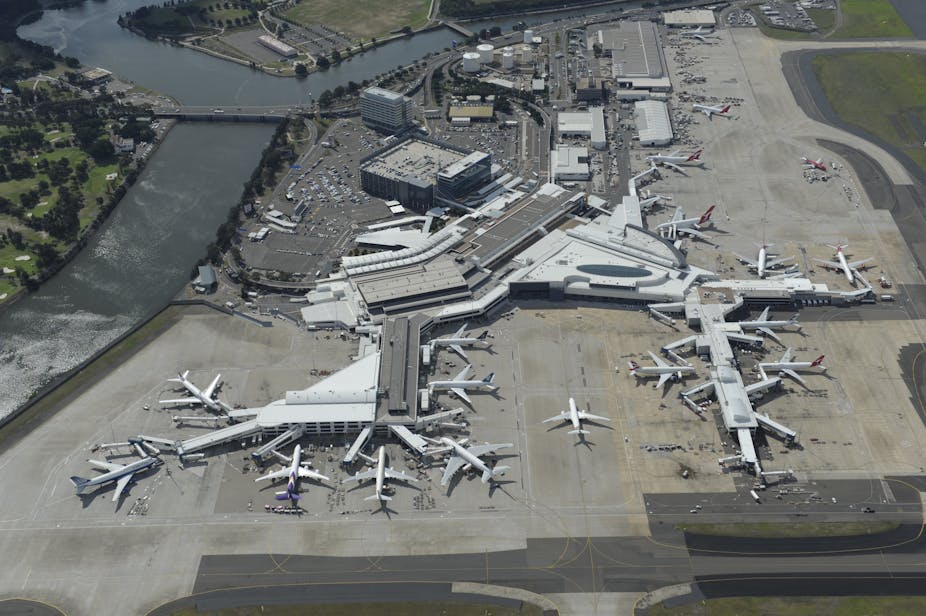
Does Sydney need a second airport? In the the recent furore, Foreign Minister Bob Carr, former Prime Minister Paul Keating, Qantas CEO Alan Joyce, former Federal Transport Minister Peter Morris, and former NSW Premier Nick Greiner have all called for another airport to be built.
But first, let’s put the need for a second airport in context. Why does Sydney need a second airport? How soon does it need it? Are there any similar examples overseas? And why are our politicians having so much trouble making a decision?
Sydney Airport: 36 million passenger movements per year …
Looking at air traffic numbers, it is clear that Australia’s airways are busy – and not just from overseas travel.
According to data released by Amadeus (a company servicing the travel industry), the Sydney-Melbourne route was the fifth busiest in the world in 2011 (by number of passengers). At slightly more than 7 million seats, Sydney-Melbourne came after South Korea’s Jeju-Seoul (close to 10m), Brazil’s Rio de Janeiro-Sao Paulo (about 7.7m), and Japan’s Osaka-Tokyo (about 7.6m). Other busy routes include Beijing-Shanghai (7th) and Mumbai-Delhi (10th).
When taking respective population masses into account, Australia’s results are nothing short of spectacular.
Sydney’s airport caters for most of Australia’s air travel, both domestic and international. The airport is currently coping with about 36 million passenger movements and 320,000 aircraft movements annually. By 2035, the airport needs to be able to cope with 80 million passenger movements (double the current number) and nearly 430,000 aircraft movements (an increase of 50%) per year.
When compared to other capital cities, Sydney is clearly Australia’s main point of arrival and departure for international travel, as shown in the figure below.

… and counting, with increasing traffic demands
In March 2012, Federal Transport Minister, Anthony Albanese, released the “Joint Study on Aviation Capacity for the Sydney Region” report. The study was overseen by an independent steering committee of government and industry experts.
According to the report, if Sydney’s future aviation needs cannot be met by 2060, the economy-wide impacts across the Australian economy could total $59.5 billion (in 2010 dollars) in foregone expenditure and $34 billion in foregone gross domestic product. The report warns of thousands of lost jobs and major traffic and train congestion if a second airport is not built.
It also warns that by around 2027, all flight slots will be allocated. In other words, unless another service is cancelled, no new entrants can be accommodated. By around 2035, there will be practically no scope for further growth at the airport. Forecasted shortfalls are shown in the figure below.

Clearly, the airlines are a major stakeholder when it comes to building a new airport. If an airport meets full capacity, airlines' bottom line is likely to suffer.
As such, Qantas CEO Alan Joyce has been quite vocal on the need for another airport – speaking of the two hours it often takes for Qantas Boeing 747s to be towed through Sydney airport and congestion routinely causing planes to spend 30 minutes circling above the city, while others were unable to take off on time.
For all the reasons mentioned above, a second Sydney airport seems critical for both NSW and Australia’s sake.
Air traffic slowed down by politics
The debate over a second airport in Sydney is not new. The discussion started back in the 1970s when the Major Airport Needs of Sydney (MANS) group was established to select a site. The group identified both Wilton and Badgerys Creek as potential locations.
In 1989, Bob Hawke put off construction of a new airport and built a third runway at Kingsford Smith. In 1995, Paul Keating legislated funding to build a Badgerys Creek airport, but John Howard revoked the funding and opted for expansions at Bankstown and Canberra airports instead. Badgerys Creek is actually owned by the Federal Government, but in 2009 Kevin Rudd had announced intentions to sell the land.
Over the past couple of years, Canberra has been increasingly mentioned as a possible alternative – a solution supported by NSW Premier Barry O’Farrell – with travel times reduced to 45-50 minutes using a high speed rail link between Canberra and Sydney. However, such plans have yet to materialise.
Going back full circle, the 2012 “Joint Study on Aviation Capacity for the Sydney Region” report states that Badgerys Creek – followed by Wilton – is the best site for Sydney’s second airport.
However, the current federal government has ruled out building an airport at Badgerys Creek, opting for Wilton instead.
All while Premier O’Farrell has repeatedly said that he did not support a second airport in the Sydney basin altogether.
Political games are clearly getting in the way of this decision.
Calls are now being made for the federal government to simply step in and get the job done as constitutional law experts say that the NSW government could not stop a second airport being built if the federal government decided to proceed.

Are other airports facing similar challenges?
When looking at airports elsewhere, there have been many instances of governments providing financial assistance with expansion of airport infrastructure.
Indeed, more than 600 international airports are publicly owned, according to a 2007 ICAO report. In Europe, 78% of all airports are publicly owned with a further 13% involving public partnership, according to a 2010 study by ACI.
Hence, when an airport is identified as approaching full capacity, the debate often turns political.
In the UK, aviation infrastructure around London has been identified as one of the most significant impediments to economic development. In 2003, a proposed expansion of London Heathrow Airport (one of the busiest airports in the world) was put forward.
The plan was supported by various groups including the British Chambers of Commerce, the Confederation of British Industry, the Trades Union Congress and the Labour Party. However, in 2010, the new UK government opposed it.
The debate still rages on – with London First, a lobbying group representing various London businesses, recently releasing a report pleading for an expansion at Heathrow.
Regardless of the chosen location, a new airport will be required to supplement the capacity of Sydney Airport within the next couple of decades.
Daryl Deal
retired
But then again, if we take the long term outlook, past 2020, does it really?
Industries come and go and do not last forever and neither should the taxpayer be made to fund a dying service industry, well past it's prime of 2006, if one looks very closely at all commercial airlines balance sheets.
Peak oil was in 2006, oil production figures from all industries sources, show that annual production is in decline. Other oil industry sources say, that by 2020, British North Sea Oil, which peaked…
Read morePeter Brown
Retired Vet
I have had this argument with quite a few people and as you say who will be able to travel by plane in 2020? Engineers are reaching the end of the potential for innovation with size, materials, engine performance etc. So unless we see some type of breakthrough with fuel efficiency then your scenario is quite a likely outcome.
As you say if airline execs are so confident of the industries future why don't they build the lot airports, transport links etc. If they want the taxpayer to pick up the bill I would be very wary of any taxpayer involvement...privatisation, free enterprise and all that...public/private partnerships in NSW have in general been dismal failures.
Byron Smith
PhD candidate in Christian Ethics at University of Edinburgh
If we would like a planet whose climate remains habitable for seven plus billion people, global aviation needs to (a) implement some breakthrough low-emissions technologies (revert to airships?) and/or (b) significantly contract. I am not aware of any global emissions pathway to a world that avoids very, very nasty outcomes that includes aviation continuing to increase its emissions. Biofuels may play some small role, but current commercially-produced biofuels have very significant drawbacks that exclude their role as any kind of silver bullet enabling the continuation of the present trajectory of the aviation industry.
Peak oil and climate change both spell very serious consequences for commercial aviation in particular. I don't think that investing in further expansion of aviation infrastructure on the basis of extrapolating trends from the last few decades is a particularly wise move.
David Arthur
n/a
Gday Byron, if we want a planet with climate remaining habitable for seven plus billion people, global aviation needs to stop recycling geosequestered carbon to the atmosphere. It doesn't need to stop using liquid fuels, it just needs to start using biofuels.
The challenge for technologists is to not obtain those biofuels from food materials, or forests. I understand that Exxon Mobil has been funding Craig Venter's research into developing GM algae suitable for extracting liquid fuel directly from atmospheric CO2.
Byron Smith
PhD candidate in Christian Ethics at University of Edinburgh
The question is whether such biofuels will be available on a relevant timescale and cost. I have not followed this discussion closely in the last year or two but prior to that, I was under the impression that algae based solutions were unlikely to be a game-changer anytime soon. Are there any new developments that make it seem likely? If not, I think it is wise to plan for reducing global aviation as far and fast as possible.
David Arthur
n/a
Airport traffic slowed by politics? No, the biggest brake on airport traffic is ground transport, between the various parts of the city and the airport.
Sydney's second airport will necessarily be constructed about fifty kilometres from the CBD, meaning at least a one hour travel time on the ground. This means that between Sydney and Melbourne, the flight is the least part of the transportation problem.
Sydney's second airport, then, may as well be at Canberra, and a rapid transit system (High Speed Rail?) be installed between that airport and the Sydney Airport.
Would a High Speed Rail link between Sydney and Canberra decrease pressure on Sydney Airport?
Riddley Walker
.
Of course the whole thing could be fixed with a High Speed Rail between Melbourne and Sydney. But that would require long term vision and commitment, something that neither Liberal nor Labor have been able to domonstrate. Perhaps it is time we gave the Greens a chance to show what they can do.
Sean Lamb
Science Denier
A high speed rail would only work if you put a hefty tax on the plane trip (and maybe used that tax to subsidise the rail trip).
A high speed rail link never ends up as fast as it is theoretically possible - particularly if you want some stops along the way.
Bob Ashworth
logged in via Twitter
Couldn't agree more. Australia is crying out for high-speed rail and better public transport. As for subsidy's, airlines are already heavily subsidized so why not environmentally friendly rail.
David Arthur
n/a
If we want to avoid some high-speed ground transport system from the new airport to Sydney CBD and other transport hubs, then we need to resume nd demolish substantial sections of such suburbs as Alexandria and Mascot - after all, they're right next to the existing Sydney Airport, and they've got the appropriately flat topography.
Short of demolishing these suburbs, some high-speed ground transport system is essential, and the last half century of worldwide urban history should suffice to tell us that motor vehicles on freeways is not a feasible choice.
It stands to reason, then, that the second airport should be at Canberra, with interconnection to Sydney via high-speed rail. It's worth noting that there are quite a few plane flights each day between Sydney and Canberra, so not only could Canberra serve as Sydney's second airport, but there'd be less plane flights between Sydney and Canberra.
Virgin Trains? Who'da thought?
Riddley Walker
.
so, we then get:
1/2 hour train to Avalon, 1/2 hour transfer to
1 hour flight to Canberra, 1/2 hour transfer to
1/2 hour train to Sydney
vs
3 hour train to Sydney.
Mat Hardy
Lecturer in Middle East Studies at Deakin University
Debate on a second passenger airport for Sydney pre-dates the 70s. I think the first investigation was shortly after WW2!
And the article doesn't dig deep enough about what stopped the Badgery's Creek option: the lobbying of a handful of property developers who happened to be ALP donors too, and who had bought the adjacent land with full knowledge an airport was on the cards. In those days the number of people affected by the second airport was low. But hose property developers have since carved up all the old farms into tens of thousands of home sites.
Gavin Moodie
Principal Policy Adviser
Sydney's inability to build a second airport contrasts vividly with Melbourne's opening of its second airport at Tullamarine in 1970, and even now some business interests are talking up the prospect of building up Avalon as Melbourne's second airport for big jets.
A very fast train between Melbourne and Sydney would be good and an excellent service would indeed cut the pressure on flights between the cities. However, acquiring the property needed for the line would be extremely expensive and would encounter considerable opposition from property owners and other interests.
Colin MacGillivray
Retired architect
Daryl you said
"In 2020, I estimate, due to high fuel costs cheap airline fares will reach the equivalent level, of that which was charged in the nineteen thirties, relative to the average persons income."
In 1935 the first flight from London to South Africa cost roughly the same as a house- 700 pounds, I think was the figure. (I shall try and google the date and cost).
It is impossible for that sort of increase in 8 years.
Jack Arnold
Director
Perhaps the optimal solution is the development of a 2,000ha (5,000 acre) greenfield airport site about 20 km NW of Inverell (IIA). This could be the Australian hub for the many monster jets that provide noise & fuel pollution for Sydney residents under the flight paths.
About 40% of international passengers into Sydney KSA tranship to other airports national ports immediately. So, transhipping is not a major problem.
Removing air freight to IIA opens up landing slots at KSA, & provides the opportunity for governments to build infrastructure outside the Sydney Basin, encouraging decentralisation thus reducing price pressure on Sydney real estate.
Oh, and we already have in place the equipment & expertise to build a billiard table to these dimensions.
Australia is a wide brown land ... why build everything on the same postage stamp plot???
Dean Ashby
Company Owner at Ezestore Storage Sydney
I am not surprised about this since there has been an increase of rentals in one of the areas that we serve. Though it is not reported, but there has been a demand of our self storage units, pods storage and mobile storage during that period. We did a mini survey amongst those who have engaged us from January until September, and this is because people are renting some rooms in their houses to for rental to tourists. With Australian dollar becoming stronger, and hotels are becoming more expensive by the day, these house owners saw an opportunity to rent out their rooms to tourists. And because they would want the rooms to be kept at a bare minimum, they would have some of their furniture items for storage.