
Tackling the challenge of Tasmania’s ageing population

Along with stagnating economic growth, Tasmania is facing a major demographic challenge – rising unemployment and a population which is both the oldest in the country and ageing faster than any other state or territory. While other states are experiencing the economic conditions to address population…

7zpxxnq6-1355788441
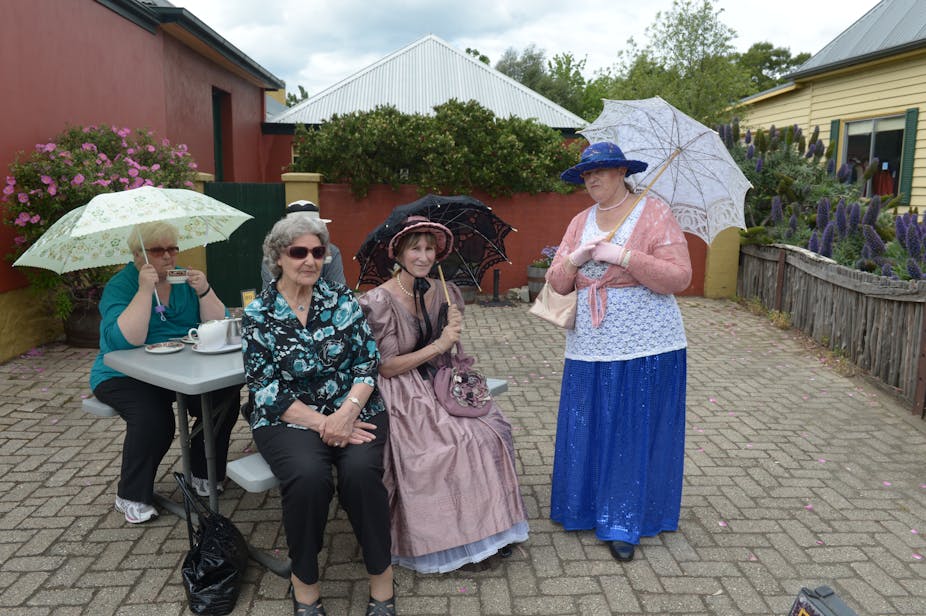
Tasmanians wait for the royal visitors to arrive earlier this year. The state has a population both the oldest in the country and ageing fastest.

Along with stagnating economic growth, Tasmania is facing a major demographic challenge – rising unemployment and a population which is both the oldest in the country and ageing faster than any other state or territory.

While other states are experiencing the economic conditions to address population ageing, Tasmania has the challenge of a growth in total dependency exceeding its growth in labour productivity.

Labour Productivity and Total Dependency Ratio – Tasmania ABS National Accounts Cat. No. 5206.0, Labour Force Data Cat. No. 6202.0, Australian Demographic Statistics Cat. No. 3101.0

But Tasmania does have untapped opportunities and resources which may provide a solution to some of the state’s challenges.

1. A largely untapped supply of labour not participating in the labour market

While the contraction in Tasmania’s working age population suggests a lack of available labour and skills, only a persistently low and falling rate of unemployment indicates a true lack of labour. More important than size to economic performance is the productivity of the labour force.

Almost 40% of Tasmania’s potential labour force is not participating in the labour market. On top of that the state has a large proportion of the population either unemployed or underemployed.

A lower level of labour market engagement by women is particularly evident, despite higher levels of educational attainment for all age groups, while varying levels of confidence are evident.

2. A ‘brain gain’ as a result of net migration movements

Tasmania’s population is influenced by migration movements in and out of the state. While net losses in the working age population have dominated discussion of Tasmania’s future supply of labour, a report by the Demographic Change Advisory Council identified migration movements between Tasmania and other Australian states between 2001 and 2006 actually resulted in a ‘brain gain’ for the state.

The percentage of the adult population with post-school qualifications increased from 36.7% in 2001 to 37.0% in 2006. This net gain was the sum of a brain drain of the 15-24 year olds and a brain gain from the 25 to 65+ age groups. However, only 56% of those who arrived in the state gained employment, compared with 67% of those who left the state. This suggests a large number of the migrants who are not active in the labour market once arriving in Tasmania. For the older migrants, however, it is likely that they come to the state to retire and are not seeking work.

3. Stabilising fertility rates at replacement level rates

In recent times, Tasmania’s fertility rates have exceeded the population replacement level (2.1 births per woman in her lifetime). The total fertility rate (TFR) reached a low of 1.797 in 1997, and since that point has trended upward. The TFR average for the past ten years is 2.074.

These births are critical to Tasmania for two reasons. Firstly, should this trend continue, Tasmania has the opportunity to stabilise and grow its population. While the birth rates are not significant enough to replace previous population losses, the opportunity to prevent any further losses is available.

Secondly, the timing of the increases in birth numbers in Tasmania advantages those born in the last five to ten years entering the labour market as the last of the baby boomers reach retirement age and exit the workforce (around 2023). These recent-borns are referred to as the “Thank God You’re Here” Generation as they will provide welcome relief in replenishing lost labour, provided Tasmania can retain the generation in the state.

4. Government commitment to industry diversification under the Tasmanian Forests Intergovernmental Agreement (TFIA).

The only way for Tasmania to safeguard itself against rising dependency ratios into the future is to increase productive investment by increasing the capacities of the factors of production.

Previously, Tasmania has made the mistake of focusing its investment in the human capital educational component of the factors of production, primarily channelling funds to the unemployed. This large-scale investment has not been reciprocated with the equivalent level of investment for increasing demand. Essentially, there is little point in investing in human capital and enhancing skill supply, particularly given evidence of relatively low levels of labour usage, limited evidence of skill shortages, and low demand for labour, unless a comparative effort is invested in increasing the demand for labour and skills.

Tasmania is in the unique position where it may actually be able to achieve this.

In August 2011 the TFIA was signed. The TFIA is designed to support the forest industry to progressively transition to a more sustainable and diversified footing and to build regional economic diversity and community resilience. Some $120 million of the total $277 million package provided under the TFIA is to be directed to identifying and funding appropriate regional development projects.

This is a one-off, significant opportunity for Tasmania to increase the state’s capacity to build demand for labour and skills.

By creating demand through the TFIA economic diversification project, Tasmania has the opportunity to set the foundations for its future, establish a new direction for its industry base and capitalise on its comparative and competitive advantages.

The TFIA provides Tasmania the opportunity to create the demand needed to both stimulate economic activity and increase labour force participation while also prepare for the future challenges of population ageing.

Despite a persistent reputation as a mendicant state, Tasmania has four factors in its favour for achieving economic and social sustainability. While the first three; an underutilised labour market, a net brain gain from interstate migration and replacement level fertility, combined with effective policy, could achieve this in their own right, it is the impetus of the fourth factor; investment in economic diversification through the Tasmanian Forests Intergovernmental Agreement which will enable complete regeneration of the state’s economy.

Articles also by This Author

Sign in to Favourite

Want to follow The Conversation?

Sign up to our free newsletter to get the day's top stories in your inbox each morning, with a special wrap on Saturday.

Spinner
Donate and become a friend of The Conversation

Join the conversation

13 Comments sorted by

  1. Jaclyn Brown

    Ocean Research Scientist

    Is there any way to know how many of the 25+ age group that move to Tassie were originally from Tassie? So are the early 20s group going away for a few 'gap' years to escape island fever or going away for University before coming home?
    If the early 20s Tassie people aren't returning, then I wonder how effective the increased birth rate is?

    report
    1. Lisa Taylor

      Workforce Demographer and PhD student at University of Tasmania

      In reply to Jaclyn Brown

      Unfortunately not, current data sources do not provide that level of data, a longitudinal study of Tasmanian movements be required. That said, anecdotal evidence would suggest that exits exceed returns considerably, primarily due to a lack of employment opportunities to return to (some cynics may say that if you want to stop them leaving, stop educating them).

      My argument regarding the increased birth rate is the opportunity attached to it. The increased births provide a known future supply of labour from which both government and enterprise can plan for, both from an educational and employment opportunities perspective (and in the meantime provide opportunities for expat Tasmanians to return to).

      report
  2. Dale Bloom

    Analyst

    I don't see a population reducing in numbers as being a bad thing, but something every state should be aiming for, and Australia's population should be 20 million max (and could go down to 5 million) for long term sustainability.

    There are countries with some of the highest standards of living in the world with a population of only 5 million.

    Elderly people coming into a state to retire can be negative, but this is similar to middle aged immigrants coming into the country, and within a few years they quickly increase the number of older people in the country.

    Our aging population has much to do with immigration.

    The economic situation in TAS would be the same in most states except for mining and ponzi demography, which appear to be the biggest industries now in states such as QLD and NSW.

    The future is less jobs, and for the majority of people to have a job, and have a sustainable society and a sustainable environment, there has to be less people.

    report
    1. Lisa Taylor

      Workforce Demographer and PhD student at University of Tasmania

      In reply to Dale Bloom

      Dale, I disagree that ''our ageing population has much to do with immigration''. in fact, at the current high levels and age profile, migrants are actually marginally slowing the rate of (structural) population ageing (eventually they will add to numerical ageing). The ageing of our population is caused by below replacement level fertility rates and increasing life expectancy. Migrants have more to do with the population growth projected, with 80% of future growth projected to come from immigrants and their yet to be born children (refer to work done by Professor Bob Birrell and others). Migrants add around 100,000 people to workforce every year (but employment growth in the 12 months to December 2012 was only 115,000).

      report
  3. Alex Green

    logged in via Twitter

    Have a look at the Grattan Institute 2011 report "Investing in regions: Making a difference" for a critique of government initiatives ostensibly developed for generating self-sustaining economic growth. TFIA will merely deliver subsidies with the government picking winners and losers. No view has been presented as to how the key drivers of a critical mass of population, economic activity and high levels of education are to be delivered. TFIA certainly doesn't address these issues.

    report
  4. STABLE POPULATION PARTY

    Written & authorised by William Bourke, Sydney

    The author makes interesting comments, but why focus on the distraction of an ageing population? It is not necessarily a bad thing to live a longer life is it?

    Migrants (intrastate or international) also age, so there is no 'solution' to ageing there. It is demographic nonsense to believe that migration can keep our population young. Where does migration and population growth end if we are always pushing for more 'growth'?

    If you want to deal with the root cause of Tasmania's problems, the…

    Read more
    1. Lisa Taylor

      Workforce Demographer and PhD student at University of Tasmania

      In reply to STABLE POPULATION PARTY

      Agree entirely. The TFIA provides the means to identify and nurture those economic opportunities, and hopefully provide the foundations for future investment.

      Just a couple of notes, no, nothing wrong with living a longer life, but eventually people no longer want to undertake paid work (understandably) and will require some level of public support in terms of health, aged care services and age pensions (despite private superannuation around 80 per cent of retirees rely on the age pension or other publicly funded income)

      Tasmania's population is ageing at a faster rate as a result of net interstate migration loss of prime working age people but the migrants that we do receive are presently an untapped resource (and still relatively young).

      report
  5. Theo Pertsinidis

    Theo Pertsinidis is a Friend of The Conversation.

    ALP voter

    Lisa Taylor "The increased births provide a known future supply of labour from which both government and enterprise can plan for, both from an educational and employment opportunities perspective"

    Stable Population Party "The major focus for Tasmanian policy makers should be the development of a more diverse range of environmentally sustainable economic industries for Tasmanians"

    There's a Job and Skill Expo heading towards Hobart. Call it first aid or whatever.

    Parts of Tasmania have been…

    Read more
    1. Lisa Taylor

      Workforce Demographer and PhD student at University of Tasmania

      In reply to Theo Pertsinidis

      Theo, it would certainly be a great outcome if the jobs expo could result in employment for the many Tasmanians currently looking for work. Unfortunately most employers are currently reporting being inundated with over-qualified applicants. The most effective initiative the government could undertake in increasing employment opportunities is to encourage investment in the state. I fear the major beneficiaries from a jobs expo such as this would be the Job Services Providers and RTOs.

      report
  6. Tony Simons

    Accountant

    Tasmania as a very attractive place should promote telework. Many Melbourne and Sydney well educated people could be attracted. NBN critical and should be rolled out quickly. Also cheap airfares and good timetables to attract more visitors. Ireland built a big tourism industry on low fares. Let's get rid of travel taxes and offer federal government subsidies to airlines.

    report
  7. Chris O'Neill

    Telecommunications Engineer

    Clearly the immediate problem is not population ageing at all. If it was there would be a shortage of labour and no such shortage exists. The immediate problem is the need for economic development for which the article discusses some proposals.

    report
  8. George Phillips

    Records Manager

    Thanks for a very interesting article, Lisa. However, I have to say I am rather skeptical regarding your fourth point concerning the opportunities for economic diversification created by the TFIA. While I mostly agree (albeit reluctantly and with some caveats) with your argument regarding the inefficiency of investing in human capital when we already have a large pool of untapped skilled labour to draw upon, I struggle to see much in the way of growth industries that Tasmania could realistically…

    Read more
    1. Lisa Taylor

      Workforce Demographer and PhD student at University of Tasmania

      In reply to George Phillips

      Hi George, thanks for your comments but I am afraid I have to disagree! I think Tasmania has a number of opportunities arising from our comparative advantages - the six industry sectors identified in the economic diversification plan are wine, dairy, aquaculture, horticulture, mining and tourism (but I agree with you on that one!). These sectors (apart from the last) can all be highly innovative and productive, the government's role in assisting this happen is to provide the infrastructure which enables them to be competitive (whether that be irrigation, freight logistics solutions, NBN, planning, energy resources etc). ICT is certainly an opportunity, at the moment it is a very small sector in terms of contribution to GSP but it does have higher levels of productivity compared with others. Cheers, Lisa

      report