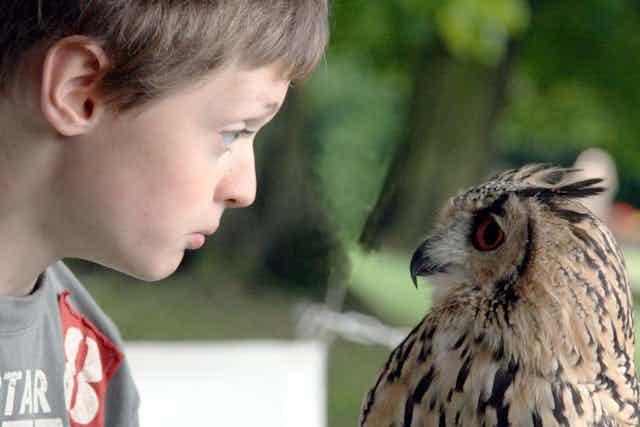
Talk it over: language, uniquely, makes us human

We humans tend to consider ourselves apart from other species. But we’re not really so different. So what makes us unique? I’d say it’s language, though not everyone would agree. Some people insist it’s our large brains, but dolphins have proportionally larger brains than we do. Some still contend our…

Ctr7bmtt-1361161754
Maybe we’re not as different as we’d like to think. pcgn7

We humans tend to consider ourselves apart from other species. But we’re not really so different. So what makes us unique? I’d say it’s language, though not everyone would agree.

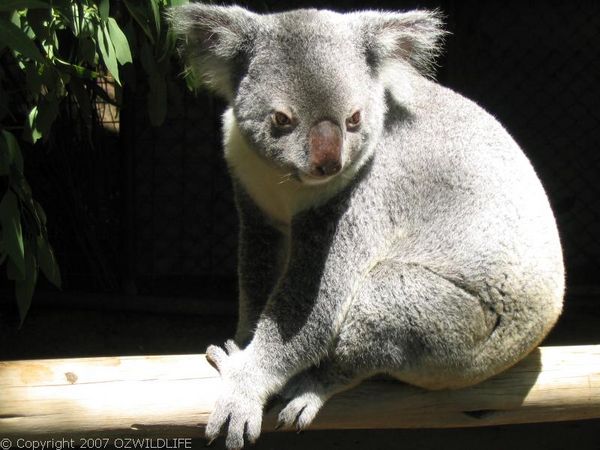
Some people insist it’s our large brains, but dolphins have proportionally larger brains than we do. Some still contend our opposable thumbs set us apart, but koalas have two thumbs on each hand.
We walk on two legs? Yes, of course, but the feathered species do that too.

Some are insistent that our individuality as a species rests on the fact we can use tools, but many diverse vertebrate species are tool-users, including primates, elephants and birds. Even the veined octopus and certain ants and wasps have been observed using tools.
Broken Simulacra

The answer, then, is … language. We uniquely have the ability to communicate complex and abstract ideas.

At first it was spoken language. Then, independently, several human cultures developed the written word – the means to communicate with others over thousands of miles or years.

Through language we have built civilisations, developed science and medicine, literature and philosophy. We do not have to learn everything from personal experience, because through language we can learn from the experience of others.

Language makes us human, and it’s encoded in our DNA.

The language gene

FOXP2, known as the “language gene”, has a unique sequence in humans. While other living mammals share identical amino acids at two key amino positions 303 and 325, these amino acids are different in humans (threonine to asparagine at amino acid 303 and asparagine to serine at amino acid 325).

Such substitution mutations occurred some time after we diverged from our common ancestor with the chimpanzee 4-8 million years ago.

We shared this unique FOXP2 protein sequence with both Neanderthals and Denisovans, from which we diverged somewhere in the region of 400,000 years ago.
M.H.G. (BAH)

Compared to these other hominids, humans have an additional mutation in a region that regulates FOXP2 gene expression. Was it this latest mutation in FOXP2 that ensured our survival through better communication, as other hominids went extinct?

This mutation was swiftly incorporated into the human genome at high frequencies during the last 50,000 years suggesting it carries a survival advantage. Studies to understand the effect of this most recent change in FOXP2 are currently underway.

The FOXP2 gene is involved in brain development, particularly those areas involved in vocal behaviour. FOXP2 is particularly important for animals, including songbirds such as finches, canaries and parrots that learn to sing by imitation.

In the songbird brain, FOXP2 expression is highest when birds are learning to sing. Reduction of FOXP2 expression in the brain of zebra finches at this critical period left birds unable to completely or accurately learn to sing.

In humans, FOXP2 mutations are associated with severe speech and language deficits known as developmental verbal dyspraxia – affecting both the ability to coordinate vocal muscles in speech and causing language comprehension difficulties. What a terrible, isolating condition that must be.

In language we find both truth and beauty; then, being human, we use it to argue about what is true and beautiful.

Language is fundamentally what makes us what we are. Would you disagree? If so, please, use your voice and let me know.

Sign in to Favourite

Want to follow The Conversation?

Sign up to our free newsletter to get the day's top stories in your inbox each morning, with a special wrap on Saturday.

Spinner
Help evidence based journalism become the norm and donate

Join the conversation

101 Comments sorted by

  1. jean wilson

    retired

    perhaps our ability to speak/write is a disadvantage? humans frequently miscommunicate and misunderstand one another.

    animals, using body language, sound, colour, movement, etc. never ever mis-read the message.

    many humans cannot even read the most obvious body language signals, from both other humans and from animals and plants.....yes, plants communicate too.

    language may prevent clear communication in humans. perhaps it is a sign of our inferiority when compared to other creatures.

    report
    1. Stephen John Ralph

      carer

      In reply to jean wilson

      Koalas may have a thumb on each "hand" - but can they play the piano.
      Some humans have a brain - but rarely use it.

      Before we can communicate those complex and abstract ideas, we first need to formulate them in our brains.

      Personally, I wouldn't nominate any ONE thing as THE most important. Our human-ness is a combination of many factors. Often language is the last action in a long thought process

      Silence can be golden, but as Ronan Keating sings..'" you say it best when you say nothing at all."

      Now that's DEEP.

      report
    2. Amy Marshall

      Molecular Biologist at Centenary Institute

      In reply to jean wilson

      In some ways, Jean, you are absolutely correct.
      But perhaps it is the complexity of human messages that leads to misunderstanding, rather than the format. Perhaps the nuances of language helps to make us human too.

      report
    3. Amy Marshall

      Molecular Biologist at Centenary Institute

      In reply to Stephen John Ralph

      Indeed Stephen, FOXP2 is also involved in the comprehension of language.
      We must comprehend the language before we can speak it.
      We should first listen, and then speak.

      report
    4. Sue Ieraci

      Public hospital clinician

      In reply to jean wilson

      "animals, using body language, sound, colour, movement, etc. never ever mis-read the message."

      How do you know?

      report
  2. David Paxton

    Veterinarian

    Thanks for an interesting Conversation, Amy. A major question is why Homo sapiens survived and Homo neanderthalensis didn't. I argue it was the relative ability to speak words that made the difference. The species which could enunciate more clearly could build concepts and share information better, given that both species had language. I argue further that the anatomy for clear enunciation could only have evolved in H. sapiens if we were an extended phenotype with the evolving dog. In other words, excuse the pun, and thanks to your Conversation, the Fox gene mutations in us survived because we had the ancestor of the dog in the caves with us. So may have the Neandertal, but the Neandertal was not quite alert enough to notice them, unless hungry. Grateful for your opinion. I should be delighted to send you a copy of my book Why It's OK to Talk to Your Dog.

    report
    1. David Paxton

      Veterinarian

      In reply to Amy Marshall

      Thanks for the reply Amy. Book is in the mail, give Australia Post a week to trundle it along our flooded highways. The white of the eye hypothesis is not as parsimonious as mine, I think, but Pat Shipman is really good value.

      report
    2. dani fried

      interpreter, policy adviser

      In reply to David Paxton

      David, you're assuming that speech = language. This is untrue. Many of the languages today are signed, not spoken. Neanderthals may not have been able to speak (I don't know) but they (and H. sapiens) may well have communicated using signed languages, or a combination of speech and signs.

      report
    3. David Paxton

      Veterinarian

      In reply to dani fried

      What a Conversation, Amy!

      Dani, no, I was being quite specific about words. Syllabic, framed content (Peter MacNeilage The Origin of Speech). Words are building blocks which can be shared, used to discuss things like ethics and genetics, built on and shared again ad infinitum. We are the only animal which can use them. Perhaps Neandertals could use sign (Jean M Auel) or ESP (John Darnton) or gibberish (Conan Doyle). There is evidence of trading and a degree of social organisation which indicates…

      Read more
    4. dani fried

      interpreter, policy adviser

      In reply to David Paxton

      David, signs - just like words - 'offer' syllabic, framed content. Signed languages are primary forms of language, just like speech is. They are NOT simply gestures and they are NOT, obviously, gibberish. We are the only animals which can use signed languages too, despite what some might say about the odd chimp (see Dr Adam Schembri's posts here on the subject). You're right that with signs, you need to be looking at a person but signs, just like words, allow you to be specific, and they can have…

      Read more
    5. Peter Ormonde

      Peter Ormonde is a Friend of The Conversation.

      Farmer

      In reply to dani fried

      Not quite the only species to use signs Dani ... those curious wiggly dances bees do on returning to the hive would seem to fit any working definition of a sign language. And they are apparently a lot brighter than we'd assumed despite their pin head brains. Makes you think don't it?

      report
    6. dani fried

      interpreter, policy adviser

      In reply to Peter Ormonde

      No Peter, bees' dances would NOT fit ANY definition of a sign language. Signed languages (or sign languages) are really very different from what bees do. For a start, as I explained above, signs - like words - can be moved around in different ways to create an infinite number of utterances. Bees' communicative dances can't do that. Bees' communicative dances don't have grammar.

      Bees might be clever examples of insects - I'm not arguing with you there - but they are not using language. Users of signed languages - Deaf people - have had to put up with their languages being denigrated for millennia. Given that we now have the linguistic proof that their languages are - just like English, Hindi and Vietnamese - real, natural languages, with the same levels of complexity as English, Hindi and Vietnamese (just as examples) there's really no excuse for comparing them to bees dancing - it's actually pretty insulting, I think.

      report
    7. Peter Ormonde

      Peter Ormonde is a Friend of The Conversation.

      Farmer

      In reply to dani fried

      Oh no Dani I am not for one moment comparing the content of bee sambas with the often beautiful expression of a great signer - but for communicating information from a distance (where and what and how much) is a basic form of functional communication using recognised grammar.

      This would seem to be one of the characteristics assigned to speech - the ability to describe or communicate something that is elsewhere. Chimps can't do that. Bees can. But their poetry just sucks.

      report
    8. David Paxton

      Veterinarian

      In reply to dani fried

      Dani, you clearly are very knowledgeable about sign language. I am not. It seems to me that sign language is very sophisticated and the people who convert words into sign at public gatherings are brilliant. The level of communication appears very advanced. I've often thought, why bother to speak, when sign could be a universal language? It would be a lot quieter, for a start. But I think it fair to say that the bulk of us tried to speak from when we were first able to sit up, which suggests that vocalization is the most likely evolutionary track that Homo species took for communication. Many animals vocalize to communicate. If only Homo evolved sign rather than through gradual natural selection of characteristics from other families of animals, it would be miraculous, but not impossible I suppose. Body language to communicate is a different matter for discussion, I think.

      report
    9. Adam Schembri

      Associate Professor, Linguistics program/Interim director, Centre for Research on Language Diversity at La Trobe University

      In reply to David Paxton

      Dani is one of those people - she is a sign language interpreter who works between Australian Sign Language and English. Although unrelated sign languages are more similar to each other than unrelated spoken languages, they do not provide the basis for a universal language any more than spoken languages do.

      report
    10. David Paxton

      Veterinarian

      In reply to Adam Schembri

      Thanks Adam and Dani. Well, I think you're brilliant. My wife has just reminded me that Oliver Sachs in Seeing Voices considered that sign enjoyed much higher respect 100+ years ago as a stand alone means of communication. Simply using it to convert words now has done us all a dis-service. Still, if one accepts that we had a primate past, that life is a dynamic of survival strategies, and that culture has a biological basis (in this case including the FoxP2 gene), then it seems to me parsimonious to think that vocalisation of words (in the company of dogs) has got us where we are now. Mind you, we may not get much further, in which case someone else (an octopus?) will one day conclude that our species chanced on the wrong path in life.

      Good on yer, Amy.

      report
    11. dani fried

      interpreter, policy adviser

      In reply to David Paxton

      thanks david. what i do is really no different to what any interpreter does (ie someone who works between spoken English and spoken French, or between spoken German and spoken Italian) - it's just that we sign language interpreters often do it more publicly. interpreting is really (amongst other things!) a matter of facilitating access - not only to the Deaf person or people, but also to the Hearing people with whom they are conversing. so yes, we terps have the job of 'converting signs to words…

      Read more
  3. Adam Schembri

    Associate Professor, Linguistics program/Interim director, Centre for Research on Language Diversity at La Trobe University

    As a linguist who works on the sign languages of deaf communities, I think you've overlooked the fact that human language exists in spoken, written and signed form.

    report
  4. greg fullmoon

    being and doing

    hmm.. definition of language from the free dictionary here; http://www.thefreedictionary.com/language
    1.
    a. Communication of thoughts and feelings through a system of arbitrary signals, such as voice sounds, gestures, or written symbols.
    b. Such a system including its rules for combining its components, such as words.
    c. Such a system as used by a nation, people, or other distinct community; often contrasted with dialect.
    2.
    a. A system of signs, symbols, gestures, or rules used in communicating…

    Read more
    1. Adam Schembri

      Associate Professor, Linguistics program/Interim director, Centre for Research on Language Diversity at La Trobe University

      In reply to greg fullmoon

      Greg, if you did a course on linguistics with me, the first thing you would hear me say is NOT to turn to a dictionary for a definition of 'language' as the word is used in a range of ways in English, not all of which are relevant. You'd also hear me explain that the evidence from signing chimps and its relevance for an understanding of human language abilities is hotly contested in our field, so not knock down evidence in the way you seem to present it.

      report
    2. Amy Marshall

      Molecular Biologist at Centenary Institute

      In reply to greg fullmoon

      Indeed, Greg, there is not enough evidence (yet?) to support the hypothesis that this latest FOXP2 mutation was what allowed us to out compete Neanderthals in the evolutionary race. I was simply tempted to speculate that it may be.

      Perhaps it is our ability to communicate that makes us so terribly effective at conquest.

      I can only hope that through communication we can work towards peace.

      report
    3. greg fullmoon

      being and doing

      In reply to Adam Schembri

      Is that an offer? No money for the course fee.. also got to live.. might stay on the heuristic pathway thanks.
      Are you saying that chimpanzee signing is an open question as to whether they are able to construct and deal with abstract ideas and thoughts?
      I was interested in this also from Amy''s article; 'In the songbird brain, FOXP2 expression is highest when birds are learning to sing. Reduction of FOXP2 expression in the brain of zebra finches at this critical period left birds unable to completely or accurately learn to sing.'
      Does this mean that someone in a white coat checked the pretty little finch's ability to sing to find this out? Just because we have human language doesn't remove the tendency toward psychopathy. Did they whistle to the songbird for their OK or did they assume it from their superior knowledge of what's the greater good? How did they know?

      report
    4. greg fullmoon

      being and doing

      In reply to Amy Marshall

      You'll need to find common language with the guys that finance the mess. The Money Power.
      They only understand profit and conquest. And no matter what is said, pleaded, or submitted they miss it completely.
      So the language thesis for human superiority here breaks down. If you want to know who go here; http://www.ted.com/talks/james_b_glattfelder_who_controls_the_world.html and http://www.plosone.org/article/info%3Adoi%2F10.1371%2Fjournal.pone.0025995
      One interesting thing I've come to recently is the fact that we are quite retarded in our societal organizational behaviour when compared to other social species.
      In the Social Insect World, termites bees, etc. have evolved cooperative strategies for the continuance of their civilization or hive. We use competition as our driving force.
      In order to have peace we will need to learn the lesson of cooperation from the lowly ant!
      Hmmm.. this is a major step as it will confound our pride in the superiority of all things human.. :-)

      report
    5. greg fullmoon

      being and doing

      In reply to Amy Marshall

      This may in part be attributable to the educational system which focuses on destructive testing whereby theses are tested in isolation and separate from their place in the overall Universal Fabric.
      The Hawk or Eagle flying overhead has a larger field of vision than the kiwi stuck on the ground in a small patch of bush.
      It is fine to have developed ego and ambition, provided these are employed in furtherance of the commonwealth, and not to hurt or exploit the other.
      We expand our Western Civilization into new arenas of opportunity by conquest and war.
      The view which holds us as special and separate from nature is a false paradigm. We are a natural extension of the Nature of the Universe toward Elegant form, thought and being. We are only human beings when we act Humanely. All other criteria are false and marginalize the reality and specialness of the human condition.
      The place where science and the spirit cohere is in this place of the unity and quality of the experience of life.

      report
    6. Peter Ormonde

      Peter Ormonde is a Friend of The Conversation.

      Farmer

      In reply to greg fullmoon

      Greg,

      Perhaps it was due to the historical context in which Darwin appeared that "competition" was determined as the driving force in selection and determining success... you know, the age of the Whiteman's Burden etc. We also tended to look more at the selection of individual rather than the species
      .
      But arguably it is co-operation and mutualism - even down to the cellular level - that is the essential criterion of life as we know it. The whole business is essentially symbiotic.

      The wonderful thinker Peter Kropotkin wrote a very nice book "Mutual Aid" in 1905 attempting to integrate social behaviour into Darwin. Recent discoveries at the genetic and cellular levels reinforce his viewpoint. Well worth a look.

      report
  5. Giles Pickford

    Giles Pickford is a Friend of The Conversation.

    Retired, Wollongong

    Language is both our greatest achievement and a serious problem when it is used to lie anf deceive.

    That is why Art and Music are so important as they communicate without words across all classes and races.

    It is a big concern that modern political wisdom sees Art and Music as an expensive luxury which the tax payer cannot afford. This is a tragedy and a corruption of what Jeremy Bentham meant when he asked "What is the use ot it?"

    report
    1. James Jenkin

      EFL Teacher Trainer

      In reply to Amy Marshall

      Great article Amy, thanks!

      Interesting question. But I think if our definition of 'language' is too broad, the term can become meaningless.

      If we decide 'art' is language, is a bowerbird's bower also a form of language?

      report
  6. Stephen Pritchard

    Researcher, cognitive science

    "We uniquely have the ability to communicate complex and abstract ideas."

    We first have to *think* those "complex and abstract ideas" before we could communicate them. Arguably there is something more fundamental about our intelligence that distinguishes humans from other animals than language, since other animals are not capable of the kind of complex/abstract thoughts that humans can have. Also, we don't consider mute people to be like animals!

    I think our capacity for complex language is…

    Read more
    1. Amy Marshall

      Molecular Biologist at Centenary Institute

      In reply to Stephen Pritchard

      Please don't misunderstand me Stephen. I certainly did not mean to imply that people with disabilities related to language were in any way less than human. I was meaning to discuss the evolutionary advantage that language has given us humans as a species.

      There are certainly various traits that make us distinct from other species. I would argue that our ability to learn and communicate through language is an important and unique one.

      report
    2. Stephen Pritchard

      Researcher, cognitive science

      In reply to Amy Marshall

      *smile*, I haven't misunderstood you Amy, apologies for the mock-indignation rhetorical comment.

      There is a core of a point to that comment though: a person who is congenitally mute is still able to think complex/abstract ideas and display uniquely human characteristics, which suggests that there is something other than language that makes us uniquely human (although such a person can still receive communication, even if they don't speak).

      You are saying that you wanted to discuss the evolutionary…

      Read more
    3. Amy Marshall

      Molecular Biologist at Centenary Institute

      In reply to Stephen Pritchard

      I am not sure if we can really separate the capacity for complex and abstract thought from complex and abstract language. I imagine that they have evolved concurrently, both important for the development of the other.

      report
    4. Adam Schembri

      Associate Professor, Linguistics program/Interim director, Centre for Research on Language Diversity at La Trobe University

      In reply to Stephen Pritchard

      Mute people can both produce and receive information - they may learn to produce sign languages, Stephen.

      report
    5. Vladimir Breskin

      logged in via Facebook

      In reply to Adam Schembri

      Sharing your view, Adam, on language as a primary (syntactic) foundation for number of media of expression (including speech).
      You are a rare linguist who studied the difference between Language and Speech facilities.:)

      report
    6. John Harland

      bicycle technician

      In reply to Stephen Pritchard

      Perhaps it was only through communication that we could develop complex and abstrac thoughts.

      Did Modern Homo sapiens prevail over Neanderthals on physical characteristics, or because they could adapt faster to change at the end of the most-recent glaciation?

      Through talking we develop strategies together and can propagate those strategies rapidly throughout the tribe/community. We can adapt far faster than any other species with our generation interval, including earlier Homo species or varieties.

      It is necessary to distinguish cause and effect here. A gene allowing speech is of no consequence without an evolutionary advantage arising from the expression of that gene. Through speaking we gained a strong adaptive advantage and so created a selection pressure favouring the FOXP2 gene.

      report
    7. Amy Marshall

      Molecular Biologist at Centenary Institute

      In reply to John Harland

      Yes, it is a little chicken and egg.

      Presumably the sequence of events was that mutation occurred in the FOXP2 gene. This mutation provided a selective advantage to those individuals that had the mutation, which over time lead the mutation to become the dominant version of the FOXP2 gene in the human population.

      However, if the gene mutation was a selective disadvantage it would likely disappear. It the mutation did not affect FOXP2 function significantly it may be maintained in the human…

      Read more
    8. Adam Schembri

      Associate Professor, Linguistics program/Interim director, Centre for Research on Language Diversity at La Trobe University

      In reply to Amy Marshall

      Can you define 'enhanced language abilities'? What specific ability do think the mutation confers?

      report
    9. Amy Marshall

      Molecular Biologist at Centenary Institute

      In reply to Adam Schembri

      What are the 'enhanced language abilities'? I am not sure, to be honest. I would imagine there are quantitative tests of a persons language comprehension and speaking ability.

      We are not sure of course of the impact of the first mutations on language in the hominid lineage, due to the fact that all other homids are extinct. Which makes it pretty tricky to measure.

      However for this latest alteration in the FOXP2 gene within the gene regulatory element there are still some humans who have…

      Read more
    10. Vladimir Breskin

      logged in via Facebook

      In reply to Amy Marshall

      Your answer is indicating the gap between advances in bioscience and theoretical bottleneck in philosophy of language.
      At least the FOXP2 gene issue is no longer a dance floor for Chomsky-Pinker proponents.

      report
    11. Amy Marshall

      Molecular Biologist at Centenary Institute

      In reply to Vladimir Breskin

      Yes indeed.

      This is somewhat the whole problem with high throughput sequencing technology. We can generate enormous amounts of data in a short period of time. But it is interpreting the data that is the difficult part. What do changes in gene sequence actually do? a single amino acid change can alter various complex traits in an organism, many of which are difficult to quantitate. This is especially true of neurological functions where the outputs are somewhat ambiguous.

      report
    12. John Harland

      bicycle technician

      In reply to Amy Marshall

      Complex behaviours are not usually attributable to single genes.

      Even if the gene were demonstrated to contribute to linguistic ability, there is no certainty that the FOXP2 gene confers a selective advantage on its own. It may only have become so when it came to be associated with specific other genes.

      The big selective advantage of our languages are in how we use them, not in the specific sounds we make. The probability seems low to me that certain people within the community developed symbolic…

      Read more
    13. Amy Marshall

      Molecular Biologist at Centenary Institute

      In reply to John Harland

      Absolutely, I doubt that FOXP2 is the only player in the game. It is perhaps the gene for which we have the most evidence for its involvement language phenotypes in humans.

      As a molecular biologist, we tend to perform exeriments by altering a single gene a certain way and observing the effects, and the repeat this process altering the gene different ways. Over time we build up a model for what the gene does. This then needs to be repeated with different genes, and if the effects are similar between two genes, then this indicates they likely function in the same cellular process or pathway. Gradually we can build up a network of how genes interact to produce an organism..

      We are still a very long way off being able to say how all genes function under all circumstances, but we are keep chipping away at it, slowly building a comprehensive picture.

      report
  7. John Zerilli

    Tutor in Law and Philosophy at University of Sydney

    Linguistic competence bespeaks underlying cognitive paraphernalia, and it is these just as much as our unique physiological vocal and musculatory apparatus which set us apart as a species. The cognitive mechanisms account, however, not just for language, but for what we regard as human thought in all its manifestations. Such mechanisms, it is true, are often evident in our speech acts, but they crop up in mathematical reasoning, logical reasoning, coordinated action, play/games, etc. This complex of phenotypic expressions makes language a powerful proxy for everything else that's going on in the cognitive underground, but it's worth remembering there's a lot of stuff in that underground world that makes language possible which we haven't begun to understand, not really anyway."Language makes us unique" is a shorthand expression. The truth is more mysterious even than this. Great article.

    report
  8. Deb Campbell

    local historian

    Sorry but in my lifetime there has been a succession of 'proofs' as to why we are so special - tools no, affect - no. etc etc

    Other creatures have language or atleast communication skills superior to ours - see Temple Grandin's work citing many others.

    Perhaps the only the thing that really makes us 'special' is our capacity to destroy our own nests and ourselves?

    What an achievement.

    report
    1. Amy Marshall

      Molecular Biologist at Centenary Institute

      In reply to Deb Campbell

      You have reminded me of this quote from the The Hitchhiker's Guide to the Galaxy by Douglas Adams

      “For instance, on the planet Earth, man had always assumed that he was more intelligent than dolphins because he had achieved so much—the wheel, New York, wars and so on—whilst all the dolphins had ever done was muck about in the water having a good time. But conversely, the dolphins had always believed that they were far more intelligent than man—for precisely the same reasons.”

      report
    2. James Jenkin

      EFL Teacher Trainer

      In reply to Deb Campbell

      That's quite sad Deb. You're suggesting literature, music, cooking and architecture are meaningless. All that matters is that humans sometimes destroy things. We're altogether loathsome.

      report
    3. Graham Gower

      ex engineer, evol biology student

      In reply to James Jenkin

      I don't see Deb saying anything is meaningless, just that the degree to which humans are able to commit genocide is unparalleled in the animal kingdom. Absolutely true. Other primates commit genocide of neighbouring groups, but don't have the technology to do so at a distance, so quickly, or so extensively.

      Human and protohuman history is mostly a big list of subjugation, rape and murder of one tribe by another. And due to natural selection, we seem to be getting better.

      report
  9. Graham Gower

    ex engineer, evol biology student

    Matt Ridley's The Red Queen discusses language. In particular, Ridley denies that complex thought and language is a result of natural selection through survivorship. He argues that our primate brethren survive just fine without our complex brains, thus have had no selective pressure to develop it to any complexity. In addition, such a big brain is a burden, using significant energy resources to run, therefore any selection pressure to develop (and retain) it must be large. Ridley explains that language…

    Read more
  10. Peter Ormonde

    Peter Ormonde is a Friend of The Conversation.

    Farmer

    Really outstanding bit of gear...

    Too much to think about to say anything off the dandruff - a week's worth of thinking.

    But there is one curious feature of parrots that worth noting: in captivity and isolation, most will imitate our calls - even responding to cues. Some species seem particularly capable of such interaction and mimicry.

    But there has never been any evidence of any parrots of any species copying any other species in the wild - they all just sound like other parrots - and a particularly "unattractive" voice it usually is. They just copy us. That is most odd.

    Speaking of mimicry - here's another puzzle: how do lyrebirds perfect their skills - do they go off somewhere quiet and practise the sound of power drills and camera shutters till they get it right? Or - as seems to be the case - they hear it a few times and just fire it off? Either way a most curious business.

    Most stimulating piece, thanks very much.

    report
    1. Graham Gower

      ex engineer, evol biology student

      In reply to Peter Ormonde

      I can't speak of the case of parrots in particular, but can perhaps provide a clue... Many birds experience a period of imprinting, whereby they may learn the sounds/songs of their parents or neighbours. This is usually when the brid is young. Once this period has ended, the songs are relatively fixed and don't change for the animal's life. Perhaps the mimicry you refer to is exhibited in parrots that learned to mimic humans at a young age?

      There was a magpie that grew up near me which would mimic the ringing of the phone. It was reasonably quiet too, indicating that it had been learned at some distance from the ringer.

      report
  11. Deb Campbell

    local historian

    No it is not sad, nor am I saying that 'literature, music, cooking and architecture are meaningless'. Rather that in our arrogance and ignorance, we simply do not know enough or indeed anything much about other creatures' 'literature, music, cooking and architecture'.

    I blame religions for teaching us that we are somehow superior. If you look at the evidence of our own stupid self-destruction, and at how other creatures survive DESPITE us, you would believe as I do that all we should feel is humility, and perhaps regret.

    I agree with Graham Gower that 'Human and protohuman history is mostly a big list of subjugation, rape and murder of one tribe by another. And due to natural selection, we seem to be getting better." Although I hope he means 'getting better' as 'getting more proficient at these things' not as in 'improving ethically'. I see no systemic evidence of that......will we elect Mr Abbott do you think?????

    report
    1. Graham Gower

      ex engineer, evol biology student

      In reply to Deb Campbell

      Yes, I meant "we're getting more proficient" - furthermore I meant that referring to recent history vs more distant history, rather than "we're getting more proficient at it day by day".

      report
    2. Deb Campbell

      local historian

      In reply to Graham Gower

      Thought so Graham - sad huh? If only there were more Jane Goodalls out there exploring animals and their abilities perhaps we would not be so sanguine about our 'specialness'?

      report
    3. Stephen John Ralph

      carer

      In reply to Deb Campbell

      HI

      I think the cute and innocent image that animals have is largely a human perception.
      Its a dog eat dog world in the animal kingdom.

      Watch any David Attenborough documentary and the only language that comes across are the words "what's for dinner".

      I guess you could call it "noble savagery", but nothing appears to be safe from being on someone's menu.

      Animals do what they do - eat other animals, (well mostly all), but the one's that don't seem to eat other animals, are on our menu.

      I always laugh at the situation where a whale or a dolphin is a sacrosanct thing, but a tuna or a sardine is just there for lunch.

      report
    4. Graham Gower

      ex engineer, evol biology student

      In reply to Deb Campbell

      Creation myths (in His image), notion of souls, the afterlife... There is certainly an air of arogance in monotheistic belief systems that humanity is somehow superior.

      I would like to start a pathogen worshipping cult. They're the real superior race!

      report
    5. Peter Ormonde

      Peter Ormonde is a Friend of The Conversation.

      Farmer

      In reply to Stephen John Ralph

      Ah yes that's what we see Stephen. We don't even need a microscope.

      But what we don't see is that no amount of lunch would be much use to even the most successful predator unless said lion was a walking ecosystem of bugs, bacteria and microorganisms all hitching a ride on her success and helping out along the way. If there were not in every cell the tell-tale marks of very basic co-operation and mutualism ... without it we'd be rocks.

      Without our little fellow travellers, not even a diet of dolphins would do us a lick of good. We wouldn't even make it to elevenses.

      report
    6. Deb Campbell

      local historian

      In reply to Stephen John Ralph

      Sure Stephen dogs eat - well not dogs but rabbits certainly - but we destroy on a whim for sport, to allow the mass production of crap, to build temples to nothingness - for no reason really except that we can.

      We have an attitude of entitlement which 'permits' us to destroy at random - that is where we differ and what makes us so not superior.

      report
    7. Deb Campbell

      local historian

      In reply to Graham Gower

      Hey Graham great idea -I'll join - it will demonstrate the actual basis of all of our destruction - fear - 'cos we sure do have a lot to fear from those pathogens!

      report
    8. Amy Marshall

      Molecular Biologist at Centenary Institute

      In reply to Stephen John Ralph

      It is funny isn't it. As a general rule, the more closely related a species is to us, the cuter it becomes. Monkeys, dogs and cats, all very cute. But a cute carrot or amoeba, not so much.

      Humans do have a tendency to anthropomorphize other species, giving them human characteristics in our minds. Cats and dogs have been able to capitalise on this, and bend us to their purpose. Just ask my cats about this.

      report
    9. Peter Ormonde

      Peter Ormonde is a Friend of The Conversation.

      Farmer

      In reply to Amy Marshall

      I live with two dogs. One is well on the way to recovering from PTSD - I kid you not... textbook symptoms from a damaging childhood.

      He and I are very close mates, together 24/7 and we play jokes on each other...strange ritualised games involving mock snarling and yes grinning. He is absolutely infatuated by my ability to blow air at him. I'm thinking of making him up a set of lips.

      Cats - as the science amply demonstrates - have no sense of humour whatsoever.

      report
  12. Doug Hutcheson

    Poet

    Language has enhanced our ability to co-operate. Co-operation has resulted in our high technology, high pollution Western civilisation. Given the rate at which we are trashing the planet, is our vaunted co-operation such a good thing? Language may end up being the most destructive trait developed by any organism.

    report
  13. dani fried

    interpreter, policy adviser

    Thanks for the article, Amy. I agree that language is what differentiates us from other animals. but I do question your sentence 'At first it was spoken language.'

    How do you know that humans' first languages were spoken? There is evidence that our first languages were gestural (ie proto-signed) languages, or a combination of sounds and gestures, not purely spoken languages. I wonder why people, including informed people such as yourself, keep ignoring this? Is it that so many people seem to have difficulty understanding that today's signed languages, used in the main by the world's Deaf communities, are in fact 'real' and natural languages?

    Readers might be interested in reading this: http://en.wikipedia.org/wiki/Origin_of_language#Gestural_theory.

    Thanks again!

    report
    1. Amy Marshall

      Molecular Biologist at Centenary Institute

      In reply to dani fried

      Thanks Dani,
      Yes I did omit sign language, as Adam has also pointed out. Thanks for the link, very interesting.
      The thing about spoken language, or sign language for that matter, it that they are only useful for communicating with a person nearby (advent of modern technology excluded). Over time, knowledge recorded this way loses fidelity as it is told and retold.
      Written language on the other hand keeps a more permanent record of knowledge. This is how we know what Socrates and Einstein were thinking. So I would say that written language was an advance on spoken or sign language in this respect.

      report
    2. dani fried

      interpreter, policy adviser

      In reply to Amy Marshall

      true, both signed and spoken languages weren't so good for communicating at a distance until we got the phone/videophone etc. but signed languages have the advantage of being quiet - handy for hunting/gossiping/joking perhaps! (Of course, you'd need to get the person's attention first...)

      report
    3. greg fullmoon

      being and doing

      In reply to Amy Marshall

      Not even sure about this Amy... the bible has been written for a few millenium and it's been transliterated incorrectly in a number of passages.
      The ancient traditions placed great value in close attention and repetition of certain passages which could then be passed down through history..
      In fact I find it fascinating that so many absolute statements are made by the scientifically trained here, which upon critique need to be amended. Why make statements which sound absolute when the jury is clearly…

      Read more
    4. Amy Marshall

      Molecular Biologist at Centenary Institute

      In reply to greg fullmoon

      Greg,

      I would definitely agree that written language isn't perfect. Translation adds another dimension of error. Then comes interpretation.

      But there is a limited amount of information a person can memorize. Being able to record information with written language removes this obstacle.

      report
    5. dani fried

      interpreter, policy adviser

      In reply to greg fullmoon

      Hi Greg

      Chimps did not actually develop signing. they may use gestures - as do other animals such as bees, as has been pointed out - but they certainly didn't sign, as signing = language, and chimps certainly don't have that. It's been suggested that the odd chimp (Nim Chimsky is the most famous) has been taught to sign, but as Adam - who is one of the foremost linguists of signed languages here in Australia - has pointed out, whether that's actually the case is one that is debated amongst linguists ie there's no doubt that Nim - and other primates - have been taught SOME signs, but whether they used them in a language-like way is up for debate. In either case, it's for absolute sure that chimps did not 'develop' signing - language, as Amy's article points out, remains, as far as we're aware, a feature only of humans.

      report
    6. Stephen John Ralph

      carer

      In reply to dani fried

      Hi

      when a chimp can order "fries with that" at Mc Donalds, then I'll be impressed.

      Lets worry about communication between humans around the world - it is a far more pressing issue than talking to the animals.

      report
    7. dani fried

      interpreter, policy adviser

      In reply to Stephen John Ralph

      Indeed! (I think the reason linguists wanted to attempt to teach language to chimps was in effect to test the hypothesis that language is innately human. Great idea, in my opinion - doesn't sound like it was so great for the chimps involved though.)

      report
  14. Alex Cannara

    logged in via Facebook

    Or, we could continue to study, rather than making the very human jump to conclusions, and recognize the clear abilities of sea mammals, in particular, to communicate via sonic energy modulations. Then there are elephants too. And, since we've taught sign language to other primates, maybe we have more to learn about languages in zoological use which we don't yet understand.

    Of course, not understanding has never prevented humans from drawing wrong conclusions, or worse.
    ;]
    It's instructive that one key reason for our unusually large frontal cortex is a double-base DNA error in a gene related to fetal jaw-muscle development. Humans without the error are diagnosed 'diseased' with microcephaly. Hmmmm.

    report
    1. dani fried

      interpreter, policy adviser

      In reply to Alex Cannara

      HAVE we taught sign language to other primates, Alex? that's certainly a bone of contention amongst linguists. and again, communication is not the same as language.

      report
  15. Adam Schembri

    Associate Professor, Linguistics program/Interim director, Centre for Research on Language Diversity at La Trobe University

    Thanks for this great conversation starter, Amy, but some of the responses here suggest that we need a couple of 'Explainer' articles: (1) What is language, and how is it different from other communication systems? (2) Are sign languages 'real' languages'?

    report
    1. Stephen John Ralph

      carer

      In reply to Adam Schembri

      Hi Adam

      I know a few appropriate words in quite a few languages.......and some sign language that won't need explaining.

      We need to master English before we can delve deep into the psychology of language.

      Although I suppose all languages are communication, but not all communication is language.

      report
    2. Amy Marshall

      Molecular Biologist at Centenary Institute

      In reply to Adam Schembri

      Gosh Adam, I am a molecular biologist, I don't know if I know enough about linguistics to delve into those 'explainer' articles. Perhaps you should pitch an article on those subjects :)

      report
    3. greg fullmoon

      being and doing

      In reply to Adam Schembri

      hi Adam, are you volunteering and save me doing your course?
      I'll take a plunge into a field and be speculative...
      Language is a field of study separate to its delivery vector.
      I imagine the field of linguistics studies the delivery of 'the idea', whence ever the idea might appear, in a language form.
      Of course language is a system of recognizable bits which are able to be reassembled according to inherent rules of the language to convey abstract meaning. The language to be effective must be…

      Read more
    4. greg fullmoon

      being and doing

      In reply to Giles Pickford

      Like the one herein? Have an argument because you can?
      Language is a tool of the perception operating the tool. No two perceptions are exact, thus the tool of language will expound diverse viewpoints.
      The capacity of genius is to apply vision to language and capture an audience's attention and soul.
      The art of communication.
      The appeal of the good idea well conveyed.
      We can look to the difference but we can work to a coherent reality.
      If we are to get folks to work toward a common ideal then the operative word will be cooperation not competition.
      This goes back to my comments in earlier posts.

      report
  16. Dale Bloom

    Analyst

    Many species do not need much brain power, and in fact operating a complex brain requires considerable energy intake.

    Luckily, most species don’t need considerable energy intake to operate in their niche.

    If most species required high energy intake, there would be very few species and much less biodiversity.

    report
  17. John Harland

    bicycle technician

    I disagree with the general proposition. Many creatures use language to communicate.

    Think of the colour and pattern language of squid, for instance, or the considerable number of different calls made by birds such as currawongs - each with a specific meaning.

    What makes our language different is not simply that we can communicate complex ideas. It is that we can develop complex ideas together by means of our communication.

    We have brains smaller than Neanderthals because we can network…

    Read more
    1. greg fullmoon

      being and doing

      In reply to John Harland

      Hey John this is an interesting idea. I've not had the advantage of this concept enunciated like this previously.
      It makes me think more into our community interactions and our reference to the grapevine.
      Language compresses the time line of evolution.
      Can it jump the horizon of the present and gain a vision of the potential distopia and bring forward the means to escape into the future garden state?

      report
    2. Amy Marshall

      Molecular Biologist at Centenary Institute

      In reply to John Harland

      Actually John, I think we agree more than disagree.
      Indeed it is the ability to communicate complex and abstract ideas that sets us apart.
      I think it's unlikely that squid are communicating moral philosophy or quantum physics as they oscilate though all those beautiful colours. Though perhaps one day science will prove me wrong.

      report
  18. Vladimir Breskin

    logged in via Facebook

    Second Signal System is well presented by Pavlov.
    He defined it as the human ability to speak.
    But I think it is the ability to language, including self-expressions by means of art.

    report
  19. John Harland

    bicycle technician

    A current theory sees our memory as being primarily a means of envisaging acton and its consequences.

    So I guess that the answer to your question, Greg, depends on the boldness of our vision, individually or collectively.

    I agree, Vladimir. Our arts are means of sharing ideas and/or emotions so they clearly constitute language, in my view. A painting, for instance, is not so much a representation of reality as it is the picture of how the artist sees and interprets the reality, to share that interpretation with others.

    report
    1. Amy Marshall

      Molecular Biologist at Centenary Institute

      In reply to John Harland

      "Our arts are means of sharing ideas and/or emotions so they clearly constitute language, in my view. A painting, for instance, is not so much a representation of reality as it is the picture of how the artist sees and interprets the reality, to share that interpretation with others."

      Well put, John.

      report
  20. Brendan O'Hara

    Pastafarian

    I know that it was all God's plan. What about the talking snake that's mentioned in the bible???

    report
  21. Ian Fox

    logged in via Facebook

    Thanks Amy for such an interesting article. I would suggest that language could not be the only factor that gave us an advantage over other animals, as dolphins for example would seem to have a similar communication level to us. Of course they can't write.. There is the question: Was there more than just this one gene mutation around that time? The homo sapiens that survived could of had stronger immunity to disease, more efficient at storing fat to help in timed of drought, invented a better technology…

    Read more
    1. Amy Marshall

      Molecular Biologist at Centenary Institute

      In reply to Ian Fox

      Dear Ian,
      Thanks for reading
      There are many other genetic differences, between humans and chimpanzees and between humans and Neanderthals and Denisovans. FOXP2 is one of the better understood differences. Over time as the functional consequences of these genetic changes become apparent through new scientific studies we will no doubt understand our own evolution much better. Studies such as this http://www.nature.com/news/2011/110309/full/news.2011.148.html for example are beginning to shed some light.

      While it is known that other animals such as dolphins (and apes and bees and so on) can communicate to some degree. It is the complexity of the ideas communicated, I would argue, that sets humans apart.
      Of course, as I said to John above, science may one day prove me wrong, perhaps the dolphins are discussing moral philosophy or quantum physics.

      report