

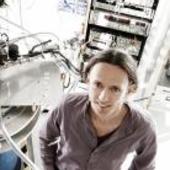

You may have heard that this year’s Nobel Prize in Physics has been awarded to Serge Haroche (from College de France) and David J. Wineland (from the US National Institute of Standards and Technology) “for ground-breaking experimental methods that enable measuring and manipulation of individual quantum systems”.
You may have also wondered what this means. So let me explain.
When I was a student – and it wasn’t that long ago – my quantum mechanics lecturer used to stress what she thought was an important conceptual and technical point.
You can observe a classical particle – say, a tennis ball – and track its trajectory in just one attempt. (There’s no need for Djokovic or Nadal to repeat the same serve a million times to convince the referee they’ve had scored an ace).
But this isn’t the case if you look at a quantum particle. Imagine a “quantum game of tennis”, where you replace the ball with, say, an electron (a negatively charged particle).
The only way to play this game is to build a million identical tennis courts, with a million clones of the same two players, hitting their electron in the same way. To find the winner, you need to calculate the average score across the million courts.
If you try to look closely at what happens on just one “quantum court” the game is over! This view of quantum mechanics essentially suggested there was no point looking at individual quantum systems – only ensembles give meaningful results.
Haroche and Wineland were recognised by the Nobel Prize committee for their seminal contributions to changing that point of view.
Haroche’s group in Paris has shown that it is possible to observe and manipulate a single photon, that is, a single quantum of light.
By constructing an “optical cavity” (two mirrors facing each other) they were able to count how many photons were present, and then play all the special games allowed in the quantum world, such as creating “superpositions” of zero and one photon, or watching “quantum jumps” between different numbers.
Notice the novelty: that’s one cavity, containing one photon (or a few, or a superposition). The technique to observe the photons relies on sending a stream of atoms through the cavity.
Wineland’s group at the National Institute of Standards and Technology (NIST) pioneered the technology to control a single atom in an electromagnetic “trap”.
In a sense, this is the complementary experiment to that of Haroche. Here they looked at the quantum state of one or a few atoms, and used a beam of light to probe it.
The very important property of the atoms studied by Wineland and his group is that they can be made to interact with each other quite easily.
Quantum information can be encoded in the internal energy state of each atom, and quantum computations can proceed by controlling their interactions.
Wineland’s work has also given us some of the most precise atomic clocks known to date.
Nowadays many other types of individual quantum systems have been observed, including macroscopic ones such as superconducting circuits and mechanical oscillators, or simple ones such as electrons in a silicon chip and colour centres in diamond.
This area of research is an exciting playground for applications ranging from quantum computing to metrology, to foundations of quantum theory.
Haroche and Wineland have been awarded the Physics Nobel Prize for teaching us how to play the quantum game of tennis with just one court and one ball.