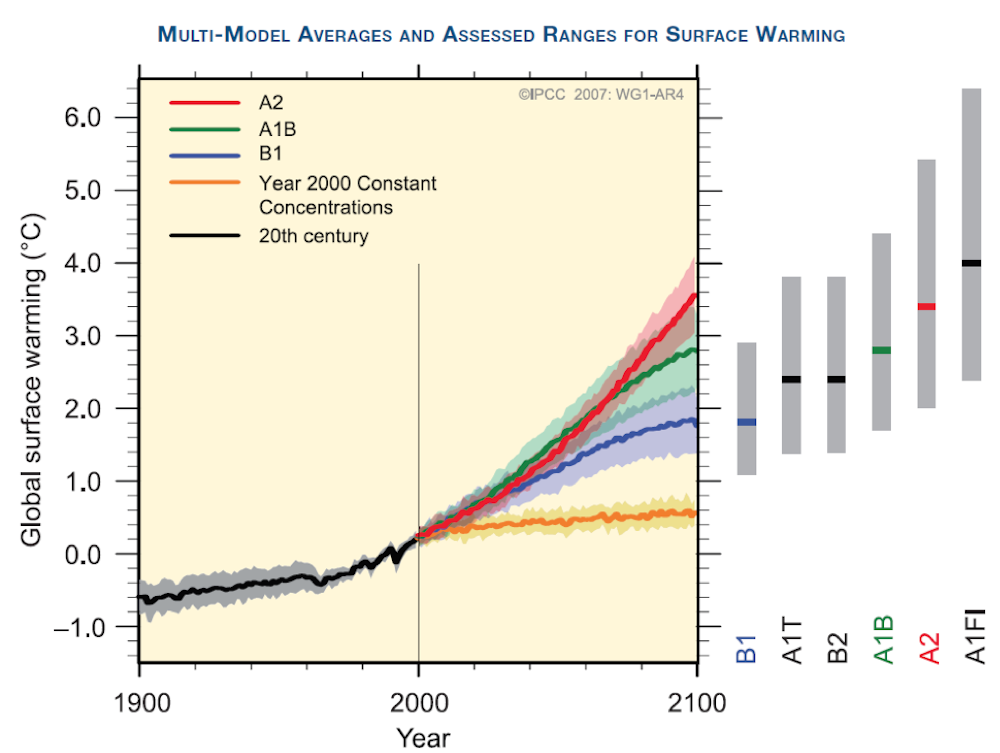
The linear nature of global warming trends projected by the IPCC since 1990 and as late as 2007 (see Figure 1) has given the public and policy makers an impression there is plenty of time for economies to convert from carbon-emitting industries to non-polluting utilities.
Paleo-climate records suggest otherwise. They display abrupt shifts in the atmosphere/ocean/cryosphere system, as manifest in the ice core records of the last 800,000 years. This suggests high sensitivity of the climate system to moderate changes in radiative forcing, whether triggered by changes in solar radiation energy or the thermal properties of greenhouse gases or aerosols. In some instances these shifts have happened over periods as short as centuries to decades, and even over a few years.
Examples of abrupt climate shifts are the 1470 years-long Dansgaard-Oeschger intra-glacial cycles, which were triggered by solar signals amplified by ocean currents, and the “younger dryas” cold interval, which occured when interglacial peaks resulted in extensive melting of ice and cooling of large ocean regions by melt water.
The last glacial termination (when large-scale melting of ice occurred between about 18,000 to 11,000 years ago) is attributed to transient solar pulsations of 40–60 Watt/m2 affecting mid-northern latitudes. This led to a ~6.5+/-1.5 Watt/m2 rise in mean global atmospheric energy level, which meant a mean global temperature rise of ~5.0+/-1.0 degrees Celsius and sea level rise of 120 meters (see Figure 2).
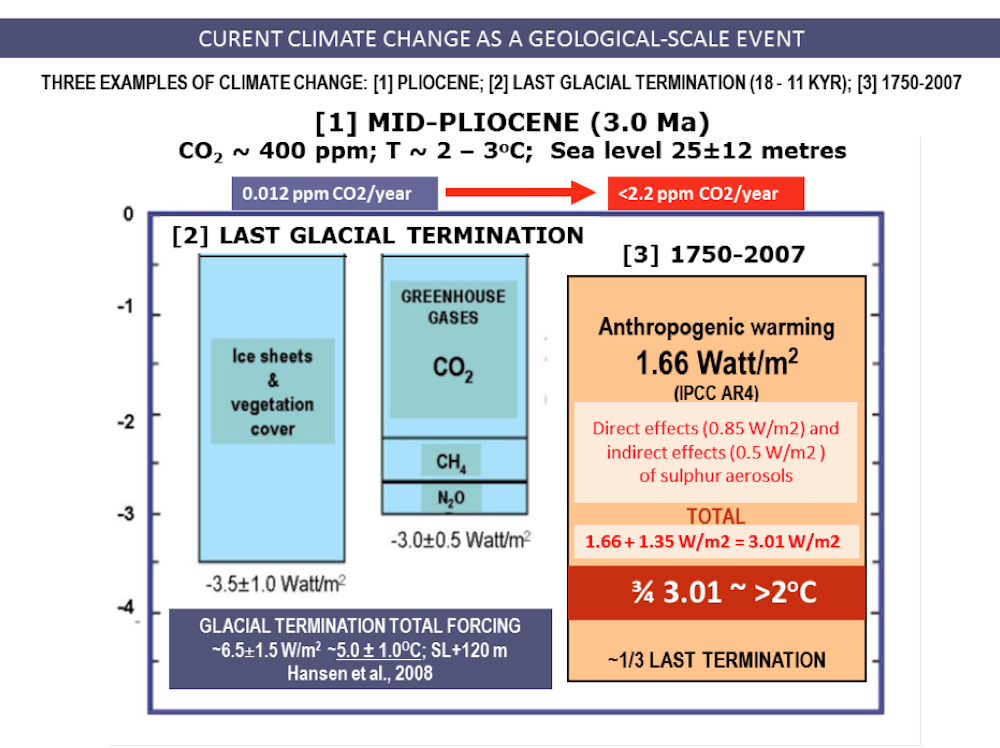
As shown in Figure 2, anthropogenic carbon emission and land clearing since 1750 have raised the atmospheric energy level by +1.66 Watt/m2. Once the masking effect of industrial sulphur aerosols is taken into account. This totals ~3.0 Watt/m2, namely near half the radiative forcing associated with the last glacial termination.
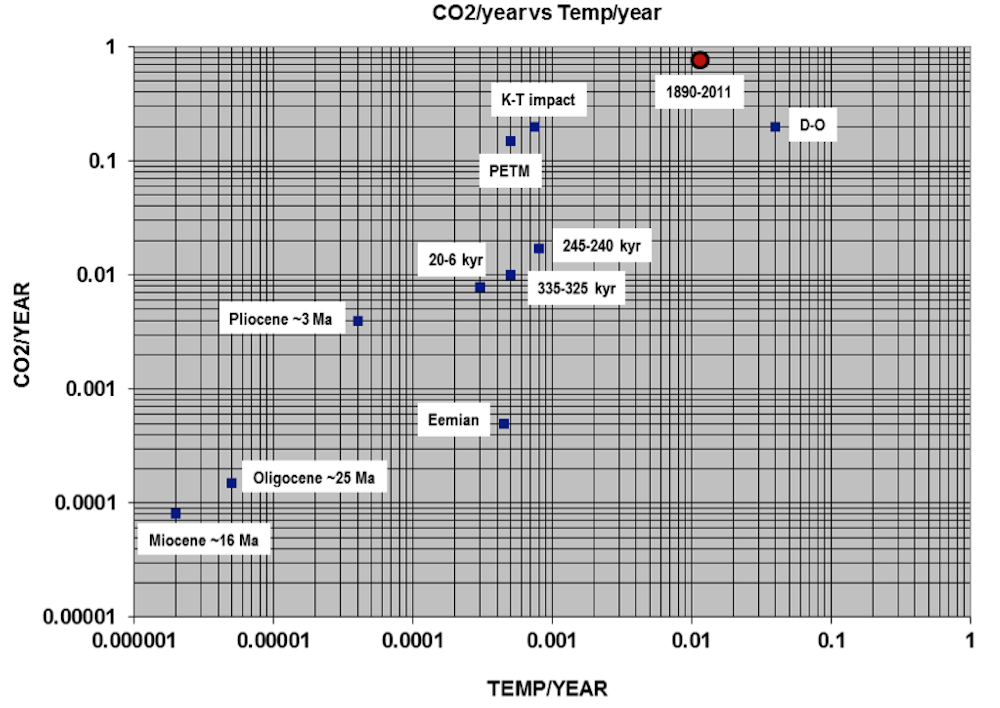
Compounding the major rise in radiative forcing over the last ~260 years is the rate of greenhouse gas (GHG) rise. This has averaged ~0.5ppm CO2 per year since 1750. That’s more than 40 times the rate during the last glacial termination, which was 0.012ppm CO2 per year. The current CO2 rise rate – 2ppm a year – is the fastest recorded for the Cainozoic (the period since 65 million years ago) (see Figure 3).
We have seen this scale and rate of radiative forcing, in particular since the 1970s, expressed by intensification of the hydrological cycle, heat waves and hurricanes around the globe. It imparts a new meaning to the otherwise little-defined term, “tipping point”.
Between 1900 and 2000, the ratio of observed to expected extremes in monthly mean temperatures has risen from ~1.0 to ~3.5. From about 1970 the Power Dissipation Index (which combines storm intensity, duration, and frequency) of North Atlantic storms increased from ~1.0 to ~2.7-5.5 in accord with tropical sea surface temperatures which rose by about 1.0 degree Celsius.
Coumou and Rahmstorf (of the Potsdam climate impacts research institutestate:
The ostensibly large number of recent extreme weather events has triggered intensive discussions, both in- and outside the scientific community, on whether they are related to global warming. Here, we review the evidence and argue that for some types of extreme — notably heat waves, but also precipitation extremes — there is now strong evidence linking specific events or an increase in their numbers to the human influence on climate. For other types of extreme, such as storms, the available evidence is less conclusive, but based on observed trends and basic physical concepts it is nevertheless plausible to expect an increase.
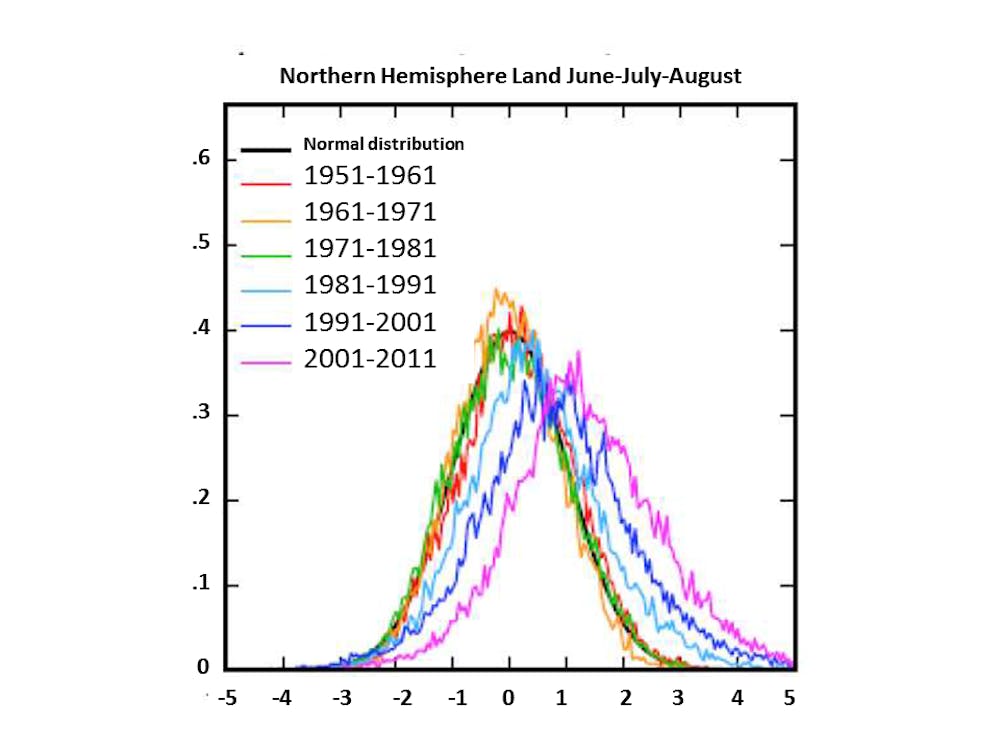
Hansen et al analysed the distribution of anomalous weather events relative to the 1951–1980 base line, displaying a shift toward extreme heat events (see Figure 4). The authors observe:
hot extreme[s], which covered much less than 1% of Earth’s surface during the base period (1951-1980), now typically [cover] about 10% of the land area. It follows that we can state, with a high degree of confidence, that extreme anomalies such as those in Texas and Oklahoma in 2011 and Moscow in 2010 were a consequence of global warming because their likelihood in the absence of global warming was exceedingly small.
The consequences for the biosphere of accelerating climate change are discussed by Baronsky et al in the following terms:
Localized ecological systems are known to shift abruptly and irreversibly from one state to another when they are forced across critical thresholds. Here we review evidence that the global ecosystem as a whole can react in the same way and is approaching a planetary-scale critical transition as a result of human influence.
Climates found at present on 10–48% of the planet are projected to disappear within a century, and climates that contemporary organisms have never experienced are likely to cover 12–39% of Earth. The mean global temperature by 2070 (or possibly a few decades earlier) will be higher than it has been since the human species evolved.
At 400ppm CO2, potential climate conditions have reached levels which last existed in the peak Pliocene epoch (5.3-2.6 million years ago). Given an increase in extreme weather events under conditions of +0.8C, an even higher rate of extreme events is expected under conditions of +2.0C currently shielded by industrially emitted sulphur aerosols.
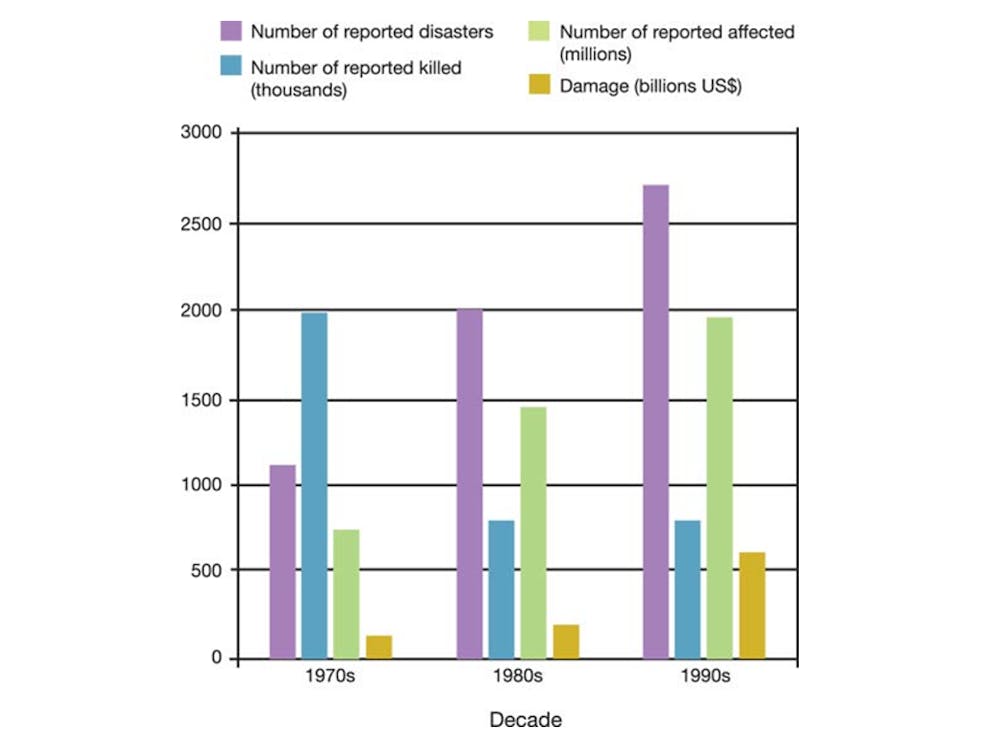
Current trends in the frequency and intensity of extreme weather events are evident globally (see Figure 5). In the USA, the number of meteorological, hydrological and climatological events rose from about 20-40 per year during 1980-1988, to about 40-80 per year during 1989-2005, to between 70-100 per year after 2006, consistent with global rise in the frequency of extreme weather events.
There is still time to act and avoid a worsening climate, but we are wasting precious time. We can solve the challenge of climate change with a gradually rising fee on carbon collected from fossil-fuel companies, with 100% of the money rebated to all legal residents on a per capita basis. This would stimulate innovations and create a robust clean-energy economy with millions of new jobs. It is a simple, honest and effective solution.
New solar technologies promise to provide a large part of the answer. Time is of the essence.
John Coochey
Mr
There is still the issue of what was attributed to President Ford "that you cannot make solar energy overnight!" and we do not have way of large scale energy storage. Can anyone confirm or deny a recent assertion by John Quiggin
" but the near-universal view of economists that the cost of stabilising the global climate will be of the order of 1 per cent of income is certainly supported by the evidence from the initial steps in this direction."
I no of no study on which this could be based.
Michael Shand
Michael Shand is a Friend of The Conversation.
Software Tester
What about Solar Thermal? the plant in spain can run at full capacity for 16 hours without sunlight
Mike Hansen
Mr
William Nordhaus, Sterling Professor of Economics at Yale University
"My study is just one of many economic studies showing that economic efficiency would point to the need to reduce CO2 and other greenhouse gas emissions right now, and not to wait for a half-century. Waiting is not only economically costly, but will also make the transition much more costly when it eventually takes place. "
http://www.nybooks.com/articles/archives/2012/mar/22/why-global-warming-skeptics-are-wrong/
John Coochey
Mr
Yes what about it? Spain is bankrupt and as far as I am aware the plant is merely experimental, do you have any figures on the cost per kilowatt hour?
John Coochey
Mr
In what way does that answer my question? Really...
David Boxall
logged in via Facebook
If memory serves, the Stern report originally said 1% of GDP. Subsequently, that was increased to 2%; delay in acting had increased the cost.
John Coochey
Mr
If the citation is correct how does that match Tim Flannery's, the Australian Chief Climate Change Commissioner, statement that if all human activity ceased it could take a thousand years for temperatures to decline, also Andy Pitman of the ANU has stated temperatures could continue to rise for twenty to thirty years if all human activity ceased. I would assume we agree that all human activity ceasing would reduce all GNP's by one hundred per cent. Is it really the case that highly paid academics are simply pulling figures out of the air as the occasion demands?
Mike Hansen
Mr
John Coochey. You keep making this claim knowing it to be false. You will continue to have zero credibility if you consistently lie. I can only assume that you feel the need to lie because you have no stronger arguments.
Matthew Albrecht (and many others also) gave you the correct quotes here 3 weeks ago and pointed out that both statements are consistent and supported by science.
https://theconversation.edu.au/climate-science-is-not-about-belief-chief-scientist-9198#comment_67953
Andy Pitman…
Read moreComment removed by moderator.
Tim Scanlon
Debunker
Ahh yes, the classic "the problem is too big, so don't bother" argument.
Plenty of reports have found that we can change to zero emissions rather quickly with proper investment, the Australian Academy of Science and The Energy Research Institute have both released reports that show this can be done and address our energy security issues.
Also, you have couched the economic argument as though we should compare new technologies with long established and antiquated technologies that have received decades to centuries of subsidies and investment. All economic analyses that have taken a comparative approach into the future cost association have shown renewables to be comparable to cheaper than fossil fuels.
Comment removed by moderator.
John Coochey
Mr
the Australian Chief Climate Change Commissioner, statement that if all human activity ceased it could take a thousand years for temperatures to decline, also Andy Pitman of the ANU has stated temperatures could continue to rise for twenty to thirty years if all human activity ceased.
Your quotes of your statement and that of Tim Flannery are
“Andy Pitman: "If we could stop emissions tomorrow we would still have 20 to 30 years of warming ahead of us because of inertia of the system."
Tim Flannery: "If the world as a whole cut all emissions tomorrow the average temperature of the planet is not going to drop in several hundred years, perhaps as much as a thousand years."
In what way was my above statement a lie?
John Coochey
Mr
And how much of your super have you got invested in the new technologies? I hope it is not in geothermal where the share price has dropped to junk bond status despite heavy taxpayer subsidy.
Tim Scanlon
Debunker
Tu quoque, but also irrelevant.
Your comment only shows the reason for market failure and lack of govt action, you are unwilling to invest and carry negative connotations into any investment. Thus you are unlikely to be a good investor anyway, unlike companies like Google, Amazon, BP, etc, who have invested heavily in renewables.
John Coochey
Mr
That is not market failure when people do not invest in something which will not work, you are obviously not a trained economist! Market failure is something like a public good, for example disease control or Defence, or a common good such as a fishery where free markets will not lead to an optimal solution.
Jonathan Ely
Student
You’re unbelievable. It’s been explained to you so many times that the statements of Pittman and Flannery do not contradict each other that I think my head is about to explode. I simply cannot fathom how you could possibly not understand this.
If your reason for posting on this site is to entertain us all with your bumbling clown act, or to display your defective cognitive skills, (possibly in an attempt to obtain some sort of disability pension?), you have succeeded… and you can go now.
Tim Scanlon
Debunker
You clearly haven't read the economic breakdowns of climate change.
Market failures occur when the market fails to allocate resources properly. In climate change this is the failure of businesses and the market place to account for environmental factors which are currently externalities. These externalities have costs associated with them, costs the market has failed to acknowledge and incorporate. As such, greenhouse gases should have been factored into the market place, thus sequestration, renewables…
Read moreDavid Boxall
logged in via Facebook
Jonathan, he doesn't understand because he can't face the facts.
John Coochey
Mr
The issue is that I was accused of lying when in fact I clearly wrote the truth this seems something some zealots are incapable of grasping. The two statements can only be consistent if we assume that temperatures will increase for twenty to thirty years and then plateau for nine hundred plus years before declining. Fatuous! There then is the question that John Quiggin asserts we can cure climate change (sic) by sacrificing one per cent of GNP. I do not see how one per cent would finance anything which would have any significant effect. I also note that no one has attempted to challenge let alone refuge Lomborg;s statement that $250 billion a year till the end of the century will only inhibit temperatures by one twentieth of a degree.
Jonathan Ely
Student
Did you clearly write the truth? Flannery indicated he believed average temperatures would not drop for several hundred years, up to a thousand. So why not temperatures would rise for 30 years and plateau for 270? You again demonstrate you are incapable of comprehending a relatively simple concept. Will you agree you are either lying, or wrong when you wrote the statements can only be consistent if temperatures plateau for over 900 years?
John Coochey
Mr
I note you did not address the Lomborg question, no one ever does. Now let assume that both Pitman, Flannery and Quiggin are all telling an objective truth and they are compatable (my belief remains these are figures pulled out of the air) If all emissions stopped tomorrow then temperatures continue to rise for thirty years, to what level has not been stated but you can bet it won't go over the politically defined 2.5 degree tipping point, and then plateau for nine hundred and seventy or so, give or take a decade. But the world will not end because taking John Quiggin's figure we can prevent this by spending one per cent of GNP? Which presumably will not result in zero emissions and so presumably cooling will take even longer? Have I got that right?
Jonathan Ely
Student
Probably not, you have a habit of being wrong about nearly everything you write, and when someone demonstrates you are wrong, you quickly change the subject. I think you need to polish up your debating skills on other sites that aren't frequented by indviduals that actually know what they're talking about. You could start at Australian Climate Madness, they're pretty clueless, then move on to Jo Nova, and maybe even Climate Audit. You shouldn't bother with any sites run by the pro Global Warming…
Read moreJohn Coochey
Mr
Actually you are wrong I got an HD in Environmental Economics at the ANU. All actions have externalities that is not market failure. I would point you to a basic text such as Samuelson.
John Coochey
Mr
In no way have you proved me wrong on anything, I note yet again you have not answered the questions particularly Lomborg. The fact that Flannery went of on motor mouth and gave a range of statements is irrelevant. The issue in question is that when you go through some linguistic somersalts to reconcile two statements (something not even attempted by the Chief Scientis, hardly a man of straw) you get a worse situation. Temperature will not decline for hundreds of years but will actually first increase if we cut all emissions, (presumably excluding breathing) That is not going to happen, there will still be someone in darkest Africa lighting a cooking fire not to mention Chinese thermal stations opening every few weeks and a few crocodile tears about put ting in a nominal tax, . But we are told all our problems can be solved by merely sacrificing one per cent of GNP. No doubt the new event at the paraolympics will involve flying pigs!
David Boxall
logged in via Facebook
John Coochey: "In no way have you proved me wrong ...". https://theconversation.edu.au/the-atmospheres-shift-of-state-and-the-origin-of-extreme-weather-events-9285#comment_75223
John Coochey: "... we are told all our problems can be solved by merely sacrificing one per cent of GNP." https://theconversation.edu.au/the-atmospheres-shift-of-state-and-the-origin-of-extreme-weather-events-9285#comment_75195
David Arthur
n/a
Err, Gerald Ford was US President some 38 to 36 years ago.
1) Back then, atmospheric CO2 was still in the comfort zone between 300 and 350 ppm.
2) Back then, photovoltaic technology was in its infancy.
You then continue on to discuss the potential cost according to some economist: don't you get it? Irrespective of what proportion of GDP it may cost, this is expenditure which MUST be carried out, else there will be no economy which can raise the funds.
Why do right-wingers routinely conflate science with economics? Is an incapacity for analytical thinking one of the prerequisites?
John Coochey
Mr
So, once again if all emissions stop tomorrow then we get twenty to thirty years of warming and then several hundred years before temperatures start to decline. Given that this goal is unattainable then actual results would be less but this less desirable (sic) outcome can be achieved by sacrificing only one per cent GNP? And what would this sacrifice achieve and when given Lomborg remains unanswered and un rebutted. Just because something has been written down does not make it true.
John Coochey
Mr
Actually the anecdote was apochaphyl (I can't be bothered to spell check that) and was an unkind cut at a President not known for his intellect. But the question remains given Lomborg's calculations which are as yet unchallenged that massive expenditure (not one per cent dear God) will achieve trivial changes but then again youth loves a cause and we all want to save the world but I have yet to see a Greenie cut up their driving licence or move to a smaller dwelling.
Jonathan Ely
Student
What planet do you live on John? There are no paraolympics, only paralympics... just another thing you're wrong about.
I'm no economist, and I'm hardly going to waste my time google researching what Lomberg and Quiggin have said when even if I discover that you're wrong you'll never admit it.
So I'll break this down for you once more, real simple this time. Now pay attention.
Flannery: temperatures won't drop for several hundred years to a thousand years... won't drop... won't drop.... won't drop... do you get it? They can go up, sideways, fly out the window and slap you in the face... but on average, they won't drop. This isn't a difficult concept to grasp. It's hardly linguistic somersaults (you got that word wrong as well), th
Tim Scanlon
Debunker
That doesn't refute the work done by several economists on this topic, but argues that you know more than them. It's great that you got an HD in a unit in your uni course, I'm really happy for you, but how about you read the papers and reports I linked that thoroughly debunked your statements and clearly show that climate change and GHGs are market failures.
Jonathan Ely
Student
What Flannery and Pitman have said do not contradict each other, it's that simple. Why don't you get it?
John Coochey
Mr
I think you are confusing market failure with an imperfect market, suggest high schools studies.
John Coochey
Mr
Thank you for making my point for me! So why are we bothering?
John Coochey
Mr
Well as I have pointed out that makes it worse! Because if we take Prophet Flannery and Prophet Pitman as correct then if by some miracle we stopped all emissions tomorrow temperatures would continue to rise (perhaps past tipping point after which "resistance is futile") for decades and then remain constant for centuries (but this will not end civilization as we know it, I assume) before it declines. Therefore in the real world any change would be less. Correct? So how much benefit would this lesser change give us and what would it cost us?
Bob Ashworth
logged in via Twitter
"....but I have yet to see a Greenie cut up their driving licence or move to a smaller dwelling."
I know lots of people who have done such things..... but that is not the point. It is global emissions that need to be cut and that requires changes internationally, not a large sacrifice by a few, but smart thinking by Governments to reduce the carbon footprint of all.
David Boxall
logged in via Facebook
https://theconversation.edu.au/the-atmospheres-shift-of-state-and-the-origin-of-extreme-weather-events-9285#comment_75223
David Boxall
logged in via Facebook
https://theconversation.edu.au/the-atmospheres-shift-of-state-and-the-origin-of-extreme-weather-events-9285#comment_75223
David Boxall
logged in via Facebook
https://theconversation.edu.au/the-atmospheres-shift-of-state-and-the-origin-of-extreme-weather-events-9285#comment_75223
Tim Scanlon
Debunker
So you are suggesting that several world renounced economic experts whose work I have referenced are confused and lacking an economics background. That's amazing. You must also hold nothing but contempt for these economists and the peer reviewed journals they have posted in, because clearly the economists in question have no training or knowledge to impart. Clearly you are the expert, clearly GHGs can't be market failure, despite economic analysis to suggest that it is the greatest market failure of all time.
Or you could be wrong.
David Boxall
logged in via Facebook
John Coochey: "... the question remains given Lomborg's calculations which are as yet unchallenged ...". They've probably been comprehensively refuted, but nobody takes Lomborg seriously enough to bother checking or you seriously enough to bother pointing it out to you.
But you're getting attention, which is what you crave.
Jonathan Ely
Student
I'm not actually sure what your point is. That somehow all the posters here who have shown that you are wrong, are actually proving you right? You could bottle that sparkling logic and sell it by gram.
I think the real question is, do you actually think about the things you write, or do you just bash randomly at the keyboard with those fancy, sausage shaped appendages at the ends of your hands, run the resultant gibberish through the spell checker and post it here?
I bother because, as amusing as your Chubb, Flannery and Pitman anecdote is, I really believe it's time to give it a rest and move on.
John Coochey
Mr
Probably doesn't cut it! Have any of his calculations been refuted, people are quick enough with links on this blog even if few or any check out.
John Coochey
Mr
But why bother? Is your position that of a sympathetic interpretation of what I consider a serious anomoly between Flannery and Pitman (which neither have sought to explain and on which our Chief Scientist does not have a clue) in which case even if we reduce emissions to zero temperature will rise of decades and then stay at the new higher temperature for centuries? Is that your position or do you believe we can reduce emissions to below zero?
John Coochey
Mr
Well it is a question of definition, I suggest you check and economics dictionary. But the only interpretation I can make if we assume Flannery Pitman and Quiggin are accurate is that Quggin's tax will reduce emissions to less than zero because otherwise we are due for several decades of rising temperatures followed by several centuries of these higher temperatures.
Blair Donaldson
logged in via Twitter
Way to miss the point John. Whether or not Spain is bankrupt is irrelevant to the performance of a solar thermal plant regardless if it's experimental or not.
Gary Murphy
Independent Thinker
"temperature will rise of decades and then stay at the new higher temperature for centuries?"
That's it John - you've got it in one.
The next question is how much temperatures will rise and how much damage will be done.
If you look at the graph in the article - it shows a variation in temperature increases of 1-4 degrees up to 2100 depending on how much more we emit.
Tim Scanlon
Debunker
What a red herring! I provided references to several peer reviewed economics papers that refer to climate change as market failure, you are trying to pretend that this is not the case with a distraction about terminology and unrelated people (WTF has Flannery got to do with anything?).
Rebut and explain how the Grantham Research Institute (Alex Bowen, Simon Dietz and Naomi Hicks), Nicholas Stern, and Smita Nakhooda are wrong. What have they failed to understand about economics, what have they failed to understand with their research?
David Boxall
logged in via Facebook
Lomborg profits by supporting the status quo.
http://www.sourcewatch.org/index.php/Lomborg
Lomborg is not a climate scientist or economist and has published little or no peer-reviewed research on environmental or climate policy. His extensive and extensively documented, errors and misrepresentations, which are aimed at a lay audience, "follow a general pattern" of minimizing the need to cut carbon emissions.
John Coochey
Mr
As expected you cannot answer so you resort to ad hominum attacks, as always.
John Coochey
Mr
Once again I must refer you to a basic dictionary. There is massive misuse of the term market failure by people who do not understand the concept. On ABC today there was a woman saying there was market failure because high risk start up companies cannot get finance, that is not market failure it is simply people estimating the risks and benefits. It is not market failure that I do not play the pokies. But once again if you accept some people's interpretation of Flannery's and Pitmans conflicting…
Read moreDavid Arthur
n/a
Mr Coochey, understand this: IF YOU BUY AN ELECTRIC CAR THEN YOU DON'T HAVE TO PAY FOR PETROL.
It matters not a jot what percentages of GDP Lomborg, or Stern, or Garnaut reckon addressing climate change will cost, because the alternative (continuing to use fossil fuels) is far far worse; I have been making this point to you many times in these pages, yet you remain oblivious to my attempts to engage your intelligence. I'm coming to the view that you have none.
David Arthur
n/a
Mr Coochey, Lomborg puts out a load of demonstrated nonsense, and you want Mr Boxall to give Lomborg some credence?
Blair Donaldson
logged in via Twitter
"As expected you cannot answer so you resort to ad hominum attacks, as always."
That's pretty rich coming from you John given your ad hominum attacks on "greenies", Flannery and others.
The criticisms of Lomborg are legitimate and have been made by numerous people qualified to speak against his claims. Stating facts and pointing out the flaws in his comments is the antithesis of an ad hominem attack.
John Coochey
Mr
And your point is? Other than you have painted yourself into a corner.
John Coochey
Mr
I have made no ad hominum attacks on anyone, I have simple questioned the consistency of their contradictory statements, some have jumped through verbal gymnastics to try and rationalize the inconsistencies but have in fact weakened their case. Once again you add to add hominum attacks but do not rebut anything Lomborg has said.
John Coochey
Mr
NO but the electricity will have to be produced by something and I can invest the money I do not spend on a short range low performance car and use the interest to pay for my liquid fuel. As I have had to point out add nauseum the two current Prophets tell us if emissions were zero we would still have decades of rising temperatures followed by centuries before cooling. We are all doomed anyway!
David Boxall
logged in via Facebook
John Coochey": "... ad hominum ...". No John, just pointing out that Lomborg is not a credible source.
Blair Donaldson
logged in via Twitter
Your notion of reality must be an interesting world. Pity the majority here don't seem to share it. Far from demonstrating contradictions, the others here have simply described your inability to reason. I concur with their assessment.
John Coochey
Mr
THEN REBUT IT! He has stated that the 250 billion PER ANNUM to the end of the century spent by Europe will result in an inhibition of temperatures of one twentieth of a degree is that right or wrong? If you must use a link then quote the relevant part and put your credibility on it.
This is like a pathetic childhood gang "We don't talk about him he is not cool!" It does not matter if he eats live kittens for breakfast is this statement true or not and if not what is the "correct" figure and how was it arrived at? Dead simple if you know what you art talking about rather than some weird desire to be "one of the gang" or a true believer.
John Coochey
Mr
Now answer the question "Where have I engaged in ad hominum" attacks.
John Coochey
Mr
OK I will make it easy for you. A meteorite landed on earth and on it was a plaque which said "The $250 billion spent each year in Europe will result in a twentieth of a degree inhibition of temperature by the end of the century". Is that correct or not" Let us leave Lomborg out of it. Now and the answer is? The fact that the meteorite is not a credible source is not an acceptable answer.
John Coochey
Mr
And a few of the errors and omissions are ? Please no links without extracted quotes. I am sick and tired of reading documents which have nothing to do with the issue in question.
Bob Ashworth
logged in via Twitter
I guess the only difference is that your "why give up what we've got... beggar the consequences" approach will almost certainly lead to catastrophes. Taking action now could lead to mitigating the worst impacts.
"We are all doomed anyway!" This may well be true at some point, but maybe we can make a difference to the time-frame!
John Coochey
Mr
And that difference is? And what have you personally given up? Here I am thinking of the ACT Greens politician who drives a V8 Landcruiser.
Bob Ashworth
logged in via Twitter
I think that this is your problem, you assume to much!
I don't even know what or who the ACT Greens are!
Jonathan Ely
Student
I've painted myself into a corner? With your interpretation of a corner, I bet you're still trying to jam the square peg through the round hole.
Jonathan Ely
Student
Two sides to every story.
http://blogs.crikey.com.au/purepoison/2010/08/12/bolt-beat-up-round-up/
John Coochey
Mr
Once again a link which hoists the writer with his own petard. If you read the link it gets worse, the family is a two car family and does in fact use the V8 Cruiser fro camping trips. What is wrong with a three liter Nissan which is actually bigger? I know because I got one.
Bob Ashworth
logged in via Twitter
... and that is why Australia has one of the biggest per capita carbon footprints in the world. You wouldn't even notice cutting 20% of emissions if it was done intelligently.
John Coochey
Mr
"Plenty of reports have shown we can switch to zero emissions,,: Such as? Get real it may be possible to reduce but zero?
John Coochey
Mr
To some degree you make my point for me but one issue I still have is people like our Greens representative driving a V8 Landcruiser without any need for one, rather hypocritical given the best form of leadership is by example, by the way when I said the Nissan was bigger I was referring to carrying space not engine size.
David Arthur
n/a
So let me get your argument right. You're arguing that because you (John Coochey) and your shabby cohort of dissemblers and outright fraudsters have succeeded in delaying corrective for this long, we may as well finish the job and kill our planet "good and proper"?
With respect Mr Coochey, that is not the attitude one would like to see in someone with whom one must share their life support system.
Just as it is undoubtedly true that there are decades of warming and further climate instability ahead of us, the first step in alleviating a head ache is to stop banging one's head against the brick.
John Coochey
Mr
And your personal contribution was exactly what? What did you do in the war daddy? As the old recruiting poster said. This again goes back to Lomborg's calculation that the $250 billion a year spent by Europe will inhibit temperature rises by the end of the Century by one twentieth of one degree. Hope it makes everyone feel good.
David Boxall
logged in via Facebook
No idea John. You're the one who pretends to know all; what's your answer?
David Boxall
logged in via Facebook
They're at the link.
David Boxall
logged in via Facebook
John Coochey: "... Lomborg's calculation that ...".
The Danish Committee for Scientific Dishonesty on Lomborg: "... there has been such perversion of the scientific message in the form of systematically biased representation that the objective criteria for upholding scientific dishonesty ... have been met". In other words, the committee considers Lomborg a fraud.
Nobody gives his calculations or anything he says any credence.
David Boxall
logged in via Facebook
From http://www.lomborg-errors.dk/
Read more"Why is it essential to point out the errors?
First, because in the handling of errors, Lomborg does not act like most persons would do. A normal person would apologize or be ashamed if concrete, factual errors or misunderstandings were pointed out - and would correct the errors at the first opportunity given. Lomborg does not do that. For example, when The Skeptical Environmentalist was heavily criticized in a review in Nature, Lomborg´s reaction was…
David Arthur
n/a
Mr Coochey, among my other contributions to this page I indicate some of my many serious concerns the changes to which humanity is committing its only possible home.
I have set out that I am concerned that we are driving the world toward an average 12 deg C temperature rise, which will render many areas uninhabitable. This entirely plausible temperature rise is the consequence of greenhouse warming due to greenhouse gases released by melting ice caps and permafrost. It is already being observed…
Read moreOmar Khalifa
logged in via LinkedIn
How many more warnings and charts are necessary to change the mainstream views of current societies and their leaders? It could be argued more concern and action was initiated 20 years ago when we had even fewer compelling facts about the impact on of our environment and what it meant for future generations.
Like the frog in the slowly warming pot, are we increasingly becoming numb to the "inconveneint truth" in favour of the pursuit of unsustainable rates of consumption and economic growth…
Read moreDavid Boxall
logged in via Facebook
Omar Khalifa: "Perhaps we should concede that not nearly enough will be done and focus on preparing for the disasters ahead rather than in preventing them?" Unless:-
Carl Sagan: "... Venus is an ominous reminder that in a world rather like the earth, things can go wrong. There is no guarantee that our planet will always be so hospitable."
Stephen Hawking: "We don’t know where global warming will stop but the worst case scenario is that the earth will become like its sister planet Venus, with a temperature of 250 degrees C ..."
How do we prepare for that which is not survivable?
Omar Khalifa
logged in via LinkedIn
David, I suppose there are different ways of us getting there if the Universe doesn't intervene some other way first:
Option 0: Problem, what problem? The so-called climate change sceptics approach where every snowflake is proof that global warming is just one more theory to redistribute wealth.
Option 1: "We are here for a good time not a long time" approach. Steady as she goes really - for those who can. Favoured by the sceptics camp as a backup when they run out of logical argument…
Read moreCraig Read
logged in via LinkedIn
http://arstechnica.com/science/2012/09/how-much-carbon-is-released-into-the-atmosphere-by-thawing-permafrost/
"the heat-trapping efficiency of each molecule of CO2 drops as the total concentration in the atmosphere increases (the more greenhouse gas molecules you have, the more likely some other one will absorb a photon first)."
Apparently, there is an "upper limit" to warming, but nobody can accurately pinpoint what that is (yet). But even if there is no possibility of Earth becoming Venus…
Read moreJohn Coochey
Mr
Well I seem to remember a study that the most common characteristic of Green voters is that they are members of frequent flyers clubs.
David Boxall
logged in via Facebook
Craig Read: "Apparently, there is an "upper limit" to warming, but nobody can accurately pinpoint what that is (yet)." I fear the only way we'll find out is when it happens.
Craig Read: "... even if there is no possibility of Earth becoming Venus 2.0, ..." It takes courage in the extreme to say "there is no possibility".
If the end result is 200 C, instead of 250, then maybe that's OK. That 50 degrees makes all the difference.
Sterilising the Earth is bad enough, but oceans don't evaporate overnight. It takes millennia. Generations of humanity could live in increasing misery, leading to extinction.
David Arthur
n/a
I seem to remember a study where the most common characteristic of Green voters is greater scientific literacy than Climate Sceptic voters.
David Arthur
n/a
Earth is extremely unlikely to become Venus 2.0 because
a) it's further from the sun.
b) it's got oodles of water to regulate temperatures between 0 deg C and 100 deg C.
David Boxall
logged in via Facebook
What makes you think that Venus didn't once have "oodles of water" too? Why do you think a mind as sharp as Hawking voices similar concerns? Sagan really did know what he was talking about.
David Arthur
n/a
Thanks David, excellent point that Venus once did have oodles of water.
Did you know that orbits the sun at only 0.72 times earth's orbit? At that distance, sunlight intensity is about 1.9 times that at earth's orbit.
Furthermore, for the earth's surface to lose its water, the upper troposphere and stratosphere would have to warm considerably (~ 50 deg C?) for water vapour to not condense out; at the moment, water evaporates at the surface and rises until it condenses out (clouds etc…
Read moreDavid Boxall
logged in via Facebook
OK David; if you say so you're brighter than Hawking and more knowledgeable than Sagan ever was.
David Arthur: "...for the earth's surface to lose its water, the upper troposphere and stratosphere would have to warm considerably (~ 50 deg C?) for water vapour to not condense out ...)". As it was explained to me (and I don't claim expertise) it's not necessary for precipitation to cease, only for evaporation to exceed precipitation. Nobody really knows under what conditions that might happen. Brighter minds say there's a risk.
David Arthur
n/a
Thanks Mr Boxall, as it happens I do have a smidgin of scientific understanding (science degree majoring in Physical Chemistry).
Consider the atmosphere. Water enters the atmosphere by the following methods.
1) Evaporation from the surface.
2) Accumulation from space (comets and the such like).
Term 1 is immensely bigger than Term 2.
Water leaves the atmosphere by the following methods.
1) Precipitation.
2) Of the negligibly small proportion that gets past the tropopause, a negligibly small proportion eventually gets up to the thermosphere by a cosmic ray, leaving an oxygen atom.
In several billion years, the sun will evolve to be a red giant, and expand and engulf several planets including the earth; perhaps Hawking and Sagan were referring to that eventuality?
David Boxall
logged in via Facebook
Perhaps, David, Sagan and Hawking were/are more knowledgeable and brighter than you.
David Boxall
logged in via Facebook
OK; I've found a bit of context for the quotes, that might relieve your confusion. http://www.youtube.com/watch?v=mu1PicT0TMU
By the way, did you really mean to imply that Sagan and Hawking were ignorant of the relative orbits of Earth and Venus?
PS. you can quite the condescending kindergarten explanations. The fact that I prefer the opinion of the best minds on the planet over yours doesn't mean I'm ignorant.
David Arthur
n/a
Thanks Mr Boxall, Sagan was and Hawking is at the top of their respective fields, there's no doubt about that. By the same token, of course they're both much brighter than I'll ever be. However, I've done some reading and thinking about physical properties of earth's atmosphere, starting with my undergraduate degree.
For that reason, I happen to know what I'm here writing about, whereas your retorts are simply appeals to authority. There is nothing condescending in my attempts to explain…
Read moreDavid Boxall
logged in via Facebook
David Arthur : "... I've done some reading and thinking ...". I too have done quite a lot of reading and, more significantly, listening.
David Arthur : "... (earth's water all boiling away) ...". It might surprise you to learn that evaporation and boiling are quite different things.
David Arthur : "The worst case I envisage ...". Do you believe that your inability to envisage the risk negates it? Bear in mind the sources of the warnings. You might characterise that as an appeal to authority;…
Read moreDavid Arthur
n/a
You've lived long enough to learn a little humility? I've lived long enough to learn a little science, a great deal of humility.
You reckon it's best to heed the best qualified voices? As I've pointed out to you, Sagan and Hawking are not that well qualified in climate science. I've also pointed out to you the direct observations and facts on which I reach my own conclusions so that you can discuss and critique them as appropriate ... perhaps even acknowledge that they are plausible.
You proudly proclaim your ignorance in this area of expertise, then turn it into pig ignorance when I doesn't prostrate myself before the deity you've imagined.
Rather than some youtube clip, how about you refer me to the peer-reviewed and published literature ... or even a transcript of the clip?
Blair Donaldson
logged in via Twitter
David, in fact Carl Sagan is one of the key individuals to kickstart concerns about CO2 and its affect on the Earth's atmosphere after studying the clear composition of the Venetian atmosphere…
http://www.aip.org/history/climate/Venus.htm
"Finally in 1960 a young doctoral student, Carl Sagan, took up the problem and got a solution that made his name known among astronomers. Using what he later recalled as "embarrassingly crude" methods, taking data from tables designed for steam boiler engineering…
Read moreBlair Donaldson
logged in via Twitter
Several years ago I heard an old interview he conducted explaining in far more detail the work he did trying to understand the climate of Venus. It was really fascinating, and as it turned out, far reaching, although the full import of his work wasn't realised until after his death. I've tried to find a link to it without much success but I'll keep looking and posted if I come across it. Cheers.
David Arthur
n/a
Luca Montabone is an academic visitor at Oxford University's "Atmospheric, Oceanic and Planetary Physics" sub-department of the Department of Physics.
He is also a research consultant at the "Laboratoire de Meteorologie Dynamique", Universite' Pierre et Marie Curie, in Paris (France).
His research field includes
Read morePlanetary atmospheres: Dynamics of the Martian atmosphere through global circulation modelling and data assimilation - Comparative planetology (mainly dynamics of planetary polar vortices…
David Boxall
logged in via Facebook
David Arthur: "Rather than some youtube clip, how about you refer me to ... a transcript of the clip?"
There are partial transcripts at (http://350orbust.com/2010/07/23/carl-sagan-and-stephen-hawking-on-effects-of-global-warming-the-runaway-greenhouse-effect-on-venus-is-a-valuable-reminder-to-take-the-increasing-greenhouse-effect-on-earth-seriously/). What's your problem with the original source material?
David Boxall
logged in via Facebook
You're determined to argue the science, which I'm not qualified to do. Given my admitted ignorance, the question comes down to the credibility of sources. So far, Sagan & Hawking win on that front.
David Arthur
n/a
Mr Boxall, you'll be pleased that I've finally listened to that youtube video, and apologise for not previously so doing.
Perhaps confusion arises if the observation that atmospheric density at Venus's surface is 90 times that of earth is neglected. This is the critical factor in its surface temperature being so much hotter than earth, too hot to allow liquid water.
Although Sagan concludes the video with "The runaway Greenhouse Effect" on Venus is a reminder that we must take the Greenhouse Effect on Earth seriously", neither Sagan nor Hawking state that a runaway Greenhouse Effect on Earth could result in high enough temperatures for water to boil away.
That said, the prospects for the next century, let alone the next millenium, are quite concerning as we have discussed. You may be interested in the cover story in the 22 September edition of New Scientist, looking at ideas for geoengineering; what's concerning is that these ideas are being considered as necessary.
David Boxall
logged in via Facebook
David Arthur: "Could water evaporate into space?
...
I hope this helps."
Given that we're talking of Venus and Earth, no.
What makes you think that the waters of Venus (or at least, the elements that once composed those waters) are not still mostly on Venus?
David Boxall
logged in via Facebook
David Arthur: "... neither Sagan nor Hawking state that a runaway Greenhouse Effect on Earth could result in high enough temperatures for water to boil away."
Stephen Hawking: "We don’t know where global warming will stop but the worst case scenario is that the earth will become like its sister planet Venus, with a temperature of 250 degrees C ..."
Evaporation != boiling. Contemplate feedback. Is water vapour a greenhouse gas?
David Arthur
n/a
You proudly claim your lack of scientific understanding, and cleave to a misunderstanding.
There might be enough water on the face of the earth that, IF it all vapourised, it would create sufficiently dense greenhouse atmosphere for a 250 deg C surface, however, it is not possible for all the water on the face of the earth to vapourise. This is because, AS PREVIOUSLY STATED, water that evaporates at the surface rises until it condenses out. When it condenses out, it releases its energy, which is radiated to space.
Climate conditions on Earth are thus maintained within the range that has prevailed for the couple of billion years. This presumably had not been explained to Hawking at the time he posited his worst case scenario.
David Arthur
n/a
Here's a calculation which Hawking and Sagan may not have carried out.
Oceans contain ~1.34 x 10^21 kg water at average temperature 2 deg C.
For all this water to be boiled, its temperature must be increased to 100 deg C. It then requires a further 2270 kJ per kg of water to change it from liquid to vapour. Heat capacity of water is about 4.18 kJ/kg/deg C, so energy required to boil all the oceans is
Read more[2270 kJ/kg + 4.18 kJ/kg/deg C x (100 - 2)deg C] x 1.34 x 10^21 kg
= 3.59 x 10^24 kJ…
David Boxall
logged in via Facebook
David,
In 1871, in the introduction to 'The Descent of Man', Charles Darwin wrote "... ignorance more frequently begets confidence than does knowledge ..."
You're evidently confident that you know what Hawking says nobody knows: "... where global warming will stop ...".
Have you figured out what happened to the waters of Venus? Did molecular H2O escape the planet?
David Boxall
logged in via Facebook
David, you're left with the basic problem of credibility. Here, we have Sagan and Hawking on one hand and you on the other.
David Arthur
n/a
David, you're left with your own credulity.
One difference between myself and Carl Sagan is that I'm still alive and reading science through New Scientist, Nature Geoscience, and sciencedaily.com, whereas Sagan died in 1996. That was the year that the world's "policy-makers" (economists and politicians, generally non-cogniscent regarding science) decided to limit warming to 2 deg C, this was code for atmospheric CO2 to not exceed 550 ppm; that is, climate sensitivity (the temperature rise due…
Read moreDavid Arthur
n/a
At Venusian atmospheric temperatures, Venus's water has boiled away to space. At earth's atmospheric temperatures, the water can't get up past the tropopause (http://en.wikipedia.org/wiki/Tropopause), as Dr Montebano explains.
Please also start escaping your ignorance by reading http://en.wikipedia.org/wiki/Atmosphere_of_Earth
David Boxall
logged in via Facebook
David Arthur: "... Venus's water has boiled away to space." Are you certain?
David Boxall
logged in via Facebook
David, are you confident that you haven't missed something?
David Arthur
n/a
Molecular H2O may well have escaped from Venus because its upper atmosphere is hot enough to be no barrier to that escape.
Once the H2O had risen far enough in Venus's atmosphere, it would have been exposed to solar gamma radiation, and dissociated to atomic oxygen, electrons and hydrogen ions (protons).
Both these processes are applicable to the very few water molecules that get past up pasty the mesopause of earth's atmosphere (http://en.wikipedia.org/wiki/Mesopause).
David Arthur
n/a
Mr Boxall asks if I am certain that Venus's water has boiled away to space.
Well, Venus's atmosphere contains little or no water (http://en.wikipedia.org/wiki/Atmosphere_of_Venus), so if there ever was significant quantities of water on Venus's surface then it has gone somewhere.
Molecular H2O may well have escaped from Venus because its upper atmosphere is hot enough to be no barrier to that escape.
Once the H2O had risen far enough in Venus's atmosphere, it would have been exposed to…
Read moreDavid Arthur
n/a
Am I confident that I haven't missed something?
I have no reason to believe that I have missed anything. That said, I look forward to being informed of some factor that I may have missed; at that time, I will will give due consideration to any such further information, and modify my views as appropriate.
Until then, I see no reason for my remarks to not stand as they are.
David Boxall
logged in via Facebook
David Arthur: "Well, Venus's atmosphere contains little or no water ...". Which, as you later point out, doesn't necessarily mean the elements that comprised the waters of Venus aren't still largely on Venus.
David Arthur: "I find Mr Boxall's question curious, ...". Asking a question can be the best way to get a recalcitrant pupil to think.
David Arthur: "... oceans to evaporate away, as (according to Mr Boxall) had happened on Venus." Am I the only one to say that?
David Boxall
logged in via Facebook
So, what went wrong on Venus; what triggered the runaway greenhouse effect?
David Boxall
logged in via Facebook
David Arthur: "I have no reason to believe that I have missed anything."
David, it's evidently important to you to believe that there's no risk of humanity inadvertently sterilising the planet. You've chosen figures and calculations to support that belief.
More substantial personalities have warned of that risk. Isn't that reason to wonder whether you've missed something?
David Arthur
n/a
Mr Boxall, a thoughtful reading of my contributions to our discussion will reveal that I have many serious concerns the changes to which humanity is committing its only possible home.
I have set out that I am concerned that we are driving the world toward an average 12 deg C temperature rise, which will render many areas uninhabitable.
I have set out my concern that we are driving polar ice cap melt, which will inundate lands that are less than 80 m above sea level. This will render many more…
Read moreDavid Arthur
n/a
Venus is a whole lot closer to the sun, so IF it ever had a benign earth-like climate, it would have been early in the history of the Solar System, and not for very long.
Don't forget, intensity of sunlight has increased by ~30% over the history of the solar system: that is, when the solar system formed, solar intensity at the orbit of Venus would have been only 50% more than what it presently is at the radius of earth's orbit; in particular, there would have been much less UV, X-rays and gamma rays, ie much less of the ionising radiation that would subsequently have stripped Venus's water.
David Arthur
n/a
Venus's atmosphere contains little or no water, because some of it has evaporated away to space, some of it has been disintegrated to oxygen and hydrogen by solar radiation (with the hydrogen being blown to space and the oxygen recombining with other substances in the atmosphere, and some of the water has combined with sulfur oxides to form sulfuric acid.
[Sulfuric acid has a much higher boiling point than water, so on Venus it rains sulfuric acid instead of water.]
Mr Boxall finds questioning a useful way to get a recalcitrant pupil thinking. In this case, where I am explaining some science to Mr Boxall, a subject of which he freely acknowledges ignorance, Mr Boxall's questions are suggestive of recalcitrance on his part.
David Boxall
logged in via Facebook
David Arthur: "Venus ... IF it ever had a benign earth-like climate, ...".
Carl Sagan: "... Venus is an ominous reminder that in a world rather like the earth, ...".
If you look into the matter, you might find that there's far more to it than you know. You might even come to realise that it holds lessons for us.
David Boxall
logged in via Facebook
You seem to be learning; that's good.
What does the chemistry of Venus' atmosphere suggest actually happened to the elements that once composed its water? Why is the atmosphere so dense?
Most significantly, how does the fate of Venus relate to Earth?
Does acknowledging ignorance necessarily mean that I know nothing that you don't know? Inasmuch as none of us is omniscient, we're all ignorant. The difference is what we're ignorant of.
David Boxall
logged in via Facebook
David Arthur: "... possibilities which we NOW know to be nigh-on impossible." So Hawking has changed his mind, right?
David Arthur: "... demanding that I go along with your running around like a chook with its head cut off." Now there's a hysterical misrepresentation.
I provided a couple of quotes and commented that Hawkings' worst case scenario is not survivable. You commented that the worst case is unlikely. Are you equating "worst case" with "likely"?
I agree with your concerns. I don't agree with your denial of worst-case severity.
Whether it's the lifeless world on Sagan & Hawking, the 90% extinction event of Hansen or the "substantially reduced human carrying capacity" of the Pentagon report, humanity's in for a rough ride. For some, the severity of the risk may be paralysing; denying it might benefit them.
For what it's worth, I reckon there's a high probability that humanity won't survive and a remote possibility that we'll obliterate the biosphere.
David Arthur
n/a
David Boxall asks, "So Hawking has changed his mind, right?", in reference to to some throwaway remarks Hawking made in video that also features Carl Sagan, who died in 1996.
I have set out a great deal of science, much of which has been established only since 1996, and Mr Boxall still insists that I must be wrong because Stephen Hawking said something at least 16 years ago, in a field in which Hawking is not a specialist (ie dependent on what he's told by other people), a field in which there…
Read moreDavid Arthur
n/a
Well, that's rich! "If you look into the matter ..." coming from someone who proudly proclaims their ignorance.
I HAVE looked into the matter, Mr Boxall. Furthermore, the entire world has had at least 16 years to further "look into the matter" since those throwaway lines from Drs Sagan and Hawking.
The ability to copy and paste selective quotes is no substitute for knowing what you're talking about.
David Arthur
n/a
Err, I've made a mistake, so I'd better try and correct it before someone else corrects it for me. I wrote: "THERE IS NOT ENOUGH FOSSIL FUEL FOR HUMANITY TO BURN TO WARM THE OCEANS ENOUGH TO CAUSE THEM TO RE-CREATE THE VENUSIAN RUNAWAY GREENHOUSE", adding a purported explanation beginning "How do we know this? ..."
I now realise that explanation is a ridiculous furphy; I've had a think, and realised that if we burnt all the fossil fuel that we know of tomorrow, we'd raise atmospheric CO2 from…
Read moreDavid Boxall
logged in via Facebook
You can lead a recalcitrant to knowledge, but you can't make 'em think. Oh well, I tried.
David Arthur
n/a
So what is this knowledge to which you have sought to lead me?
That I am not worthy to think, that the throwaway remarks of a couple of well-credentialled nearly two decades ago are of much greater veracity than all the accumulated science since then.
Science is the accumulation of empirical observations, ever subject to revision and correction. It is the ultimate in ego-less knowledge. Mr Boxall, you seem to have not grasped even that much. Still, you're not yet dead. You may yet learn something.
David Arthur
n/a
The knowledge to which you have sought to lead me, and about which I seem so recalcitrant, is that there is no God but Hawking-Sagan, and that Boxall is His Prophet.
David Boxall
logged in via Facebook
To paraphrase Confucius: "The more a wise man learns, the more he comes to appreciate how much he doesn't know." In the course of this discussion, have you shown wisdom? Beyond that selected to support your belief, have you shown learning?
As you say, the quotes that so alarm you are quite old (if memory serves, Hawking's was 2006). In the interim, has anyone of stature comparable to Sagan and Hawking voiced objections similar to yours? Has Hawking recanted?
If you can't cope with the full significance of the risks we face, then perhaps your chosen course (denial) is best for you. Don't try to force it on others.
David Arthur
n/a
Thanks Mr Boxall, to paraphrase another wise man, if I have seen further than others, it is because I have stood on the shoulders of giants. You, on the other hand, seem to have remained rooted to footsteps that those giants once made, drinking their spittle long after they have moved away to speak elsewhere.
Has Hawking "recanted"? IF he has revisited the issue, in the light of more recent findings, of course he will have modified his view. That is what science does (unlike this Boxall religion…
Read moreDavid Arthur
n/a
In the course of this discussion, you have most certainly displayed your ignorance, instead clinging to your religion. I suggest you review "The Life of Brian" (you're good at watching videos), and compare yourself to the crowd in the alley under Mary's window from which Brian preached to them that they are all individuals; in unison they all cried "Yes! We are all individuals!", except for the little bloke at the back who muttered "I'm not".
Has Hawking changed his view? Matter of fact, he never had a view on greenhouse warming in the first place: according to Google Scholar, Hawking has published nothing on greenhouse warming, or on Venus, either before, during or after 2006.
That's not surprising: he's a cosmologist, with interests in theoretical physics, relativity and quantum theory - none of which includes atmospheric physics.
Comment removed by moderator.
Tim Scanlon
Debunker
Great article Andrew. Given the recent statements by Arctic researchers suggesting the tipping point may have been reached there, we really are needing to get public pushes happening for industry and governments to start doing something.
Luke Weston
Physicist / electronic engineer
James Hansen is also firmly in favour of fission power too - although in many cases like this, people quoting Hansen seen to chop off the quote before that is mentioned.
Garry Baker
resarcher
The linear nature of global warming trends projected by the IPCC"" is a misleading headline to use because their projections were hammered into the ground by politicians the world over. Moderate them to our needs, or we won't support your findings - best describes the IPCC outcome.
As a result, the published IPCC findings were super conservative.
John Nicol
logged in via email @bigpond.com
“Examples of abrupt climate shifts are the 1470 years-long Dansgaard-Oeschger intra-glacial cycles, which were triggered by solar signals amplified by ocean currents, and the “younger dryas” cold interval, which occured when interglacial peaks resulted in extensive melting of ice and cooling of large ocean regions by melt water.
Read moreThe last glacial termination (when large-scale melting of ice occurred between about 18,000 to 11,000 years ago) is attributed to transient solar pulsations of 40–60 Watt…
Ugo Bardi
logged in via Facebook
Hello, Dr. Glikson, I would like to reproduce figure 3 of this article in my upcomong book titled "Plundering planet Earth". Can I have your permission to do so? If possible, please contact me at ugo.bardi@unifi.it. Thanks!