




Not satisfied with the abundance of our own natural resources, Australian mining companies have spread their interests across the region. Many of these ventures— Ok Tedi, Bougainville, Freeport-Grasberg — have proved disastrous for local communities, the environment, and Australia’s reputation as a worthy corporate citizen and neighbour.
Despite these disasters, the current mining boom has intensified mining exploration in countries like Indonesia, which has cheap land, rich resources and a government that is keen to marshal the expertise and capital of international partners.
Certainly, this synergy is driving Intrepid Mines’ Tujuh Bukit venture into a relatively undeveloped coastal region of East Java. Reaching into the tropical waters of Pulau Merah (Red Island), the Tumpang Pitu mountain is estimated to be one of the richest copper and gold deposit in the world.
In itself, the site might seem to be a nirvana for international mining projects. With a protected deep water entrance and potential port facilities, accessible deposits and relatively secure governance systems, Pulau Merah has the potential to produce enormous capital wealth for at least a generation.
Local communities have met the exploration and project plans with a mixture of applause, bewilderment and trepidation. Even during the exploration phase, villages around the base of the mountain have been gifted with new roads, health and community development facilities and employment opportunities that have brought an infusion of cash into the local economy. Already, the Pulau Merah area has experienced a micro-boom in home renovations and the sale of motorbikes, TVs and mobile phones.
Already employing over a thousand local people, the mining company is not simply motivated by altruism or even the economic imperatives of cheap labour. Intrepid’s employment, information, and community engagement strategies are designed to enlist support for the exploration and proposed mine.
Such support was critically missing from Arc Exploration’s gold project in Sumbawa late last year, where local fisherman, farmers and students rioted, leaving protestors dead and exploration licences revoked.
With the project precariously suspended at the precipice of full development, the Australian mine managers have been careful to present the anticipated rewards of the venture in terms of local development and the advantages of modernisation. While community liaison is largely the responsibility of the Indonesian partner, IMN, the Australian mine managers have scrupulously modulated the public image of the venture and the potential for opposition.
These public relations and information programs entirely parenthesise the prospects of a radical disruption to the Pulau Merah vista and its cathedral of jungle-topped mountains. For most local people, radical change is simply inconceivable: the mountains and sea are vested in a sacred and cultural inviolability, as enduring as time itself.
Even so, opposition to the mine is steadily growing in size and amplitude. The owner of a local eco-tourism business, Zainal Arifin, for example, is offering an alternative development model based on community capacity-building and entrepreneurialism. For Arifin and numerous others, the sacrifice of the local ecology is too high a price to pay for industrial scale development. These views are being multiplied across the Internet and regional community networks, as environmentalists, students and many local villagers are stirring in protest to the radical transformations that are envisaged.
Part of this opposition may simply be linked to the uneven distribution of returns and pleasures that the mine will bring: for those that sit outside the promised affluence, there is simply no value in the transformation.
However, even those villagers who have been employed for the exploration venture are beginning to see the ecological consequences of drilling.
Waterways have been contaminated and the exploration drilling has drained water from the agricultural system, leaving corn and other crops desiccated and unproductive.
Full-scale mining would radically disrupt the agricultural and fishing industries of the region, transforming the natural vista and destroying waterways.
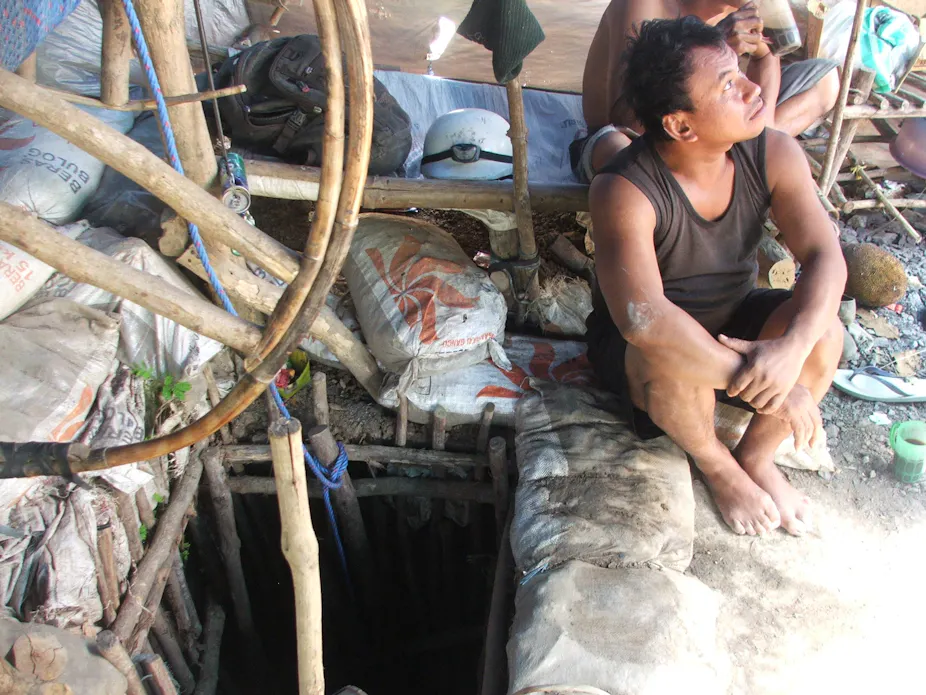
Already, too, the lower slopes of the mountain have been invaded by illegal miners, a common consequence of gold discoveries in Indonesia. These illegal mines are narrow, unstable and often constructed without effective reinforcements. Barely the width of a human body, shafts reach to depths of 50 meters. Air is fanned through a thin hose, as alluvia and rocks are excavated and passed from hand to hand along the length of the shaft. At least 20 people have died in the illegal mines of Tumpang Pitu —a measure both of the unregulated nature of Indonesian mining and the sheer desperation and poverty of the miners themselves.
Of course, the authorized mining exploration cannot be held responsible for this desperation. The mine mangers, in fact, would argue that their high-tech mining removes the risks and provides a safe and secure environment for workers. They would also argue that the negative consequences of the proposed mine are more than offset by the benefits the mine will bring to the community, the province and Indonesian nation.
Moreover, a regulated mine will conform to the high environmental and ethical standards set within Australia. The mine managers are clear on this point: Pulau Merah is far better off with an Australian mining company than a solely-owned Indonesian or Chinese company with much lower standards of corporate responsibility, community engagement and environmental protection.
And as far as it goes, this is certainly true.
Equally true, however, is the inevitability of struggle and contention between the respective claimants. In a country that is so desperate for development and with so much money at stake, these various claims are being exercised through the complex politics of information, knowledge and choice.
At the precipice of full development, Intrepid’s Indonesian partner, IMN, has recently excluded Intrepid from the mining zone. While Intrepid has invested millions of dollars in the exploration, IMN holds the land leases and is mostly responsible for government and community negotiations. In response, Intrepid has enlisted the support of Indonesian media mogul, Surya Paloh, offering him a 6 percent stake in the mine if he can marshal national and community support for the project—and for Intrepid itself.
Community violence, corporate intrigue and media warfare might seem an inevitable part of a project worth an estimated $5 billion. Inevitably, too, this venture seems destined to stir the passions of environmentalists and shareholders in both Indonesia and Australia.
Even so, if we are to avert disasters like Freeport, where the ecology was destroyed and around 800 protestors were killed, then the ultimate decisions in Pulau Merah need to be based on open communication and information sharing. Choices need to be measured against all options and consequences. Each of the parties needs to understand the ways in which their world will change through the impact of industrial scale mining. There is simply no virtue in deceit or naiveté: more than anything else, a clash of ignorance will lead directly to another mining catastrophe.
Nor indeed should outsiders control the destiny of Pulau Merah. It is not for us to deny the people of the region the material comforts and pleasures that mining has delivered throughout the history of Australia. Rather, in a global economic and political system that is predicated on the uneven distribution of pleasure and risk, the choice should replicate a democratic process by which the players make informed and accountable decisions.
Indeed, if democracy is to mean anything in modern Indonesia—and in Australia for that matter—then it must supplant a system that rewards only the powerful. Our choices, that is, must be accountable to the human and non-human lives that are most at risk.
Walking through the jungle that caps the gold and copper mountain at Pulau Merah and hearing the rustle of monkeys in the canopy, I became acutely aware of these choices. I wondered who would speak on behalf of these other lives—who would make the choices, and who would be held responsible for their consequences.