


The United Nations Environment Programme (UNEP) is co-ordinating a new venture to tackle short-lived global warming agents such as black carbon.
Should we be paying more attention to black carbon?
Yes, indeed we should, because black carbon plays complicated and multi-faceted roles in global carbon dynamics. It also poses some deep research challenges and moral conundrums.
Black carbon in the form of aerosol soot from wildfires and anthropogenic sources such as diesel exhausts is believed to be a large contributor to global warming, directly by positive radiative forcing (because it absorbs the solar radiation that is reflected by the surface-atmosphere-cloud system) and indirectly by the snow/ice albedo effect (because soot deposited on snow and sea ice darkens and enhances solar absorption by the icy surface).
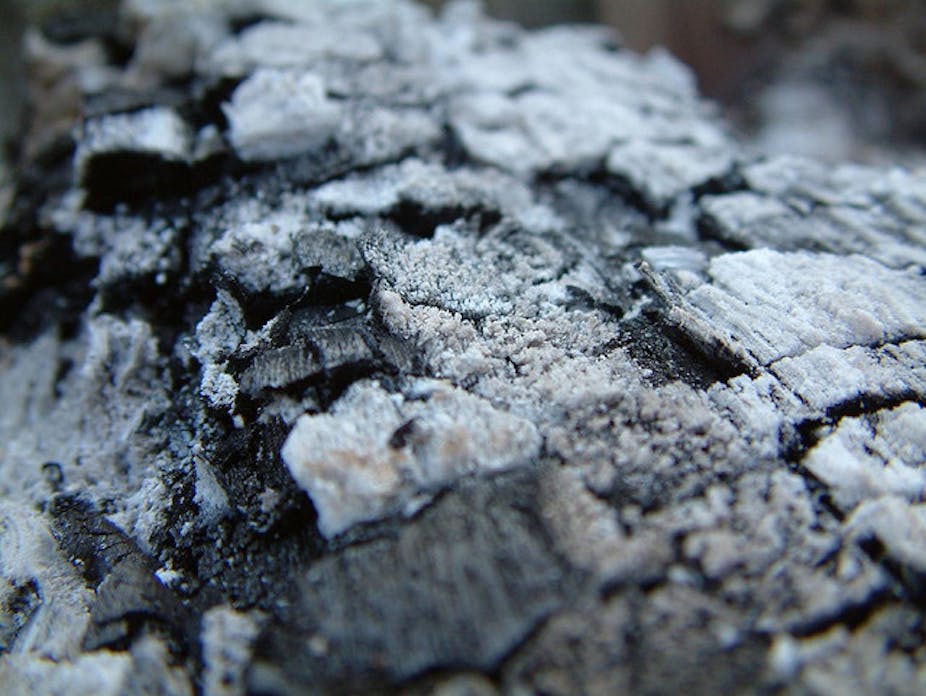
Another form of black carbon is solid charcoal. Black carbon has been made by nature for some 400 million years in open vegetation fires. During each fire event a fraction of the carbon in the vegetation is released back to the atmosphere as carbon dioxide, and a smaller fraction is transferred to the long-lived (hundreds to thousands of years) global black carbon reservoir, because fires always produce some charcoal and soot.
In fact, conversion of waste biomass to charcoal in kilns and distribution of the charcoal in soils has been advocated as a method of removing and sequestering carbon dioxide from the atmosphere.
But is charcoal really a carbon sink? It is by no means certain that the world’s black carbon reserves are not actually a net source of atmospheric carbon dioxide rather than a sink.
Charcoal can be a CO2 sink or a CO2 source
Charcoal accumulates in soils and sediments only if its rate of formation exceeds its rate of oxidation. Otherwise charcoal is a net source of atmospheric carbon dioxide, not a net sink for it.

This brings us to the first “charcoal challenge”: what are these rates? How much charcoal is produced globally from fire activity per year? We need reliable estimates for these quantities in order to determine whether human intervention to escalate charcoal production on a grand scale could backfire (as it were) disastrously as a carbon dioxide sequestration strategy.
Global carbon management strategies and geoengineering schemes involving black carbon therefore need to be based on a thorough understanding of the role of fire in regulating carbon cycles. Vegetation (including peat) fires are great movers and shapers of the terrestrial environment and significantly influence global carbon balances.
Suppressing vegetation fires reduces the rate at which carbon can accumulate in the black carbon pool and enhances the rate of return to the atmospheric carbon dioxide pool by decay, or respiration.
This introduces a second “charcoal challenge”: Is nature’s use of fire to distribute carbon between long-term black carbon and short-term atmospheric carbon dioxide pools fundamentally incompatible with humans’ need to suppress fire?
Are we prepared to have more fires?
The widespread and frequent conflagrations that create charcoal in nature are at the very least disagreeable, and often deadly, to humans. Human society – our health, aspirations, economic and cultural activity - and wildfires cannot coexist in harmonious equilibrium, so human activities tend to suppress fires.
Are, then, the human imperatives to remove carbon dioxide from the atmosphere and curb wildfires fundamentally incompatible? Have we cornered ourselves?

Regionally and in the short term human activities promote fire. In the Amazon basin human activity has promoted fire since 1970. The occurrence of forest fires in Southeast Asia is believed to have increased greatly since the 1960s. Currently prevailing socioeconomic conditions are likely to promote tropical biomass burning in the short term.
Yet charcoal accumulation studies clearly show that vegetation fires declined globally from 1 to 1750, and abruptly further after 1870, the latter reduction being due to agricultural and pastoral expansion and fire suppression in intensively farmed areas.
Human-mediated suppression of fires is likely to continue and increase globally. The widespread fires that have been used to clear tropical rainforests for the planting of crops and create settled communities with higher standards of living are a transient phenomenon. Once settled, it will be in those communities’ interests to suppress fires.
Say we want it; can we do it?
Suppose we resolve the “wicked problem” of the first charcoal challenge and determine that black carbon is indeed a global carbon sink, and suppose we come to some sort of accommodation with the second charcoal challenge, we are then faced with a third.
Is it possible to produce and distribute enough charcoal, over and above that produced by nature, safely and without otherwise adding to environmental problems, to significantly lower atmospheric carbon dioxide levels in a time frame compatible with human responses to climate change?

Some authors see a realistic potential for charcoal production to remove about 1 Gt (109 tonnes) of carbon dioxide per year from the atmosphere. Terrestrial biomass is produced at a rate of about 120 Gt per year. The carbon content of dry vegetation is about 50% by mass, that of charcoal is about 80%. Charcoal conversion efficiencies range from about 30% for kilns to about 1 to 10% when produced by open vegetation fires. A back-of-envelope calculation finds we would need rates of vegetation thermoconversion ranging from about 2.3 Gt per year (for making charcoal in kilns) to 6.8-68 Gt/year (open vegetation fires).
Can we subject about 2–6% of the terrestrial biomass per year to charcoal-producing thermal treatment, in kilns and/or by managing open vegetation fires to promote charcoal formation? Should we? And, to go back to where we started, what are the effects of changing fire management regimes on aerosol soot levels?