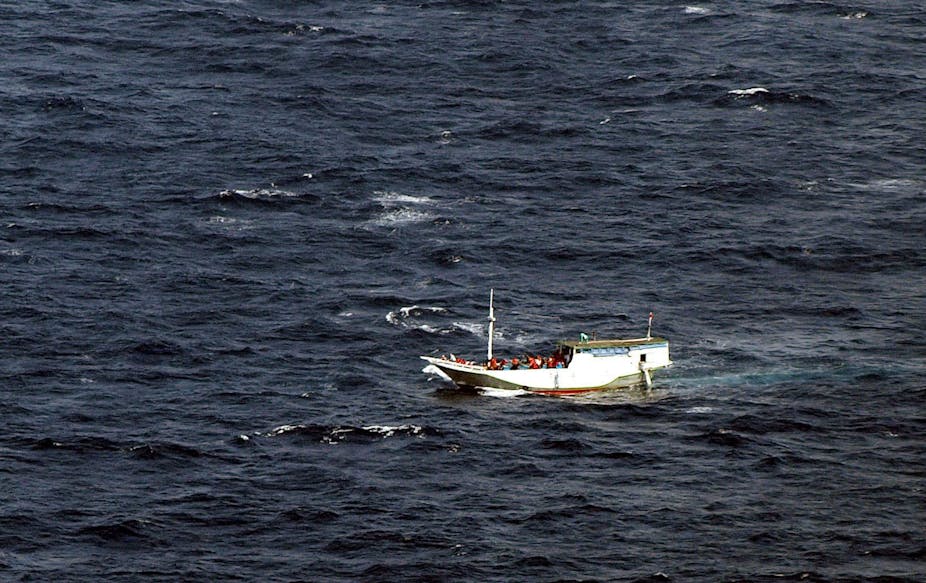
The Conversation has brought together a team of six academic experts to tackle one of the thorniest issues in Australian politics – asylum seeker deaths at sea.
Over the next few weeks, they’ll be examining the research evidence to address the Houston panel’s terms of reference, and provide workable policy recommendations for the public and the government to consider.
Their discussions and policy proposals will be public, and published on our group blog (and of course reader comments are welcome). Stay tuned.

Sharon Pickering
Professor Sharon Pickering researches irregular border crossing and has written in the areas of refugees and trafficking with a focus on gender and human rights.
She currently leads a series of ARC projects focusing on the intersections of security and migration. She has previously worked in Northern Ireland, on counter-terrorism policing, and human rights and women in South East Asia. She is currently head of the Criminology program at Monash University and is the Editor of the Australian and New Zealand Journal of Criminology. She has recently taken up an ARC Future Fellowship on Border Policing and Security.
Savtri Taylor

Dr Savitri Taylor is an Associate Professor in the Law School at La Trobe University and presently the School’s Director of Research.
Her research over the past 20 years has focused on refugee law and asylum policy at the national, regional and international level.
Her most recently completed research project, an ARC Linkage Project conducted with Professor Sandra Gifford, in partnership with Oxfam Australia and Jesuit Refugee Service Australia, looked at the impact of Australia’s border control cooperation with Indonesia and PNG on the human rights of asylum seekers and host communities in those two countries.
Stephen Castles

Stephen Castles is a Research Professor of Sociology at the University of Sydney and a Research Associate of the International Migration Institute (IMI), University of Oxford.
He is a sociologist and political economist, and works on international migration dynamics, global governance, migration and development, and regional migration trends in Africa, Asia and Europe.
His current research project “Social Transformation and International Migration in the 21st Century” is concerned with the way global forces interact with local factors to shape human mobility. It involves fieldwork in Australia, Turkey, South Korea and Mexico.
From 2001-2006, Stephen Castles was Director of the Refugee Studies Centre at Oxford University. He has been an advisor to the Australian and British Governments, and has worked for the International Labour Organization, the International Organization M, the European Union and other international bodies.
Sandy Gifford

Sandy Gifford is Professor of Anthropology and Refugee Studies at the Swinburne Institute for Social Research. She was the previous founding director of the La Trobe Refugee Research Centre – La Trobe University.
Her background is in medical anthropology and her research has addressed ethnicity, migration, settlement and health in Australia. Her current research focuses on settlement, wellbeing, policy and practice among recently arrived humanitarian migrants in Australia with a particular focus on young people.
She has expertise in ethnographic longitudinal studies using a mix of methods from standardized surveys and in-depth interviewing to digital media, film and participatory art based methods.
Melissa Phillips

Melissa has more than 10 years’ experience working with refugees and asylum-seekers in Australia, the United Kingdom and South Sudan. She has managed a humanitarian resettlement program (for refugees arriving under the offshore program), worked with Red Cross’ International Tracing and Refugee Services Section, and has also worked at Villawood Immigration Detention Centre.
Melissa has worked for the Refugee Council of Australia and was a board member of the Board of the Refugee Advice and Casework Service (RACS – NSW).
In 2005, Melissa was seconded to the United Nations Office for the Coordination of Humanitarian Affairs (UNOCHA) in South Sudan; she lived in the capital Juba up to 2009 working with UN and later in an NGO coordination role.
Helen Ware

Helen Ware is Professor of Peace Studies at the University of New England. She was formerly Director of Research for the Australian Human Rights Commission. Her training is in demography.
She has acted as an AUSAid educational advisor on the Pacific and Asia, as the Australian High Commissioner in Zambia and within the Australian Human Rights Commission and the Office for the Status of Women within the Department of Prime Minister and Cabinet.
Helen has many years of policy experience as senior bureaucrat working in the fields of human rights, development, education and international affairs.
Do you have any questions for our panel? Leave a comment below.
John Coochey
Mr
Of the many millions of refugees and others seeking a better life in the world how many should Australia take and how should they be selected?
Marilyn Shepherd
pensioner
Why do you incessantly whinge about things we have no control over? We can select a few thousand refugees as migrants but we cannot decide how many people seek asylum because everyone is allowed to seek asylum.
John Coochey
Mr
I fail to see how asking the key question succinctly is whingeing. We do or should have control over our own borders and we can certainly control who is given residence in Australia. Anyone can ask for asylum as anyone can ask you for the deeds to your house but you do not have to give it to them. International conventions extend only to those seeking safety from a clear and present danger, they do not give anyone the right to swan around the world to get the best deal they can.
Michael Silverton
logged in via Facebook
According to Tony Abbot refugees in Malaysia face a clear and present danger of caning. Refugees in Indonesia face dangers of being maltreated in detention centres. Where is this half way house where refugees are safe?
John Coochey
Mr
If that is the case why do they go there? They are not pouring across the border from Thailand or Singapore. Is there situation any worse than millions of peasants in India which could face starvation the next time crops fail? Once again how many should we accept and which ones and how many will be adopted by advocates a la Australian Story?
Michael Silverton
logged in via Facebook
They go there because they have nowhere else to go. Frankly I think (assuming we are not prepared to accept all comers) that the Malaysian solution is about the best alternative we have. I was trying to point out the illogicality of Abbots position.
If you think a hazara in Afghanistan is in no more danger than a poor peasant in India then I have to disagree.
John Coochey
Mr
Have you ever been to Afghanistan or India and if not how can you disagree?
Steve Hindle
logged in via email @bigpond.com
You ask a very valid question.
Unfortunately it has become standard procedure to be attacked for asking this question.
Comment removed by moderator.
Sue Sturgess
logged in via Facebook
Julia's "Malaysian Solution", only dealt with the first 800. We are currently getting more than that per month. What happens from 801 onwards???
Sue Sturgess
logged in via Facebook
The issue is, no-one hops on a boat in a landlocked country like Afghanistan. The Afghan asylum seekers pass through multiple safe countries along the way, and are completely safe in Indonesia - they want Australia because of our welfare system, not because of safety.
Michael Silverton
logged in via Facebook
If Australia did accept all the genuine refugees who reach Malaysia and Indonesia how many would we end up taking? Presumably the number reaching those two countries would increase if we were to adopt such a policy.
Philip Dowling
IT teacher
This would surely be added to by Malaysians who work in Captain Emad's shops.
Gary Murphy
Independent Thinker
Is there a case for setting up designated refugee camps in Malaysia / Indonesia so that their living conditions could be improved.
I found this link on another article about refugee living conditions in Malaysia:
http://repository.forcedmigration.org/show_metadata.jsp?pid=fmo:5596
Max Hardy
logged in via Twitter
An impressive panel, but are they the only experts we need? Check this piece by Stuart Waters who raises some very interesting ideas. http://www.twyfords.com.au/news-and-media/our-blog/new-thinking-in-engagement-the-key-to-an-enduring-refugee-solution
Shirley Birney
retiree
Hunt down the estimated >50000 overstayers who are collecting the "black," evading tax obligations and depriving other Australians of employment.
John Coochey
Mr
Actually Immigration attempts to do that but the two actions are not mutually exclusive. One issue on which I have pondered is how long does one keep refugee status. If someone arrived from the US saying they had originally fled nazi Germany and there was no rising anti semitism (sic) in the US should we process their application?
Philip Dowling
IT teacher
The visa overstayers certainly underpay tax, but they do pay GST for most purchases.
Many work in jobs that Australians don't want.
They certainly aren't a burden on Australian taxpayers as refugees are, many of whom are unemployed for years after arrival.
I suggest that this comment is used as useful as the standard red herring argument that is so frequently trotted out without any analysis.
Shirley Birney
retiree
Unless you collude with visa overstayers, you would not know where these people work (or live). Therefore it is presumptuous to imply that offenders work only where Australians will not.
These people are essentially free riders (someone who uses a public resource without paying for it at the expense of everyone else). Overstayers who work in this country, their employers or contractors are knowingly violating immigration and taxation laws which your ethics-free opinion obviously regards as acceptable.
Locating and removing overstayers in breach of their visa conditions from Australia costs the taxpayer millions of dollars each year.
Philip Dowling
IT teacher
Thank you for your response.
Most employers' ads explicitly state that visas are checked before permanent employment is granted.
I would have expected you to know that prostitution does not normally require visas.
Shirley Birney
retiree
1) DIAC: Fact Sheet 86 – Overstayers and Other Unlawful Non-citizens:
“Long-term overstayers become neighbours, friends, colleagues, employees and even relatives of lawful Australian residents, some of whom might not be aware of their unlawful status.
"Unlawful non-citizens have no entitlement to remain in Australia and are expected to depart. Where unlawful non-citizens refuse to leave Australia voluntarily, they may be detained and removed from Australia at the earliest practicable opportunity…
Read moreJohn Coochey
Mr
And your point is precisely? The issue is supposed to be deaths at sea, I wonder when some of the expert panel is going to enter the discussion?
Philip Dowling
IT teacher
Thank you for the references. I have seen this kind of data being endlessly spruiked before.
Read moreMay I draw your attention to the following.
"The countries with the highest visitor overstay rate (overstayers from a particular country as a proportion of the total visitors from that country) differ substantially from the main source countries (see table 5.38). At June 2000, for visaed visitors from the two main source countries, Japan and the United Kingdom, the overstay rates were close to zero."
http…
Shirley Birney
retiree
A quick perusal of all thirty posts on this thread reveal there are precisely zero comments about "deaths at sea." That also includes your contributions to this article . And your point is precisely?
John Coochey
Mr
I think you should learn to read because that has been much of my point. If people did not leave for Australia there would be no "deaths at sea", or at least non of public note e.g crab vessels of Alaska or ferries in the Phiipines ( I cannot e bothered to spell check that). There has however been a significant change in boar arrivals to Australia with at least one commentator suggesting if you added arrival under a successful policy with those of an unsuccessful one and the averaged them you had a meaningful statistic. I think the answer obvious.
Shirley Birney
retiree
I repeat, none of the points you have raised have alluded to, or are relevant to "deaths at sea," not on this thread or elsewhere:
John Coochey :
06 Jul 2012 7:43:34am:
"There are tens of millions of genuine refugees in the world and many more on the margin who would like to come to Australia. How many do we accept and which ones?"
John Coochey :
05 Jul 2012 5:25:44pm:
"Let us get one thing straight, Australia has no responsibility to save lives at sea willy nilly. If a fishing boat…
Read moreShirley Birney
retiree
Providing statistics for the year 2000 and the scribblings of a blogger from the UK (which has an estimated 150,000 overstayers) is an illicit process in patterns of argument - a smelly red herring which has no bearing on Australia’s officially documented statistics for the years 2011/2012 including the est. 58,400 overstayers currently residing in Australia.
Peter Dowling = Straw Man Extraordinaire.
Insanity: doing the same thing over and over again and expecting different results (Albert Einstein).
John Coochey
Mr
It is actually very simple. If people do not get on boats they will not drown should they sink. Given that people are now aware that getting on a boat gives you a good chance to get residency in a developed country. If a certain number are flown here at taxpayers expense there will still be millions left who would still like to live here and they will then look for boats and people smugglers. That is of course unless Australia puts no limits on numbers which leads back to my original question how many refugees do we take and which ones? It is Indonesia with three times the naval ships than Australia has responsibility for rescues in its own maritime area not Australia. But then of course the boats and their passengers would not be brought to Australia.
Tony P Grant
Neo-Mort
Add to that "tax evading force" local trades and services that never offer a receipt...that's where the "real money " is not the working for $5 an hour to these "criminals"?
Philip Dowling
IT teacher
I am always puzzled as to the resources and focus that is put on people claiming refugee status that land in Australia.
If one takes a global view then to me it always seems a curious use of resources.
The asylum seeker industry seems curiously focused on predominantly wealthy, young men, and to encourage this demographic.
Would it not be more appropriate to focus resources on camps in countries of first entry, and to educate as many as possible there, and to allow those at most risk and who could benefit most to then move to Australia.
Could the experts comment on the morality of self-selection.
John Coochey
Mr
I thought it might be useful to put some fact on the table as issues about asylum seekers seem to often avoid them. I copied these from Gerard Henderson's column. I have not checked them but have no reason to doubt their veracity.
Boat Arrivals Since 2000 By Calendar Year
Year Number of Boats Number of people
2001 43 5516
2002 1 1
2003 1 53
2004 1 15
2005 4 11
2006 6 60
2007 5 148
2008 7 161
Year Number of Boats Crew Number of people excludes crew
2009 60 141 2726
2010 134 345 6555
2011 69 168 4565
2012(to 9.7.12) 75 138 5459
So, do the like of Burnside and Bongiorno take any responsibility for the implementation of a policy which had the unin
Philip Dowling
IT teacher
Burnside is merely an advocate, whose arguments are plausible but not balanced.
John Coochey
Mr
The issue is the statistics, they originated from the Parliamentary Research Service if you believe them incorrect say so and provide alternatives, preferably not some internet address which is actually irrelevant which seems to happen a lot on this blog.
Philip Dowling
IT teacher
John, I think that you missed my point. Julian is just another mouth for hire - or perhaps I should clarify that he is an expensive voice for hire.
Poor Julian has previously demonstrated that he has some difficulty in reading the fine print in legal documents such as in the Terms Of service of twitter, just as another prominent person with legal training confused tenant with tenet on national TV. Of course, they may still suggest that they continue to be naive.
Steve Hindle
logged in via email @bigpond.com
There is a disconnect between experts and the general public.
Experts often talk about law, conventions, and our moral obligations, often in very abstract ways.
The general public seem to be worried about numbers. How many will come?
It does not help that the Australian Government has lost control over who enters the country, something that many refugee advocates never predicted as the "Pacific solution" was dismantled. This has made many Australians quite cynical about the advice of experts…
Read moreJohn Coochey
Mr
I think you have touched on a critical point in that is there such a thing as an expert in this field? I remember Ian Chubb when VC of the ANU complaining a local member would not support his demand for compulsory student unionism. he complained "Why will people not listen to the experts?" I had a letter published in the Canberra Times pointing out that he was not a member of the organizations he wanted to extort money for despite a reported salary of $1.6 million that year and why was he more of an expert on how I should spend my money than I was? I never got a response. What field of expertise can tell us how many refugees we should take, what is a refugee and how long they retain the status and privileges of being a refugee. Answer I think is none!
Dalit Prawasi
logged in via Facebook
True refugees in Australia are the people who occupied this land mass for more than 40k years.
They have no place to go and they are the most disadvantaged people on this planet like the Inuits and Red Indians etc.
The refugee conventions and laws etc are very old hat and out of date.
Some groups are exploiting these so called 'humanitarian" laws and practices with the help of powerful institutions (include governments and their intelligence services) for their own objectives.
There…
Read moreDalit Prawasi
Auditor, Accountant, Trade Teacher
True refugees in Australia are the people who lived here for more than 40k and they are the most disadvantaged people on the planet like similar people in Canada and US etc. Unfortunately they have nowhere to go to seek refuge or asylum.
Read moreThere are millions of refugees in the world who are much worse off than the ones who land here dead or alive. They are rotting away in places like Africa, South America and Asia.
We should not favour those who land here just because they are the ones we see, hear…
Sue Sturgess
logged in via Facebook
I think the big issue with the so-called asylum seekers is that most board the boats in Indonesia. Once they have reached Indonesia, they are quite safe and are no longer in danger of the persecution they might have suffered in their home countries. also, for the muslim asylum seekers, Indonesia is a much better religious and cultural fit than Australia. A female muslim counsellor said it all on SBS's Insight one night, in saying... "but Australia has the wonderful Centrelink who pays for everybody". Their reasons for coming here are strictly financial, else they would apply through proper channels, and not destroy their papers.
Dalit Prawasi
Auditor, Accountant, Trade Teacher
COMMENT TO A PANELIST POST ELSEWHWRE
"Refugee arrival trends across the decades from Indo-China in the 1970s, the former Yugoslavia in the 1990s, to Afghanistan and Sri Lanka today, reflect contemporary crises. We can no sooner predict where the next group of refugees will emerge from than we can their demographic profile.”
The writer is either not aware or is stating a blatant lie. The so called refugees from Sri Lanka are not just arrivals of today.
Read moreThis takes me back almost thirty years…
John Coochey
Mr
It appears any argument about whether the boats can be turned back is now over with the promise of joint Indonesian - Australian patrols http://www.theaustralian.com.au/national-affairs/politics-news/jakarta-agrees-to-joint-patrols-for-asylum-boats/story-fn59nqld-1226433393250
What would be the purpose of sabotaging or scuttling your craft if you are going to be picked up by an Indonesian vessel and taken back to Indonesia?
The problem of asylum seeker deaths at sea is about to be solved without any academic input at all!
Chris Baulman
logged in via Twitter
Asylum seeker policy is really about protecting our comforts, not their safety, right? So how could a more open approach improve our comfort & their safety?
I don’t believe the line that this is about breaking people smugglers or safety of asylum seekers. As clark&dawe said on ABC TV 7.30 first of all, we could "Send safe boats to pick them up!". But this is really about our fear for our comfort, not their safety, right?
Any "SOLUTION" will need to recognise that as a political reality but…
Read moreJohn Coochey
Mr
I think your comment has been overtaken by events in that it appears Indonesia will now be more active in patrolling. No point in putting to sea to be taken into custody by a ship which will take you back where you started from. No more passengers therefore no more drownings. Australia can then decide, as a nation, how many it will take and which ones. Those with strong views on refugees as opposed to other unfortunates, will be free to lobby decision makers .
John Coochey
Mr
An interesting development in that an asylum seeker boar has been in contact with the Australian Marine Safety Authority saying its engine is broken and it is taking in water. It is to the North West of Bali, which means to the North of the Indonesian Archipelago http://www.abc.net.au/news/2012-07-26/asylum-boat-in-distress-off-bali/4155326
"AMSA told Indonesian rescue authorities, but they failed to find it and called off the search overnight, saying they were ill-equipped to deal with the situation
"
Charles Pragnell
Freelance Social Commentator
From the backgrounds of this `Expert' Panel, it appears to be extremely heavily weighted towards sympathisers with the rights of asylum seekers and not with those who can examine the impact on Australian society of unrestricted and unlimited immigration.
It is long overdue that this issue is looked at from an Australian viewpoint.
Firstly, world history and current events around the world demonstrate that multi-ethnic groups occupying the same country/territory inevitably results in social…
Read morePamela Curr
campaign coordinator
Just a gentle reminder that i and thousands of other Australians have been overstayers as we travelled the world working here and there. It is somewhat hypocritical to attack overstayers with vehemence when young Australians (many of us were young once) have been doing the same.
That said this issue is a red herring to the discussion at hand.
So toxic and polarised have many Australian attitudes become towards asylum seekers arriving by boat that the minute the discussion starts there is an…
Read moreCharles Pragnell
Freelance Social Commentator
Pamela Curr - "Why do we think we are so special that we should not be expected to open our doors and take our share ? ".
Read moreI would venture to suggest that Australians have a number of concerns regarding the current situation and which are not being addressed.
Firstly, those who apply for legitimate immigration to Australia have to undergo very stringent tests before being accepted including health examinations for diseases (e.g. HIV/AIDS etc), Criminal revords, and possible Terrorist activities…
Pamela Curr
campaign coordinator
To those who worry about asylum seekers bringing in disease. Every year 14 million plus tourists come into Australia without health checks. The movement of people is a fact of life. Asylum seekers are no more likely than tourists to have communicable diseases less likely in the case of some diseases such as AIDS which have not afflicted all countries equally.
Read moreOn arrival asylum seekers by boat have a medical check before they are released into the community. People coming by air don't have checks…
forman ullah
self employed
Dear Sir,i have an irrelevant question.I am married with Jinat Afroza through our personal choice.Her father has not recognized it.Her father is powerful and thana aamir(president) of Bangladesh-Jamaat-Islami ,Satkania thana,Chittagong district,Bangladesh.They attacked me two to three times to kill me.Now i and my wife want to live.Our country is not safe at all for us.How we can find a better way to live?Sir please suggest me.Now we are in Bangladesh.