In November 2001, Doha hosted trade talks over intellectual property and public health. The discussions resulted in the landmark Doha Declaration on the TRIPS Agreement and Public Health. The Doha Declaration recognised “that the TRIPS Agreement does not and should not prevent members from taking measures to protect public health” – particularly in relation to HIV/AIDS, tuberculosis, malaria and other epidemics.
More than a decade on, in December 2012, Doha hosted the international climate talks for parties to the United Nations Framework Convention on Climate Change 1992 and the Kyoto Protocol 1997. There was, once again, a contentious debate over intellectual property – this time in relation to clean technologies. The Climate Action Network argued that there should be a Declaration on Intellectual Property and Climate Change to facilitate the “rapid and efficient uptake of technologies to address mitigation and adaptation”.
Disappointingly, the 2012 Doha Climate talks resulted in no declaration or agreement on intellectual property and clean technologies. Indeed, the discussions on intellectual property were deadlocked. There was instead a cluster of decisions known as the Doha Climate Gateway.
While such decisions did not address intellectual property or open innovation, the Doha Climate Gateway selected the United Nations Environment Programme to host the UNFCCC Climate Technology Centre.
Intellectual property and clean technologies
In the debate over the Doha climate talks, there was division over whether there should be text in respect of intellectual property and clean technologies.
China said, “We’re not going to request technology transfer free of charge. We certainly respect intellectual property rights.”
South Africa argued the talks should address “questions of equitable access to sustainable development, intellectual property rights and unilateral trade measures.”
The Philippines requested that the Technology Executive Committee consider issues “related to intellectual property rights as they arise in the development and transfer of technologies.” The country was particularly concerned about the need to address climate emergencies.
The Progressive Latin Americans – such as Venezuela – mooted text on a wide range of co-operative measures on intellectual property and climate change.
A green intellectual property exchange?
There was also significant discussion of co-operative models for facilitating open access to clean technologies.
In their book MacroWikinomics, Don Tapscott and Anthony Williams have called for the establishment of a green technology commons, sharing humanity’s knowledge of sustainable technologies.
The Creative Commons – celebrating its 10th birthday – has established the GreenXChange.
The Climate Action Network has proposed building on such a model, and establishing an intellectual property exchange to “enable secure, efficient and transparent arms-length transactions for intellectual property licensing”.
India put forward compromise text on intellectual property and climate change. India’s lead negotiator, Mira Mehrishi, called for a fund to enable access to clean technologies with intellectual property rights. Mehrishi commented: “If we don’t get cheap technology we will never be able to adapt to climate change."
However, developed countries rebuffed such compromises.
Intellectual property, piracy and climate change
As noted by attendee Michael Mazengarb, developed countries said there should be strong enforcement of intellectual property to encourage investment in clean technologies.
The United States and the European Union insisted that the Doha Climate Gateway should be silent on intellectual property. Other developed countries argued that other forums – such as the World Trade Organization and the World Intellectual Property Organization – would be better placed to address intellectual property and climate change.
It is striking that, while intellectual property was a taboo subject in the Doha climate talks, the United States simultaneously pressed for an expansionist chapter on intellectual property in the Auckland talks on the Trans-Pacific Partnership.
Indeed, the Edison Electric Institute – which represented United States energy companies in climate discussions – promoted the controversial Trans-Pacific Partnership as a preferable model where “global innovation is maximized” and “intellectual property rights are adequately protected”.
The Climate Technology Centre
The Copenhagen Accord 2009, the Cancun Decisions 2010, and the Durban Platform 2011 established the foundations of a technology mechanism – a UNFCCC Climate Technology Centre and Network.
In the lead up to the Doha negotiations, the Technology Executive Committee asked for greater clarity about the Climate Technology Centre’s role in matters of intellectual property.
The topic was discussed during the climate talks in Durban. Draft text on December 7, 2012 alluded to intellectual property, suggesting the Technology Executive Committee should be “examining effective mechanisms that promote access to affordable environmentally sound technologies, reward innovators and increase the dynamic of global innovation”. However, even such euphemistic language was erased in the end.
One of the key positive decisions of the Doha climate talks was the selection of the United Nations Environment Programme (UNEP) to host the UNFCCC Climate Technology Centre for an initial term of five years.
UNEP had put together a collaborative bid. The United Nations Industrial Development Organization (UNIDO) will be a co-manager. The partners of the consortium included research and scientific organisations in Thailand, India, Argentina, Costa Rica, Kenya, Germany, the Netherlands, Denmark, and the United States.
India will play a key role. The United States partner is the National Renewable Energy Laboratory – an innovator on a wide range of clean technologies.
The UNEP emphasized in its bid: “We will be driven by country needs, recognizing as well that weak institutions are often a barrier to the transfer of technologies and that developing the capabilities of developing countries is critical.”
The Executive Secretary of the UN Framework Convention on Climate Change, Christiana Figueres, was optimistic:
The world has the money and technology to stay below two degrees. After Doha, it is a matter of scale, speed, determination and sticking to the timetable.
Tim Scanlon
Debunker
Did anyone else laugh when they read this?
China said, “We’re not going to request technology transfer free of charge. We certainly respect intellectual property rights.”
Grant Burfield
Dr
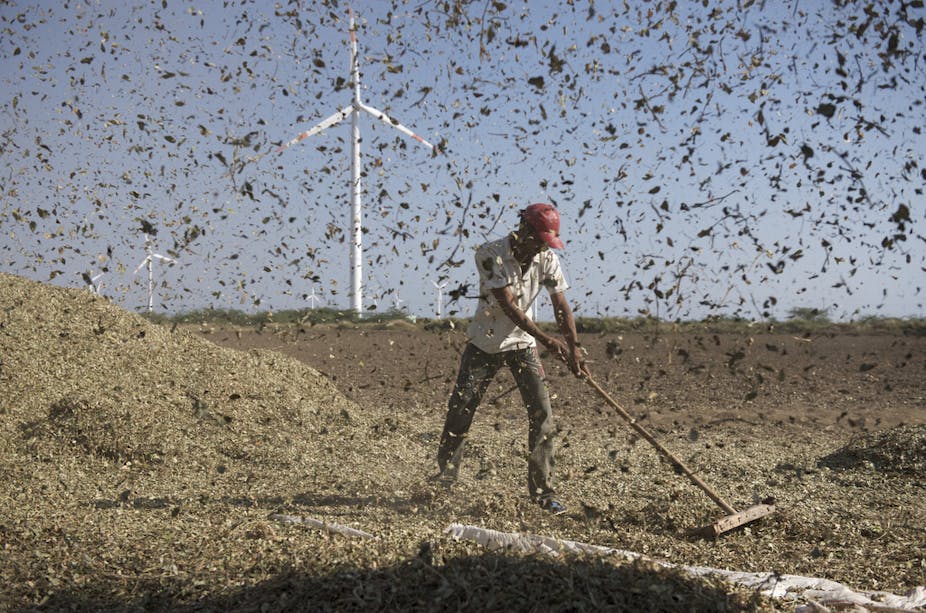
A workman fights a losing battle sweeping up raptor bits and pieces as they fall from an ever darkening sky as the blades turn now and then.
Peter Lang
Retired geologist and engineer
Doha deadlock is just one more in a long line of strong indications that the Climate Change agenda pushed by the UN, the environmental NGOs, Left governments and climate scientists is the wrong approach. It is dead wrong. It’s been clear that it’s wrong for 20 years. Why can’t they see that it is a wrong approach?
Penalty schemes don’t work. People respond best to reward schemes. Here is a list of bad policies and good policies (i.e. what we should be doing instead, IMO):
Bad policies…
Read morePeter Lang
Retired geologist and engineer
I believe this statement is correct and must be strongly supported:
“developed countries said there should be strong enforcement of intellectual property to encourage investment in clean technologies.”
What investors will put up investment risk capital if there is a high risk the product they want to develop will be stolen.
Atomic Energy Canada Limited (AECL) developed the ‘SlowPoke” small nuclear power plant (for remote communities). China stole the design and commercialised it. AECL…
Read moreMatthew Rimmer
ARC Future Fellow and Associate Professor in Intellectual Property at Australian National University
It is worth noting the diversity of intellectual property measures that were debated in the Doha Climate Talks.
Venezuela's submission is indicative: http://unfccc.int/files/bodies/application/pdf/venezuela_tt_ipr_040912.pdf. The Latin American country argued that the Parties should cooperate to undertake a range of measures including to:
a) Create a global pool of goods and technologies to promote mitigation and adaptation to climate change; in which intellectual property right owners of climate…
Read morePeter Lang
Retired geologist and engineer
"Create a global pool of goods and technologies to promote mitigation and adaptation to climate change; in which intellectual property right owners of climate technologies are required to make their intellectual property as well as know-how available to developing countries;"
Wow! This scares me to death. It looks to me like they are looking for a free lunch. Who pays? Do they expect the innovators to work for free?
This looks like arguing for communism. Have I misunderstood? Is this what it is really about?
Gerard Dean
Managing Director
Is that the same Venezuela that I know.
The Venezuela that has squandered billions of dollars of oil revenue through corruption and mismanagement.
The Venezuela that has appropriated the property of foreign companies and individuals.
The Venezuela that has crushed the aspirations of the hard working middle class by appropriating property and extorting
The Venezuela that bans media that dares question the government.
The Venezuela that ignores its own constitution and bullies and threatens its own citizens who dare to speak out.
Because, if it is the same Venezuela that I am thinking of, why in the hell would you take any notice of what they say at all.
Gerard Dean
Matthew Rimmer
ARC Future Fellow and Associate Professor in Intellectual Property at Australian National University
Patent pools have generally developed in market economies. So it would be incorrect to claim that patent pools are somehow an argument for communism. Patent pools have a long and rich history: http://www.cptech.org/cm/patentpool.html. A historical example is the Motion Pictures Patent Pool. A more recent example is the Medicines Patent Pool http://www.medicinespatentpool.org/ The Eco-Patent Commons is a clean tech venture: http://www.wbcsd.org/work-program/capacity-building/eco-patent-commons.aspx Patent pools usually involve voluntary, co-operative licensing.
Matthew Rimmer
ARC Future Fellow and Associate Professor in Intellectual Property at Australian National University
Gerard Dean, your post is off-topic and unrelated to the article.
Peter Lang
Retired geologist and engineer
Matthew Rimmer,
Your comments avoids the point. My questions refer to this statement of yours:
"in which intellectual property right owners of climate technologies are required to make their intellectual property as well as know-how available to developing countries;"
My questions asked:
"Wow! This scares me to death. It looks to me like they are looking for a free lunch. Who pays? Do they expect the innovators to work for free?
This looks like arguing for communism. Have I misunderstood? Is this what it is really about?"
The fact you haven't dealt with the real issue of who pays suggests to me you don't understand the real world of business and investment.
If you want progress, people advocating scheme s and policies really do need to come to grips with the requirements of the commercial world. Otherwise we'll waste another 20 years being blocked by totally unacceptable policies pushed by so called 'Progressives'.
Comment removed by moderator.
Gary Goland
Gary Goland is a Friend of The Conversation.
Researcher
An inspiring article Mathew. A classic picture of the industrial turbines creating bedlam on the ground, making the efforts of those who try to clean the fallout from out “growth at all cost” culture, an impossible task. A further hidden part of this picture is the death of other species and health impact of the giants.
Read moreWonderful comments all. Peter I love your reference to the essence of our market based system as reliant on benefits, in whatever way they can be gained, and relating that the…
Gary Goland
Gary Goland is a Friend of The Conversation.
Researcher
Gentlemen, accepting the thrust of invention and development for reward in our free world, I question the right to take unreasonable benefit, and forever. Dare I suggest the winner of development change that can contain greater risk to the planet, than has been, ought not be able to take the world for their benefit. “Progress” on our planet inevitably needs to be about the development of a safer and more sustainable planet that identifies the rights of all species on it. Peter I question your…
Read moreMatthew Rimmer
ARC Future Fellow and Associate Professor in Intellectual Property at Australian National University
Christiana Figueres: Global deal on climate complex but possible
http://www.rtcc.org/figueres-time-to-ditch-the-politics-of-blame-and-size-opportunity/
"We need maximum effort from everyone.
We need to move beyond the zero-sum mentality to cooperative action in pursuit of an urgent shared objective. We need mutually reinforcing efforts to accelerate the momentum toward a low emission economy. Together we can migrate from the politics of blame to the politics of opportunity.
The 2015 agreement…
Read morePeter Lang
Retired geologist and engineer
Matthew Rimmer,
If you think you can do it by regulation, forget it. Surely 20 years of failed UN conferences should have made that absolutely clear by now.
If we make robust decisions, we can deal with the GHG issue, and others as well. So why don’t we put our effort into robust decision analysis (http://econ.worldbank.org/external/default/main?pagePK=64165259&theSitePK=469382&piPK=64165421&menuPK=64166093&entityID=000158349_20120906142854)?
What would a robust policy response give us…
Read moreMatthew Rimmer
ARC Future Fellow and Associate Professor in Intellectual Property at Australian National University
John Vidal: Bangladesh's climate compensation push a ray of light after dismal Doha
Vulnerable countries including Bangladesh played a role in getting agreement at Doha on help for victims of climate change
http://www.guardian.co.uk/global-development/poverty-matters/2012/dec/12/bangladesh-climate-compensation-doha?CMP=twt_gu
"One landmark agreement changes all future climate politics and takes countries into a new era. Countries agreed to the principle of "loss and damage", to help victims…
Read moreMatthew Rimmer
ARC Future Fellow and Associate Professor in Intellectual Property at Australian National University
Michael Mazengarb, Piracy to Solve Climate Change?
http://www.theverb.org/piracy-to-solve-climate-change/
"The current negotiations have the potential to build a strong foundation for improving access to clean technology in developing countries. For success to be achieved, it will require concessions from both sides. Patent rich countries should acknowledge that their technologies have an importance that reaches beyond trade concerns. Likewise, governments turning a blind eye, or worse encouraging…
Read moreMatthew Rimmer
ARC Future Fellow and Associate Professor in Intellectual Property at Australian National University
Subpatentable, Unpatentable, and other Overlooked Problems in Access to Clean Technologies
Colleen Chien on Green Patents
http://t.co/yvoBdX28
Matthew Rimmer
ARC Future Fellow and Associate Professor in Intellectual Property at Australian National University
Reactions to COP18′s Doha Gateway: “Open to irreversible climate change, shut to equity”
Chris Lang
http://www.redd-monitor.org/2012/12/11/reactions-to-cop18s-doha-gateway-open-to-irreversible-climate-change-shut-to-equity/
Matthew Rimmer
ARC Future Fellow and Associate Professor in Intellectual Property at Australian National University
UN Climate Change Negotiations 2012: India satisfied at negotiations; manages to retrieve key issues it lost in Copenhagen & Durban
http://articles.economictimes.indiatimes.com/2012-12-11/news/35749510_1_key-issues-intellectual-property-rights-indian-negotiator
India's lead negotiator Mira Mehrishi said, "Mr President, you have presented us a package. We are not happy with all parts. Some are extremely problematic for us. Many of our issues have not been addressed...The unilateral measures have…
Read moreMatthew Rimmer
ARC Future Fellow and Associate Professor in Intellectual Property at Australian National University
Why the Doha climate conference was a success
Connie Hedegaard
http://www.guardian.co.uk/environment/2012/dec/14/doha-climate-conference-success
"True, Doha was not fantastic, but we did make progress towards the 2015 deal. Of course, it's not difficult to be frustrated with the slow pace and the low common denominator of international negotiations. But does it mean that we should give up? Can the world afford that? Where would the dialogue continue?
Although frustration is a renewable source, it does not reduce emissions. To overcome frustration, one must remain intensely focused on the final goal that all parties have signed up a global climate deal by 2015. Doha took the first steps."
Matthew Rimmer
ARC Future Fellow and Associate Professor in Intellectual Property at Australian National University
Human Climate Link Firms
Ben Cubby and Tom Arup
"EVIDENCE for climate change has grown stronger and it is now ''virtually certain'' that human greenhouse gas emissions trap energy that warms the planet, according to a leaked draft of the next major Intergovernmental Panel on Climate Change report.
Prepared on behalf of the United Nations every five or six years to summarise climate change research, the panel report draws on hundreds of peer-reviewed papers.
Compared with the previous report in 2007, the draft expresses even more confidence that changes being observed across the planet are ''significant, unusual or unprecedented'' on historic time scales.
It says carbon dioxide is the biggest cause of climate change, far outweighing natural causes. The concentration of atmospheric carbon dioxide is the highest in 800,000 years."
Read more: http://www.theage.com.au/environment/human-climate-link-firms-20121214-2bfdi.html#ixzz2F4rBy8Ji