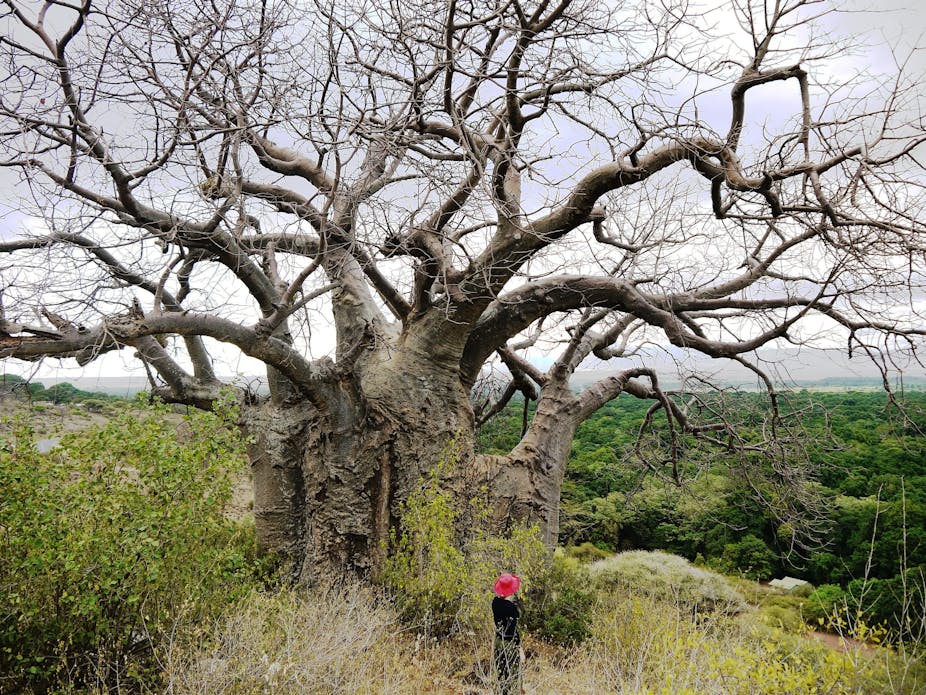
When I was a small lad there was a stately old tree in our backyard. My little sister and I practically lived in it — it was our lair, our fortress, our stairway to the sky.
Decades later, I sometimes recalled that regal giant as I studied rainforest trees in the Amazon. There, towering trees were dying en masse. Often the causes were obvious – growling bulldozers and chainsaws — but sometimes the reasons were mystifying.
In isolated fragments of rainforest, for instance, many trees simply dropped their leaves and died standing. Countless other trees died during droughts. Most puzzling, we discovered, was that the biggest rainforest trees were most vulnerable of all.
Why would big trees be so susceptible? In the Amazon, as elsewhere, large trees are often centuries or even millennia old. One would imagine such behemoths had survived many climatic vicissitudes over their vast lifetimes. But in an increasingly varying world, their great stature is evidently a curse. They struggle to get water up to their foliage without suffering dangerous embolisms in their vascular systems. For this reason droughts or the drier conditions prevailing in rainforest fragments can be fatal.
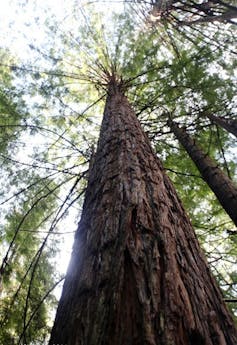
Big trees seem to be declining almost everywhere. Loggers have targeted big trees for centuries and vast forests have been razed worldwide for farmlands and urban sprawl, but a range of new and insidious threats are appearing too.
In India, exotic weeds like lantana are becoming so dense in the understory of many forests that trees simply can’t regenerate.
Equally alarming is gamba grass, which is plaguing the savanna-woodlands of northern Australia. This giant African grass burns so fiercely that nearly every tree is killed. It’s become so bad that Australian ecologist David Bowman recently suggested — only half in jest — that we should import African elephants to help control it.
Exotic diseases and pests are also a growing threat. Dutch elm disease is killing off millions of stately trees that once graced forests and cities. In North America, increasingly mild winters are favouring outbreaks of bark beetles, which can kill entire stands of trees. In rainforests, lianas — woody vines that parasitise trees and reduce their growth and survival — are increasing, possibly because their growth is being boosted by rising levels of carbon dioxide in the atmosphere.
A year ago, the realisation that big trees were declining virtually everywhere prompted me to pen an article in New Scientist that initially highlighted the growing scale of the problem. The story was covered by scores of newspapers and websites internationally, including The Guardian and Le Monde.
But the scary news about big trees has gone positively viral following an article last week in Science. In that article, I teamed up with two of the world’s top ecologists to critically evaluate the vulnerability of big old trees globally.
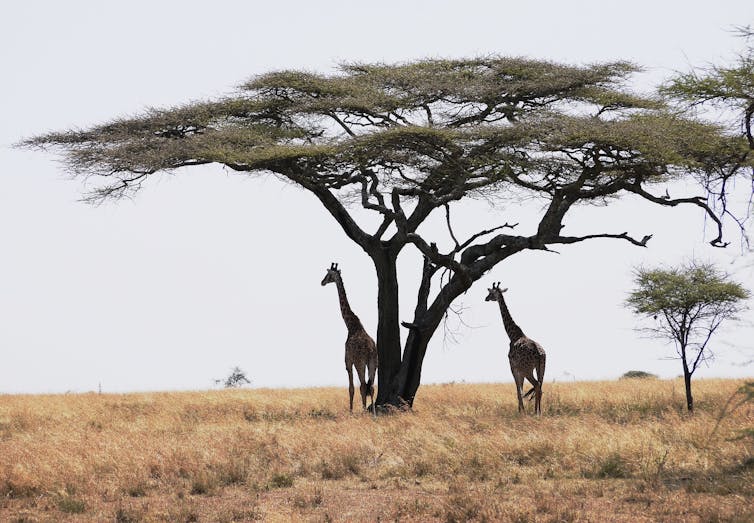
One of my coauthors, David Lindenmayer of Australian National University, is renowned for his studies of mountain ash trees — the world’s tallest flowering plants — which have been decimated in southern Australia by logging and wildfires. Natural hollows in mountain ash trees provide crucial shelter for over 40 species of wildlife, but such hollows only begin forming when the trees are at least 120 years old. Few of the trees get to live that long.
My other coauthor, Jerry Franklin of the University of Washington in Seattle, USA, is famed for his research in western North America, where logging has wiped out most old-growth conifer forests. These ancient forests harbour numerous rare species, including the endangered spotted owl.
Our analyses highlight the special challenges faced by big old trees. In the broadest terms, they need a safe place to live and reproduce and long periods of relative stability. But time and stability are becoming very rare commodities in our modern world, where massive land-use changes, invaders, pathogens and climate alterations are rife. If big trees are to persist, we need special strategies to conserve them — for instance, by protecting the key refugia where big trees still persist, safe from logging and other threats.
In many ways, big trees are a barometer of the health of our planet. Their decline foretells a world where ancient behemoths are replaced by weedy, short-lived trees that can grow anywhere, where forests store less carbon and sustain fewer dependent animals.
I fear it might also be a world where kids don’t have stately old trees to climb and play in — or just to stare in awe at a giant cathedral-like crown.
Whyn Carnie
Retired Engineer
I can't see why 'big' trees should be accorded any special value over smaller trees, other than more structural furniture timber may be milled from them. Mature trees are not necessarily the biggest. In today's increasingly populated world there is no room for big or even medium trees. In suburbia big trees are a cost to communities when they wreck footings, damage infrastructure, property and people. Plenty of room in the bush, only there they must compete with the rubbish allowed to grow unfetterred beneath them. The whole issue needs review and better management, not just Greens' view that to save all trees is the best way forward.
Alan Stenhouse
Chief Monkey
Whyn - did you read the whole article? Big trees are living ecosystems themselves on which many other species depend. Killing all the big trees destroys whole ecosystems, before we've even had a chance to examine them, in many cases.
No room for big or medium trees?? I think you might need to widen the scope of your reading. Perhaps doing some reading + research on all the free environmental services that we get from nature - currently for free, but we're starting to realise their value, albeit too slowly.
Les Mitchell
Retired Biologist
Whyn, you suggest that 'rubbish' growing beneath big trees in natural forest affects their health, but that is contrary to the picture in many old growth forest in Australia where big eucalypts have a dense understorey of rainforest trees and have been in this state for many years.
I have also observed that many big trees left after early farming activities and now surrounded by regenerating forest are very susceptible to lightning strikes. On my property several large 60 metre tall Eucalyptus quadrangulata have died from lightning strikes in recent years, and have observed this for a number of outstanding trees in Kangaroo Valley in NSW. I'm not sure whether there has been an increase in electrical storm activity here in the past decade.
Whyn Carnie
Retired Engineer
Les, didn't mean to imply that rubbish undergrowth affects tree health. I was referring to the notional value of trees is reduced and cost to the community increased by the rubbish that is allowed to grow under them. Increased fire risk, weed and vermin control costs. Lightning strike is par for the course for tall dry trees. They act as lightning attractors. And when struck can cause large colateral damage.
Alan, wasn't saying kill all the big trees, just restrict them in suburbia. Humans are an ecosystem unto themselves and also deserve protection.
David Boxall
logged in via Facebook
Whyn Carnie: "Humans are an ecosystem ...". I'm beginning to wonder about the relative value. ;-)
Felix MacNeill
Environmental Manager
Whyn, the problem with protecting humans is that you have to protect them from themselves, given that nothing else offers any meaningful threat these days. Given also that we are so overwhelmingly the most powerful and dangerous life form on the planet (except maybe some viruses) arguing for our need to be protected is the rough equivalent of asking the police to intervene to help and protect a gang of skinheads who are beating up some innocent passerby.
Additionally, just unilateraly deciding that you can claim what someobody's policy is (i.e. The Greens and trees) on the basis purely of personal prejudice and in the absence of evidence is a bit of a give away that you're not really bothering to think very well, isn't it?
David Boxall
logged in via Facebook
Felix MacNeill: "... the rough equivalent of asking the police to intervene to help and protect a gang of skinheads ...". What's a poor skinhead to do when some thug assults his boot with their face?
Joe Landsberg
Joe Landsberg is a Friend of The Conversation.
Retired forest ecologist; ex-Chief, CSIRO Forest Research
I find Whyn Carnie's remarks depressing. What a dreary, utilitarian view of the world - that big trees only have value in terms of the structural timber that can be milled from them. Not to mention the apparent lack of appreciation of the immense value of forests for the range of ecosystem services they provide including, for those lucky enough to have access to them, relief from the cacophony of our crowded world. In Carnie's terms, big trees probably have more value as tourist attractions than destroyed for wood.
Dianna Arthur
Dianna Arthur is a Friend of The Conversation.
Environmentalist
I remember the Walnut tree at the end of the back yard. As well as providing a bounty of nuts, it was one of the best climbing trees - spent many a happy time resting in its graceful branches. I wonder if it is still flourishing.
Am at a complete loss of what to say to Whyn Carnie - if humans are becoming an endangered species, it's due to our fouling of our own nests. We destroy old growth forests at our peril; we evolved here on this planet, we depend upon it for our survival, if the current conditions in which we evolved are altered (and climate change indicates such) we have only ourselves to blame and only we can take the steps necessary to mitigate our damage.
Or we can just sit around arguing about it all, trying to score points off each other.
Wil B
B.Sc, GDipAppSci, MEnvSc, Environmental Planner
Those mountain ash trees in Victoria and Tasmania have been decimated, but only in the original sense of the word, not the modern sense. It's still not hard to find very extensive stands of trees 80 metres high or so, there are very very large areas in national parks, and mountain ash are fire adapted.
Murray Webster
Forestry-Ecology Consultant/Contractor
Hi Wil, have you seen an article by Brett Mifusd on the impact of the Black Saturday bushfires on Victorias tallest trees? It is based on actual measurement and field survey
Read morehttp://www.forestry.org.au/news/articlefiles/1906-The%20Effect%20of%20the%20Black%20Saturday%20Bushfires%20on%20Victoria's%20tallest%20trees.pdf
quote:
"In one day Victoria lost the 5 trees measured in 2001 at over 90m tall and a further 35+ trees that were over 85m tall. These areas now consist of a sea of even aged 2…
Cat Mack
logged in via Facebook
There is a one remaining (live) big tree near where I grew up. It is named imaginatively 'the Big Tree'.. One of the last remaining remnants of the towering Eucalyptus forests that once existed in South/East Gippsland and now a tourist attraction. Poor thing has been doing it very hard during the ten year drought but it was big fires near Mirboo North that have done the real damage. The fires were fierce enough to reach the canopy - which is just unheard of - it stands many metres above the surrounding…
Read morepeter mackenzie
Transport Development and Road Safety Researcher
I heard Prof David Lindenmayer speak on this topic last week on radio.
But in respect to Tasmania at least, Prof Laurance and Lindenmayer can't be correct. Forestry Tasmania and the "Woodchip-It-All" community choir keep chanting the decades old "Sustainable Forestry" mantra.
And they repeat that chopping down and burning our wet forests is the way to save them, which is the opposite of what Prof Lindemayer was saying.
If they were correct, it would very clearly bring into question how Celery Top Pine with a 400 year regrowth cycle could ever be logged sustainably.
So while an interesting article, I remain unconvinced and closed minded- it's woodchips all the way for me.
duncan mills
Social Ecologist
Read CO2 Australia's report and you will understand the fragility of your belief system!!
The beauty of published conversations is we all are encouraged by it to reflect on the quality of our own thought and action.
Dont worry, been there done that too!
My reading of it suggests we should leave them until 120 years old, retaining a small % as habitat trees. The cost of this sort of logging are challenging, but lets face it it took them 50 years to refine Clearfell Burn and Seed. Their…
Read moreMurray Webster
Forestry-Ecology Consultant/Contractor
Duncan, I think the major problem is the we try to manage complex systems using adversarial politics which results in short-term political compromise.
Seems to me we could work it out, but we have just divided into two tribes (kind of like chromosomes splitting for mitosis) and engaged in battle. The battle has been on in the media for a few decades now trying to influence the beliefs of an ignorant public - especially inner city voters.
Surely there is another way, but most comments on "The Conversation" and other public forums constantly reinforce the polarisation of views.
Meg Thornton
Dilletante
I'm currently renting in a slice of suburbia where the native bush was pretty much clear-felled in order to create a space for housing. There are a few old-growth eucalypts up on the ridge of the hill (one of them appears to be a red-flowering gum) that are inhabited by a lot of the local bird life. But there aren't any replacements happening for them. The council's "street trees" are sparsely spaced plane trees (that shed leaves all year round and drop little hard-shelled nuts ditto), and the…
Read moreDianna Arthur
Dianna Arthur is a Friend of The Conversation.
Environmentalist
@ Meg T
Where I am currently living is in among Mountain Ash and Messmates. Whenever I return from a journey down into the smoggy city, I could arrive home blind-folded and still know where I am simply from the smell of eucalyptus and clear invigorating air.
Plant local eucalyptus and don't forget the under-story of compatible native shrubs. Natives such as Westringia, grevilleas, callistomen love to be pruned; a regular tip prune prevents them from become too rangy and adds years to their life span. Beneath these lower storey plant add such as paper daisies or if you don't get frosts add a vertical colour splash of kangaroo paw - wonderful hardy dwarf varieties are now available.
You won't regret attracting the many birds that feed upon these flowering plants.
peter mackenzie
Transport Development and Road Safety Researcher
Hi Meg
Not in any way trying to tell you how to run your own garden, but it's worth getting good advice on what Eucalypt to plant -depends on where you are, size of block etc- some can be a real problem in a relatively short time -especially in a smaller garden.
The alternative could be the Jacaranda plus understory bird-attracting natives. But if you do go that way, see if you can also fit a Calondendron Capense for a double visual treat when flowering.
As are many Eucalypts of course, so happy treeing in any case.
duncan mills
Social Ecologist
Aaaagh, attachment!!!
Our two edged curse!!!
We must HAVE all pretty things!!!
Now and to hell with our grandchildren.
Reality , read "The Sixth Extinction", Richard Leaky
Peter Ormonde
Peter Ormonde is a Friend of The Conversation.
Farmer
There's an interesting phenomenon that occurs with us humans ... we have a generational scaling down of our expectations. This is most obvious in the world of fishing - where a fish I would could consider a handsome catch today would have been regarded with scorn by my father. It's a mark of my father's generation and their success that today's good sized fish would have barely made a bait for my dad.
I'm wondering if the same thing happens with trees. That what we today regard as massive specimens…
Read moreDianna Arthur
Dianna Arthur is a Friend of The Conversation.
Environmentalist
Mr O
I believe that trees do suffer from loneliness - else why forests? Trees like company, but they don't vote and feeling powerless have shrunk to make room for more Whyn Carnie's.
Such is life.
Murray Webster
Forestry-Ecology Consultant/Contractor
Hi Pete,
Read moreWith regard to red cedar ( Tooma ciliate – used to be T. Australia), it is subject to attack by red cedar tip moth, particularly when planted together with other red cedars. Foresters tried plantations early last century and that was what stopped it from being successful. The moth eats the juicy growing tips and kills them, this forces the plant to shoot from lower down the trunk creating more branches down low and resulting in crooked short trunks – which is fine for amenity plantings…
Whyn Carnie
Retired Engineer
Dianna Art seems to live in tree heaven. Seems I made an unfortunate choice for my home. It was purchased after the original farmers subdivided their cleared land. I had 200º water views including low mangroves. In the last 15 years council has allowed unfettered rubbish regrowth such that I no longer have the views. Council still rates me as if I did. Now I can't walk to the water over intervening recently declared conservation zoning for lantana, bracken, hybrid swamp sheoak. The mangroves, now…
Read morePeter Ormonde
Peter Ormonde is a Friend of The Conversation.
Farmer
Whyn...
Concrete mate. There's no problem so big that it cannot be tackled with enough cement and gravel.
See there's a problem with not buying right on the waterfront - stuff grows - whether it's trees or neighbours' mansions.
Trouble is, when it comes to evaluating trees in the burbs - who do we ask? See I'd reckon anything that "interferes with your views" would be regarded as a cost. But only to you. Not to everyone else. It's in the eye of the beholder.
Time to move I'd reckon ... somewhere paved. And don't waste your money on the view. It's not yours.
Don Aitkin
writer, speaker and teacher
I dunno. It might be worth reading Craig Idso's huge review of the effect of increased carbon dioxide on eco-systems, at
http://www.co2science.org/education/reports/greening/greening.php
Idso reviewed about 450 peer-reviewed journal articles, and concludes that there has been occurring a greening of the earth, despite all the calamities that have occurred.
If you want a short summary, see today's post at www.donaitkin.com
Alan Stenhouse
Chief Monkey
You might want to get a more trusted source if you want a good debate...
Peter Ormonde
Peter Ormonde is a Friend of The Conversation.
Farmer
Aw heck Don... a scion of the Idso family? This is worth summarising?
Craig is the former Environmental Science Director for Peabody Coal, the largest privately owned coal company on earth. He is an adviser - along with Princeling Monckton - to a most dodgy outfit called the Science and Public Policy Institute which seems to be a collection of well-paid crackpots with oil and coal backgrounds.
The family business has the three Idso's running an operation - the Center for the Study of…
Read moreDon Aitkin
writer, speaker and teacher
Alan and Peter below: He is reviewing 450 articles in peer-reviewed journals. He's simply using what is out there in the journals. If you think he is missing the point, or doing that badly, well, show that. But dismissing him and not reading the stuff, doesn't sound at all rational to me.
Felix MacNeill
Environmental Manager
Don, you've nailed your colours to the mast of a sinking ship.
Tim Scanlon
Debunker
What a crock, Don. This is the CO2 plant food meme again, which is just plain rubbish.
Show me a desert (high in CO2 low in water) where there is plant life. Now show me a an ocean (high in water low in CO2) and try to ignore the plant life. Stupid example aside, the fact is that CO2 is not a driver, nor limiting factor in photosynthesis, water and light are. CO2 is abundant in the atmosphere, plants grew fine at 288ppm of CO2, so why the hell would you think that more does anything to influence…
Read morePeter Ormonde
Peter Ormonde is a Friend of The Conversation.
Farmer
Don,
Is this the same 450 "peer reviewed" papers listed on Anthony Watt's website in 2009?
See those I have examined ovber several weeks and found that the vast majority were not in fact peer reviewed in any accepted sense of the word, for example appearing in Energy and Environment - not as reviewed articles -but as open-access "research notes" which are, according to the editors, not reviewed at all. Or you can nominate your own reviewers if you'd submit an article for the Idso's family journal.
Old. Limited and largely obsolete. Dodgy. And overwhelmingly coming from politically motivated champions of free enterprise and their corporate backers.
You reckon raking over this old discredited stuff is "science"?
Note to self Don: must keep up. Must read more. Argument has moved on. They lost.
Don Aitkin
writer, speaker and teacher
Peter and others,
You didn't go and have a look, did you. I have no idea whether the 450 papers were on WUWT in 2009. But by the time I got to E in the references I had encountered half a dozen papers in Nature, one or two from Science, and others from journals I recognise. There are some I don't recognise, too. But I didn't see one from E&E.
Go and have a look at the paper, and stop sniping at the author. If you don't like what you find there, say so, and say why.
Dianna Arthur
Dianna Arthur is a Friend of The Conversation.
Environmentalist
Dear Mr O
Don't be so harsh on poor Whyn, his Section 32 did not list the fact that trees grow and low growing mangroves, if conditions are healthy, grow into some of the most beneficial ecosystems to a massive diversity of life - this is where all those tasty fishes, prawns and other toothsome delights get their start. Whyn should sue someone.
(Note to Don, Whyn's expanding mangroves do not mean that we do not have to adapt to climate change, greening in one environment does arrive at a cost…
Read morePeter Ormonde
Peter Ormonde is a Friend of The Conversation.
Farmer
Don,
No, mea culpa. Didn't look. Just asked if it was the same list as Watt's ... takes a long time to actually go back find the original, contact the editors and authors and find out oif they agree with the way the Idso's "interpret" their research.
But I've had a look and it looks different. Basically Craig Idso has done a search on CO2 and delivered a report purportedly on "The State of Earth's Terrestrial Biosphere: How is it Responding to Rising Atmospheric CO2 and Warmer Temperatures…
Read moreNeville Mattick
Grazier: Biodiversity is the key.
Large Trees are diminishing, in a short time our family has been here (130 years) the number of significant Box and Gum trees (Yellow, White, Blakely's Red Gum and Red Stringybark) in the landscape here is noticeable.
One recent culprit is Climate Change, for the years of 2010 and 2011 this area had record and unprecedented high rain fall.
The clay based soils turned to putty, a few of the largest specimens literally folded down into the spongy soil under their increasing weight of growth and moisture uptake, with the relentless winds that run this area the last straw for most.
Interestingly the Mugga Ironbarks never let go, preferring to anchor into slate they are doing really well, giants and all. Oh when I say giant maybe fifty metres tall is a giant around here - admittedly on poor soils.
Whyn Carnie
Retired Engineer
But Peter Ormonde, the view was ours. Perhaps my choice of the pronoun 'I' has misled you. The State took away our right to retain it. Many others enjoyed it as well as I. These same enjoyers of the views now gone are also complaining. And Dianna Art, since when has there been any demonstrable shortage of mangroves? How many mangroves will be enough? If you truly believe the guff about, "most beneficial ecosystems to a massive diversity of life - this is where all those tasty fishes, prawns and other toothsome delights get their start", you may be able to explain why despite our protection of mangroves the Government has seen fit to close off large parts of our sub tropical waters to recreational fishermen to improve falling fish stocks. One guess is that many of the mangrove species being let grow unabated are the wrong type for spawn and fingerlings to survive under and the associated hydrogen sulphide and related acidification reduces survival rates.
Peter Ormonde
Peter Ormonde is a Friend of The Conversation.
Farmer
Nope ... you might have had a view - but you and your neighbours didn't own it Whyn... you didn't own the land on which these appalling bits of vegetation have set their grasping roots.
Legally you do not "own the view". As I said before, if you want to own the view make sure you can afford the dirt ... all of it. If you don't own the land you have no "right to retain your views" as you imply.
Could be worse - how about a wall of 20 storey apartments instead of the trees? That's what I…
Read morePeter Ormonde
Peter Ormonde is a Friend of The Conversation.
Farmer
Don Aitkin
Don - where'd you get to?
I've made you a decent offer to seriously crawl through at least one section of the Idso paper - no summaries - back to the sources and the original authors he "quotes".
I've already contacted a few of them and am reading their more recent work. If I can prove - by quoting the original authors of the documents Idso cites - will you desist in promoting his nonsense?
Now Don you might be satisfied with getting your info prechewed by the likes of the…
Read moreDon Aitkin
writer, speaker and teacher
Peter, I don't do ad hominems. Not worth the time or energy. I don't care a fig who Idso is. I'm interested in the science he has gone through. If he has misquoted it, and ignored other papers that he should have seen, then that's important.
I'm not sure what the 'rubbish' is, and I don't have to explain anything more than why I felt this was an important article in the context of big trees. I explained that in my essay. It is the case that food production has increased. I don't know that we can say what the components of that increase are, but increased carbon dioxide is likely to be one of them.
Where did I get to? I was working.
Peter Ormonde
Peter Ormonde is a Friend of The Conversation.
Farmer
Glad you're back Don.
"I don't care who Idso is. I'm interested in the science he has gone through."
Excedllent that's what I wanted. Let's look at the science he's gone through - the science you reckon is worth touting about as a view worth considering.
You seriously think that increased food production is attributable to an increase in global CO2 concentrations from 280ppm in pre-industrial times to 391 ppm as at October 2012?
We grow more food and increased CO2 is "likely" to be…
Read moreDon Aitkin
writer, speaker and teacher
Oh dear. Back to ad homs. You didn't actually look at any of the argument and evidence used by Idso, did you. Now you reverse the situation, and suggest that I do it for you. I did a bit of it in my post. What he does is to summarise the argument and evidence of each paper, and then summarise the lot at the end. Seems sensible to me. But you dismiss it because you think that the author is a baddie.
To me that's game-playing. Not my thing.
David Boxall
logged in via Facebook
Don Aitkin: "... that's game-playing." It looks to me more like Peter's trying to get to real science, while you're trying to distract from the fact that you've blundered.
Sorry Don, you've made a fool of yourself and seem determined to compound your errors.
Peter Ormonde
Peter Ormonde is a Friend of The Conversation.
Farmer
No Don, this is not an ad hom, this is an advisory note to retired academics. Stick to what you know something about.
This site and others is chockers with old chemists, physicists and engineers who have wandered out of their home paddocks and a straying about in the public discourse making all sorts of pronouncements based on the pre-digested "evidence" they glean from comforting websites such as those you list on your blog.
Don this is not an ad hom. This is a stement of fact: You quite…
Read moreDon Aitkin
writer, speaker and teacher
With respect, Peter, yours is a statement of opinion, not of fact. You are welcome to it. But you are still doing the ad hom. You don't know me, or much about me, but you go on as though you do, and from a lofty height.
Don't you realise how empty all that stuff is? Where is your contribution to this debate?
Whyn Carnie
Retired Engineer
Peter Ormande, get a grip.
Advisory notes, negation of ad homs, denigration of people wandering about pronouncing and predigesting over this public discourse is not a very adult way to convince us you know it all. Being retired, or heavens forbid, old, doesn't rule our opinions out. We weren't born that way. Surely farmers were not the only ones born wise.
If you huff and puff you won't blow our house down. A little more careful reading of what has being said may help.
Peter Ormonde
Peter Ormonde is a Friend of The Conversation.
Farmer
I'm retired myself Whyn ... just had my first heart attack ... well on the way to passing all those milestones we associate with inevitable disintegration and decrepitude.
I'm not about huffing or puffing - all I'm pointing out is that Don's long-standing promotion of the climate change denialist/enthusiast position is not based on the science. Don doesn't really care about or understand the science. It's political. It's comforting. Like coming home to old slippers.
Not often in life one…
Read morePeter Ormonde
Peter Ormonde is a Friend of The Conversation.
Farmer
Don,
One of the downsides of running a website dedicated to oneself is that over time one reveals far more about oneself than might be considered advisable. It's a lesson many teenagers are learning rather painfully. You're getting off light.
For those who need a practical illustration: http://donaitkin.com/
In fact I've actually followed your views and opinions quite closely - certainly since my Canberra days in the 1980s and before I suspect. I enjoyed your independent and occasionally…
Read moreTim Scanlon
Debunker
Spot on Pete. Don is trying to raise a much debunked trope, which fails to understand plant biology and the science that it is referencing. Hiding behind the fallacy "just asking the question" shows that he hasn't bothered to actually read up and understand the science, nor consult with some actual scientists who understand this field. Thus, he stirs up conjecture and muddies the waters, taking us away from addressing the very real issue of climate change abatement. I notice he didn't respond to my explanation below about the reality of CO2 and plants.
I also had a look at his webpage, and upon reading his articles there is a blithe ignorance to his posts that shows Don likes to pass comment without actually doing the background reading. His comments on windpower are patently incorrect, his comments on the report by Gilding and Randers are nothing more than denial.
Don Aitkin
writer, speaker and teacher
My last response. You are still doing the ad him, both on me and on Idso. You say that no one takes him seriously. But we're not talking about Idso, but about the papers he is summarising. Is it in fact true that the rain-forest patches in the NT have grown in size over fifty years? The papers he cites say so. If the papers didn't, and he just made it up, you'd have him over a barrel. But you denounce him for his associates and antecedents, not for the quality of his summary. That doesn't wash with me. I'm interested in data and argument, whoever is putting it forward.
Both you and Tm start from a position of confidence and certainty, and use terms like 'denialist' that are more fitting for religious argument. I know there are people for whom AGW is a kind of religion. I'm not one of them. I'm sceptical and unsure, but I feel that great confidence is something where the very data are rubbery is not persuasive , at least to me.
Peter Ormonde
Peter Ormonde is a Friend of The Conversation.
Farmer
Don,
Not much point continuing other than to note that for a bloke "interested in data and argument, (not) whoever is putting it forward" you seem to be very selective in your reading. Do you actually read them? I suspect not.
The short answer to your question is yes, "rainforest" (not sure I'd call it all that - wet well covered stuff, I'd be thinking) has increased according to the aerial survey work done by Dave Bowman. However he now regards his previous comments about the possible effect…
Read moreTim Scanlon
Debunker
Pete, I notice Don just dismissed me and didn't address my points on CO2. Both yourself and myself have a large background in plant biology yet we are being dismissed as biased and closed minded. Considering this is actually the complete opposite of the case, that we actually understand plants and photosynthesis and can see false claims about this topic, you would think he would listen to us.
Oh well, guess Don would rather believe a guy that has no qualifications in biology or plant science and is paid by oil companies. http://www.desmogblog.com/craig-idso http://www.sourcewatch.org/index.php?title=Craig_Idso
I really wish people would read about plants, they are amazing things, because then they wouldn't call 280 ppm "near plant death". http://www.skepticalscience.com/co2-plant-food-advanced.htm