


Last Friday the World Heritage Centre and the International Union for the Conservation of Nature (IUCN) released a report on the state of the Great Barrier Reef, the world’s largest World Heritage Property. It warns Australia that the reef will be placed on the List of World Heritage in danger unless the reef is protected from a slew of new port and infrastructure projects.
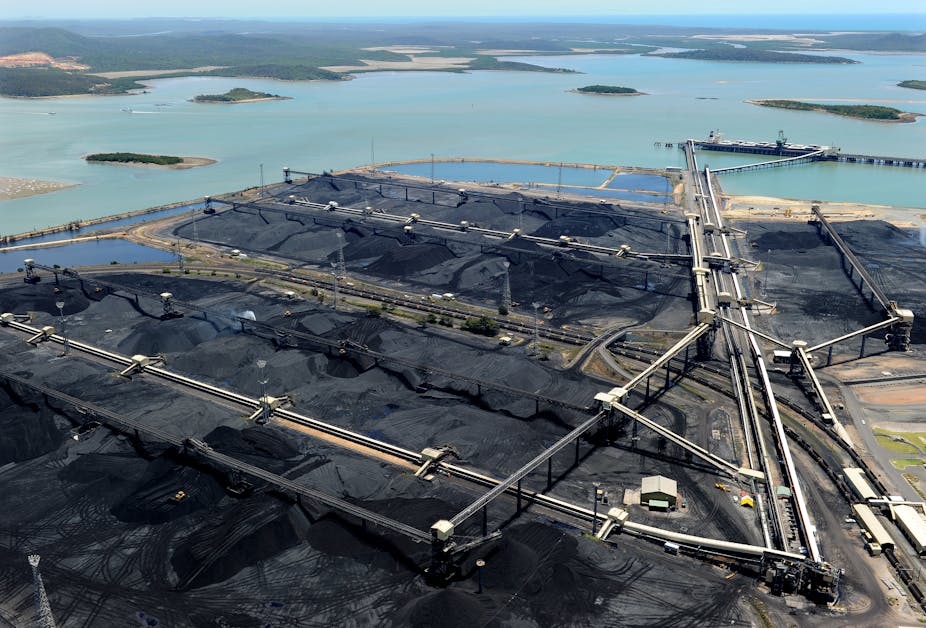
The report notes that there have been an unprecedented number of approvals in the last decade of a range of projects, including liquefied natural gas plants on Curtis Island, and new or expanded ports such as Gladstone Harbour. These are being set up to support the flourishing coal industry.
The Great Barrier Reef is Australia’s most iconic environmental asset. The most extensive stretch of coral reef in the world, the reef comprises over 2,900 individual reefs, stretches more than 2,000 kilometres along the north-east coast of Queensland and covers an area of approximately 350,000 square kilometres. It is one of the world’s biodiversity hotspots, with over 400 species of coral, 1500 species of fish, 4000 species of mollusc and 240 species of birds, plus a diversity of sponges, anemones, marine worms and crustaceans.
It is also of critical importance to the Queensland economy, generating up to $5 billion dollars in tourism revenue and supporting over 60,000 jobs.
World Heritage listing means the Commonwealth is in charge
In recognition of its outstanding natural heritage value, the Great Barrier Reef World Heritage Area was inscribed on the World Heritage List in October 1981. This listing gives the Federal government lead responsibility in ensuring that the reef is appropriately protected. The reef is managed cooperatively by the Commonwealth and Queensland governments through the Great Barrier Reef Marine Park Authority, which reports to the Minister for Sustainability, Environment, Water, Population and Communities, Tony Burke.
The Bjelke-Petersen government vehemently opposed World Heritage listing of the reef and since 1981 there have been flashpoints between the Queensland and Commonwealth governments over the reef. Commonwealth governments of both political persuasions have taken a generally conservationist approach to the reef. It was the Howard government that developed and implemented no-take zones across 30% of the reef, and this has been vital to restoring the ecological health of many parts of the reef.
With the election of the Newman government, a fresh Federal-state row is brewing over the reef; it’s strongly reminiscent of the Bjelke-Petersen days. The new Premier has refused to slow development despite the World Heritage report, declaring that Queensland “is in the coal business”. He is at odds with Federal Environment Minister Tony Burke, who has welcomed the report and criticised the new Queensland government’s rush to open up new ports along the reef.

This Federal-State tension may be short lived. The Federal Opposition Leader Tony Abbott has said that under a Coalition government, environmental approvals of many developments affecting the reef would be handed back to Queensland; something that has not occurred since the 1980s.
The Great Barrier Reef clearly faces an uncertain future. Its environmental integrity is at risk. But its management framework is also up for grabs: will it continue to protect the reef for the benefit of future generations, as the World Heritage Convention requires?
Sending more ships out to sea
The environmental threats to the reef can be categorised as immediate or longer term. The latter include human-induced climate change (which is heating the waters of the reef and bleaching large areas of coral) and ocean acidification (the changing chemistry of the oceans due to oceanic absorption of carbon dioxide from the atmosphere). The prospects for the Great Barrier Reef are exceptionally bleak under a business-as-usual emissions scenario.
But it is the more immediate threats to the reef that must be addressed if the reef is to be given the best possible chance of surviving and thriving in a changing climate.
As the World Heritage Committee/IUCN report indicates, the most serious of these is the extent of proposed development along the Great Barrier Reef coast. That development is of concern not only because of localised environmental impacts, but also because it will promote a substantial increase in shipping traffic in the reef area. There are around 9,700 voyages through the Great Barrier Reef World Heritage Area each year, and the Australian government has told the World Heritage Committee that it expects a 20% increase in shipping traffic in the next five years as industrial and mining activity increases.
This raises the prospect of an accident resulting in a major oil or chemical spill, groundings that physically damage reef structures, introduction of invasive species from ballast water, and a general increase in pollutants such as sewage and bilge water entering the pristine waters of the reef.

Because much of the Great Barrier Reef falls outside Australia’s territorial sea, international rules control how ships navigate through the reef. Australia has been exceptionally proactive in the International Maritime Organization (IMO) in ensuring that the rules are appropriate for this sensitive area. In 1990 the Great Barrier Reef was recognised by the IMO as the world’s first Particularly Sensitive Sea Area (PSSA). On the back of this designation Australia successfully pushed for the adoption of what are called “associated protective measures”.
These have become progressively stricter since the 1990s. A compulsory pilotage system was put in place between Cape York and Cairns in 1991. In 1997 a mandatory ship reporting system for larger vessels was introduced. In 2004 a “coastal vessel traffic service” was introduced (which is akin to a system of air traffic control), and from 2008 vessels had to install an “automatic identification system” to provide improved tracking. These schemes have been tweaked in response to particular incidents (such as the grounding of the Shen Neng 1 in 2010), and penalties under Australian law for failing to follow the rules ratcheted up.
Most notably the Australian Government extended the compulsory pilotage scheme to the northernmost part of the reef in the Torres Strait in 2006, after the strait was also recognised as a PSSA. However, we have learned from diplomatic cables obtained by WikiLeaks that the compulsory pilotage scheme was wound back following protest from Singapore and the United States that the scheme infringes navigational freedoms.
In other words there are clear limits to how far Australia can push its protections for the reef. That means that there are limits in the extent to which Australia can minimise the risks facing the reef.
Coal is a threat now, but a bigger threat in future
At the request of the World Heritage Committee the Commonwealth and Queensland governments are currently undertaking a strategic assessment of the Great Barrier Reef World Heritage Area identifying planned and potential future development.
The reality is that the extent of shipping from Queensland ports is not exceptional when compared with the enormous movements in and out of the world’s major harbours in Europe, North America and Asia. What makes the case of Queensland special is the presence of the world’s largest World Heritage property on the doorstep of a coal El Dorado. That coal can only be effectively exploited if there is port infrastructure in place, serving a vast increase in shipping traffic exporting coal to the world.
Expect the strategic assessment to produce new recommendations for managing shipping movements through the area. This may go some way to addressing immediate threats to the reef. But there is a tragic irony and mismatch in the approach being taken to managing risks to the reef. There is understandable public concern in ensuring that the reef is not threatened by a major grounding or spill. But in the longer term these risks pale into insignificance to climate change, which is being driven by growing emissions from Queensland coal exported to the world through the Great Barrier Reef.