
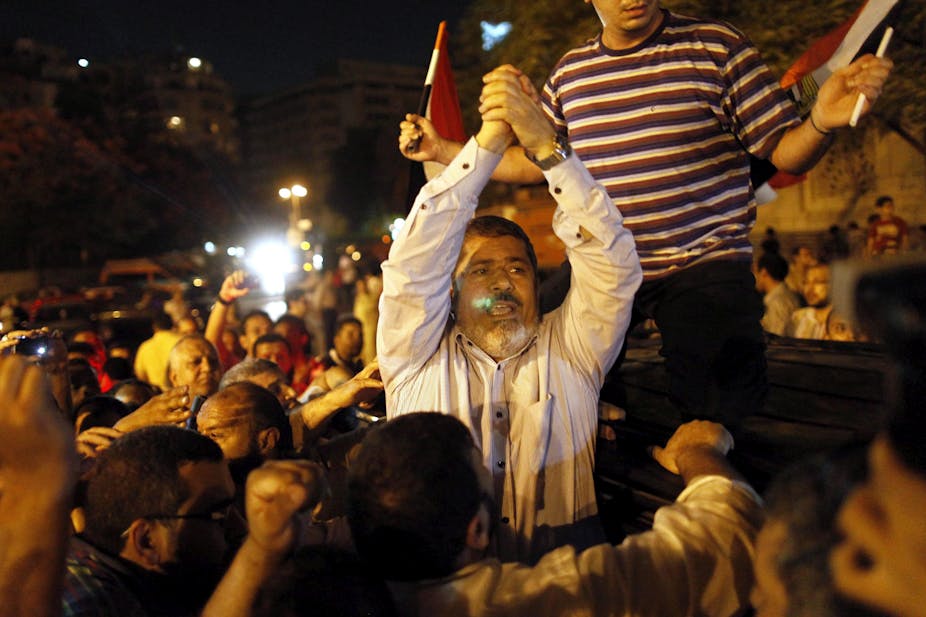
Whatever the outcome of the Egyptian presidential runoff scheduled for 16-17 June, Middle Eastern electoral politics are now conforming to a remarkable rule. When elections are held in a free and fair environment, moderate Islam is not only a force to be reckoned with but, usually, reports resounding victories.
Following the Arab Spring, the rise of moderate Islam has redesigned the political landscape of North Africa. Moderate Islamist parties have obtained parliamentary majorities in the elections held in post-revolutionary Tunisia and Egypt and – outside of the framework of the Arab spring – semi-authoritarian Morocco.
Yet, to be fully understood, the electoral rise of moderate Islam ought not to be restrictively interpreted vis-à-vis post-2011 North Africa.
From Turkey to Tunisia
The successful electoral platforms advanced by Ennahda in Tunisia and the Parti de la Justice et du Développement (PJD) in Morocco represented the most recent manifestations of a longstanding trend inaugurated by the AKP in Turkey and controversially followed by Hamas in Palestine.
From 2002 onwards, the advancement of democracy in the Middle East (with the notable exception of post-Baathist Iraq) has invariably required the involvement of moderately religious political actors.
These politicians successfully met the expectations of the different populations. Some demonstrated a superior organisational capability (Muslim Brotherhood in Egypt), others a closer proximity to the business interests of a growing bourgeoisie (AKP). More simply, some had an immaculate record vis-à-vis corrupted regimes (Ennahda, PJD) or declining political opponents (Hamas).
Economic credentials
Moderate Islam, in the many authoritarian contexts in which it prospered, capitalised on its outsider status, moving from a condition of political marginalisation, unlawfulness or exile to having legitimate standing. The accession to power of moderate Islamic politicians has also been followed by the establishment of relatively successful governments.
The dual call for hurriya (freedom) and tanmiyya (development) was behind the Arab uprisings of 2011. As regimes fell for their disastrous political and economic performances, the post-revolutionary governments are expected to deliver in both economic and political terms.
For these reasons, there is much anticipation around the economic choices moderate Islamists will make in North Africa.
Ennahda’s leadership appeared conscious of such expectations and provided an economic agenda that, at least in the banking sector, will attempt to strike a balance between traditional outlooks and more modern stances. The Muslim Brotherhood and the PJD are measuring their permanence in power by their ability to attract (and maintain) an increasing amount of foreign direct investment.
The AKP – in spite of its human rights record – stabilised the quality of Turkish governance and, most importantly, delivered a rather remarkable economic performance.
And it is precisely here – at the intersection of politics and economics – that the irresistible rise of moderate Islam can profoundly (and perhaps irreversibly) change the Middle Eastern landscape.
Recognising democrats
Asking whether governments led by moderate Islamic parties meet the standards upheld by international democratic practices is shaping to be a futile exercise.
These organisations have already demonstrated they have the support of their respective populations, have publicly outlined agendas that do not systematically subjugate modern values and, most importantly, have repeatedly declared their opposition to the more conservative interpretations of the Islamic belief system.
It is time international public opinion recognised these parties for what they ultimately are: Muslim Democrats – a label reminiscent of the Christian Democratic political tradition that prospered in Western Europe throughout the Cold War.
The likely path
Moderate Islamic parties throughout the Middle East are likely to follow the path traced by the AKP in Turkey: advancing a moderate Islamist agenda at home and embracing a free market credo in shaping the country’s economic outlook.
Turkey’s solid economic performance – characterised by significant GDP growth (8.2% in 2010) and an enviable trade profile – increased the electoral appeal of the AKP.
Rather than at 7th century Arabia, the Muslim Democrats might be looking at 21st century Ankara while shaping the future of the modern Middle East.
Adrian Vazquez
Student
Hmm. There is no such thing as "moderate" Islam. This term is simply an artificial Western invention. Just like the terms Islamists and "radical" Muslims are also Western inventions. These terms are not used in the Muslim world, (not until the West used them anyway).The dividing of Muslims into good "moderates" and evil "radicals" doesn't actually exist in reality. Islam is Islam. I would also dispute the assertion the "new democrats" have rejected "more conservative strands of Islam" .There was…
Read moreMat Hardy
Lecturer in Middle East Studies at Deakin University
Not sure I would describe Hamas as 'moderate' Islamists.
Stiofán Mac Suibhne
Contrarian / Epistemologist
Irresistible rise or irresistible fall? It's too early to tell.
Let us gather in 12 months and see how the Copts in Eygpt are doing in terms of body count / destroyed churches and review the performance of elected Islam.
Kristin Ma
statistician
It is psychologically interesting that the very people who view the prospect of an avowedly Islamist government in a faraway land with equanimity are also the ones who would object most vehemently to a "Christian" government in Australia. In fact they are the most assiduous in trying to erase all vestiges of Australia's Christian heritage from the public square.
Ivo UQ
logged in via Facebook
Even so, perceptions matter in the mediated world we live in. The author's intention is surely to persuade us to reconsider the way we discuss newly democratised countries where Islamic belief dominates others.
The idea, presumably, is orient us to 'their' successes in being good democratic capitalists, just like 'us'.
Given the reality-distortion field religions cast around notions of 'us' and 'them' perhaps just focusing on doing business is not a bad idea to start with. Maybe later when we're good friends we can give each other advice on how to move the national furniture around.
A Ahmed
Student
@Luca,
I can understand how Humanities would be interested in how this movement in Egypt would be affecting the human condition of its people.
However, i am at a loss as to how you see Muslim Brother Hood as moderates? Have you looked into their violent history? I sure that many things have been said but i was taught as a child "Look to what a thief steals rather than the story he tells you"... I suggest you do a simple google search "egyptian muslim brotherhood violence" and then…
Read moreThomas Edwin Yeats
Mr
The big question is whether or not these parties can renounce the Koranic ban on the use of compound interest in modern finance as Christianity and Judaism have. Usury is usury after all.
DMK
logged in via Twitter
Finally! Someone standing-up for moderates who ban women from high-level public office, put apostates to death, practise female genital mutilation and call for war against the Jews!
They're practically Christian Democrats!
See here for a full deconstruction of this argument:
http://aijac.org.au/news/article/la-trobe-lecturer-s-worrying-idea-of-modern-valu
Ivo UQ
logged in via Facebook
Maaate!
From DMK @ Australia /Israel & Jewish Affairs Council:
"Putting to one side the groups in Morocco (which has no real power), Turkey (which requires an extensive discussion) and Tunisia (which did not win the election outright) leaves two groups: The Muslim Brotherhood in Egypt and Hamas in Gaza (which itself is an offshoot of the Muslim Brotherhood)."
So it's a Muslim Brotherhood problem then?
Seems to me you've mistaken a reconstruction for a deconstruction of the argument.
DMK
logged in via Twitter
Well no. The Moroccan and Tunisian Muslim Brotherhood parties do not have real power or majority support, so the argument was wrong from the beginning and it was not necessary to show that they are not "moderate" (which, by the way, they aren't).
The Turkish AKP is a different story altogether because it was elected into power in a state with a whole structure designed to prevent Islamist rule. They have been incrementally transforming Turkey into a more conservative society, however they are playing the long game.
Suffice to say that Turkey today looks less democratic than it did ten years ago and it is an increasingly worse place to be a woman, a non-Muslim or a member of an ethnic minority. That said, the situation is not really comparable to the Islamist rise in the Arab states.
Ivo UQ
logged in via Facebook
I share your concern for followers of Islam. Heaven forbid religious ideology produces repressive regimes through democratic processes!
DMK
logged in via Twitter
I'm not exactly sure what you meant by that, but I never expressed concern for the "followers of Islam". I expressed concern for the people living under Islamist theocracies.
Also, a democracy requires far more than merely elections. Without a strong civil society and the protection of important rights – ie freedom of association and freedom of speech – elections are not democratic.
wilma western
logged in via email @bigpond.com
The article might be overoptimistic but surely it can't be denied that there are influential groups of middle-class Muslims in these nations who are more moderate than the Islamist caricature some western propagandists insist on. As for the claim that all Muslims unite in suopporting extreme policies - such claims fly in the face of the daily evidence not just from the Middle East but also from Indonesia,Malaysia, etc. What about the Iranian opposition?
A Ahmed
Student
@Wilma
Read moreNot sure if you can understand this, but NO Muslim can go against the Quran. The Quran is the word of God and it is blasphemy to question of contradict it’s teachings.. The Quran is full of hate and if you follow the life of Mohammad, you will see where it came from, as Mohammad personally participated in the beheading of 700 men of the tribe of Banu Quraiza, just to name one of a whole string of questionable behavior, especially by today’s standard.
Oh, but “middle class Muslims…