


Everyone is entitled to his own opinion, but not his own facts. – Daniel Patrick Moynihan.
Political fact checkers seem to perform a vital public service for American democracy. Websites such as FactCheck.org, PolitiFact.com and the Washington Post’s Fact Checker blog have grown famous in the last four years for scanning statements by politicians and evaluating their factual accuracy. After every speech at the recent Republican and Democratic party conventions, the media turned to the fact checkers for their judgement. Had the speakers been truthful, or had they earned the scornful ratings of “4 Pinnocchios” or “Pants on Fire”?
In a world where politicians are constantly trying to get away with lies and half-truths, this idea of a neutral umpire is immensely appealing. But in any team sport, the umpire himself can be a figure of suspicion. And American politics is definitely a team sport.
For years, conservatives have argued that the fact checkers exhibit the same liberal (left-wing) bias as the rest of the mainstream media. Liberals are friendlier to the fact checkers, which amplifies conservative suspicion about their biases. But some liberals argue the opposite, that the fact checkers overstate minor inaccuracies from the left to maintain a false equivalence with the systematic lying of the right.
In 2011, a University of Minnesota political scientist found that PolitiFact accuses Republicans of lying at three times the rate of Democrats. This is a solid, well-researched number, but what does it mean? That PolitiFact is biased to the left, or that Republicans tell a lot more lies than Democrats? How you choose to interpret the number is likely to depend on your existing political inclinations. And this brings us to one of the big problems with the whole fact-checking enterprise: “facts” are not always politically innocent.
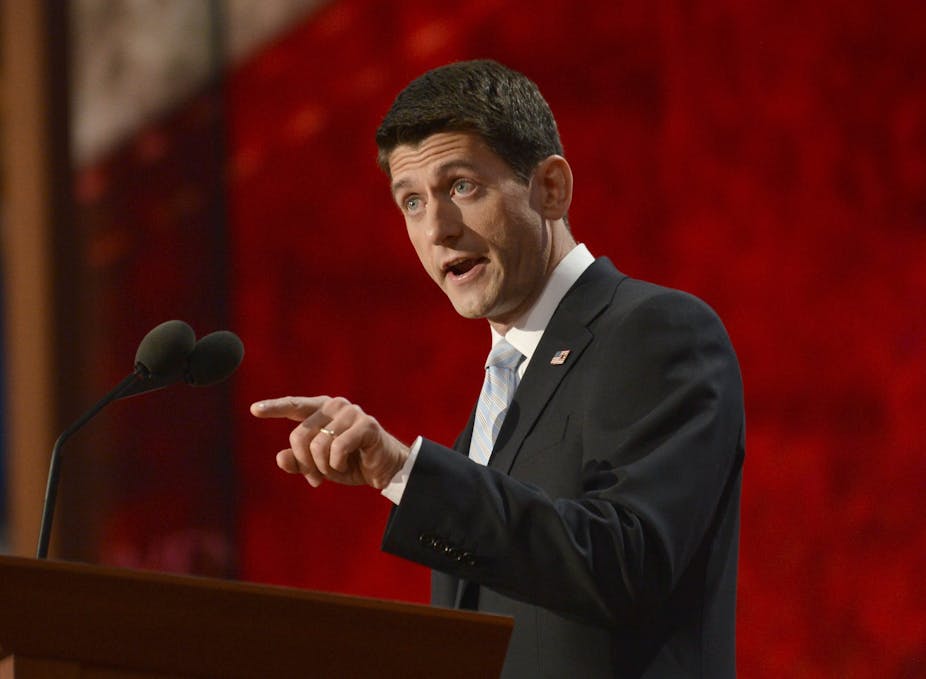
Take, for example, one of the most contentious fact-checks at the Republican convention. Vice-Presidential nominee Paul Ryan recalled that in 2008 Barack Obama had told GM workers in Ryan’s hometown of Janesville, Wisconsin that “if our government is there to support you … this plant will be here another hundred years”. However, Ryan noted, the plant closed within a year: “and that’s how it is in so many towns today, where the recovery that was promised is nowhere in sight”.
PolitiFact called this passage of Ryan’s speech “false” because the plant had closed before Obama was inaugurated, and he had not promised to keep it open, but rather expressed a belief that it could be viable with government help. FactCheck.org and the Washington Post weighed in with similar verdicts.
Conservatives claimed they had all completely missed the point. Ryan did not accuse Obama of failing to save the plant, but of holding a hopelessly naive view that government spending could save industries. For Republicans, the speech was about a core difference in economic philosophy, not a broken campaign promise.
In fact, in an earlier version of the speech Ryan had explicitly accused Obama of breaking a pledge to keep the plant open. CNN’s fact checker noted that he had cleaned up the convention version, and awarded the revised speech a rating of “true but incomplete”.
This is the bewildering world of the fact-checker. Politicians say things in deliberately ambiguous language that can mean one thing to their supporters and something else to their opponents. They respond not to their opponents’ words, but to the most damning implications of their words. They divide their time between intentionally misinterpreting their opponents and getting outraged about being intentionally misinterpreted. Even the most high-minded fact-checkers are unlikely to escape some kind of bias as they try to turn this chaotic mess into a coherent picture.
Under these circumstances it is tempting to become completely nihilistic about facts, which is what has happened to one segment of American politics. Fox News and various talkback radio hosts repeatedly warn their conservative audiences that they simply cannot trust any other form of media. In the parallel universe they have created, Moynihan’s rule does not apply. One is entitled to one’s own facts. If, for example, you can’t bring yourself to acknowledge that Barack Obama ordered the assassination of Osama bin Laden, you don’t have to: Fox News host Sean Hannity is sure there is a tape somewhere proving that the mission to kill bin Laden would not have happened if Obama “had his way.”
This is why, in the end, fact-checkers are unlikely to change people’s minds. Paying attention to politics is highly correlated with strong partisanship. If you care enough to find out what the fact-checkers are saying about an issue, your mind is probably made up already.