
In the midst of a maelstrom of economic woes caused by the Euro crisis the German economy has continued to perform relatively well. While many of its neighbours suffer recession and high unemployment, Germany emerged from the Global Financial Crisis of 2008-2009 in good shape and has continued to experience growth, albeit at a slower rate since 2011.
At a macro-level Germany has a much smaller budget deficit than most of its European Union counterparts, and one that is significantly less than non-EU major economies such as Japan and the United States. Although it experienced some negative impact in its manufacturing sector, Germany’s labour intensive industries such as construction and services remained buoyant.
The role of the Mittelstand
An important component of Germany’s economic success is the role of the small to medium-sized enterprises (SMEs) known as the Mittelstand. These firms typically have between 10 and 250 employees and annual turnovers of €2 to €50 million. They fall between the micro-enterprises that make up around 83% of Germany’s businesses and the large firms that comprise around 0.5%. In the field of manufacturing the Mittelstand represent just over 26% of all firms in Germany, employ around 42% of the workforce and contribute about 35% of the value adding.
Despite their size they include brand names such as white goods manufacturer Miele and the high pressure cleaner manufacturer Kärcher. The success of the Mittlestand is their focus on developing international excellence in niche markets where they can maintain strong market positions. They base their competitiveness on offering superior value not lower costs.
As well as being strongly export focused these firms are also characterised by high levels of innovation and private ownership. Over 70% of Mittelstand firms are family owned and located in smaller cities or regional towns. Their average age since foundation is around 70 years. The annual growth rates in revenues for these firms over the past twenty years have generally been twice that of the larger listed German firms.
In order to maintain their competitive position the Mittelstand invest strongly in R&D and aim to continuously improve their products. Their production networks are closely linked to their R&D and they keep close ties with customers, suppliers and their employees. They also have a bottom-up management style. This is characterised by a hands-on approach to company leadership in which a deep knowledge of their products is a feature.
There is a strong culture of family ownership within Germany’s Mittelstand and an investment in technical skills training and apprenticeships. The Mittelstand take on 83% of all apprenticeships in Germany. Furthermore, because they are often located in regional towns and smaller cities, the Mittelstand invest a lot in developing the skills of the workforce in their local community.
Australia’s missing middle
When compared to Germany’s Mittelstand Australia’s SME sector is characterised by a much larger proportion of micro-enterprises. As shown in the figure below, Germany’s Mittelstand of small and medium sized firms comprises around 16.5% of all businesses in that economy. By contrast, Australia’s Mittelstand is only 3.7% of the total.
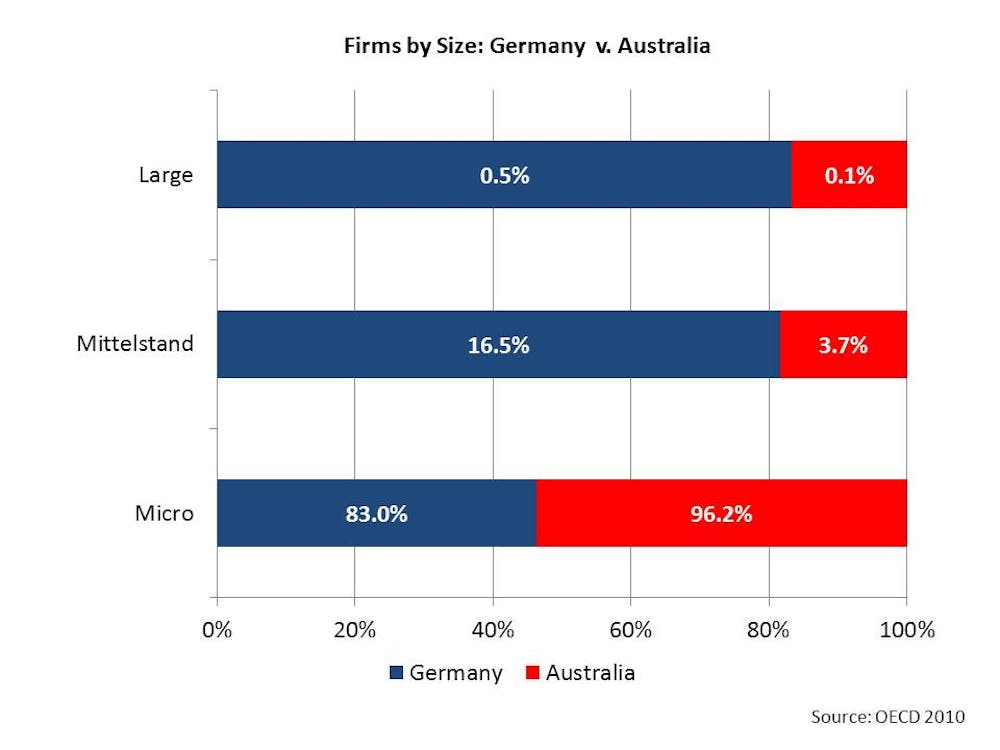
This represents a missing middle in the Australian business landscape. Our economy has a very high proportion of micro-businesses, the majority of which are non-employing. Compared to Germany we do not seem to be able to sustain large numbers of medium sized firms.
In relation to export activity the 237 large mining companies comprise less than 1% of all our businesses, but generate around 48% of the total value of Australia’s goods exports. By comparison Australia’s SMEs comprise 86% of all goods exporting businesses. However, they generate only 5% of the total value of exports. Medium sized firms comprise around 56% of Australia’s SMEs goods exporters and 80% of the total value.
This suggests that medium sized firms have greater capacity to add value to Australia’s export sector. Unfortunately, the relatively small number of mid-sized businesses within our economy means that such potential cannot be fulfilled.
New venture creation and destruction
Australia is generally a good place to start up a new business. As shown in the figure below the rate of new business start-ups in Australia over the period 2006-2010 was good in comparison to countries such as the UK, USA and Spain. Bankruptcies over the same period were also relatively stable. Particularly when compared to the USA and Denmark.
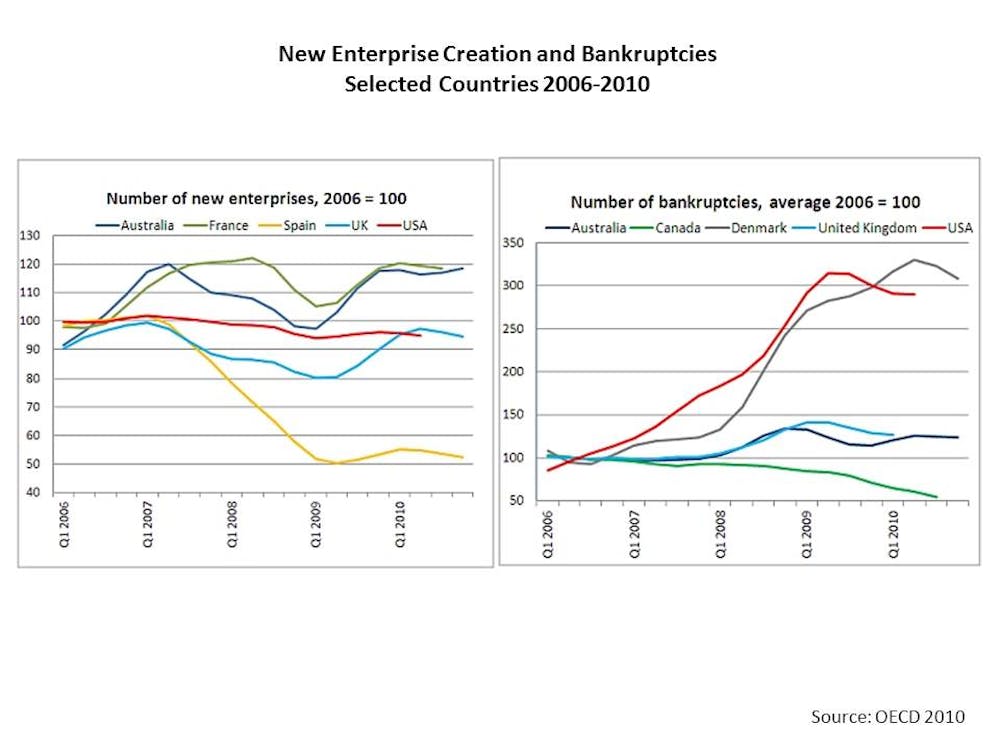
Yet there remains a high churn rate amongst Australia’s SMEs. This is the number of firms that cease trading compared to new business starts. Each year the majority (e.g. 99.5%) of employing businesses that cease trading are SMEs. These firms may be quickly replaced in total by new start-ups, but this churning does not assist the strengthening of the national Mittelstand.
Assisting the middle ground
The process of growing a business from start-up to maturity is a massive challenge. Most small businesses do not grow beyond micro-enterprise status and rarely employ more than 5 people. To grow a business sustainably and operate with between 20 and 200 employees requires the development of a range of management systems not typically required for smaller firms.
These mid-sized firms are often highly vulnerable to competitive forces. They are too large to get some of the support and benefits provided to their smaller counterparts, but they are big enough to be viewed as threats by much larger companies.
The Federal Government has launched a range of initiatives targeted at mid-sized businesses. These are managed via the Department of Innovation, Industry, Science and Research, Ausindustry, Enterprise Connect and Commercialisation Australia. They are focused largely on innovation and R&D initiatives. Enterprise Connect is one of the few schemes offering more general strategic management assistance to mid-sized firms. Many of the other schemes are designed for firms with fewer than 20 employees.
The national political debate has focused recently on small business and the need to assist such firms. There have been considerations given to better definitions of small business, tax reform and the cutting of red tape. While such initiatives are welcome, it would be desirable for policy makers to give more attention to strengthening Australia’s Mittelstand.
Dale Bloom
Analyst
I have found that people employed part-time or on short-term contract contribute few ideas to improve the company. So the company relies on a small number of full-time workers or relies on senior management to provide innovation.
It would be interesting to know how many workers in the medium-sized firms in Germany are employed full time, part time or short-term contract only.
I also understand that in times of recession, German firms often cut back on hours being worked by the workforce rather than lay off workers. Australian companies seem to do the opposite and lay off workers, and this could make it more difficult to end a recession.
Tim Mazzarol
Winthrop Professor, Entrepreneurship, Innovation, Marketing and Strategy at University of Western Australia
Hi Dale,
Germany's labour market performance over recent years has been very good and unemployment levels have been among the lowest in the OECD. Labour market reforms have raised working hour flexibility and helped to ease structural unemployment.
The work sharing rather than work shedding that you refer to is a feature of this. However, the German workforce is ageing and over one third of women work part time resulting in Germany having the third highest gender earnings gap in the OECD. Germany has also made use of skilled migrant workers.
An interesting aspect of Germany's economic growth has been a strong commitment to technical education and training. They have also begun to invest heavily in green technologies and are among the world's leaders in renewable energy and sustainability.
Dale Bloom
Analyst
Hi Tim,
I am of the opinion that universities in this country must amalgamate with TAFE colleges for universities to be of long term use to our economy.
An important factor in Germany’s economy could be Germany’s arms industry, which has expanded rapidly in recent years, and Germany is now the third largest arms exporter in the world. It appears not all of Germany’s green projects have been successful, and many of Germany’s solar power projects have been largely abandoned.
http://www.project-syndicate.org/commentary/germany-s-sunshine-daydream
Suzy Gneist
logged in via Facebook
From personal observation (as a German-born Australian), I believe the ethic in German industry is very different to Australia.
Businesses largely invest in their workers (well-being and education) and provide a 'work community'. There isn't as much profit-taking, as profits are re-invested or even shared in good times - just as downturn losses are shared by 'Kurzarbeit' for those periods without losing loyal and good workers through laying off. This builds loyalty and pride by employees in 'their' firm (Miele, SMA, etc).
Much of this is not considered in Australian businesses (or considered an 'expense' rather than an 'investment') as the management heavy approach and the hire-and-fire policy does not allow any community to build that works together for the longer term.
A change in business culture would be required to build a successful Mittelstand.
Tim Mazzarol
Winthrop Professor, Entrepreneurship, Innovation, Marketing and Strategy at University of Western Australia
Hi Suzy,
Thank you for your comments.
I agree with you that on balance the German approach to management is different to that of the "Anglo" model. However, this 'hands on' and collaborative approach with a "work community" culture is not uncommon in Australia's SME sector.
There are many mid-sized, family-owned businesses in Australia that adopt a similar approach to the German Mittelstand.
The fostering of a Mittelstand management culture in Australia industry is therefore more likely…
Read morePeter Redshaw
Retired
Hi Suzy
I can only agree with your comments. From what I have seen of this difference the German system has a much better management style. It has a much more cooperative and skills driven approach with its work force and a greater appreciation of the value its workforce add to the company. It also no doubt helps that the German Government also promotes and supports this management style.
In Australia over the past two to three decades I also believe that we have gone down the wrong path…
Read morePeter Ormonde
Peter Ormonde is a Friend of The Conversation.
Farmer
Excellent article Tim.
I increasingly find myself wondering if Australia has actually got a "capitalist class" in the technical sense - certainly in the sense that one finds in northern Europe.
I suspect one of the predominant reasons for the predominance of small business in Australia is the size of the vision of the owners, their obsession with costs (particularly labour costs) and the interaction with our banking system - perhaps the most risk averse in the world: dirt good, people bad.
The ownership structure of mid-sized European forms and their financial strength is a critical factor in establishing and building a vision that looks beyond next month's figures.
There are very good reasons why a lot of small businesses in Australia stay small.
Tim Mazzarol
Winthrop Professor, Entrepreneurship, Innovation, Marketing and Strategy at University of Western Australia
Hi Peter,
If you have a wide gap between the large firms at the top and the micro firms at the bottom (most of which only employ the owner-operator) you get the same kind of imbalance that occurs when household income gaps widen.
The "missing middle" in business is something akin to the decline of the middle class. It is not healthy in the longer term.
Germany is not perfect but they have a stronger focus on technical skills development and investment in innovation and value adding in applied engineering and science. The massive investment by mid-sized German firms in their technical trade skills area is something to be admired.
Gavin Moodie
Principal Policy Adviser
Maybe the Fraunhofer-Gesellschaft is also worth examining. This seems to be like a very applied and decentralised CSIRO. It has 60 institutes which get 70% of their funding from industry, which in Germany seems to be more engaged with R & D than in Australia.
James Walker
logged in via Facebook
So large businesses: Germany 0.5%, Australia 0.1%
Middle businesses: Germany 16.5%, Australia 3.7%
0.5 is 5 times 0.1
16.5 is 4.46 times 3.7
Your 'missing middle' doesn't exist within your own figures! Both large and middle are about 5 times as common in Germany as OZ.
Joseph Bernard
Director
Very good article and i agree, the missing middle will add to Australia’s robustness..
When comparing Germany to Australia, we have to consider that Germany has the home town advantage, as it sits in the middle of Europe and has a significantly bigger market to play in.. and this does offer more opportunity than exists here.
Not all is lost however and every industry is different of course. Software is my main focus, which has presented its own issues especially when faced with having to compete…
Read moreDale Bloom
Analyst
I would agree with this, and I have found that there are people in Australia who believe purchasing something from Australian companies is displaying “favouritism”.
Most of the mid-sized firms in Germany would have grown from micro-sized firms initially, and they must have been supported by local German customers to enable them to initially grow. That local support could be regarded as “favouritism” in this country, and deemed a bad thing.