
The paucity of information overload

It might not be a front line issue, but media policy is a significant election year debate. Communications Minister Stephen Conroy is still committed to bringing a submission to cabinet in coming weeks or months, despite a long delay caused by differences within the government between those who would…

7x5p9fyk-1360739955
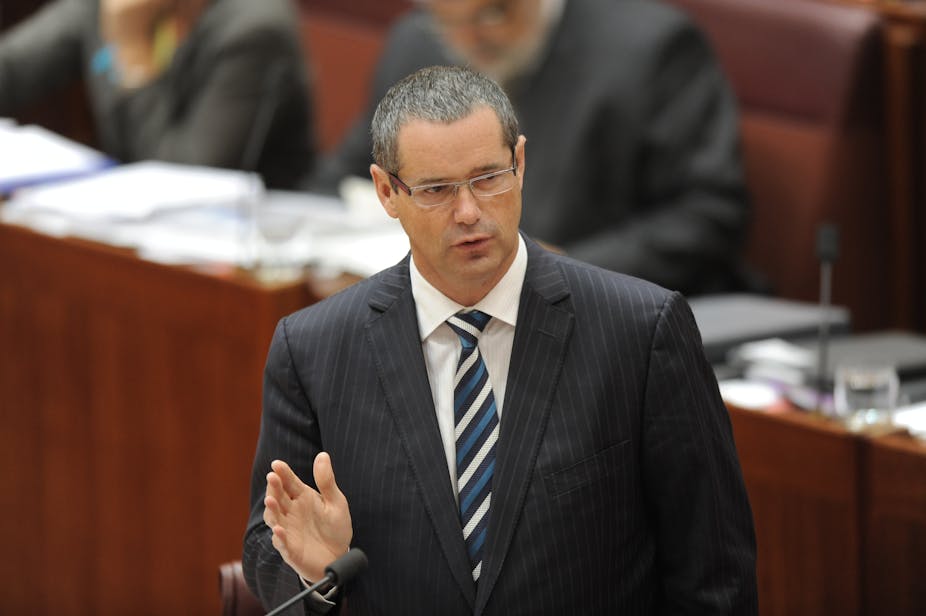
Stephen Conroy is still to bring media policy to cabinet. AAP/Lukas Coch

It might not be a front line issue, but media policy is a significant election year debate.

Communications Minister Stephen Conroy is still committed to bringing a submission to cabinet in coming weeks or months, despite a long delay caused by differences within the government between those who would like a robust approach following the Finkelstein Inquiry and others, including the Prime Minister, who do not want to upset the media companies.

The debate has also been heightened by the cost cutting and staff shedding by the major media organisations, Fairfax and News Limited, and by the imminent entry of The Guardian into the Australian market.

This week Professor Robert Picard, from the Reuters Institute for the Study of Journalism at the University of Oxford, gave a grim assessment of the difficulty for the public of obtaining quality information in the age of information overload.

“We are receiving more information than ever before, but it is a narrow form of information. We get endless flow of events news, disaggregated facts, and massive amounts of sports and entertainment news. These are increasingly shortened and disconnected from other information to limit complexity and allow quicker consumption. This information is replicated and echoed through multiple digital sources—magnifying its availability,” he told the National Press Club in Canberra.

“This expanding information hides the diminishing focus on complex social issues and challenges, the reduction in oversight and pursuit of accountability of social institutions, and an impoverishment of in-depth reporting and analysis.”

“These are occurring because changes in technology and economics are dismantling the traditional financial configurations that made Western media independent and provided the resources needed to carry out regular coverage of social institutions and undertake expensive and time consuming investigations,” Professor Picard said.

Digitalisation had destabilised the business models, he said, with digital developments concurrently stripping wealth from the news industry, forcing newspapers and other news operations to become smaller, reducing news bureaus and staff.

“The digital world is thus producing a paradox in which news and information sources and distribution platforms are increasing, but the capacity of news organisations to provide quality news is diminishing,” he said.

The media had become more dependent on the market and this had rendered them all highly vulnerable to commercialism, vying for larger, more attractive market segments.

“As a result media accentuate competition, manufacture conflict, and create false excitement in a desperate bid to attract audiences. Dialogue has become shouting matches, observation of the human condition has become voyeurism, and even cooking has become competition. Media celebrate mediocrity and folly; give great attention to unaccomplished and mindless individuals; and venerate the common and the mundane,” he said.

“The market pressures are reducing journalistic quality, producing practices that diminish the social value of news content, and diverting the attention of journalists from social activities to those primarily related to the business interests of the enterprises.”

These trends had led to debate about whether public action should be taken and if so what sort of action, including increased regulation, support and incentives to improve content.

Picard canvassed a range of actions that had been taken overseas and the pros and cons of various types of intervention, he also noted that it was not just a case of whether governments should or should not do but said that society should also encourage non-government support for quality news.

“The challenges facing quality news provision are complex and there will be no single easy solution, but it is vital that society address the growing gulf between our aspirations for information society and the information that it is actually providing,” he said.

“As we look forward, the most important issue is not whether traditional news providers survive, but how news will be gathered and distributed in the coming century. The issue involves questions about what institutional and organizational arrangements will emerge to support newsgathering, curating, and analysis. Distribution of news is no longer the challenge, but the business arrangements surrounding it clearly are in question.”

He said it had become increasingly clear that “markets are highly useful for providing some types of information and content, but that they are not able to fully meet the information needs of democratic society.”

Picard did not delve particularly into Australian examples. But here, the situation is complicated by the fact that tax payers already fund a major media player, the ABC, making the advocacy of money to support other news gathering operations more difficult. The ABC itself periodically becomes a political issue, with both sides at times complaining about its coverage. If there is a coalition government elected this year, the national broadcaster could find itself under funding pressure.

Meanwhile, the Gillard government is likely to tread softly on the issue of standards for the newspaper industry. The real test of its media policy will be whether it maintains Labor’s support for a public interest test on the sale of media assets to be introduced, to prevent even further concentration of an already highly concentrated industry.

Join the conversation

23 Comments sorted by

    1. Dave McRae

      logged in via Twitter

      In reply to Michael Shand

      Aye - same here, most pleasantly surprised. No Ruddstoration. And, after downloading the linked Prof Picard article, an accurate representation and excellent summation.

      On the old media, I had a habit, an addiction if you like, that was costing me easy $30pw - I'd get every available Saturday paper and 1 or 2 papers on any weekday. This started to drop off as the papers became increasingly full of rubbish untill eventually there was only the AFR left that still had excellent policy coverage in…

      Read more
    2. Kevin Bain

      Teacher

      In reply to Michael Shand

      Yes, I was just about to post on the Rudd-Gillard-Swan article by MG as follows: "The "uncertainty" theme of MG and the "chaos and confusion" theme of News Ltd are two sides of the same coin: lacking in evidence and functioning to foster the media as "player". Where are the contributions by academics above the fray to analyse the "meta-politics" operating here?"
      Then this came along. Hoping this signals a change of direction.

      report
    3. Simon Mann

      Armchair Observer

      In reply to Kevin Bain

      I agree that this is a much better direction.

      Hearing week after week that Rudd will “challenge for PM next week” is tiresome. I am sure that Rudd would love to be PM again and I don’t need unsourced whispers to confirm that assumption. I also assume Turnbull, Hockey and Robb (to name a few) would also like to be PM.

      ALP policy isn’t much different under Rudd and Gillard, however Abbott reversed the LNP position on carbon pricing, and from what little is reported there seems to be quite a…

      Read more
  1. Leigh Burrell

    Redhead inspector at Young and Naive Redheads - Special rates for union officials. No records kept.

    "If there is a coalition government elected this year, the national broadcaster could find itself under funding pressure."

    Quite so. As opposed to receiving a bonus $10 million cash splash as they just did under this government. Says it all really. Labor, Liberal and Michelle are in agreement, The ABC leans to the left.

    report
    1. Michael Shand

      Michael Shand is a Friend of The Conversation.

      Software Tester

      In reply to Leigh Burrell

      Im not sure how you got ABC lean to the left out of this article, it was merely stating that ABC is a national media outlet and as such they receive criticism from both sides of government - that doesnt mean it leans left

      Unless you are acknowledging that reality has a well known liberal bias

      report
    2. Sally Boteler

      customer service officer at health & leisure

      In reply to Garry Bickley

      Yes...i've noticed a quickening of the pace of change in the ABC's leanings of late and wonder if Grattan may have identified a partial motivation when she states :" If there is a coalition government elected this year, the national broadcaster could find itself under funding pressure."
      Many have pointed the finger at Mark Scott, but i think this is too narrow, and in any case fails to examine exactly how, why and where Scott is guilty of suach a charge.

      report
  2. Stephen John Ralph

    carer

    The Triumph of Virtual Reality Cosmos and History: The Journal of Natural and Social Philosophy

    In an exchange of comments with Glenn Mc Laren in this forum about a week ago, Glen suggested I read his article on a website called Cosmos and History: The Journal of Natural and Social Philosophy

    The article is titled The Triumph of Virtual Reality.

    I would recommend it as an interesting read. I also read (or started to read) another article on the website, and because I have…

    Read more
  3. Russell Y

    Financial planner

    Excellent piece of reporting, thankyou. I agree that technological change has splintered media where being commercially viable seems to be about who can shout the loudest. The shrill writing and reporting from the Australian media could have lasting damage to our society. Like many I feel that a public interest test is vital perhaps it is something we should discuss and debate. Unfortunately the most powerful are likely to distort and pervert the nature of the discussion. Two discussions come to…

    Read more
  4. David Doe

    Videogame Producer

    Imagine my surprise at reading this.

    Of the 829 words in this piece, 550-odd are a direct quote of someone else, and even then, are explicitly not in an Australian context so have reduced relevance to the key subject of the article - media policy in Australia.

    Ms Grattan, what kind of grade would you give a student in your course if they gave you an essay that was over 50% quote?

    Professor Picard makes a good point. You do not look have to look far to see "the difficulty for the public of…

    Read more
    1. Noely

      logged in via Twitter

      In reply to David Doe

      Agreed. I was amazed thinking it was a detailed report from Ms Grattan, which I was not expecting and would have to eat humble pie after asserting that the writing here would the same old same old from the paper. As you did David, I then read closer and of course it was the quoting of Professor Picard is the actual analysis which is spot on, not Ms Grattan.

      Having said that, at least Ms Grattan is talking to people with some knowledge for her information, not just hyped up rumours & whispers which is standard fair for the papers?

      report
  5. David Stephens

    Writer and activist

    This is better though I agree it is rather long on the quote from someone else. I will do the old fashioned thing and print it out to read over a cuppa. Better photograph of the author also!

    report
    1. Paul Pfluger

      retired

      In reply to David Stephens

      Funny to see Ms G being congratulated on a pretty standard piece of reporting, but it is much better than usual.

      report
  6. Stephen John Ralph

    carer

    I find Mr Rudd's comments at most times to be calculated to achieve a few goals...

    keep him in the news
    attract attention
    nibble or take bite size chunks at the current labor leadership and its policies de jour
    make him seem a viable alternative pm

    He is a destabilising influence on the government, and their chances of re-election.

    I also think labor is saddled with him ...... its a lose - lose situation for Labor.

    report
  7. wilma western

    logged in via email @bigpond.com

    Good suggestion whoever it was and David Doe

    report
  8. Pat McConnell

    Honorary Fellow, Macquarie University Applied Finance Centre at Macquarie University

    Michelle
    Now take off your journalist's hat and put on your academic one

    Your comment "If there is a coalition government elected this year, the national broadcaster could find itself under funding pressure" is nice throw-away line, but what is the 'evidence' for it? As an insider you would have wonderful resources not available to the rest of us, to elucidate.

    As a winner of a Walkley yourself you will be (I assume) pleased that Leigh Sales has just received one for the Best Interview for…

    Read more
  9. Garry Bickley

    Garry Bickley is a Friend of The Conversation.

    Retired teacher

    A sharp, accurate, precise and long awaited article. Clear to see why Michelle G got out of the game at Fairfax and into a much better one with "The Conversation". The ABC plays the same game as commercial news media now ("gottcha!" matters more than arriving at the facts and news reports tinged with snide comments, or carefully inserted emotive terms) and it is increasingly losing its credibility. Perhaps Michelle could explore that in a future article.

    report
  10. Felix MacNeill

    Environmental Manager

    Brilliant comments from Picard - absolutely nails it!

    Why am I being reminded of that old saw from Marx about capitalism destroying itself? (I once heard it quoted, rather more colourfully, but probably apocryphally ,as 'capitalism will digest its own corpse' - remarkably apropos to Picard's trenchant observations)

    report
  11. Peter Ormonde

    Peter Ormonde is a Friend of The Conversation.

    Farmer

    That's more like it.

    And if you want proof of the good prof's points take a look at the Conversation here... all refugees and exiles from the tweeting and twittering that our media has become.

    It's not just commercial pressures either ... our notion of "news" is changing... becoming Kardashianised. Even ABC has felt itself driven to dumb down its political coverage to the essentially tabloid offerings of Chris Yuillman to look and sound more "commercial" and less challenging for mouthbreathing audiences.

    Hence the TC reactions to this Rudd resurrection rubbish. We want more than gossip and the superficiality that dominates the airwaves and pages of the mainstream meeja.

    Time - and the place - to show us how good you are Ms G... kick some arse.

    report
  12. Michel Syna Rahme

    logged in via email @hotmail.com

    Bring on The Guardian in Australia. Bloody good idea!

    report
  13. john davies

    retired engineer

    Great article on an extremely important subject. More of this please Michelle. More on the effect of all this on our Press Gallery reporting.

    report