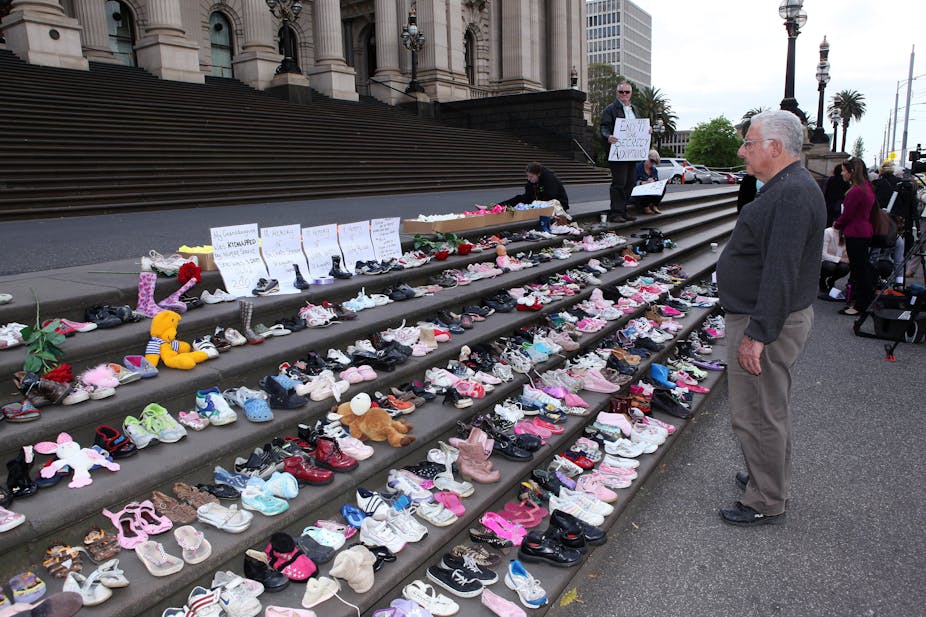
You might not have realised it, but it is Adoption Awareness Week. Every year at this time lobbyists pull out the big gun – the celebrity card – and Deborra-Lee Furness hits the airwaves.
The messages are clear – we must rescue more orphans, cut red tape, privatise adoption like in the US, and anyone who opposes us, especially the government, is anti-adoption. The reality is the informed members of the adoption community (and there are many) understand intercountry adoption for what it is – a very complex matter.
Everyone has a right to an opinion but when a small, well-connected and media-savvy group of lobbyists claim personal opinion as fact and claim to be the voice for the adoption community in Australia, there is a problem. My PhD research shed light on the tactics used by lobbyists in Australia – keep the message simple and emotional.
“There are millions of orphans in the world that need to be saved” fits that bill. It sounds a lot better than “a single mother is encouraged by an adoption agency to send her child overseas for adoption and then when she changes her mind and returns the next day, she is told it is too late” or “the family who does not understand what intercountry adoption really means and thinks their child is leaving to go to school” or “some children adopted into Australia have been trafficked”.

The other tactic, first used in the US, is to create an enemy; that way there is someone to fight and it keeps the emotions all churned up. This is where the “anti-adoption culture” tag comes in handy. “Anti-adoption” was readily taken on board by the politicians involved in the 2005 Inquiry into Overseas Adoption, while other voices were shut down.
The trouble is the more we hear opinion spoken as fact and don’t hear about the research on intercountry adoption, the more dangerous it becomes.
Where is the evidence? Why don’t we ever hear about the research from overseas that tells us what is really happening in sending countries of children and the voices of those affected – those who lose their children much like the Australian mothers to whom we are now apologising. Why don’t we hear about the research happening in this country? Adopted children are other people’s children. Even after children have been adopted they will always have two families even if they don’t know who their mothers, fathers and first families are. Maybe, just maybe, there are more options than the two we are presented with: life in an orphanage or adoption. Do we lobby governments to improve the conditions of families where adoption occurs? It would cost a lot less.
At this point, I feel I have to say I am not “anti-adoption”. I have spent many years assessing prospective parents here in Australia and can honestly say our adoptive families are good parents and do their best for the children they adopt and love them as their own. Adoption does have a place, but when we focus only on Australia we only see the parents who want to adopt a child. We do not see what happens overseas and we believe the hype. It is the pressure we put on overseas countries to allow intercountry adoption that create opportunities for bad practice and at worst, trafficking.
So what does the research say? Most adopted children are not orphans – they have families. The stories of many mothers are so similar to those of Australian mothers several decades ago, you wouldn’t know the difference by reading them. Orphanages are often created to feed the adoption industry – conflicts of interest abound. Children are often placed into orphanages temporarily during hard times for families, much as they once were in Australia if dad was widowed and had to go to work. Reports of parents coming to get their children (sometimes after saving up to pay the fine) only to find them adopted overseas are many. Of course every country is different and there are different circumstances affecting families, but sadly the threads are all too common.
Unfortunately, intercountry adoption research does not dig up simple messages, does not appeal to the emotions as children in need of rescue do. In fact, there is a lot of grey.
Opinion is much more exciting than evidence. For a long time, adoption scholars here and overseas have talked about what could be done for families and children in trouble overseas. The issue doesn’t start with a child in an adoption agency – the problems start before that.
It is about inequality and disadvantage – let’s build a school, let’s educate women, let’s work towards a basic system of support for widows, let’s trace the children’s families. These steps should come first.
According the The Hague Convention on the Protection of Children and Co-operation in Respect of Intercountry Adoption, adopting children from foreign countries is a last resort. Yet all our resources are poured into responding to the claims of lobbyists. While we do this, we are failing to provide adequate post-adoption services for the children and adults we have adopted. If we’re going to have a discussion of adoption this week, let’s get the facts right.
Dania Ng
Retired factory worker
A great article, which should open our eyes more to the exploitation of the most vulnerable in our global community by a few rich westerners whose wants spawns unnecessary ethical dilemmas for the rest of society. Now that 'gay marriage' is on the horizon, we need to brace ourselves for a radical increase in this pathetically inhuman want - the market for inter-country adoption will be booming. We all know that what the market wants, the market will get.
Angela Barra
Forced Adoption - Adoptee Activist
Dania, well said !x
Jenny Goldie
editor
I am an adoptive mother of children from overseas. My daughter was adopted from Korea in 1971 and my son from Vietnam in 1975. They are both in their forties now and are doing well. In many ways overseas adoption in these cases could be deemed a "success". I agree, however, it should be the option of last resort. Nevertheless, in the case of my two children, my daughter was literally abandoned - she was left as a baby on the doorstep of a police station. No chance of finding family there. In my son…
Read moreGeoffrey Edwards
logged in via email @gmail.com
Jenny, you do descend into the emotional appeal that Patricia is addressing.
Take your example of the fall of Saigon and mothers pleading for you to take their child. You conclude from that not every mother wants to keep their child. Another person might equally conclude that these are mothers who hold grave fears for their children's immediate safety and seek to protect them - not abandon them. It is not that their child is a liability, but they do what many mothers do and think of that child…
Read moreIan Clarke
Director, Pacific Strategy Partners
Jenny, congratulations on raising your adopted children. I'm sure they appreciate what you have done for them.
Patricia, of course the long term solution is economic development, especially educating girls. The short term is often undervalued, however, and in the short term the lives of a lot of children could be improved and extended through adoption. If you have the data on relative infant mortality, it wouldn't be that hard to show how many children stopping inter-country adoption would kill each year. It would also be good to have evidence from a longitudinal study of why parents give up children, how many want them back later, and whether they go on to have other children. A mechanism to reconnect shouldn't be that hard either ...
Angela Barra
Forced Adoption - Adoptee Activist
Oh Patricia...you are a breath of fresh air. As an activist and adoptee subject to forced adoption your article epitomises what we in the community have been saying. However, unlike NAAW we do not have celebrities to endorse us and we remain virtually unheard. In my case, I have been fortunate to be on the Queensland Reference Group for the Apology and undertake radio and print interviews however the mainstream media are not particularly interested in hearing out accounts. I welcome the Royal…
Read moreKate Rowan-Robinson
Kate Rowan-Robinson is a Friend of The Conversation.
Registered Nurse/Sexology Student
An excellent comment, Angela. As an adoptee I often feel we are not heard and carry the burden of 'gratitude' for being adopted. This is a thoughtful article and raises many considerations that are relevant overseas adoptions occuring today and past adoptions that have already occured.
What I can never understand is if people are so desperate to 'help' or 'save' children why are they not donating to relevant charities, making loans to small businesses via an organisation such as Kiva or volunteering…
Read moreAngela Barra
Forced Adoption - Adoptee Activist
Kate Rowan-Robinson. Thank you Kate and could not agree more with your comments X
Nicki Avery
logged in via Facebook
Hi Kate,
I would like to address just a couple of the points you have bought up in your comment, not to create a situation of adoptive parent vs adoptee but rather perhaps clarify a few things for yourself and other readers.
In your second paragraph you discuss people who are desperate to help or save children and wonder why they don't donate to relevant charities etc... I think you'll find that many many adoptive parents or prospective adoptive parents are already supporting charities and…
Read moreKaren Meehan
Editor / Communications
Thank you for this thought-provoking piece, Patricia. I think most people in the adoption community agree that the simplistic presentation of these issues in the media is at best unhelpful and at worst misleading. What we do about this I am not sure, as any complex discussion in the mainstream media seems inevitably reduced to simplistic sound-bites (which is why we are all in The Conversation, I guess).
As an adoptive parent, it’s very confronting to be told that your family is somehow “wrong…
Read moreNicki Avery
logged in via Facebook
I find it interesting that the 'lobbyists' are represented in this article as keeping their message emotive as a tool for change yet this article is titled "The politics of ‘orphans’ and the dirty tactics of the adoption lobby" Also key phrases such as "Orphanages are often created to feed the adoption industry..." are designed to be stir emotion in a way that creates a negative view on adoption. It is the AGD responsibility to ensure ethical programs however the way the system is currently managed in Australia, particularly at a state level, is poor at best.
Clarissa Stuart
Mother
My children do have living birth parents. They were however relinquished by them, given 6 months to change their minds and return for them before the children were made available for local and then international adoption. Both their orphanages were founded originally to care for children whose birth parents could not. Both provide respite care for children while their families get back on their feet and in a position to care for them. They are not there to supply a need for parents wanting children. I am offended for the orphanages I have come to know and love. They work hard to fill the needs of the children in their care and sometimes the greatest need is for a Mummy and Daddy!!
Clarissa Stuart
logged in via Facebook
My children do have living birth parents. They were however relinquished by them, given 6 months to change their minds and return for them before the children were made available for local and then international adoption. Both their orphanages were founded originally to care for children whose birth parents could not. Both provide respite care for children while their families get back on their feet and in a position to care for them. They are not there to supply a need for parents wanting children. I am offended for the orphanages I have come to know and love. They do however work hard to fill the needs of the children in their care and sometimes the greatest need is for a Mummy and Daddy!!
Jacqui Young
logged in via Facebook
http://theconversation.edu.au/seven-billion-reasons-to-open-our-hearts-and-homes-to-adoption-4044
Kate Rowan-Robinson
Kate Rowan-Robinson is a Friend of The Conversation.
Registered Nurse/Sexology Student
@ Nicki Avery
I really do believe that adoptive parents feel they are acting in their childrens best interests - I don't doubt that adoptive parents do their best to become informed and offer the best care they can. I'm trying to be careful with my words as I understand this is a difficult subject.
Personally I struggle with the reasoning that birth parents have made a conscious and educated decision to relinquish their children. I do believe that is the case, but it's the fact that they have…
Read moreClarissa Stuart
Mother
HI Kate. It is very hard to understand from our perspective living in Australia that birth parents in third world countries often have no other choice. It is devastating for them and their babies. I have never had a warm and fuzzy feeling about the reality that my children's birth mother, their other Mummy, felt she had no options but to place her children in the state's care. I am deeply saddened and hurt for her. We hold them in high esteem in our family, pray for them and honour them on…
Read moreTony Dunne
logged in via Facebook
Interesting comments & all polite - good, a nice change from sone blogs!
Read moreMay I say it is hard not to be emotive when talking about this but I will try.
1. I have a biological niece who was given up for adoption in the 70's so have some idea of the part of the adoption spectrum.
2. our family consists of two home grown children and two adopted children from Philippines.
3. I am President of Internatonal Adoptive Families of Qld Inc. a 34 year old ngo set up to support families involved in ICA…
Nicki Avery
logged in via Facebook
@ Kate Rowan - Robinson,
Hi Kate, Thank you for your reply to my comment.
You wrote 'Personally I struggle with the reasoning that birth parents have made a conscious and educated decision to relinquish their children. I do believe that is the case, but it's the fact that they have no other viable option that really kills me'
It kills me too. As a nation we need to step it up and get more support into the developing nations providing resources and finances and working alongside local NGO…
Read moreKate Rowan-Robinson
Kate Rowan-Robinson is a Friend of The Conversation.
Registered Nurse/Sexology Student
Hi Nikki,
As strange as it might seem I do appreciate where you are coming from. I do my best not to be clouded by my own experience and try to take a step back. I do agree that these women are giving up their children to give them the best opportunity at life and I am glad that children can be provided with safe homes. It's difficult to explain how it feels to be on this side of adoption and while we may have grown up in better circumstances than what we would have done there is still the eternal…
Read moreNicki Avery
logged in via Facebook
Kate it seems to me you were very much meant for this world. I wish you the best in your post grad work studies and am stoked that you will be taking that further and working to educate internationally around the issues of family planning and health care. My husband and I have both worked overseas quite a bit and my husband (also an RN) has given quite a number of health care and first aid seminars to leaders of schools, villages and orphanages to equip them to continue to teach others in their own villages. I hope many other professionals will step up and do the same.
I have really enjoyed talking back and forth with you. Thank you.
Peter Dodds
logged in via Facebook
I couldn't agree more with Patricia Fronek. I was adopted from a German orphanage by American parents and created this video to show the many human rights abuses of the international adoption industry. It includes the African adoption situation as well as Australia's Stolen Generations.
http://www.youtube.com/watch?v=LJlnfkRtBX4
Julianne Godbold
Sales Manager
The reason for birth mothers abandoning or relinquishing their children is often due to poverty, but not always. There are many many reasons. Not all pregnancies are wanted. In Australia, many of these unwanted pregnancies are terminated. In developing countries where abortion is not available, the baby may be carried to full term and then relinquished. The reasons are varied - social unacceptance, too young, not suiting lifestyle, rape, etc. I've read a report of a birth mother who tried to abort…
Read moreNicki Avery
logged in via Facebook
Oh dear Peter Dodds. Your youtube piece is one sided, contains quotes out of context and uses unrelated comparisons. The very fact that you agree with Patricia Froneck only highlights the fact that the author presents a negative or dare I say it 'anti adoption' argument. We are discussing Adoption in Australia and as much as improvements need to be made in their processes we still conduct an ethical adoption program.
Vivienne Webb
logged in via Facebook
Thankyou Patricia. It is a breath of fresh air to read this well reasoned article.
Patricia Fronek
Senior Lecturer School of Human Services and Social Work at Griffith University
Thank you to all those (including the critics) who have taken the time to read the article and links. My email inbox is full. The response has been overwhelmingly positive from parents, adoptees and others who support conversations around adoption that are not labelled ‘anti’ or ‘pro’ - conversations that include all information that affects the adoption phenomena and everyone involved – even the hard stuff. It is only by acknowledging all aspects of adoption and hearing all the voices affected that everyone can work together rather than in opposition.
Jacqui Gilchrist
logged in via Facebook
Accurate family trees (the birth-rite of all) require BDM to provide TRUE & CORRECT data...how did those who stood to profit from adoption manage to hide the fact that records were being falsified with the blessing of the Federal Govt (Liberal from December 1949 to December 1972)?
How does our legal system justify the falsification of identity and birth-rite? How did this happen? There's no way they could have convinced a majority of Australians to agree with falsifying history to satisfy the wants of those who would dispossess mother and child...I smell a rat...